

Football
Breaking the Press: Defensive Shape Transition Play
Master the art of transitioning from a compact defensive block into a dynamic attacking shape when under high pressure from the opposition.
What you need
1 Full-size pitch, 2 Full-size goals, Footballs, Bibs in two colours, Cones or flat markers
1. Overview
In modern football, the ability to transition seamlessly from a compact defensive shape into an expansive attacking structure is paramount. This set play, "Defensive Shape Transition Play When Pressed," focuses on exactly that: how a team organized in a low or mid-block can effectively break out when the opposition applies a high press.
The primary objective of this play is to draw the opposition's press, exploit the spaces they leave behind, and swiftly transition into a counter-attacking or controlled build-up phase. By utilizing coordinated movements, numerical superiority in the build-up zone, and precise passing sequences, your team can bypass the first line of pressure and advance into the attacking half with momentum.
This routine is particularly effective against teams that employ an aggressive, man-oriented high press. It teaches players how to remain composed under pressure, recognize pressing triggers, and execute pre-planned movements to create passing lanes and escape routes.

2. Setup

To effectively run this set play in a training environment, you need to replicate match-like conditions as closely as possible.
Equipment Needed:
- 1 Full-size pitch (100-110m x 64-75m) or a scaled-down version for younger age groups.
- 2 Full-size goals.
- Plenty of footballs placed in the goals to ensure quick restarts.
- Bibs in two contrasting colours (e.g., Blue for the team in possession, Red for the pressing team).
- Cones or flat markers to delineate specific zones (Defensive Third, Middle Third, Attacking Half).
Pitch Setup & Player Positions:
- Set up a standard 11v11 scenario.
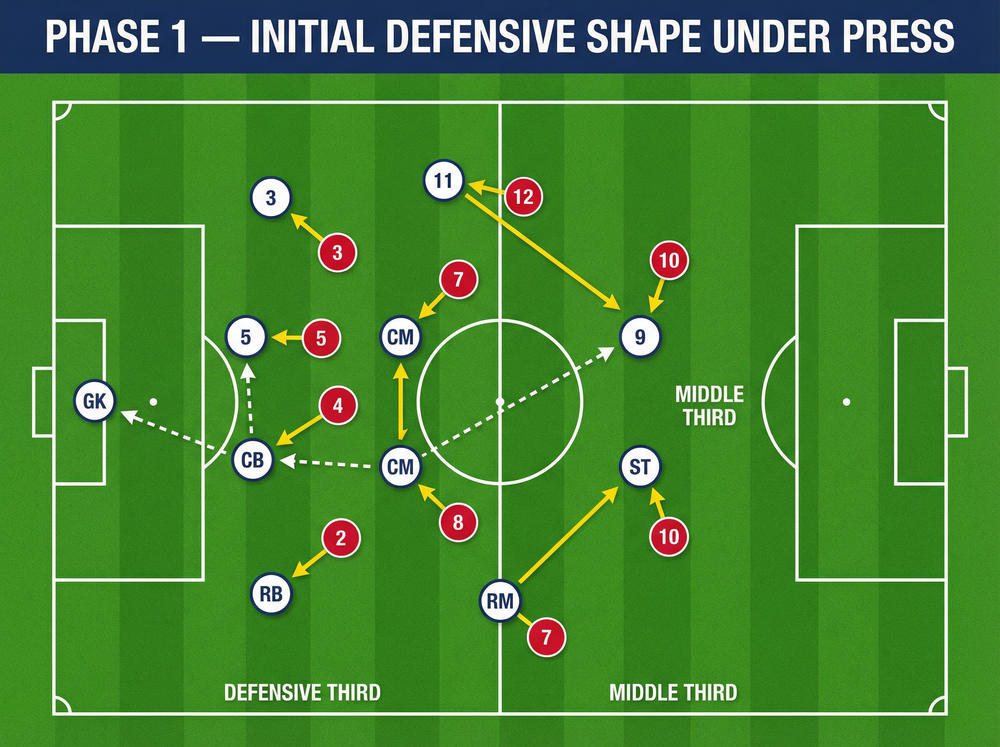
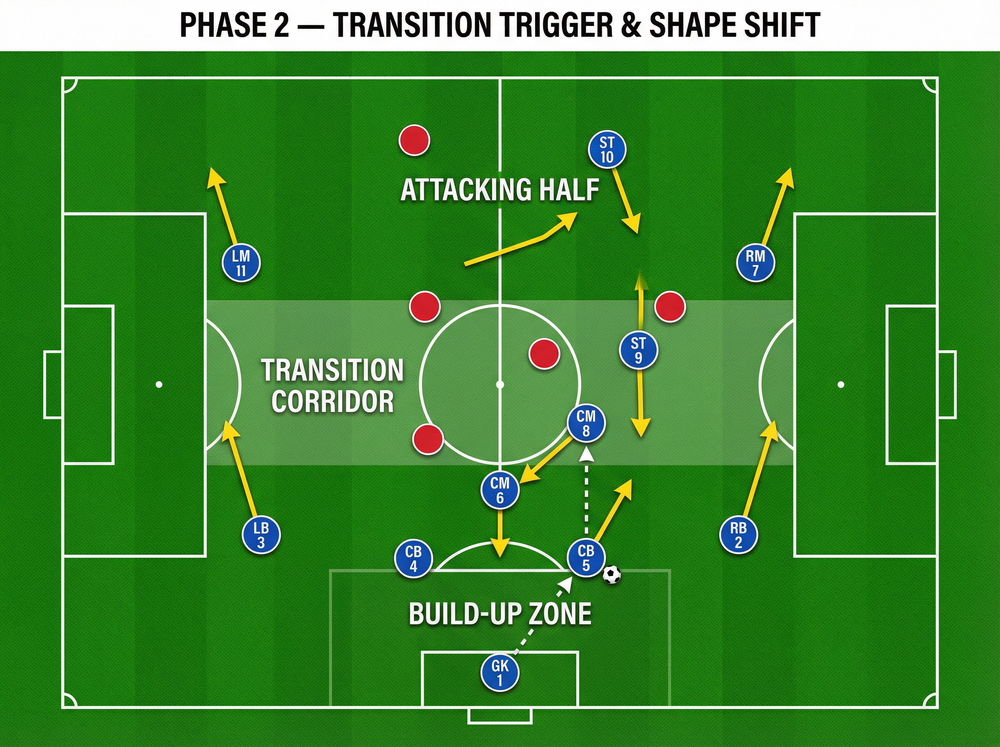
- The coaching team (Blue) sets up in a classic 4-4-2 defensive block in their own half.
- Goalkeeper (1): Positioned centrally in the penalty area.
- Back Four: Left Back (3), Centre Back (5), Centre Back (4), Right Back (2) forming a flat line across the edge of the 18-yard box.
- Midfield Four: Left Midfielder (11), Central Midfielder (6), Central Midfielder (8), Right Midfielder (7) positioned approximately 10-15 metres ahead of the defensive line.
- Strikers: Striker (9) and Striker (10) positioned near the halfway line.
- The opposition team (Red) sets up in an attacking formation, ready to initiate a high press as soon as the ball is played.
3. Step-by-Step Instructions
Step 1: The Trigger (Drawing the Press)
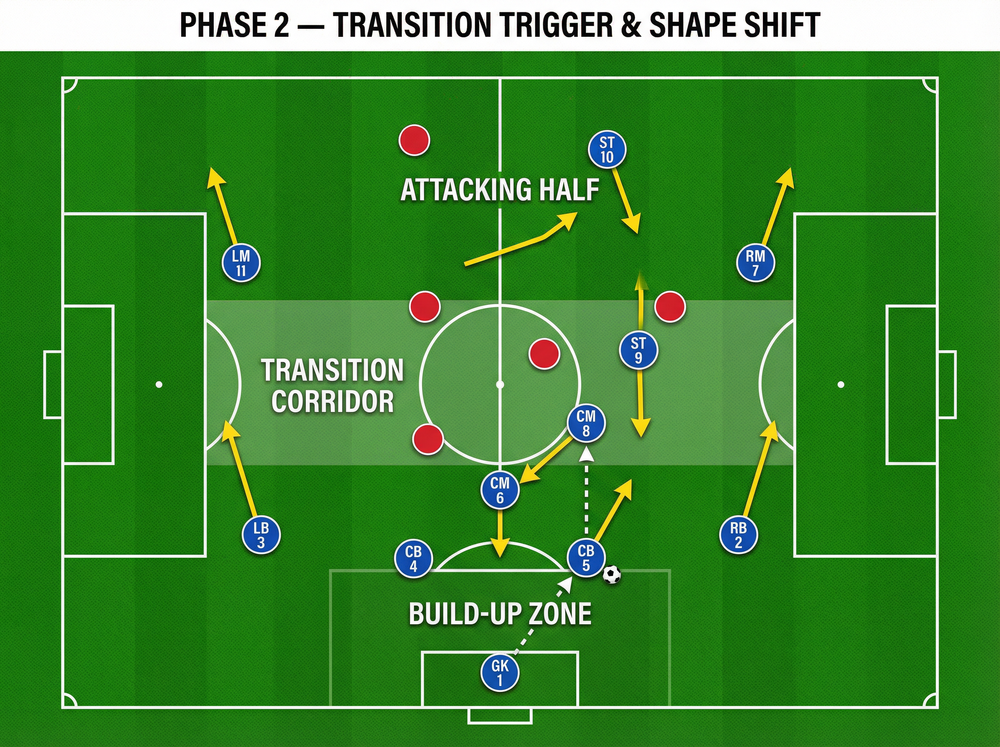
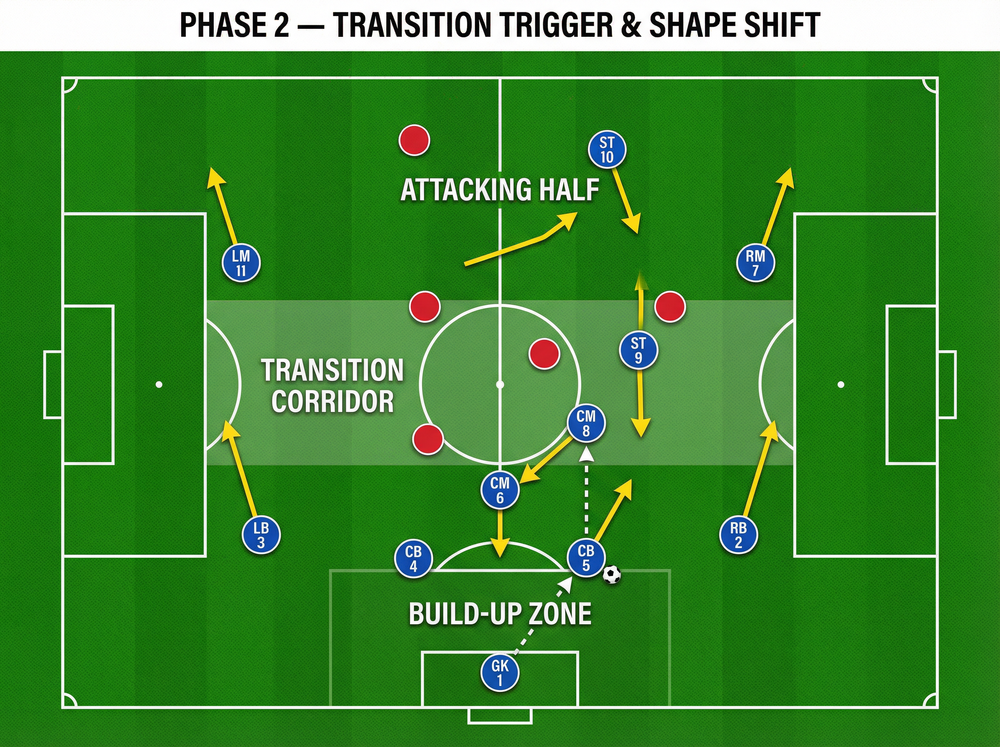
The play begins with the Goalkeeper (1) in possession. The GK plays a short, firm pass to Centre Back (5) who has dropped slightly to receive the ball. This pass acts as the trigger for the opposition to initiate their press.
Step 2: Shape Shift (Creating Width and Depth)
As soon as CB (5) receives the ball, the team's shape must immediately expand. Left Back (3) and Right Back (2) push wide and high up the touchlines. Central Midfielder (6) drops deep between the two Centre Backs, forming a temporary back three and creating numerical superiority (3v2 or 4v3).
Step 3: The Pivot and Link Play
Central Midfielder (8) pivots to receive a forward pass as the primary deep-lying playmaker. Striker (9) drops into the hole between the opposition's lines to link play. Wide Midfielders (11) and (7) maintain width.
Step 4: Bypassing the Press
CB (5) assesses the structure. Option A: play centrally to ST (9) or CM (8). Option B: play wide to the advancing LB (3) or RB (2) if the centre is congested.
Step 5: Attacking Transition
Once the press is broken, Striker (10) makes a darting run in behind the defensive line. The team floods forward to support the attack.
4. Key Coaching Points
- Composure Under Pressure: Remain calm; rushed decisions cause turnovers in dangerous areas.
- Speed of Thought and Movement: Recognize the trigger and execute movements instantly.
- Body Shape and Awareness: Open body shape and pre-scanning are essential for receiving players.
- Quality of the Pass: Firm, accurate passes to the back foot allow the receiver to play forward quickly.
- Communication: Constant verbal cues — "Man on!", "Turn!", "Set!" — keep the play flowing.
5. Common Mistakes
- Lack of Width: Full-backs fail to push wide quickly enough, creating central congestion.
- Static Midfielders: CM (6) and CM (8) fail to create dynamic angles, stagnating build-up.
- Forcing the Pass: Players attempt central passes when the lane is blocked, risking turnovers.
- Poor First Touch: Heavy touches under pressure invite immediate challenges.
- Disconnect Between Lines: Strikers fail to drop deep, isolating the attack from midfield.
6. Variations & Progressions
- Varying the Press: Opposition alternates pressing triggers to force the Blue team to read and adapt.
- Overload the Midfield: LM (11) tucks inside to create a midfield overload while LB (3) provides width.
- Direct Route: GK or CB plays a long diagonal ball in behind for ST (10) or wide midfielders to chase.
7. Age Adaptations
- Under 8–10: Focus on basics — spread wide, keep possession, short passes. Use 7v7 on smaller pitches.
- Under 12–14: Introduce the CM dropping to form a back three. Emphasize body shape, scanning, and first touch.
- Under 16–Open: Full tactical execution at high speed. Players must autonomously read pressing schemes and apply all variations.
