

Netball
Centre Pass Variations Drill: Dominating the First Phase
Master the critical first phase of play with three dynamic centre pass variations designed to break defensive structures and guarantee first-phase possession.
What you need
1 Netball, 7 Bibs (C, WA, GA, GS, WD, GD, GK), 4 Cones
Overview
The centre pass is the most frequent set piece in netball, making it a critical area for tactical dominance. A predictable centre pass allows the opposition Wing Defence (WD) and Goal Defence (GD) to set up effectively and dictate the space. This comprehensive drill introduces three distinct centre pass variations designed to keep the defense guessing, create isolated one-on-one matchups, and ensure your team consistently secures first-phase possession. By implementing these variations, coaches can equip their attacking unit with the tools to adapt to any defensive structure on the 30.5m x 15.25m court.
Setup
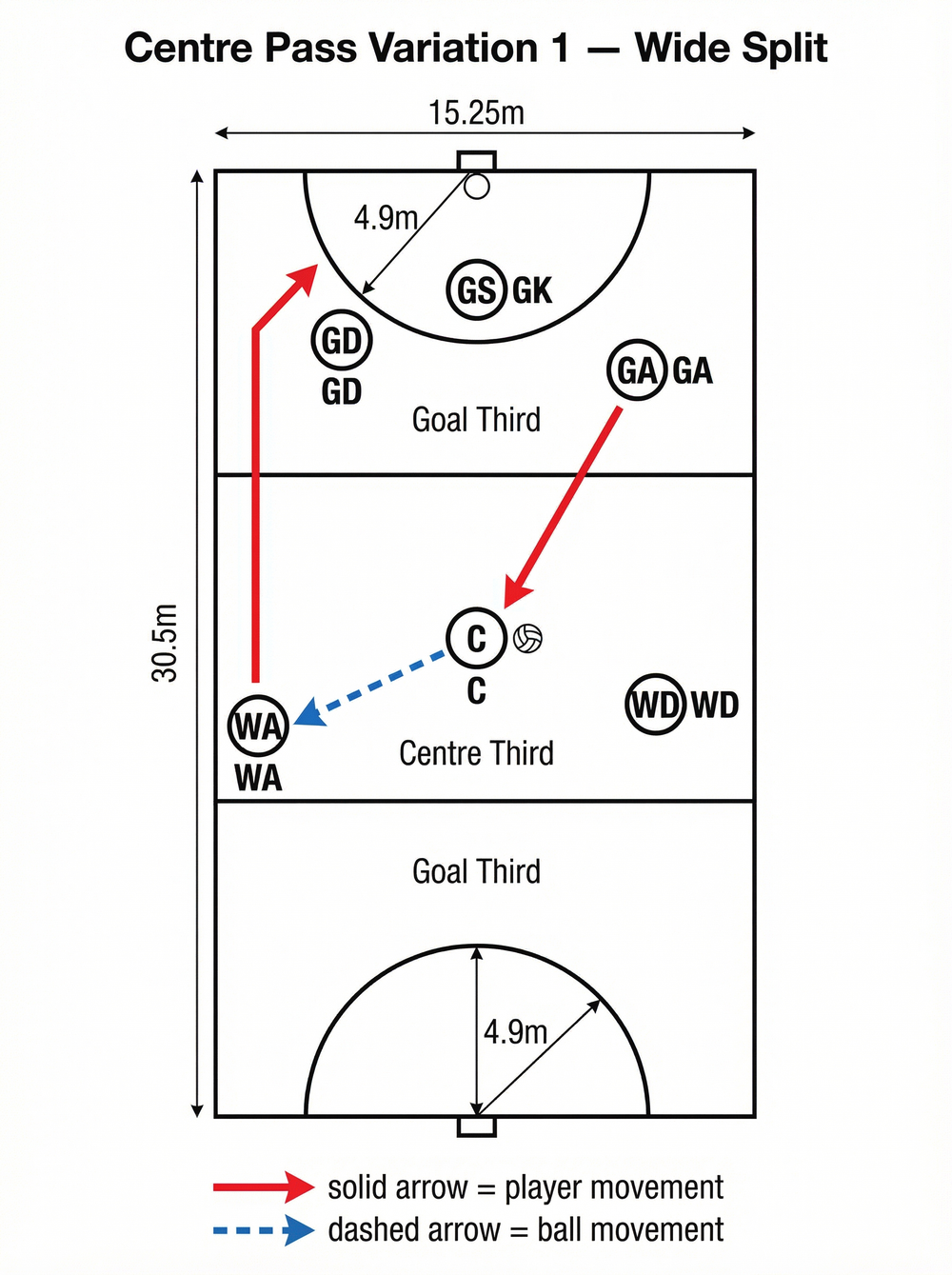
To run this drill effectively, you will need a full netball court and specific equipment to simulate match conditions.
Equipment Needed
- 1 Netball
- 7 Bibs (C, WA, GA, GS, WD, GD, GK)
- 4 Cones (optional, for marking starting positions if players are struggling with spacing)
Court Setup and Player Positions
Set up on a standard netball court. The drill requires a minimum of 7 players, though it is best run with a full 14-player squad to allow for rotation and live defense.
- C (Centre): Starts entirely within the 0.9m centre circle with the ball.
- WA (Wing Attack): Sets up in the goal third, positioned near the transverse line. Starting width varies based on the specific variation.
- GA (Goal Attack): Sets up in the goal third, positioned near the transverse line. Starting width varies based on the specific variation.
- GS (Goal Shooter): Positioned inside the 4.9m radius goal circle, preparing for the second phase of play.
- Defenders (WD, GD, GK): Set up in their respective defensive positions to provide passive (initially) and then active resistance.
Step-by-Step Instructions

This drill is broken down into three specific variations. Teach them sequentially, ensuring players understand the timing and spacing before moving to the next.
Variation 1: Wide Split
This variation is highly effective against a crowded middle corridor or a zone defense that pinches centrally.

- Starting Position: The WA and GA set up close together near the middle of the transverse line.
- The Split: On the umpire's whistle, the WA makes a sharp, explosive sprint diagonally outwards towards the left sideline.
- The Counter-Cut: Simultaneously, the GA makes a hard diagonal cut towards the right sideline.
- The Delivery: The C assesses the defenders' reaction. The C must deliver a strong, flat chest pass to the player who has created the most separation (typically the WA in this setup, as shown in the diagram).
- Second Phase: The receiver immediately looks to transition the ball down the court, eyeing the GS or the driving GA for the next pass.
Variation 2: Through the Middle
Use this variation when the opposition WD and GD are playing wide to shut down the sidelines, leaving the central corridor exposed.
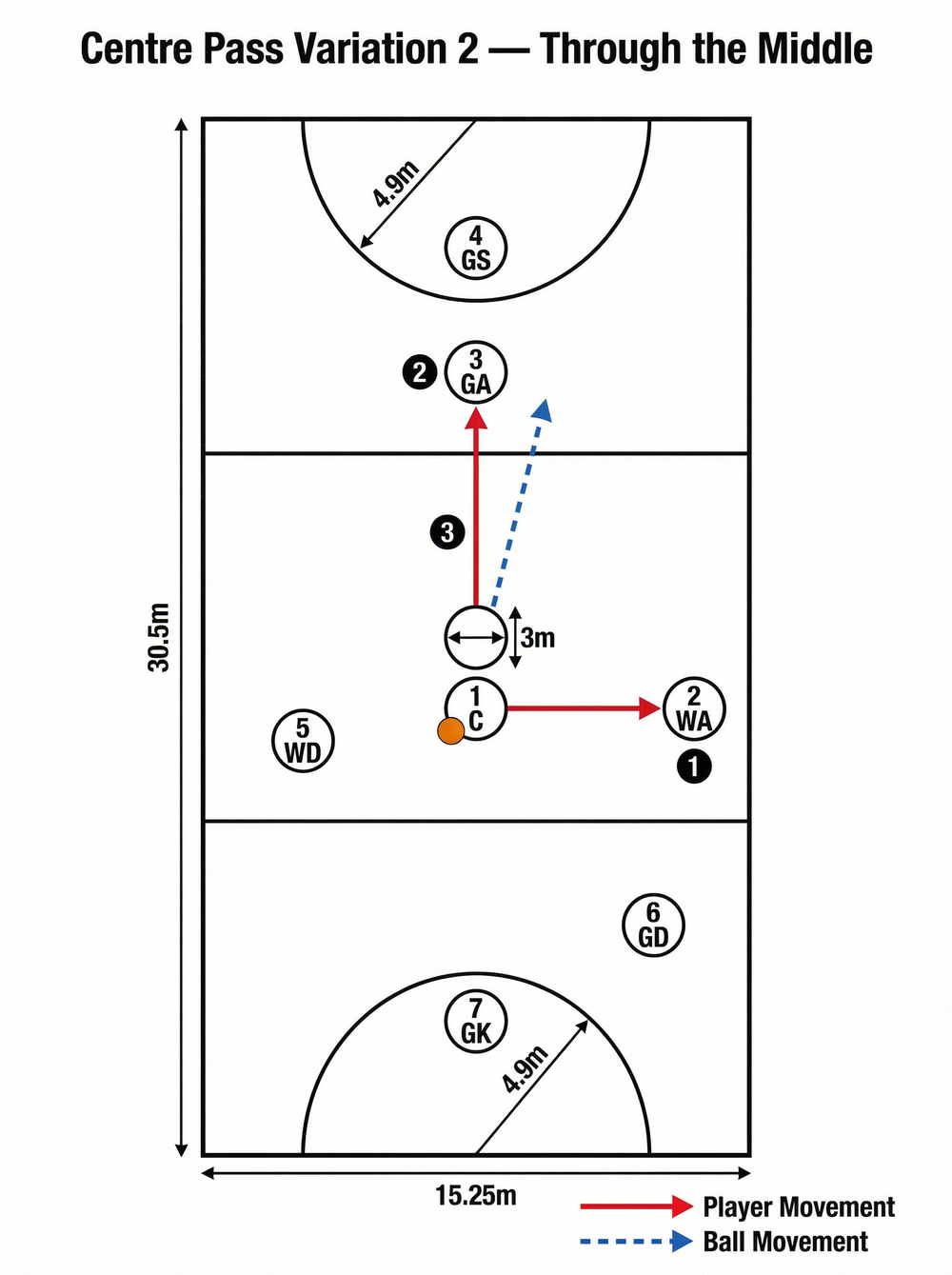
- Starting Position: The WA sets up extremely wide on the right transverse line, while the GA sets up centrally.
- The Decoy: On the whistle, the WA makes a dummy lead, driving hard down the sideline to draw the WD away from the middle.
- The Drive: The GA hesitates for a split second, then drives straight and hard down the central corridor, aiming to receive the ball approximately 3 meters over the transverse line.
- The Delivery: The C executes a quick, direct pass into the space ahead of the GA, ensuring the ball is delivered out in front to maintain momentum.
- Second Phase: The GA catches on the run and immediately looks to the top of the goal circle where the GS is holding position.
Variation 3: Double Lead & Switch
This is an advanced variation designed to cause confusion and force defensive switches, often resulting in a free player.

- Starting Position: The WA and GA set up moderately wide on the transverse line.
- The Initial Lead: On the whistle, both the WA and GA drive straight forward into the centre third for approximately 2 meters.
- The Switch: Both players abruptly plant their outside foot and cut sharply across each other in the designated 'Switch Zone' in the middle of the court.
- The Delivery: The C must read the play carefully. The C passes to the player who successfully loses their defender during the cross. This requires excellent timing and vision from the C.
- Second Phase: The receiving player uses their momentum to turn and feed the next phase, while the non-receiving player clears the space.
Key Coaching Points

To ensure the success of these variations, focus on the following critical elements during the drill:
- Explosive First Step: The success of any centre pass variation relies entirely on the attackers' ability to create immediate separation. Emphasize a low center of gravity and an explosive push-off on the whistle.
- Timing is Everything: The C must not release the ball until the attacker has committed to their final drive. Releasing too early allows the defense to intercept; releasing too late kills the momentum.
- Eye Contact: The C must establish clear eye contact with the intended receiver before delivering the pass. This prevents turnovers and ensures the receiver is ready.
- Strong, Flat Passes: Centre passes should be delivered with pace. Loop passes give the defense time to recover. Demand strong chest or shoulder passes.
- Clear the Space: The player who does not receive the ball must immediately clear out of the area to open up driving lanes for the second phase.
Common Mistakes

Watch out for these frequent errors and correct them immediately:
- Leading Too Early: Attackers moving before the umpire's whistle, resulting in a free pass to the opposition.
- Running in Arcs: Attackers running in rounded arcs rather than sharp, angled cuts. Arcs are easy to defend; sharp angles create separation.
- C Stepping Out: The Centre stepping outside the 0.9m centre circle before releasing the ball. Ensure the C maintains foot contact inside the circle.
- Forcing the Pass: The C throwing to a predetermined player even if they are heavily defended. The C must read the play and pass to the open option.
Variations & Progressions

Once the basic movements are mastered, increase the difficulty to simulate match pressure.
- Add Passive Defense: Introduce a WD and GD who shadow the attackers but do not attempt to intercept. This helps attackers get used to visual pressure.
- Full Live Defense: Introduce full, competitive defense (WD, GD, and a defending C). This forces the attacking unit to execute under genuine match conditions.
- Time Limit: Challenge the attacking team to get the ball into the goal circle within 3 seconds of the centre pass whistle, emphasizing speed of transition.
Age Adaptations

Tailor the drill to suit the developmental stage of your players.
- Under 10s: Focus solely on Variation 1 (Wide Split). Keep it simple. Emphasize the basic mechanics of a strong chest pass and catching on the run.
- Under 12s/14s: Introduce Variation 2 (Through the Middle) and begin adding passive defense. Focus heavily on the timing of the drive and the C's decision-making.
- Under 16s/Open: All variations should be utilized against full, live defense. Focus on the complexity of Variation 3 (Double Lead & Switch) and the speed of transition into the second phase.
