

Netball
The Centre Third Trap: Defensive Press Play at Centre Pass
Master the aggressive centre third trap to force turnovers directly off the opposition's centre pass and disrupt their attacking flow.

What you need
1 Netball, Full set of positional bibs (7 per team), Cones (optional)
1. Overview
The 'Centre Third Trap' is an aggressive defensive set play executed immediately following an opposition centre pass. Its primary objective is to suffocate the attacking options in the centre third (a 10.17m x 15.25m area), forcing the ball carrier into a high-pressure, low-percentage pass, or ideally, creating a clean interception.
This play is particularly effective when you need to break the opposition's rhythm, overturn a deficit late in the quarter, or capitalize on an opposition Centre who struggles under physical pressure. By committing multiple players to the primary press zone, the defensive unit dictates the space and timing of the attack.
2. Setup
Equipment Needed:
- 1 Netball
- Full set of positional bibs (7 per team)
- Cones (optional, for marking the 'Press Zone' during practice)
- A standard netball court (30.5m x 15.25m)
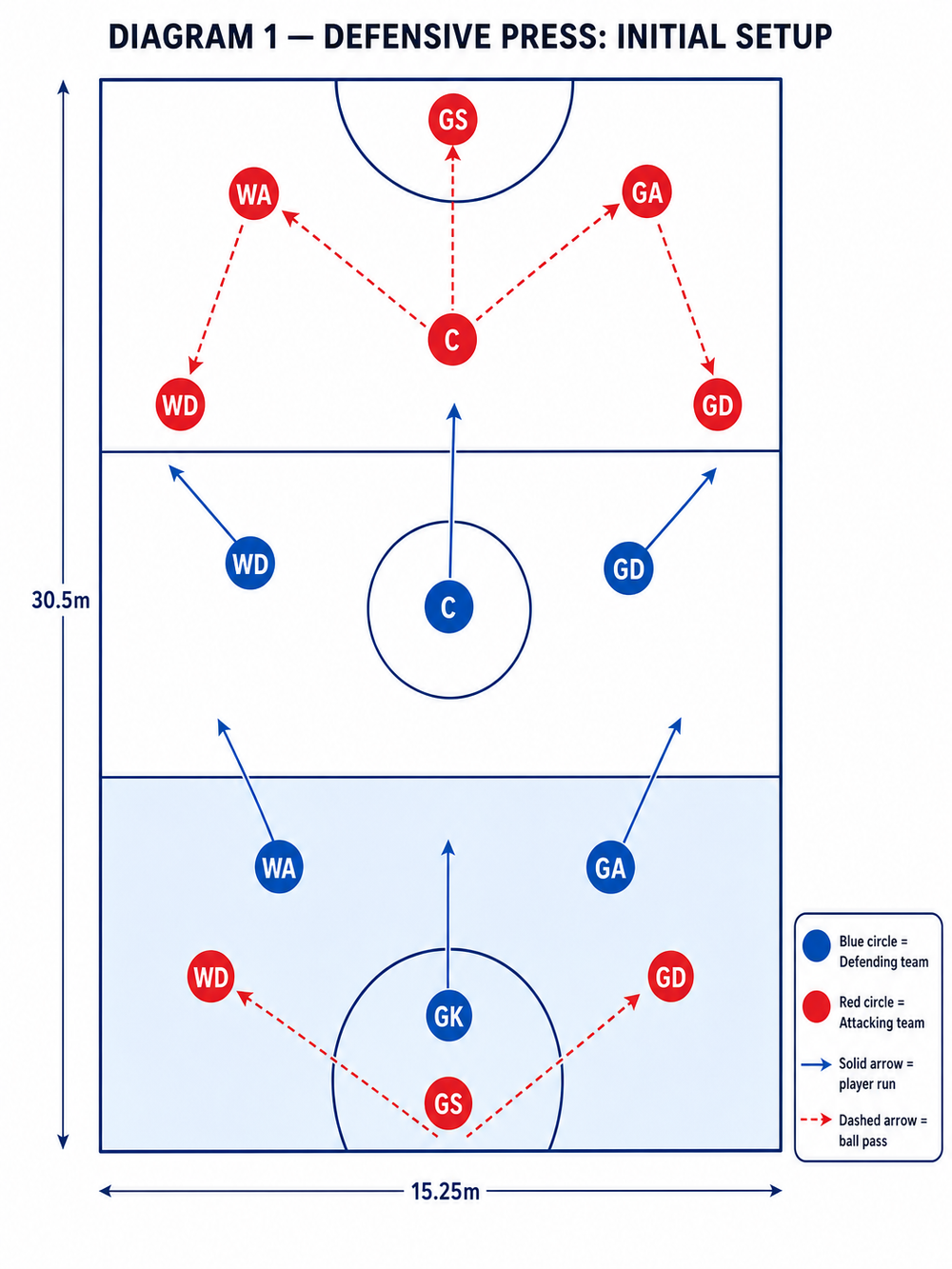
Player Positions (Defending Team):
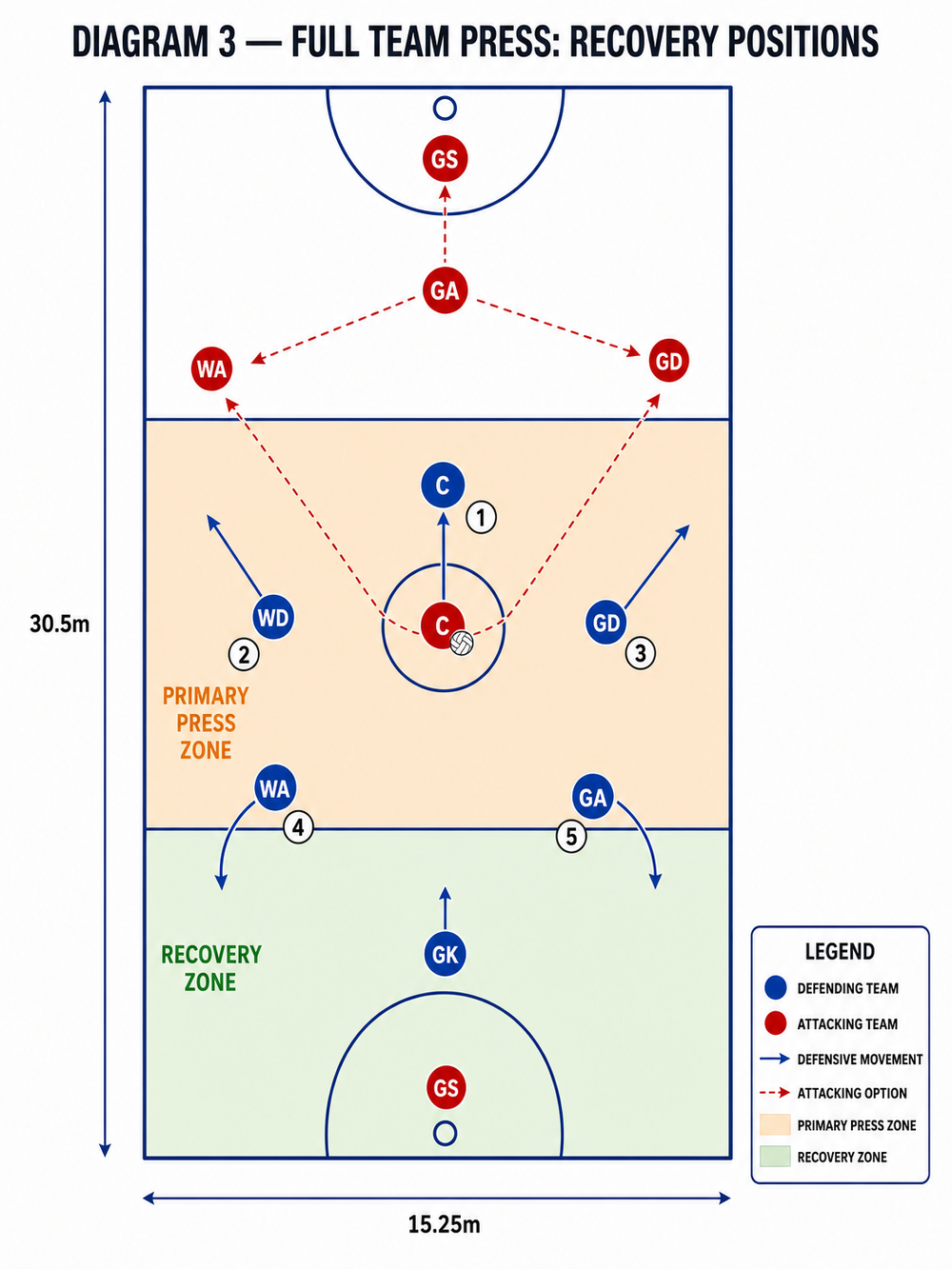
- C (Centre): Positioned toe-to-toe with the attacking Centre on the edge of the centre circle (0.9m radius).
- WD (Wing Defence): Positioned slightly infield, ready to cover the left attacking channel.
- GD (Goal Defence): Positioned slightly infield, ready to cover the right attacking channel.
- WA (Wing Attack) & GA (Goal Attack): Positioned deep in the attacking third, prepared to drop back into the centre third as secondary defenders.
- GK (Goal Keeper): Holding the top of the defensive goal circle (4.9m radius).

3. Step-by-Step Instructions
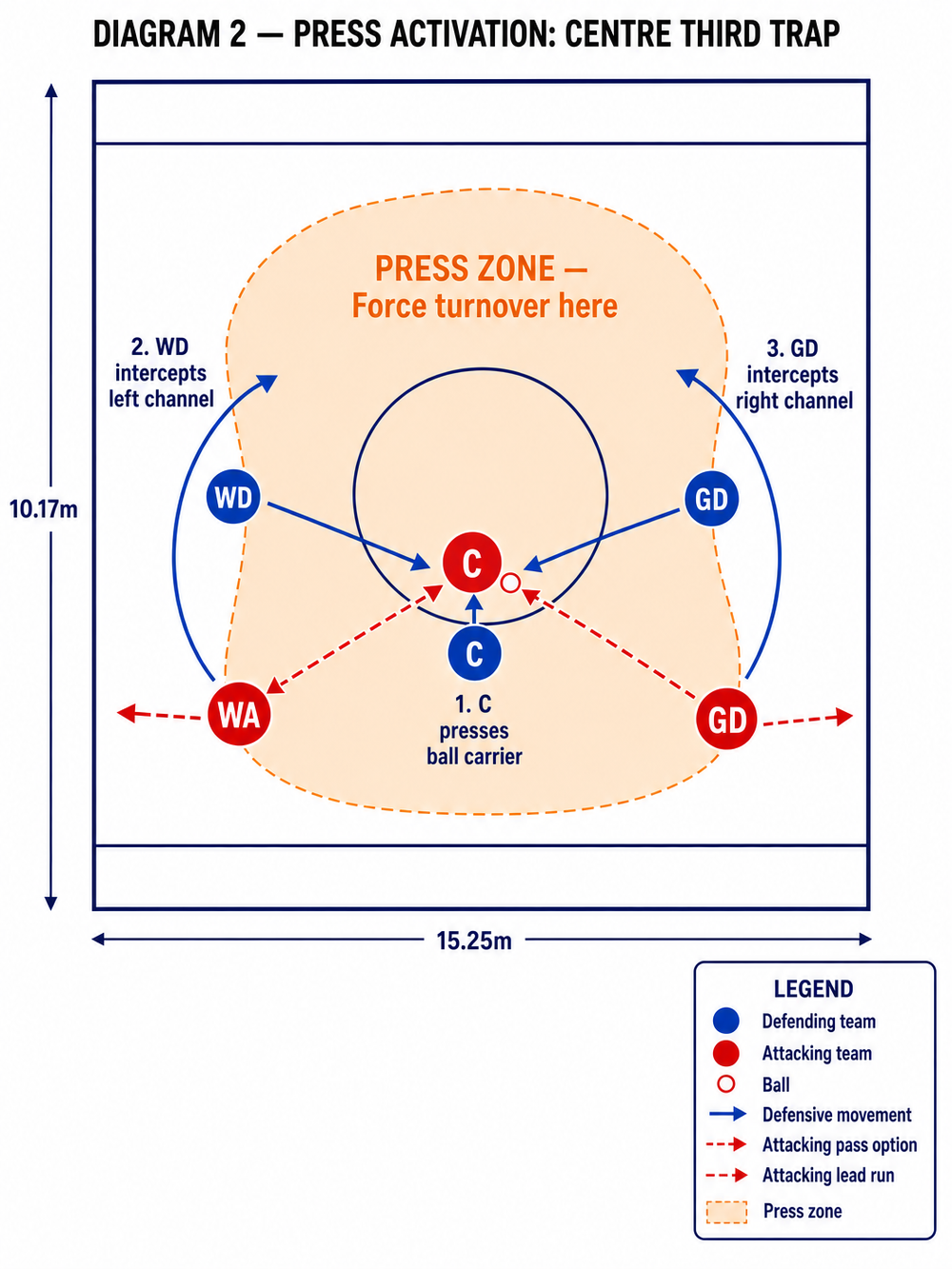
- The Whistle and Initial Engagement: As the umpire blows the whistle for the centre pass, the defending C immediately applies a tight, arms-over 0.9m defensive stance against the attacking Centre, preventing a quick, flat pass.
- Channel Denial: Simultaneously, the WD and GD step up and slightly infield, physically blocking the direct, straight-line leads of the opposing WA and GA. They must force the attackers to take wide, looping paths towards the sidelines.
- Setting the Trap: By forcing the attackers wide and applying pressure on the ball carrier, the defensive unit creates a 'Press Zone' in the middle of the centre third. The attacking Centre is forced to hold the ball longer than desired.
- The Interception Drive: As the attacking Centre looks to release a longer, floated pass to the wide-running attackers, the WD or GD (depending on the direction of the pass) explodes off their player, driving aggressively into the passing lane to take the interception.
- Secondary Recovery: If the initial trap fails and the pass is completed, the WA and GA must immediately sprint back into the defensive third (the 'Recovery Zone') to pick up any loose attackers and slow the transition to the goal circle.
4. Key Coaching Points
- Immediate 0.9m Pressure: The success of this play hinges entirely on the defending Centre's ability to immediately establish a legal 0.9m distance and get arms up. Without pressure on the ball, the trap will fail.
- Dictate the Space, Don't Follow: Defenders (WD and GD) must hold their ground and force the attackers wide. If they simply follow the attackers on their leads, they open up the middle of the court.
- Communication is Critical: The backline (GK) must call out the movements of the attacking shooters, while the WD and GD must communicate if an attacker crosses into the other's channel.
- Explosive First Step: When committing to the interception, the defender must use an explosive, angled drive towards the ball, not the player.
- Three-Second Rule Awareness: Use the three-second rule to your advantage. The longer the Centre holds the ball, the more desperate the pass will be.
5. Common Mistakes
- Soft Pressure on the Ball: If the defending Centre is slow to react or fails to put arms over the ball, the attacking Centre can easily hit the first lead, bypassing the trap entirely.
- Over-Committing Too Early: If the WD or GD steps into the passing lane before the ball is released, the attacking Centre will simply pivot and hit the open player on the other side.
- Ignoring the Goal Shooter: The GK must remain vigilant. If the GK gets drawn too far up the court, a quick, long pass over the top to the holding GS will result in an easy goal.
- Failure to Recover: If the trap is beaten, the team must transition to a recovery defence immediately. Standing and watching the play develop is a critical error.
6. Variations & Progressions
- Progression 1: The Double Teaming Trap: Instead of both WD and GD holding their channels, one defender drops back slightly while the other aggressively double-teams the primary attacking lead alongside the Centre.
- Progression 2: The Zone Shift: Transition from the initial man-on-man press into a strict zone defence across the transverse line if the first pass is completed.
- Variation 1 (Easier): Practice the trap without the attacking WA and GA initially. Focus purely on the Centre's pressure and the WD/GD's timing on the interception drive.
- Variation 2 (Harder): Introduce a time limit (e.g., the attackers must get the ball into the goal circle within 5 seconds). This increases the intensity and realism of the drill.
7. Age Adaptations
- Under 10s & Under 12s: Focus primarily on the 0.9m defensive pressure from the Centre. Introduce the concept of 'forcing wide' without expecting complex interception drives.
- Under 14s & Under 16s: Emphasize the timing of the interception and the communication between the WD and GD. Begin practicing the secondary recovery phase.
- Open/Advanced: Execute the full play at match intensity. Focus on the psychological aspect of the trap, using it to intimidate and disrupt the opposition's flow.
