

Basketball
Clutch Free Throw Shooting & Rebound Rotation Routine
Master the fundamentals of free throw shooting under pressure while seamlessly integrating box-out and transition mechanics for your entire five-man unit.

What you need
1 Basketball, Half-court (FIBA standard 15m x 14m), Whistle
1. Overview
The free throw line is often where close games are won or lost. However, free throw practice is frequently relegated to the end of practice when players are fatigued and mentally checked out. The Clutch Free Throw Shooting & Rebound Rotation Routine is designed to simulate game-like pressure at the line while simultaneously drilling your team's box-out mechanics and transition defense.
This drill achieves two critical objectives: it isolates the mechanical execution of the free throw for the shooter, and it reinforces the positional responsibilities of the other four players on the floor. By running this drill, coaches can ensure that every trip to the charity stripe maximises scoring potential while minimising the risk of giving up an offensive rebound or a fast-break opportunity.
2. Setup
To run this drill effectively, you will need a standard FIBA basketball half-court (15m wide by 14m deep) and at least one basketball. The setup requires a full five-player unit to simulate a live game scenario.
Player Positions
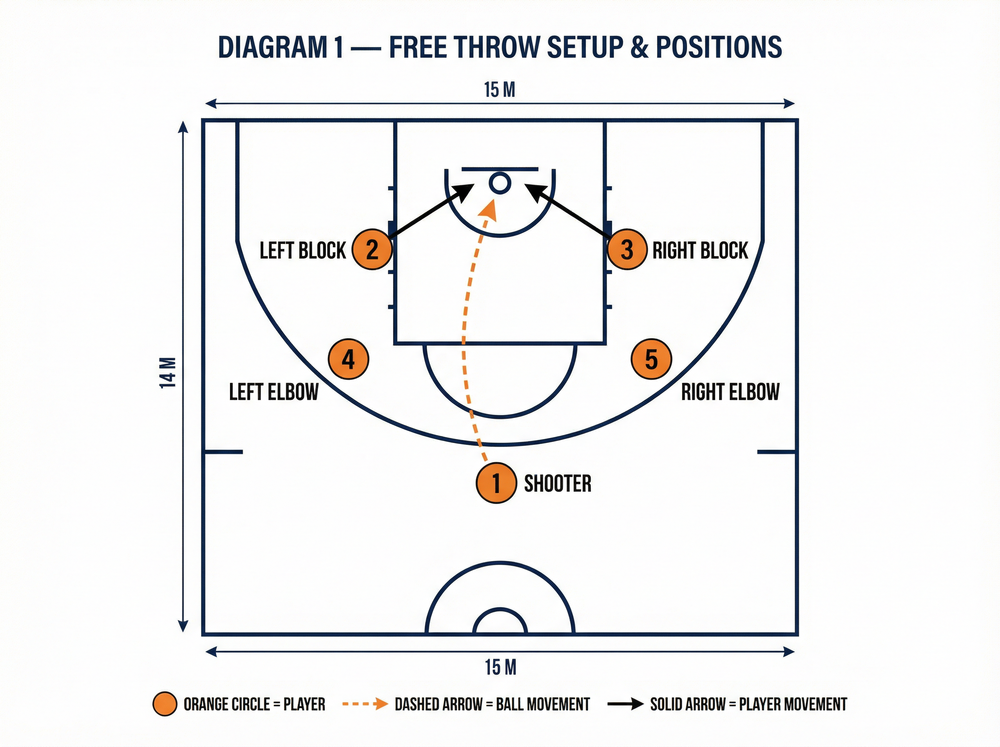
- Player 1 (Shooter): Positioned squarely at the centre of the free throw line (5.8m from the baseline).
- Player 2 (Left Block): Positioned on the left low block lane marker, prepared to box out the defensive player.
- Player 3 (Right Block): Positioned on the right low block lane marker, mirroring Player 2.
- Player 4 (Left Elbow): Positioned on the left lane space mark just outside the key, acting as the safety.
- Player 5 (Right Elbow): Positioned on the right lane space mark, ready to leak out or secure a long rebound.
3. Step-by-Step Instructions
- Establish the Routine: Player 1 steps to the line and executes their personal pre-shot routine. This should take no longer than 5–7 seconds. The other four players must hold their positions just outside the lane lines.
- The Release: As Player 1 begins their shooting motion, focus must remain on mechanics: elbow aligned under the ball, wrist snapped forward, and a high follow-through.
- The Crash: The moment the ball leaves Player 1's fingertips, Players 2 and 3 execute a reverse pivot to establish inside positioning. They must make physical contact before tracking the ball.
- The Safety Rotation: Simultaneously, Player 4 backpedals toward the top of the key to act as the defensive safety.
- The Outlet Rotation: Player 5 flares out toward the wing to establish a passing lane for a quick outlet pass.
- Reset and Rotate: If the shot is made, the team resets. If missed, players play the rebound live. After two shots, rotate the shooter.

4. Key Coaching Points
- Consistent Routine: The shooter must use the exact same pre-shot routine every time.
- Hold the Follow-Through: Hold the "gooseneck" until the ball crosses the rim.
- Hit First, Look Second: Players 2 and 3 must make contact before looking up at the ball.
- Communication: Player 4 must call out "Safety!" loudly to keep the team balanced.
- Game Speed: All post-release movements must be executed at 100% game speed.
5. Common Mistakes
- Rushing the Shot: Players speed up their routine when fatigued. Enforce the full routine.
- Leaking Out Early: Breaking the box-out early gives up easy put-backs.
- Ball-Watching: Shooters and rebounders get caught watching the flight instead of executing.
- Ignoring the Safety: If Player 4 crashes the glass, the team is exposed to transition.
6. Variations & Progressions
- Add Live Defenders: Introduce 2–3 defenders to actively contest rebounds on the blocks.
- Conditioning Penalty: If the shooter misses both free throws, the unit runs a sideline sprint.
- Fatigue Shooting: Run this drill immediately after a high-intensity conditioning segment.
7. Age Adaptations
- Under 10 / Under 12: Focus purely on shooter mechanics and basic box-out concepts.
- Under 14: Introduce elbow roles (safety and outlet) and the "hit first, look second" principle.
- Under 16 and Open: Run with full live defence, shot clocks, and conditioning consequences.
