

Cricket
Mastering the Spin Squeeze: A Coach's Guide to Defensive Field Settings
Learn how to set intelligent, adaptable defensive fields against spin bowling to stifle runs, create pressure, and dictate the flow of the game.
What you need
Cricket balls, Cones or markers, Bats, Pads, Helmets, Gloves
1. Overview
Setting a field to a spin bowler is one of the great tactical arts of cricket. Unlike pace bowling, where fields are often dictated by the bowler's speed and line, spin bowling is a game of chess. A well-set defensive field for a spinner does more than just stop boundaries; it aims to control the run rate, build immense pressure, and force the batsman into making a critical error. This set play is most effective when the pitch is offering turn, when you have a quality spinner in a good rhythm, or during middle overs of a limited-overs game where controlling the tempo is paramount. The goal is to cut off the batsman's primary scoring areas, deny easy singles that rotate the strike, and create a sense of claustrophobia that leads to a wicket-taking shot.
2. Setup
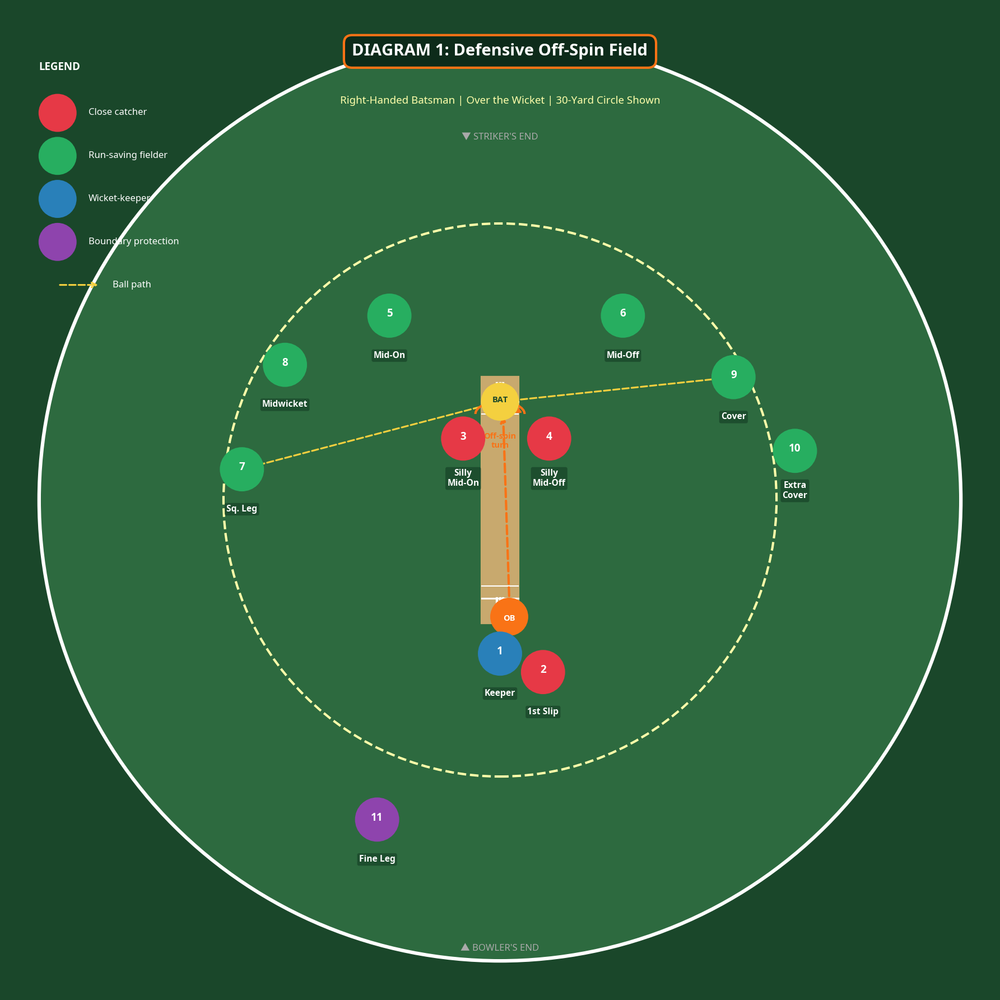
Executing this strategy requires clear roles and precise positioning. The setup is adaptable based on the type of spinner (off-spin vs. leg-spin) and the batsman's style (right-handed vs. left-handed).
Equipment Needed
- Standard cricket balls (ideally older, scuffed balls that grip the surface)
- Cones or markers to denote specific fielding positions during drills
- Full batting equipment (bats, pads, helmets, gloves) for realism
Pitch & Field Setup
- A standard 22-yard cricket pitch on an oval ground.
- The ideal condition is a dry or slightly worn pitch that offers assistance to the spinners. Coaches should teach players to assess the pitch before setting the field.
Player Positions
Positioning is everything. The core principle is a balanced field with players in positions to save both singles and boundaries. We will cover two primary scenarios for a right-handed batsman.
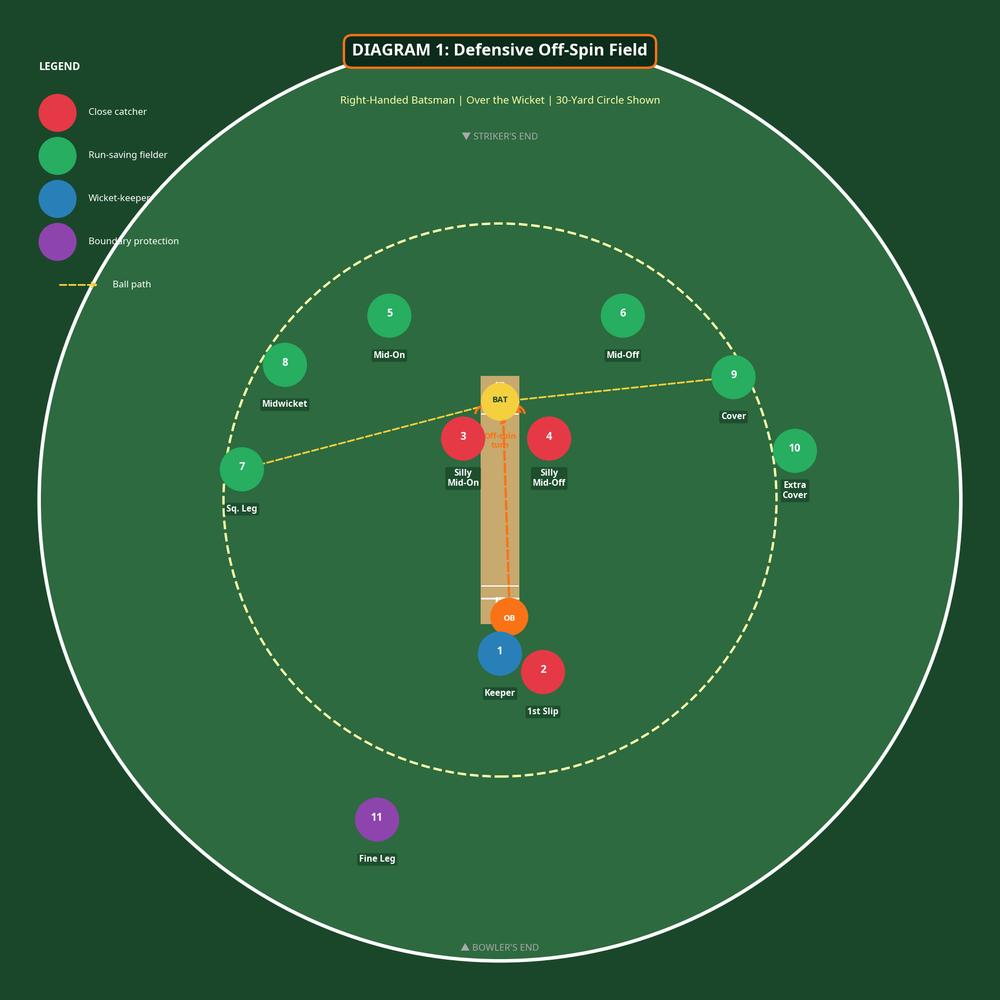
Scenario A: Defensive Field for an Off-Spinner
This field is designed to counter the natural angle of the off-spinner, who turns the ball into the right-handed batsman. The primary aim is to block the on-side and force the batsman to hit against the spin.

- (1) Wicket-keeper: Stands a few paces back to cover the turn and potential edges.
- (2) First Slip: A crucial position for any outside edge.
- (3) & (4) Silly Mid-On / Silly Mid-Off: Close-catching positions to create pressure and catch the defensive prod that pops up.
- (5) & (6) Mid-On / Mid-Off: Positioned inside the 30-yard circle to cut off easy singles straight down the ground.
- (7) Square Leg: Prevents the easy single or nudge on the leg side.
- (8) Midwicket: Covers the gap for on-drives and flicks.
- (9) & (10) Cover / Extra Cover: Form a wall on the off-side, denying the drive.
- (11) Fine Leg: A boundary-saving position for the glance or sweep.
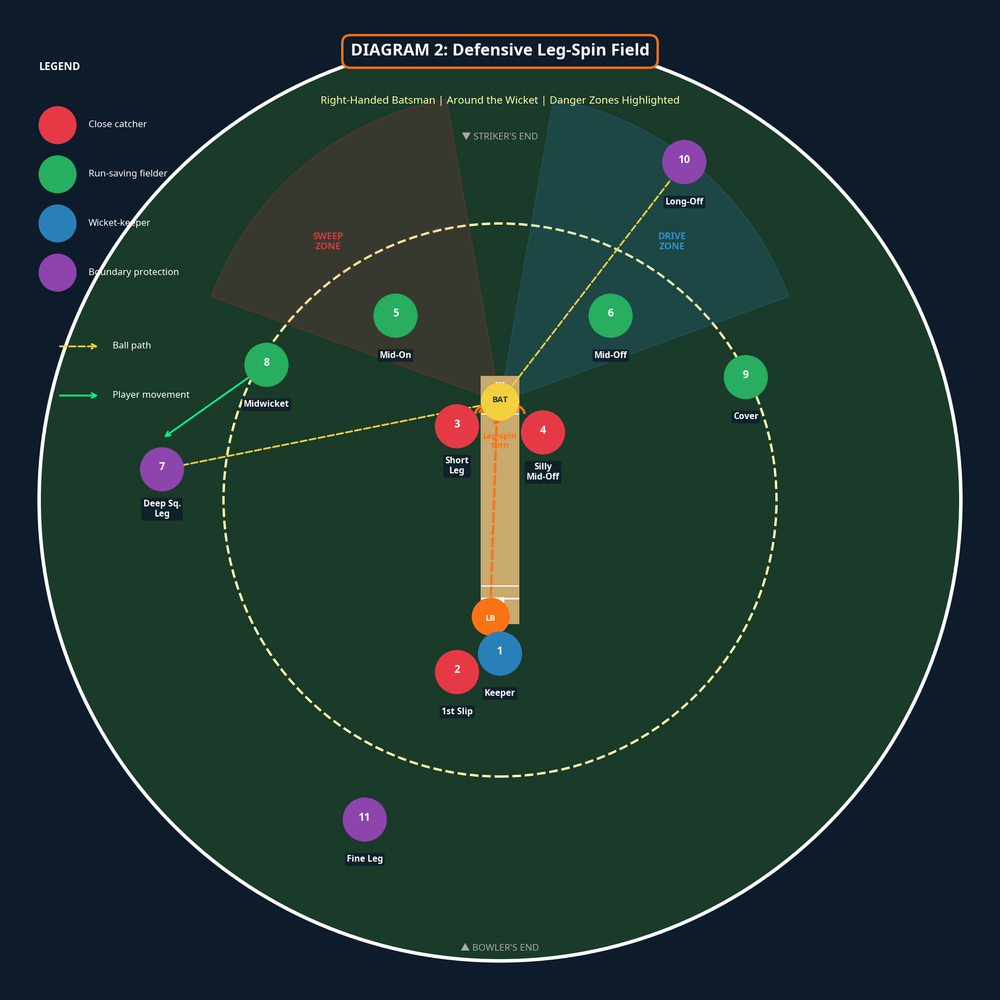
Scenario B: Defensive Field for a Leg-Spinner
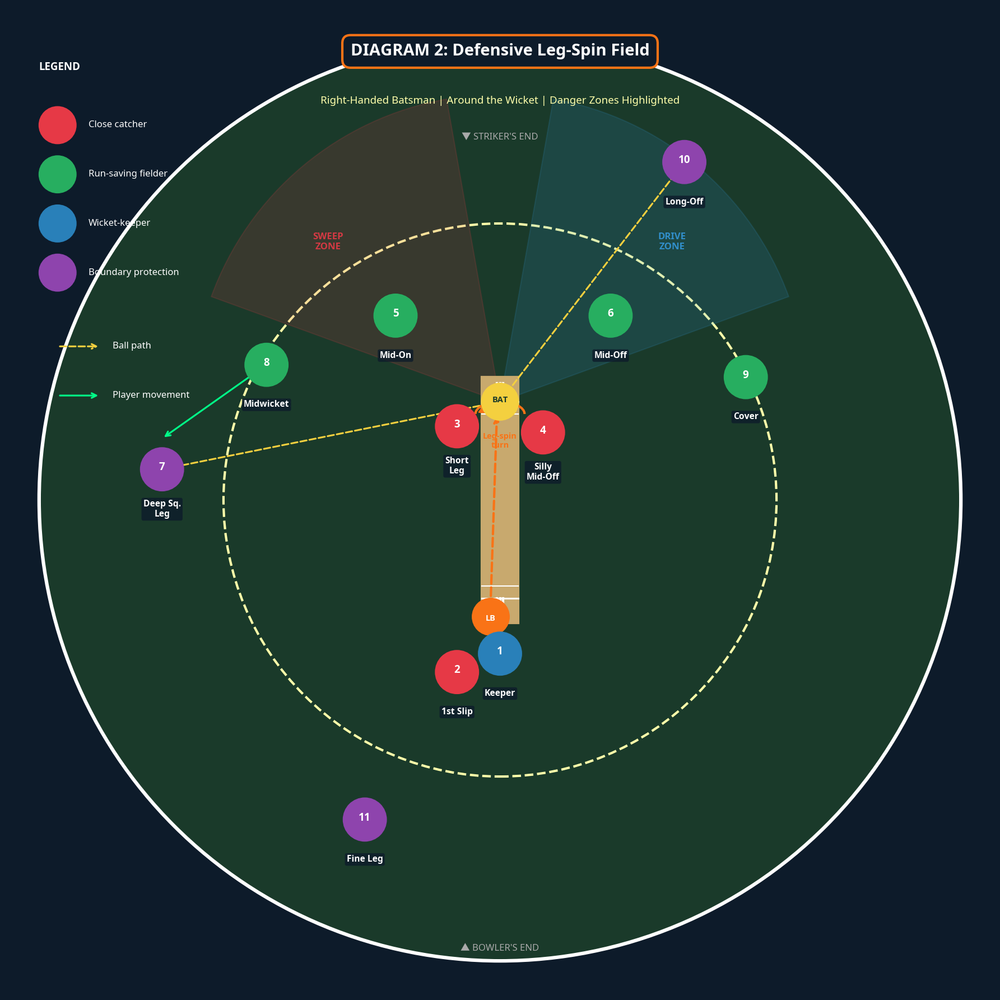
For a leg-spinner turning the ball away from the right-hander, the field adjusts to cover the batsman's likely scoring zones: the sweep on the leg-side and the drive on the off-side.
- (1) Wicket-keeper & (2) First Slip: Remain key catching positions.
- (3) Short Leg: A vital bat-pad position for the ball turning into the batsman's body.
- (4) Silly Mid-Off: Creates pressure for the forward defensive shot.
- (5) & (6) Mid-On / Mid-Off: Tighter in to save the single.
- (7) Deep Square Leg: Protects the boundary from the sweep shot, a common release shot against leg-spin.
- (8) Midwicket: Plugs the gap on the on-side.
- (9) Cover: A run-saving position on the off-side.
- (10) Long-Off: A boundary rider to prevent the lofted drive over the top.
- (11) Fine Leg: Protects the fine glance.
3. Step-by-Step Instructions
- Brief the Bowler: The coach, captain, and bowler must be aligned. Discuss the plan: bowl a tight line and length, aim for a specific spot on the pitch, and trust the field. The bowler's job is consistency.
- Set the Inner Ring: Place the close catchers (Slips, Short Leg, Silly Mid-On/Off) first. These players set the tone. Ensure they are alert and in athletic stances.
- Position the Run-Savers: Place the Mid-On, Mid-Off, Cover, and Midwicket fielders. Their starting positions should be on the edge of the 30-yard circle, ready to move in or back. Their primary job is to create pressure by stopping singles.
- Place the Boundary Riders: Position the deep fielders (e.g., Deep Square Leg, Long-Off, Fine Leg) in locations that protect the batsman's most likely boundary options. They must be aware of the ground dimensions.
- Walk Through Scenarios: Have the bowler mime their action. Point out the key scoring areas and instruct the fielders on their specific roles. For example, tell the Cover fielder, "Your job is to stop the drive. Anything hit in the air to your left or right is yours."
- Run the Play Live: Begin with a batsman playing defensively. The bowler should aim for consistency. The coach should observe the fielders' starting positions, anticipation, and movement.
- Communicate and Adjust: The field is not static. The captain and bowler must constantly communicate. If the batsman is favoring a particular area, a subtle shift (e.g., moving Cover squarer) can be made.
4. Key Coaching Points

- "Hunt in Packs": Emphasize that every fielder is connected. The pressure built by a tight Mid-On allows the Slip to be more effective. Fielders must work together.
- "Anticipate, Don't React": Coach fielders to watch the batsman's setup and movements. Does he look like he's shaping to sweep? The Square Leg and Midwicket should be on their toes.
- "Know Your Role": A run-saving fielder should not be trying to catch a ball at their toes. Their job is to stop the single cleanly. A boundary rider's job is to cover ground and prevent the four. Clarity of roles is essential.
- "Body Language Speaks Volumes": An alert, energetic field creates immense psychological pressure. Insist on players being on the balls of their feet, moving in with the bowler, and showing intent.
- "Bowl to Your Field": This is the most critical point for the bowler. If you have a Long-Off on the boundary, do not be afraid to toss the ball up and invite the drive. Trust the plan.
5. Common Mistakes
- Fielders Too Deep in the Ring: Fielders inside the circle who stand too deep concede easy singles, releasing all the pressure the bowler is trying to build.
- No Communication: A silent field is an ineffective one. The captain, bowler, and senior players must constantly be talking, encouraging, and making minor adjustments.
- Boundary Riders Too Square or Too Fine: Fielders on the boundary must be positioned correctly. A few yards in the wrong direction can turn a potential catch into a certain boundary.
- Bowler Not Following the Plan: The entire structure fails if the bowler abandons the strategy and bowls a different line or length to the one agreed upon.
- Poor Anticipation: Fielders who are flat-footed and only react after the ball is hit will always be a step behind. This is a mental error as much as a physical one.
6. Variations & Progressions
Progressions (Making it Harder)
- The Aggressive Squeeze: Move one of the boundary riders into another close-catching position (e.g., a second Slip or a Leg Slip) to intensify the pressure once the run rate has dried up.
- Targeted Scenarios: Set up a game situation, e.g., "20 runs to defend in 5 overs." This forces the fielders and bowler to execute the defensive plan under pressure.
Variations (Making it Easier)
- Beginner's Ring Field: For younger players, remove the close-catching positions like Silly Mid-On and Short Leg. Instead, focus on creating a simple, solid ring of 5-6 fielders inside the circle to teach the concept of saving singles.
- Cones as Fielders: In a net session, use cones to represent the field. This allows the bowler and batsman to visualize the gaps and scoring areas without needing a full team.
7. Age Adaptations

- Under 10/12: Focus on the absolute basics. Introduce the concept of a Mid-On and Mid-Off. Forget complex positions. The goal is to stop the ball straight and have fun. Use a softer ball and reduce the pitch length.
- Under 14/16: This is the ideal age to introduce the full defensive set play. Players have the game awareness to understand roles. Introduce the diagrams and walk through the positions and their responsibilities in detail. Emphasize anticipation.
- Open Age / Senior Cricket: At this level, the focus shifts to tactical nuance. Players should be able to adjust the field on the fly based on the batsman's weaknesses, the state of the pitch, and the match situation. The coach's role is to facilitate these decisions and empower the captain and bowler.
