

Cricket
Mastering the Cordon: A Coach's Guide to Slip Cordon & Catching Field Setup
Learn how to strategically set up and coach your slip cordon and close-catching fields to turn edges into wickets and dominate the game.
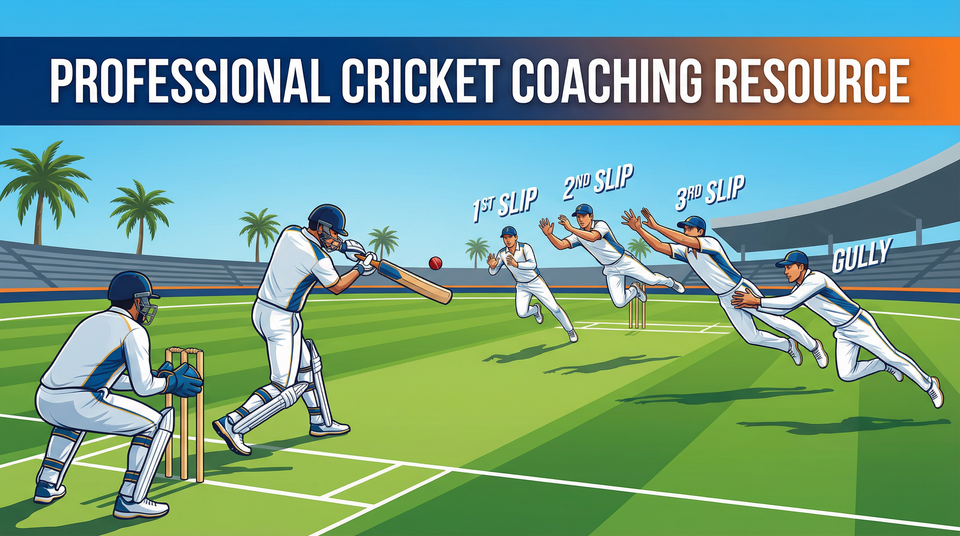
What you need
Cricket Balls, Cricket Bat, Stumps, Cones/Markers, Helmets (for close catchers), Shin Guards, Protective Box
1. Overview
A well-drilled catching cordon is the sharpest weapon in a bowling team's arsenal. It represents a statement of intent, applying immense psychological pressure on the batsman and turning half-chances into match-defining wickets. For pace bowlers, the slip and gully cordon is the primary catching zone for balls finding the outside edge. For spin bowlers, a ring of close-in catchers around the bat preys on mis-timed shots, defensive prods, and turning deliveries that pop up off the bat or pad. This resource provides a comprehensive guide for coaches to establish, drill, and refine these crucial set plays, ensuring your team is ready to capitalize on every opportunity.
2. Setup

Equipment Needed
- Cricket Balls (a good supply for continuous drills)
- Cricket Bat (for the coach or a feeder)
- Stumps (full set with bails)
- Cones or Markers (for positioning and spacing)
- Helmets and Protective Equipment (mandatory for close-in fielders)
Pitch & Field Setup
- A standard 22-yard cricket pitch is required.
- The drill should be run on a grass oval to accurately simulate match conditions.
- Ensure the area is clear of any obstacles and safe for diving catches.
Player Positions
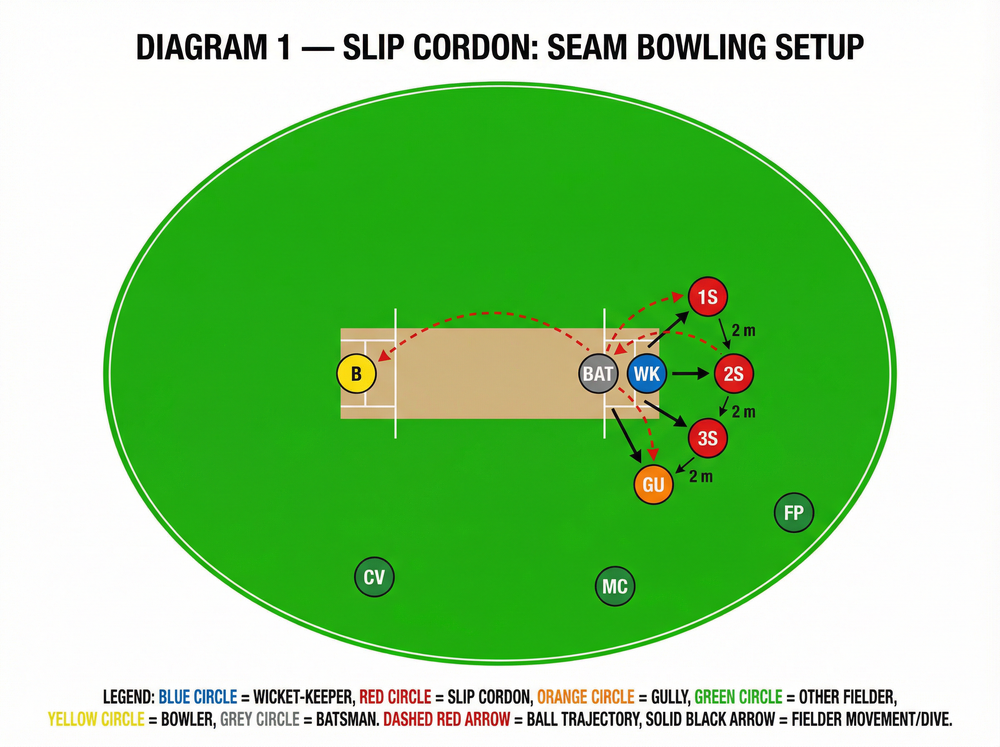
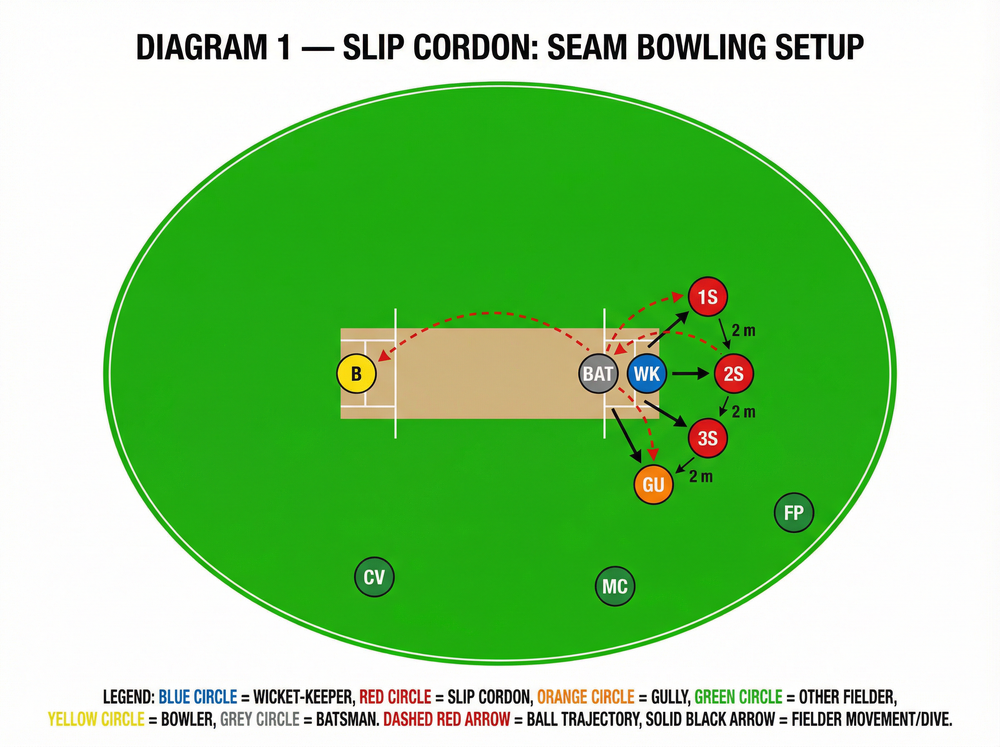
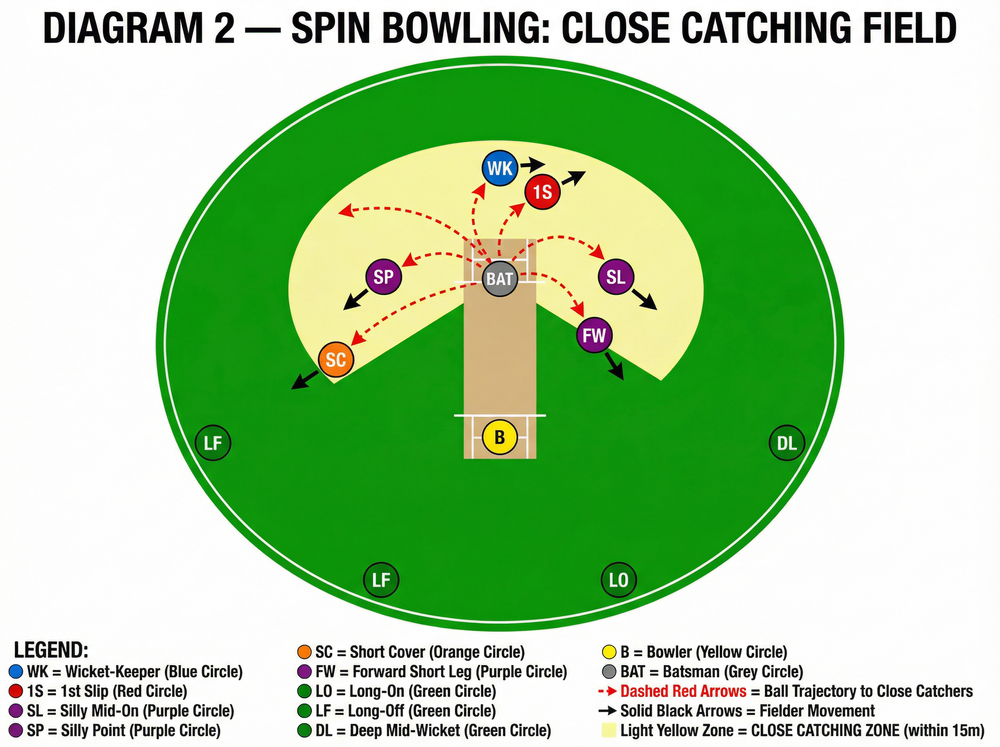
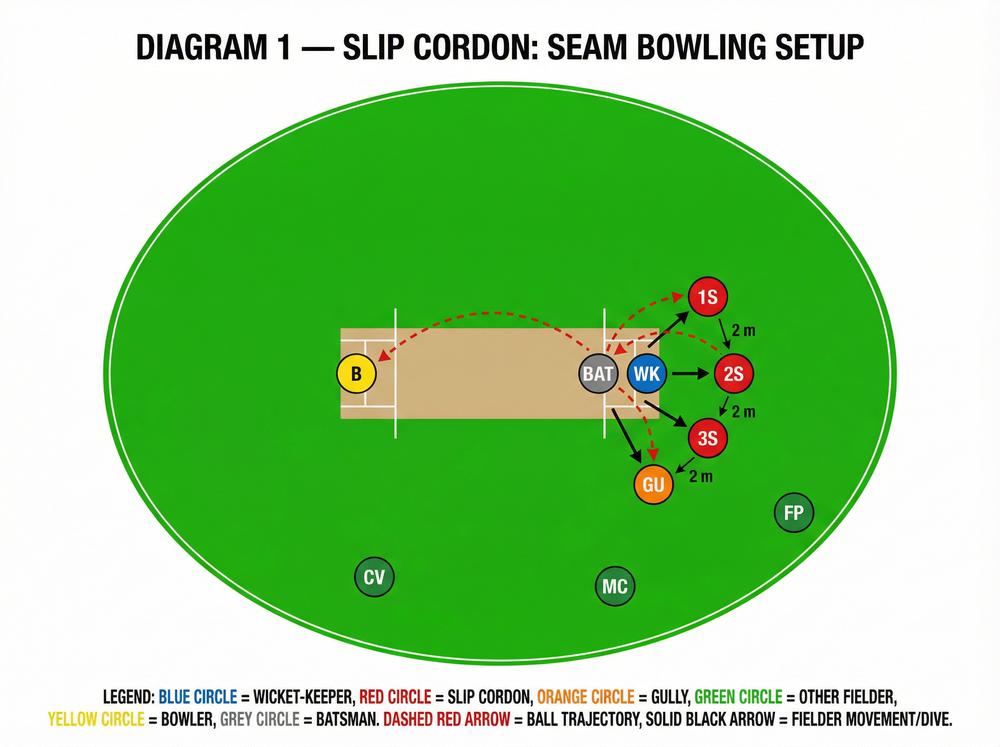
- Wicket-Keeper (WK): The cornerstone of the cordon. Stands behind the stumps, position varying based on the bowler's pace.
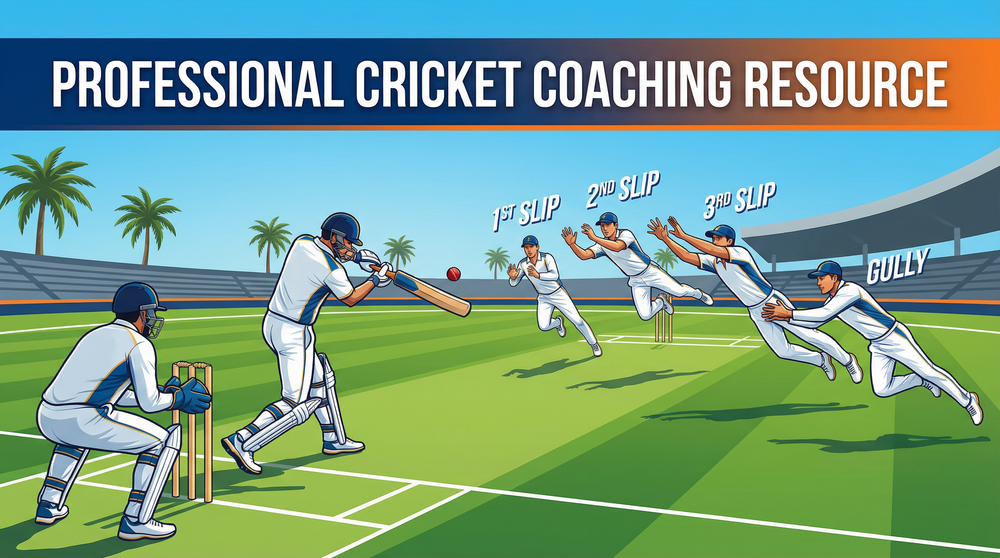
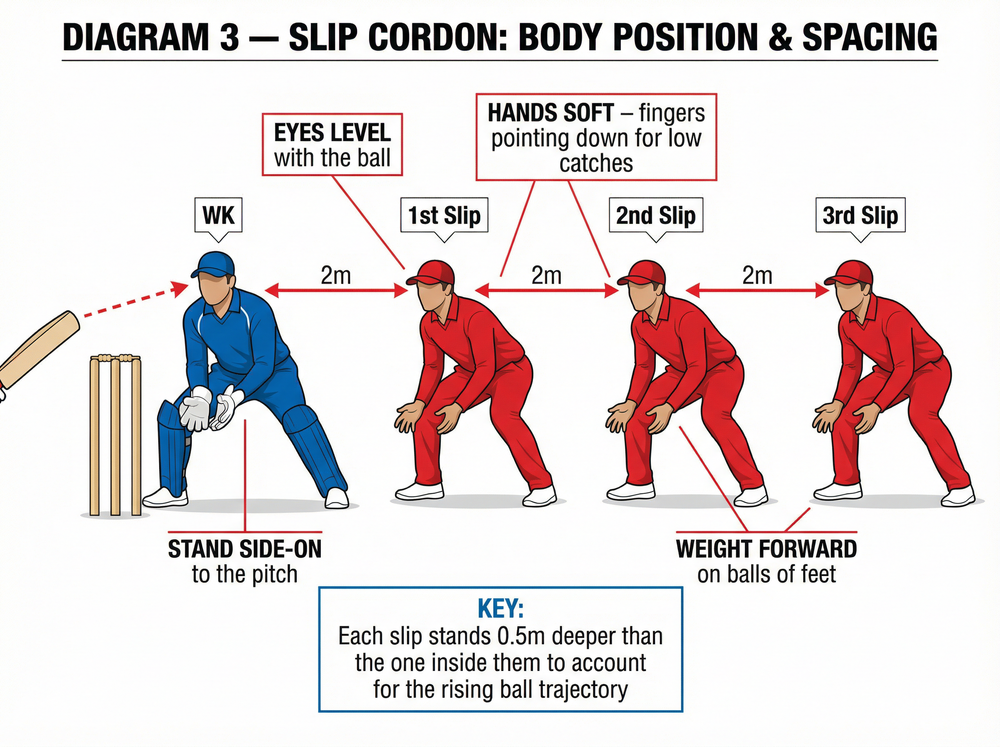
- Slip Cordon (1S, 2S, 3S): A line of fielders positioned next to the wicket-keeper on the off-side. They stand in a slight arc, each fielder approximately 0.5m deeper than the one inside them to account for the rising ball trajectory.
- Gully (GU): A specialized position, squarer and slightly deeper than the slips, covering the area for thicker edges and aerial drives.
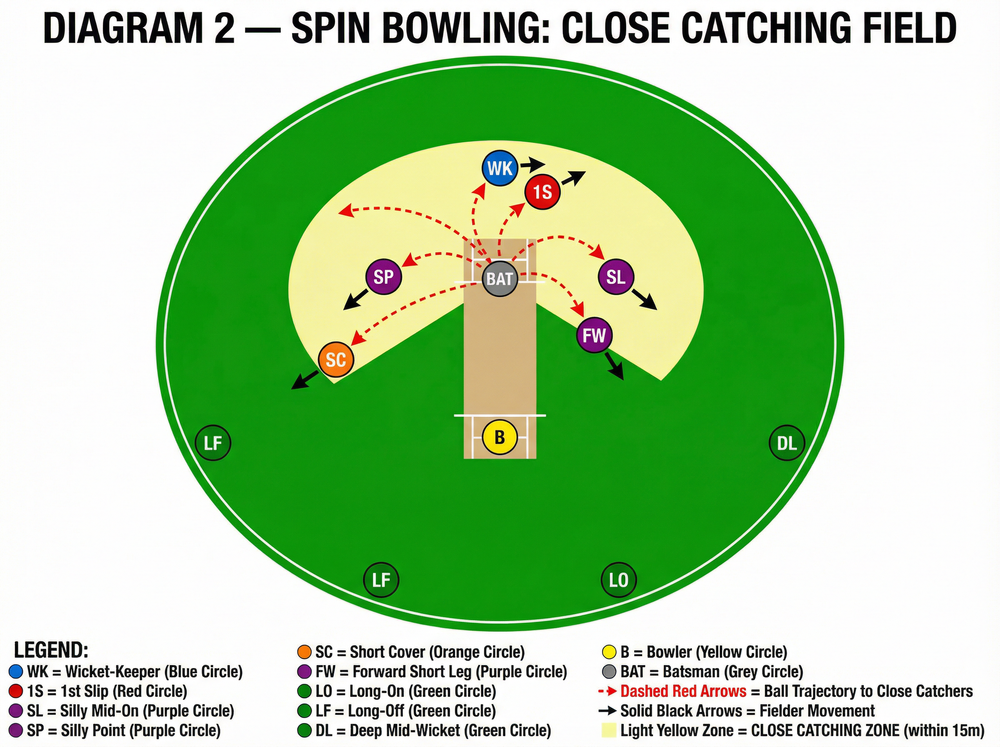
- Close-In Catchers (Spin): Positions like Silly Point (SP), Short Leg (SL), and Forward Short Leg (FW) are deployed for spinners, standing within 5 metres of the batsman to catch balls that pop up off the bat or pad.
3. Step-by-Step Instructions
Drill 1: Pace Bowling Slip Cordon
- Positioning: Set up a wicket-keeper and a 3-man slip cordon (1S, 2S, 3S) plus a Gully using cones for markers. Ensure spacing is approximately 2 metres between each fielder, with each successive slip standing 0.5m deeper than the one inside them.
- Feeding: The coach stands near the batsman's crease with a bat and a bag of balls.
- Execution: The coach simulates an outside edge by hitting or throwing the ball into the cordon. Vary the height, speed, and direction of the feed to cover all types of edges — thin, thick, high, and low.
- Focus: Fielders should maintain their starting position until the ball is fed, then react. The focus is on footwork, moving towards the ball, and catching with soft hands.
- Rotation: Rotate players through the different slip positions so they experience different angles and trajectories. Spend at least 5 minutes at each position.
Drill 2: Spin Bowling Close Catching
- Positioning: Set up a wicket-keeper standing up to the stumps, a 1st slip, a silly point, and a short leg. Use cones to mark the correct starting positions.
- Feeding: The coach stands in the batsman's position and uses a bat to hit gentle 'pop-ups' or deflections towards the close catchers.
- Execution: Fielders must hold their ground, stay low, and be prepared for sharp, sudden chances. Their focus is on anticipation and quick reflexes.
- Safety: Emphasize that close-in fielders must wear helmets, shin guards, and a protective box. This is non-negotiable.
- Progression: Introduce a batsman to play defensive shots against slow bowling, creating more realistic and unpredictable catching opportunities.
4. Key Coaching Points

- The Stance is Everything: Fielders must have a balanced, athletic stance. Weight should be on the balls of the feet, knees flexed, and hands ready. For low catches, fingers should point down; for high catches, fingers point up.
- Watch the Ball, Only the Ball: Train fielders to focus intently on the ball from the moment it leaves the bowler's hand. Losing sight of it for a split second is the difference between a dropped catch and a wicket.
- Soft Hands: Remind players to 'give' with the ball as it enters their hands. Rigid, hard hands will cause the ball to bounce out. Think of hands like a cushion, not a wall.
- Communication is Key: The cordon must work as a unit. Clear calls of "Mine!" or "Yours!" prevent collisions and confusion. The wicket-keeper typically leads the cordon and has the final say.
- Anticipation & Awareness: Great catchers anticipate the edge. They study the batsman, understand the bowler's plan, and are always expecting the ball to come to them on every single delivery.
- Spacing and Depth: The spacing between fielders is crucial. They should be close enough to cover the gaps but far enough apart not to impede each other. The slight arc ensures that fielders are at the correct depth for the ball's trajectory as it travels further from the bat.
5. Common Mistakes
- Standing Up Too Early: Fielders rising from their crouch before the batsman has played the shot. This lifts their centre of gravity and slows their reaction time, especially for low catches. Cue: "Stay down until the ball is hit."
- Hard Hands: Snatching at the ball with rigid hands and arms. This is a primary cause of dropped catches. Cue: "Receive the ball, don't grab it."
- Poor Spacing: Fielders standing too close together (leading to confusion and collisions) or too far apart (creating large gaps for the ball to travel through unchallenged).
- Eyes Off the Ball: Fielders getting distracted by the batsman's movement or the bowler's run-up and failing to track the ball all the way into their hands. Cue: "See the ball into your hands."
- Moving Across Too Early: Slips moving laterally before the ball is hit, trying to guess where the edge will go. This unbalances them and makes it impossible to react to a deflection in the opposite direction.
6. Variations & Progressions
Progressions (Harder)
- Live Match Scenario: Move from coach-fed drills to using a live batsman facing a genuine bowler. This creates game-like unpredictability and trains fielders to read the bowler's delivery.
- Deflection Board: Use a Katchet board or similar deflection device to create sharp, random, and fast-paced deviations that test reflexes to the maximum and build reaction time.
- Pressure Drills: Create a scenario where the cordon must take 5 clean catches in a row to 'win' the drill. If a catch is dropped, the count resets to zero. This adds a layer of mental pressure that mirrors match conditions.
Variations (Easier)
- Tennis Ball Catches: Start with softer tennis balls to build confidence and focus purely on the technique of catching without the fear of a hard ball. Ideal for younger players.
- Stationary Feeds: Begin with the coach feeding simple, predictable catches from a stationary position to get fielders used to the volume of catching and the correct hand positions.
7. Age Adaptations
| Age Group | Key Adaptations |
|---|---|
| Under 10 / Under 12 | Use tennis balls; focus on basic catching technique; introduce 1st Slip and WK relationship only; keep drills fun and success-oriented. |
| Under 14 / Under 16 | Introduce hard ball; build full slip cordon; coach technical stance and hand position; reduce spacing slightly; safety equipment is mandatory. |
| Open Age / Senior | Full technical and tactical application; high-intensity pressure drills; study opposition batsmen; fine-tune cordon communication and unit coordination. |
