

Cricket
Middle Overs Masterclass: Bowling Change & Field Rotation Strategy
Learn how to proactively rotate bowlers and set fields to break partnerships and maintain pressure during the crucial middle overs of a match.
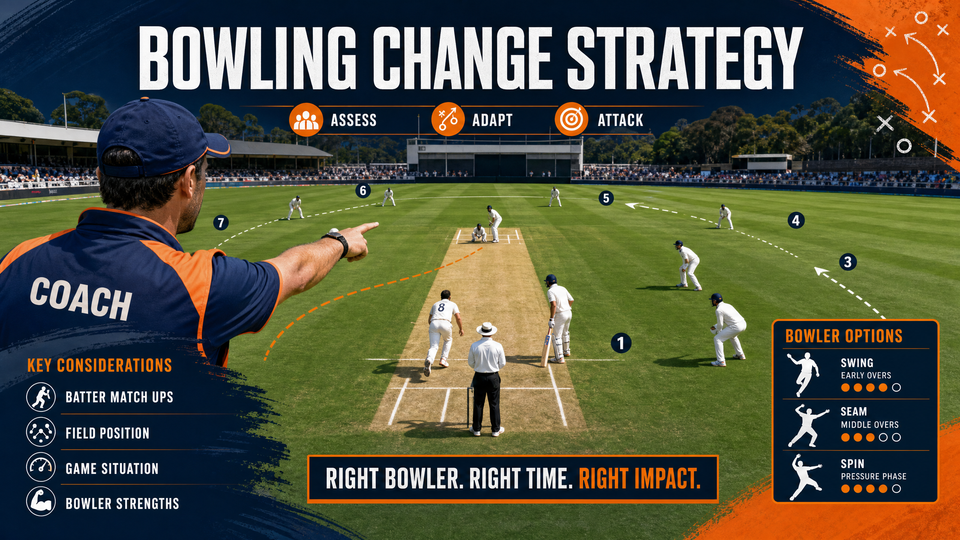
What you need
Cricket balls (new and semi-new), Full set of stumps (both ends), Cones or markers (for the 30-yard inner circle), Standard batting gear (helmet, pads, gloves, bat), Wicket-keeping gear (gloves, pads)
1. Overview
The middle overs (typically overs 15–35 in a 50-over match, or overs 7–15 in a T20) are often where matches are won or lost. As the initial swing and seam movement fades, and fielding restrictions ease, batters look to consolidate and rotate the strike. This set play resource equips coaches and captains with a proactive strategy to execute effective bowling changes, shifting the momentum and breaking established partnerships. By introducing spin or change-up seamers at the right moment, accompanied by specific field adjustments, you can create dot-ball pressure and force the batters into making errors.
2. Setup
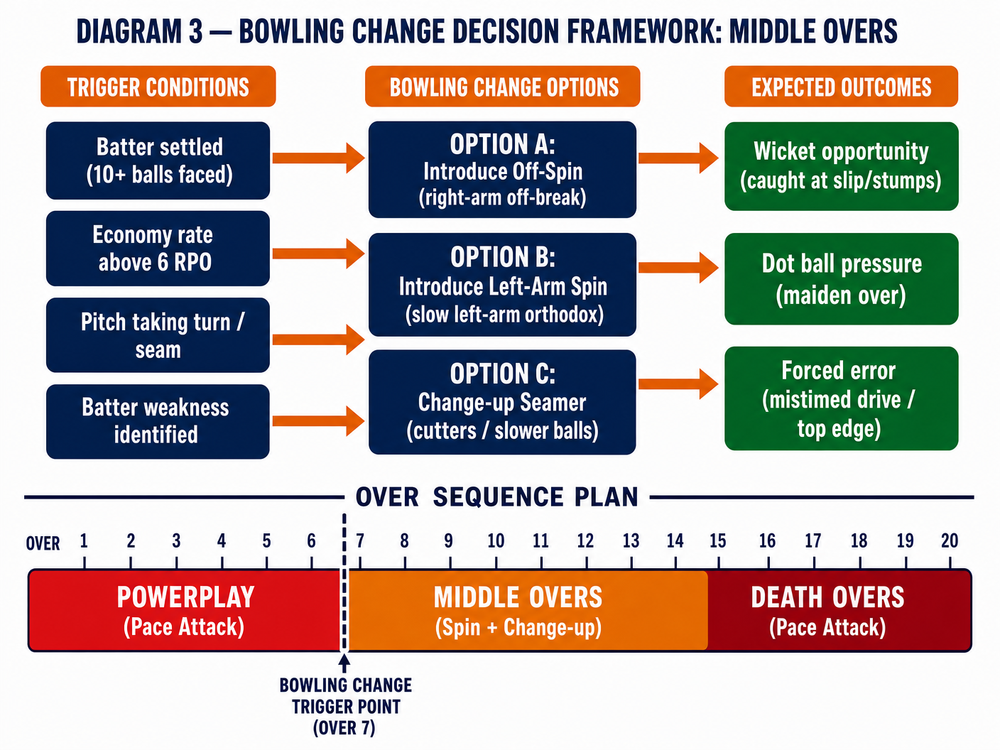
To practice and implement this strategy in a training environment, you will need the following setup.
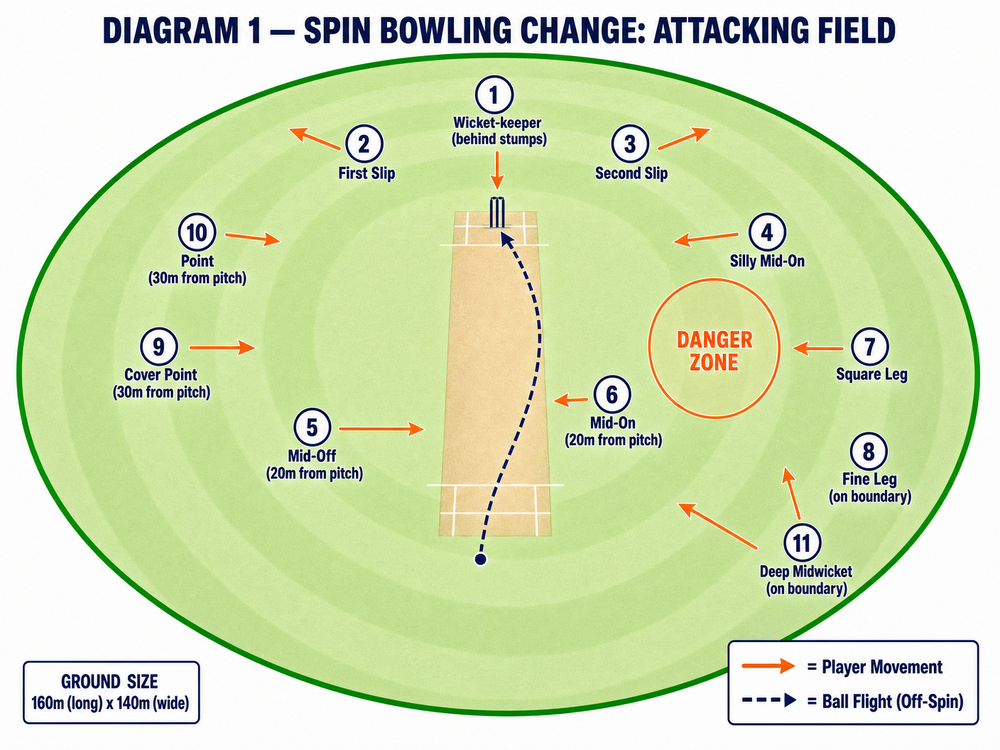
Pitch & Field: A standard 22-yard turf or synthetic pitch on an oval ground. Mark the 30-yard inner circle clearly using cones or markers. The full oval should measure approximately 160m (length) × 140m (width).
Players: Minimum 11 players (1 bowler, 1 wicket-keeper, 9 fielders) plus 2 batters to simulate match scenarios. A total of 13 players is ideal.
Equipment: 1–2 new or semi-new cricket balls, standard batting and wicket-keeping gear, and a full set of stumps at both ends.
Positions: Fielders should be familiar with standard positions, particularly the differences between attacking (slips, close catchers) and containing (deep cover, deep midwicket) roles before this session begins.
3. Step-by-Step Instructions
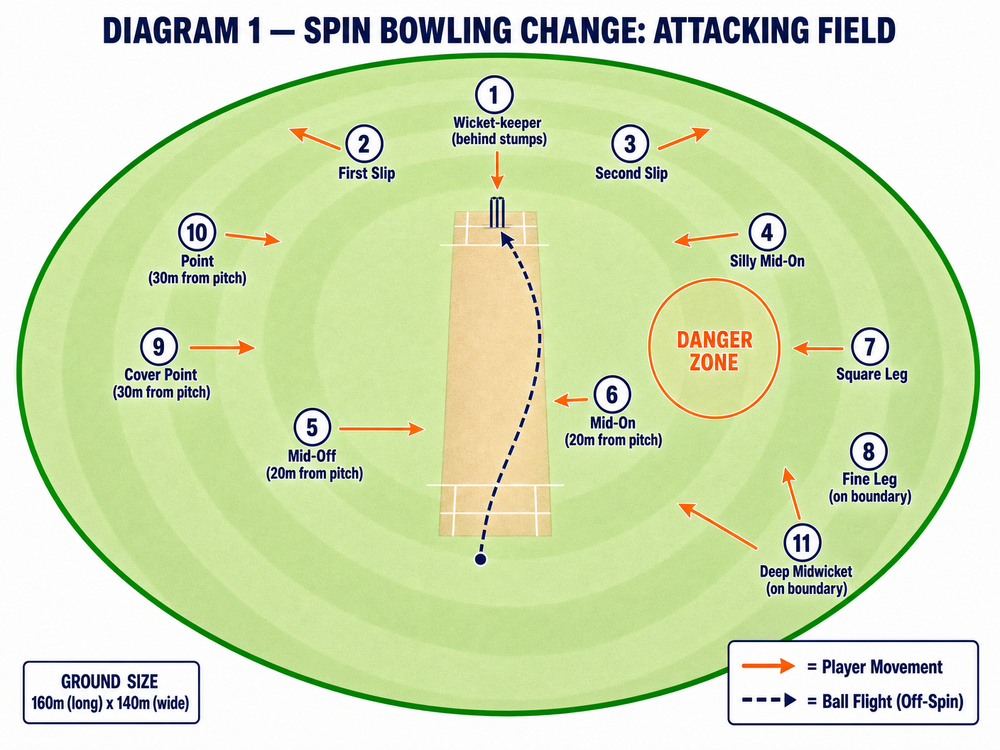
Implementing a successful bowling change requires clear communication and precise execution. Follow these steps to transition smoothly from the powerplay to the middle overs phase.
Step 1 — Identify the Trigger
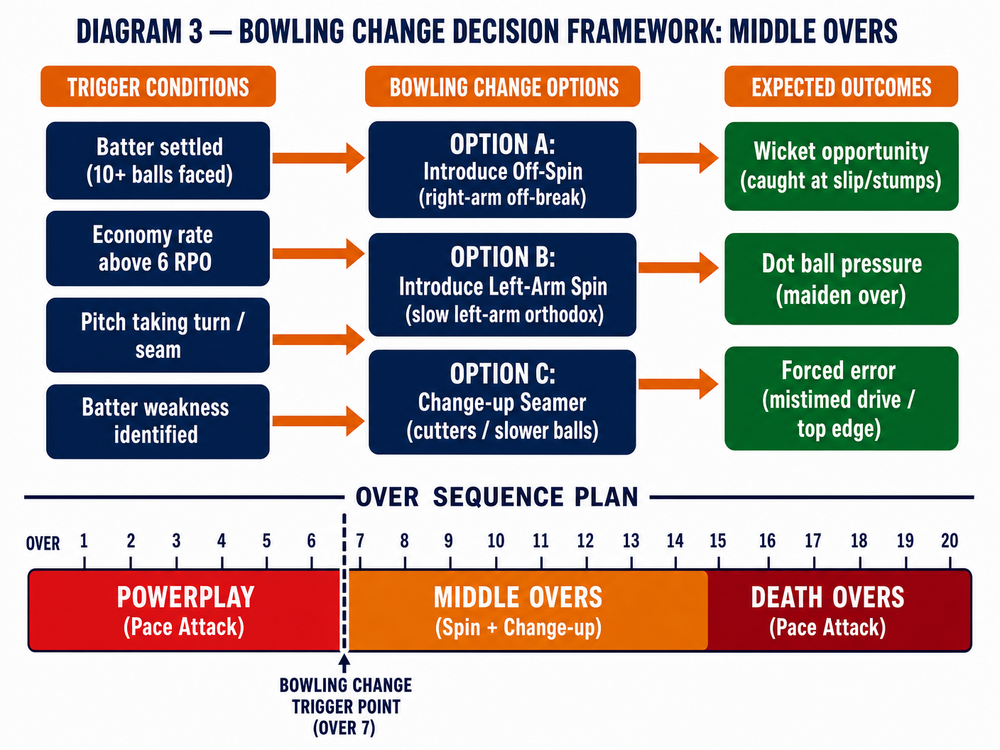
The captain and coach must monitor the game situation to identify the optimal moment for a change. Key triggers include the opening pace bowlers completing their initial spell (usually 4–6 overs each), the run rate climbing above 6 runs per over, batters looking settled after 10+ balls, or the ball stopping to swing, requiring a change in pace or trajectory.
Step 2 — Communicate the Change
Once the trigger is identified, the captain must communicate the plan clearly to the incoming bowler and the rest of the team. This should happen at the end of the previous over, giving fielders a full 90 seconds to move into their new positions before the first ball is bowled. The captain should confirm the bowler's primary objective: are they attacking for a wicket, or containing to build pressure?
Step 3 — Set the Field for the Spin Option
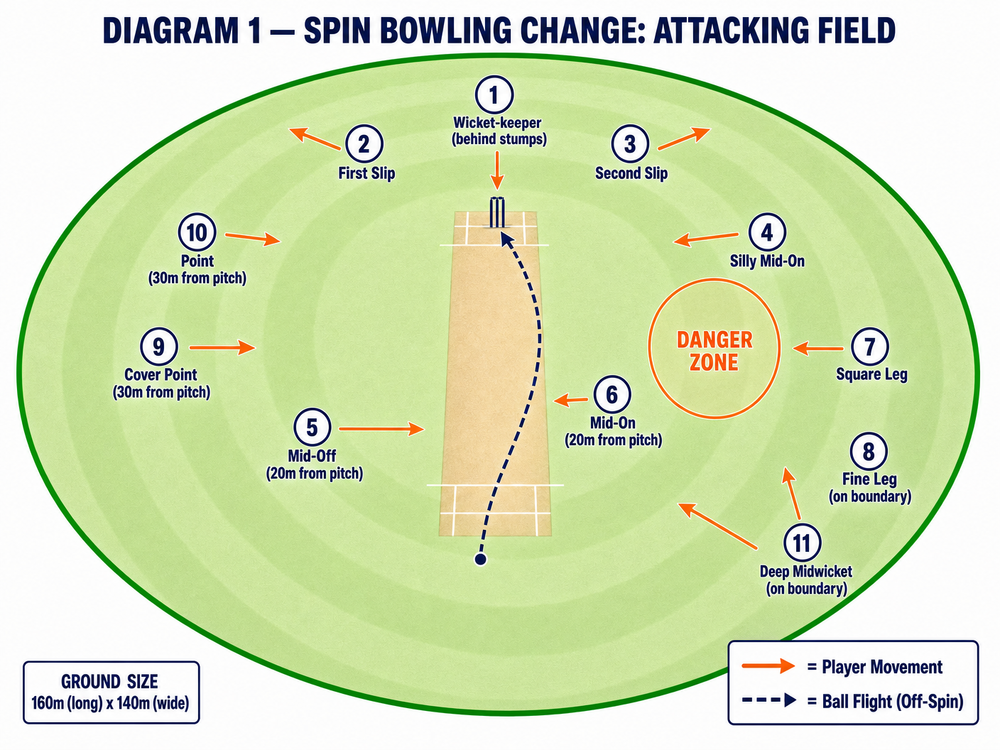
If introducing a spinner, the field must be adjusted to support their specific style. For an off-spinner bowling to a right-handed batter, the focus shifts to creating pressure on the off-side while protecting the leg-side boundary.
Move a slip fielder (Position 2 or 3) to a catching position on the leg side, such as short mid-wicket or square leg (Position 7). Ensure mid-off (Position 5) and mid-on (Position 6) are positioned at the edge of the 30-yard circle, approximately 20m from the pitch, to cut off the single. Place a deep mid-wicket (Position 11) on the boundary to protect against the slog sweep or heave over the leg side.
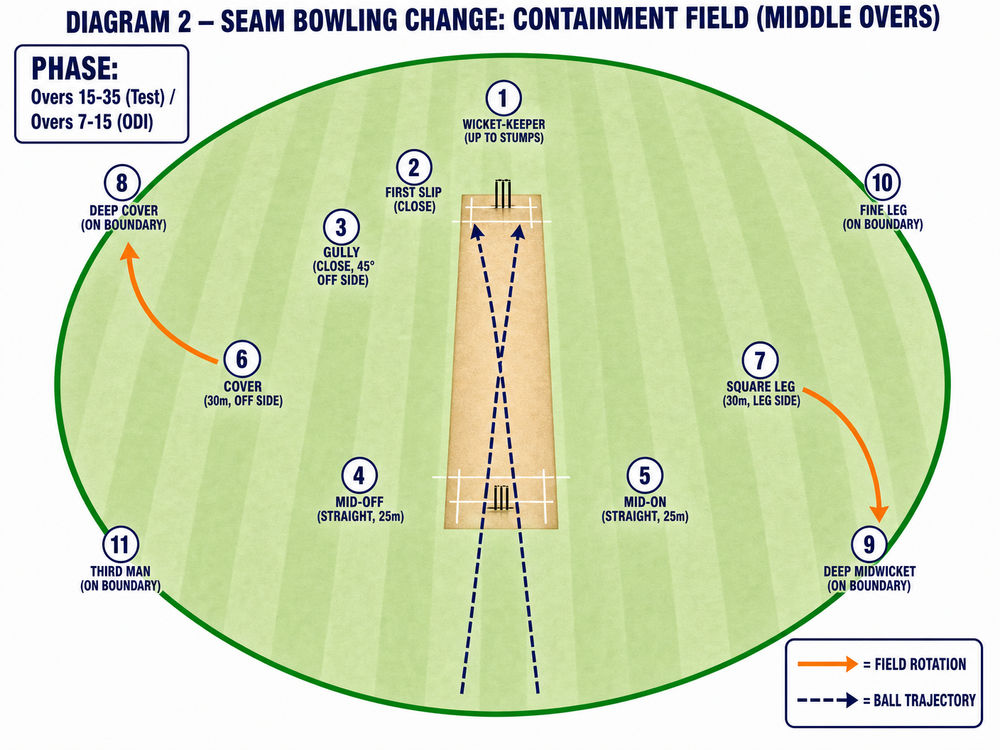
Step 4 — Set the Field for the Change-up Seam Option
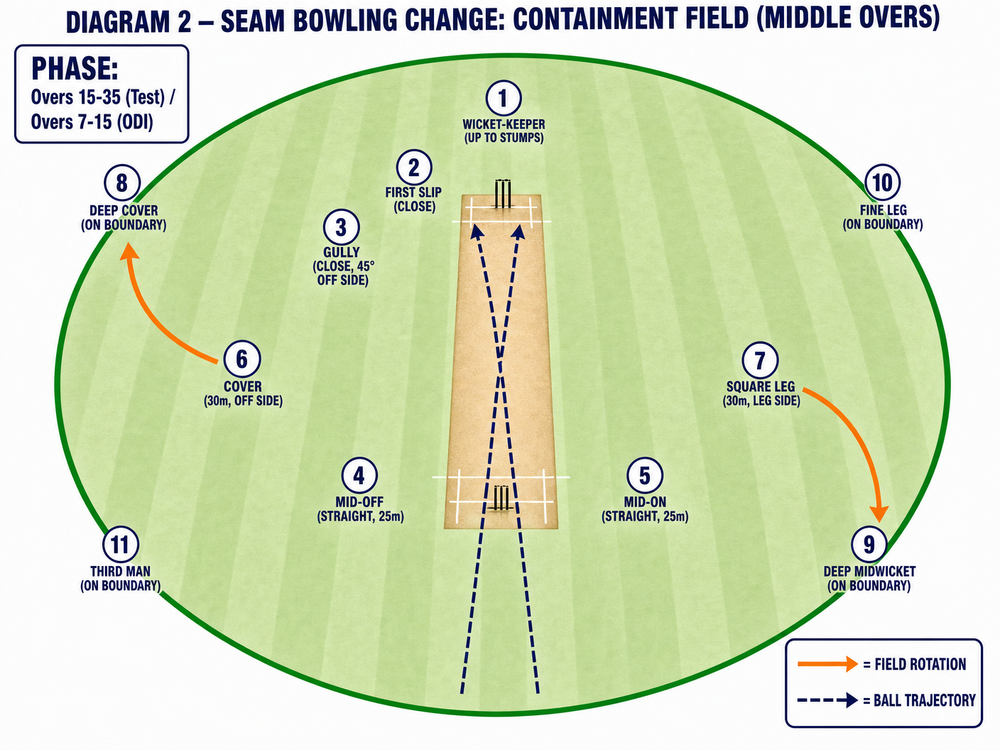
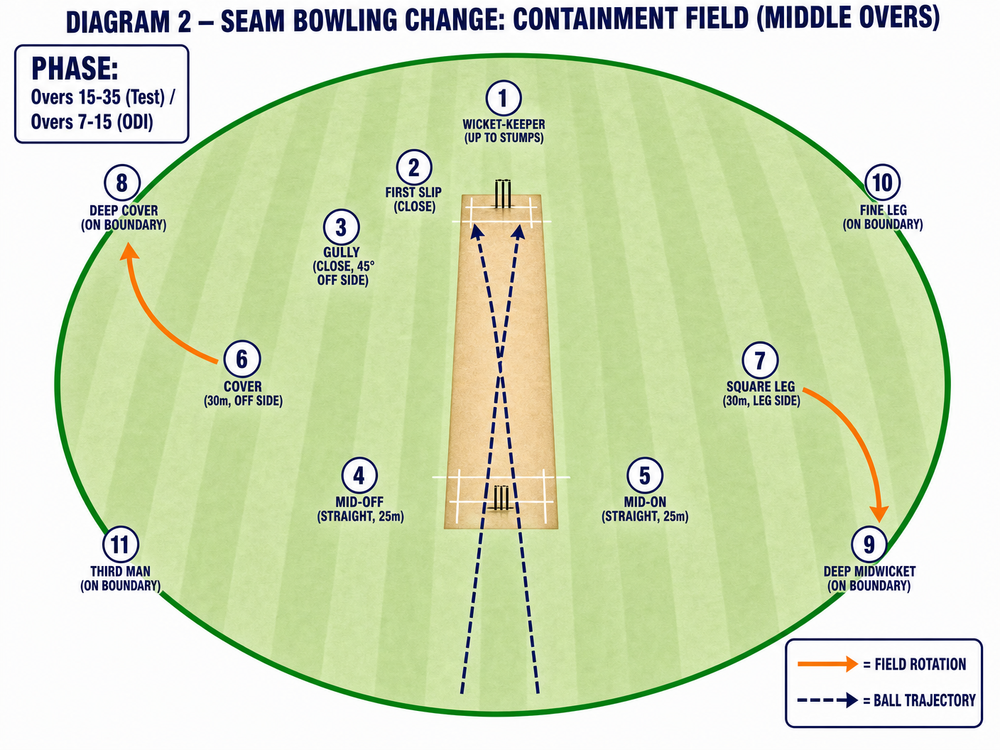
If introducing a medium-pacer who relies on cutters and slower balls, the field must be set to contain and encourage mistimed shots.
Push the cover fielder (Position 6) back to deep cover (Position 8) on the boundary to protect against the drive. Move square leg (Position 7) back to deep mid-wicket (Position 9) to guard against the pull shot. Keep mid-off (Position 4) and mid-on (Position 5) relatively straight at approximately 25m from the pitch to prevent easy singles down the ground. Retain a slip (Position 2) and gully (Position 3) to create catching opportunities for the batter who tries to force the pace.
Step 5 — Execute the Plan and Monitor
The bowler must now execute the agreed-upon plan, focusing on hitting the right areas and building pressure through dot balls. The fielders must remain alert and anticipate the ball. After each over, the captain and coach should assess whether the plan is working. If the economy rate remains high after two overs of the new bowler, be prepared to adjust the field or switch to the alternative bowling option.
4. Key Coaching Points
Proactive, Not Reactive. Don't wait for a partnership to become unbreakable before making a change. Anticipate the game's flow and introduce new bowlers to disrupt the batters' rhythm before they fully settle.
Clear Communication is Non-Negotiable. Ensure the bowler understands their role — attacking for wickets versus containing runs — and that the field is set to match that objective. A bowler trying to take wickets with a defensive field is set up to fail.
Bowling in Partnerships. Remind bowlers that they are working together as a unit. A tight, economical over from one end creates psychological pressure that can produce a wicket-taking opportunity at the other end.
Fielding Intensity Must Lift. A bowling change should be accompanied by a visible lift in fielding energy. Encourage fielders to be vocal, move quickly between overs, and attack the ball in the field. Saving even one run per over across 9 middle overs is a 9-run swing in the match.
Match the Bowler to the Batter. Use the data available — whether from a scorebook or observation — to identify batter weaknesses. A right-arm off-spinner is a natural match-up against a right-handed batter who struggles against the ball turning away from the bat.
5. Common Mistakes
Waiting Too Long to Make the Change. Allowing the opening bowlers to bowl 8–9 overs each means they are fatigued and the ball is old, reducing their effectiveness. The change should come before the partnership is fully established.
Predictable Bowling Changes. Always making the same change at over 7 in every match allows the opposition to plan ahead. Vary the timing of changes to keep the batting side guessing.
Mismatched Fields. Setting an attacking field (slips, close catchers) for a bowler whose primary role is containment, or vice versa, sends a confused message to both the bowler and the batting side.
Lack of Captain–Coach Communication. The captain on the field and the coach on the boundary must be aligned. If the captain makes a change the coach disagrees with, the resulting confusion can undermine the team's confidence.
Ignoring the Batter's Footwork. Before setting the field, observe whether the batter is moving to the off side or the leg side. A batter who plants their front foot and drives is vulnerable to the ball angled into their body; set the field accordingly.
6. Variations & Progressions
Double Bowling Change. Introduce two new bowlers simultaneously at both ends to completely change the pace and style of the attack. This is particularly effective when a partnership has built momentum, as neither batter can rely on the familiar pace and trajectory of the previous bowlers.
The 'Surprise' Over. Bring back a strike pace bowler for a single, unexpected over in the middle phase. The batter who has settled against spin will suddenly face a 130+ km/h delivery, creating a significant adjustment challenge.
Scenario-Based Training Drill. Set up practice matches with specific middle-over scenarios (e.g., 120/2 after 25 overs, needing to restrict to under 250 total). Challenge the fielding team to restrict the batting side using the bowling change framework, and debrief after the session on what worked and what didn't.
7. Age Adaptations
Under 10 / Under 12. Focus on the basics of rotating bowlers to ensure everyone gets a go. Keep field settings simple with just three or four positions explained per over. Emphasize the importance of bowling straight and hitting the stumps, rather than complex tactical plans.
Under 14 / Under 16. Introduce the concept of bowling in partnerships and setting fields to specific bowler types (e.g., spin versus pace). Encourage captains to take ownership of bowling changes and to communicate their reasoning to teammates. Begin using the trigger-condition framework from Diagram 3.
Open / Senior. Implement the full strategy outlined in this resource, focusing on nuanced field adjustments, identifying batter weaknesses through match observation, and executing specific plans under pressure. Introduce video analysis to review bowling change decisions post-match.
