

Cricket
Mastering the Powerplay: Attacking Field Settings & Defensive Adjustments
Equip your bowlers with the perfect field settings to maximize early wickets while mitigating boundary risks during the crucial first six overs of a T20 or ODI match.
What you need
1 New Cricket Ball, Stumps and Bails, Marker cones (optional)
1. Overview
The Powerplay in limited-overs cricket (the first 6 overs in T20s, first 10 in ODIs) is a critical phase where fielding restrictions apply. With only two fielders allowed outside the 30-yard circle, batting sides look to capitalize and score quickly. As a coach, your objective is twofold: take early wickets with the new ball and restrict easy boundaries. This set play outlines an aggressive, attacking field setting to exploit early swing or seam movement, and a defensive adjustment to fall back on if the batters begin to dominate. Mastering these transitions ensures your team dictates the pace of the innings rather than reacting to it.
2. Setup
Equipment Needed:
- 1 New Cricket Ball (white or red depending on format)
- Stumps and Bails
- Marker cones (optional, to visualize the 30-yard circle in practice)
Pitch & Field Dimensions:
- Standard 22-yard pitch.
- Standard oval ground with a clearly marked 30-yard fielding restriction circle.
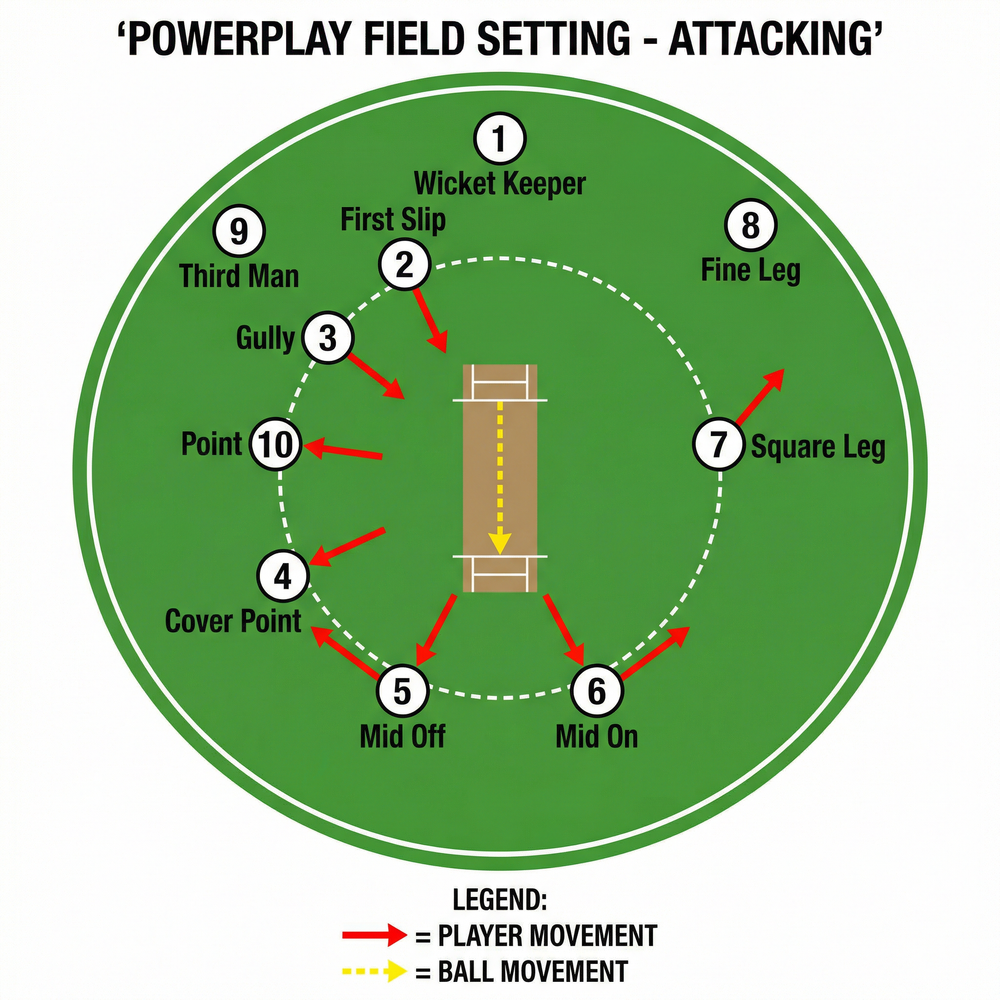
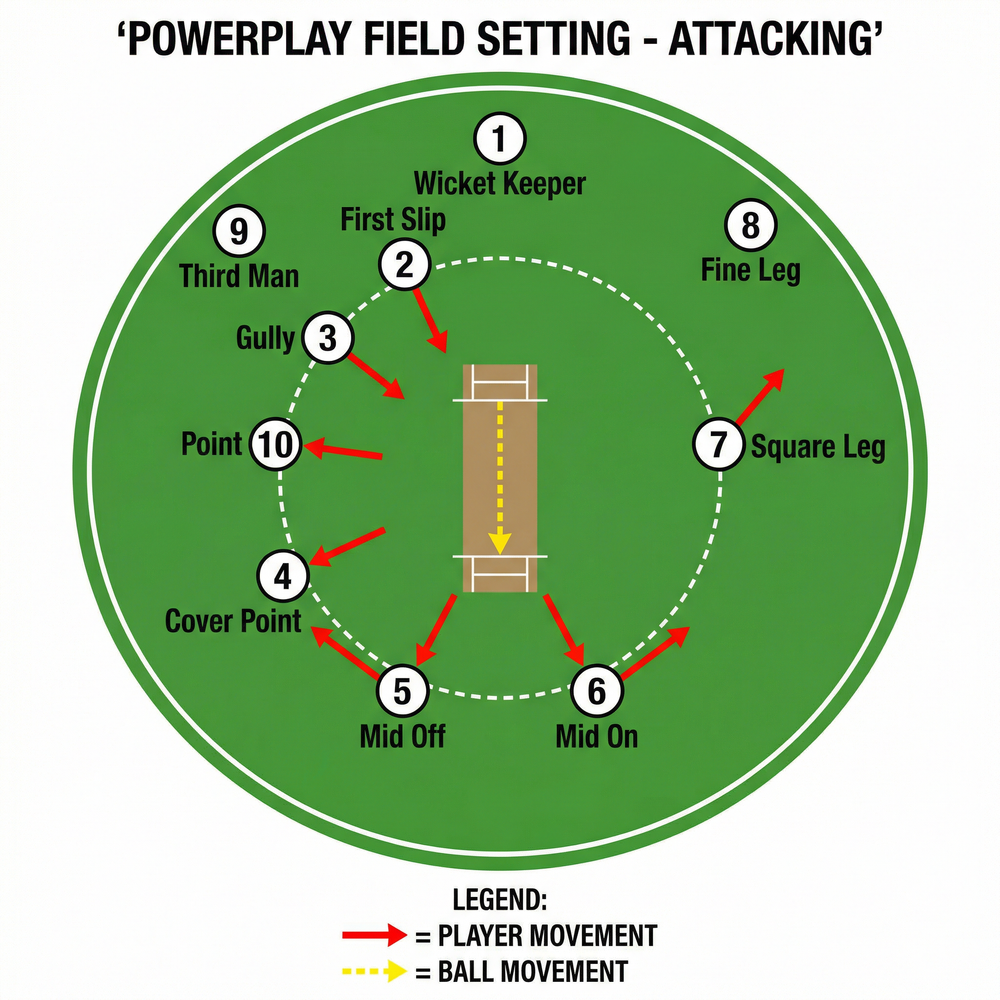
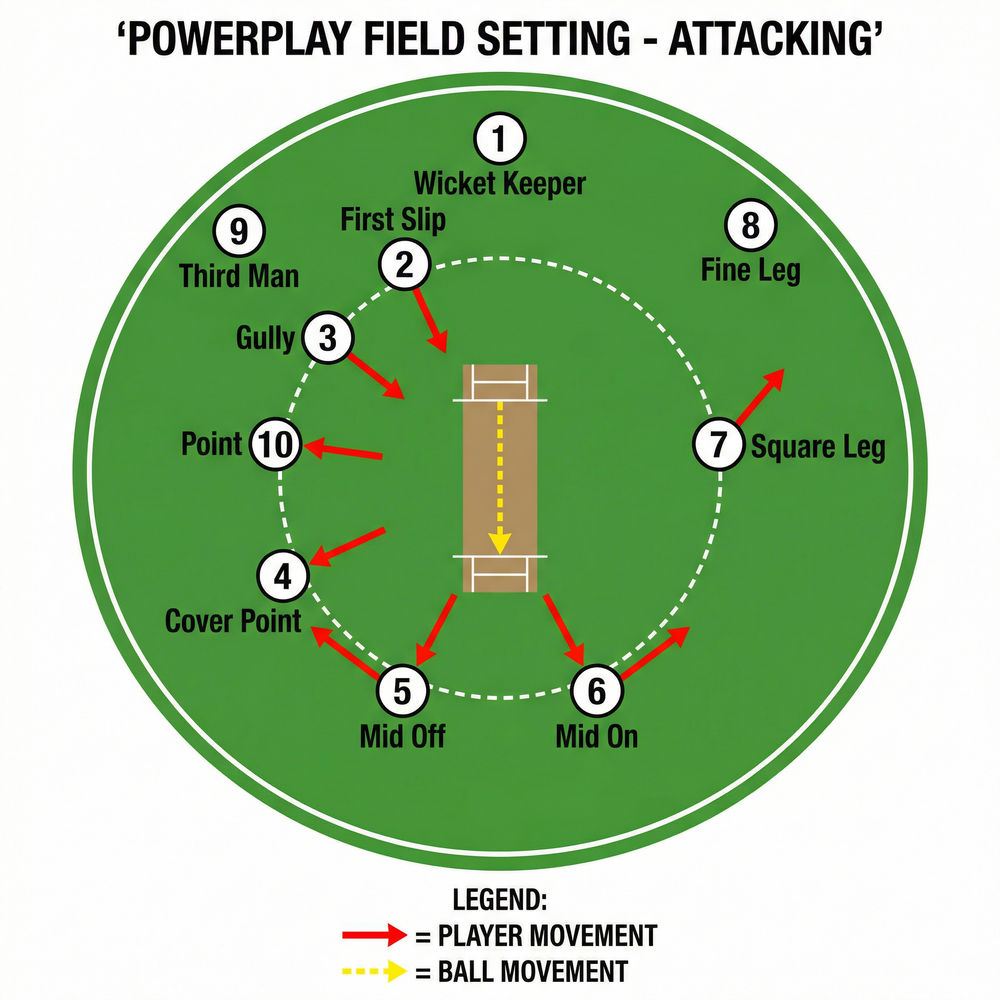
Player Positions (Attacking Setup):
- Wicket Keeper: Standing back for pace, or up for medium/spin.
- First Slip: Essential for the new ball to catch edges.
- Gully: Positioned to catch squarer edges off the pace bowlers.
- Cover Point: Inside the circle to cut off square drives.
- Mid Off: Straight and inside the circle to prevent straight drives and encourage the batter to hit over the top.
- Mid On: Straight and inside the circle, mirroring Mid Off.
- Square Leg: Inside the circle for the pull or flick.
- Fine Leg: Inside the circle, fine behind square to save the sweep or glance.
- Third Man: On the boundary (outside circle) to protect against upper cuts and thick outside edges.
- Point: Inside the circle, square of the wicket on the off side.
3. Step-by-Step Instructions
Phase 1: The Attacking Setup (Overs 1-3)
This phase is designed for your opening pace bowlers when the ball is new, hard, and likely to swing or seam.
- Establish the Slip Cordon: Place your most reliable catcher at First Slip. Add a Gully if the bowler generates significant bounce or away movement.
- Protect the Boundaries Behind Square: Position your two allowed fielders outside the 30-yard circle at Third Man and Fine Leg. This protects against edges and errant deliveries down the leg side.
- Create an Infield Ring: Position Cover Point, Point, Mid Off, Mid On, and Square Leg tightly on the edge of the 30-yard circle. Their primary role is to cut off singles and pressure the batter into taking risks over the infield.
- Bowling Execution: Instruct the bowler to pitch the ball up, targeting the top of off stump. The goal is to induce the drive and find the outside edge for the slip cordon or gully.
Phase 2: The Defensive Adjustment (Overs 4-6)
If the batters are settled, or the ball stops moving, you must transition to a defensive setup to protect boundaries while maintaining pressure.
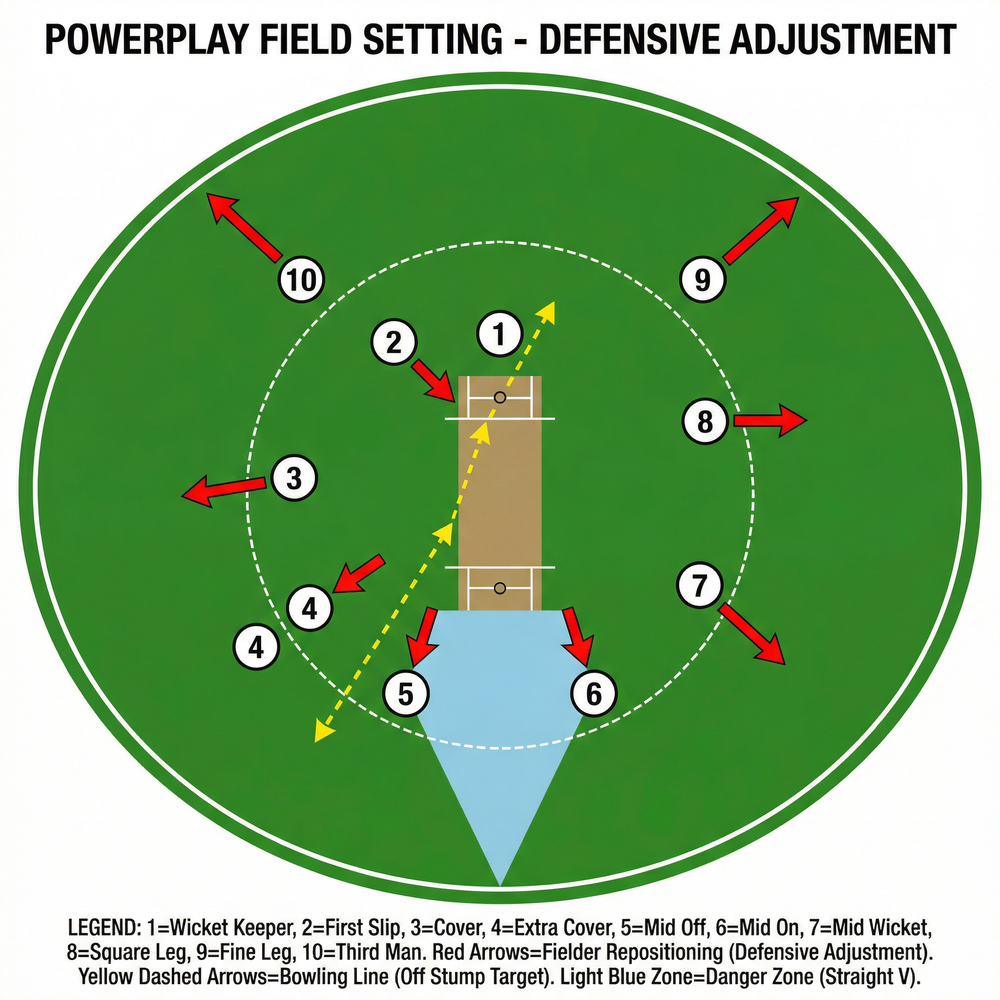
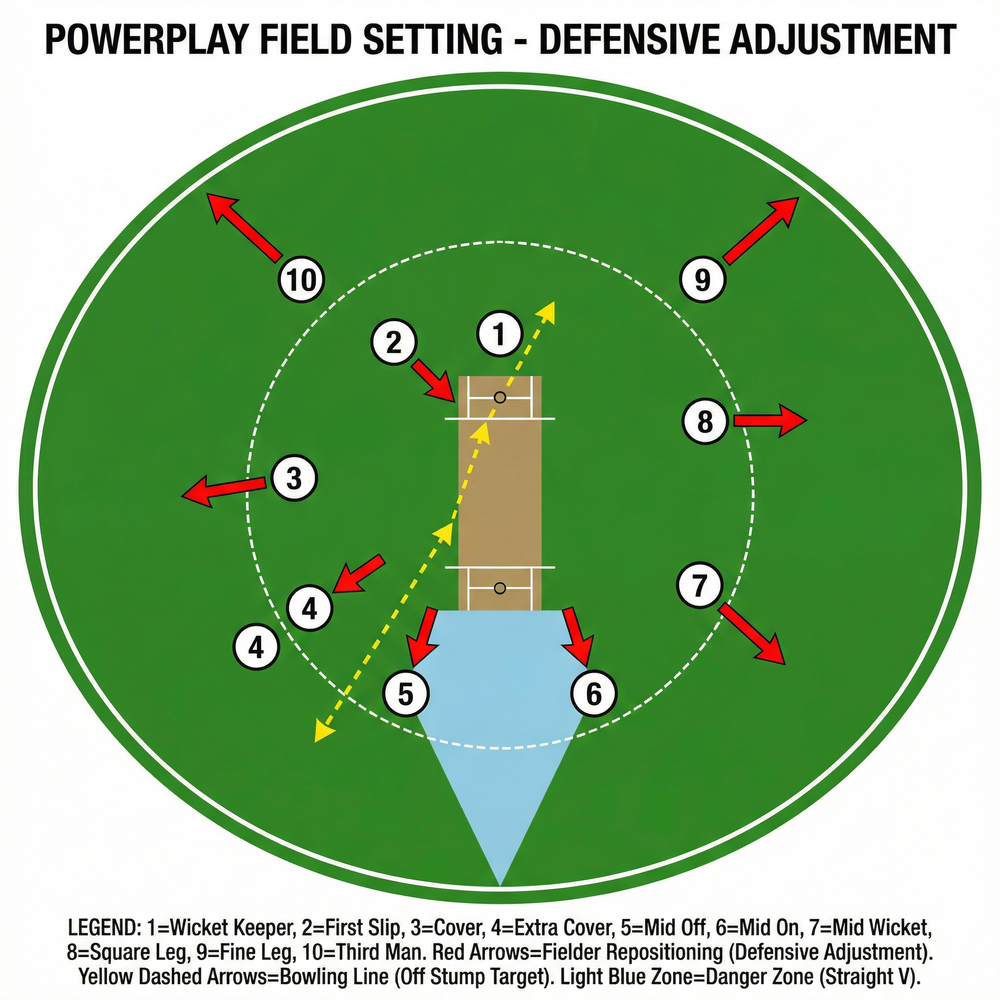
- Remove the Slip: Move the First Slip out of the cordon. The new ball threat has diminished, and you need that fielder to plug gaps.
- Strengthen the V: Move Mid Off and Mid On slightly deeper, perhaps 20 yards from the pitch, to protect the straight boundaries (the 'danger zone').
- Adjust the Outfielders: Move the Third Man and Fine Leg squarer to deep point and deep square leg if the batter is hitting strongly square of the wicket. Alternatively, drop a fielder back to Long On or Long Off if the batter is hitting straight.
- Plug the Gaps: Position the former slip fielder at Cover or Extra Cover inside the circle to stop the drive.
- Bowling Execution: Instruct the bowler to bowl a tighter line, aiming for the top of middle and leg stump, utilizing variations like slower balls or cutters to deceive the batter.
4. Key Coaching Points
- Adaptability is Crucial: The captain and bowler must communicate constantly. If a plan isn't working after one over, adjust immediately. Do not wait for the end of the Powerplay.
- Fielding Intensity: Fielders inside the circle must be energetic and proactive. Walking in with the bowler builds pressure and saves crucial runs.
- Bowling Discipline: An attacking field requires disciplined bowling. If the bowler strays down the leg side or bowls too short, the field setting becomes irrelevant, and runs will leak.
- Catching Practice: Slip and gully catching practice is non-negotiable. These chances must be taken during the Powerplay.
- Understanding the Batter: Analyze the batter's strengths. If they are a strong driver, push the covers deeper; if they are a strong puller, adjust the square leg position.
5. Common Mistakes
- Stubbornness: Keeping a slip fielder in place for too long when the ball isn't swinging, sacrificing a run-saving position in the infield.
- Poor Bowling Lines: Bowling too straight with a heavy off-side field, allowing easy runs through the leg side.
- Lack of Anticipation: Infielders standing flat-footed instead of anticipating the stroke and moving dynamically.
- Ignoring the Pitch: Setting an attacking field on a slow, low pitch where edges are unlikely to carry.
6. Variations & Progressions
- The Spin Powerplay: If opening with a spinner, remove the slip and place fielders at short fine leg and short third man. Encourage the spinner to bowl full and straight, using variations in pace and flight.
- The Slower Ball Strategy: Introduce a slower ball specialist early in the Powerplay. Adjust the field by bringing mid-off and mid-on tighter and pushing point and square leg deeper.
- The Short Ball Trap: If a batter is susceptible to the short ball, position a deep square leg and a fine leg, and instruct the fast bowler to use the bouncer effectively.
7. Age Adaptations
- Under 10s / Under 12s: Focus on the basics of bowling straight and fielding aggressively. Complex field changes can be confusing. Stick to a standard ring field and emphasize stopping the ball.
- Under 14s / Under 16s: Introduce the concept of bowling to a specific field. Teach captains how to read the game and make simple adjustments (e.g., moving a fielder from the off side to the leg side based on the batter's shots).
- Open / Seniors: Full implementation of attacking and defensive strategies, emphasizing communication, execution of specific plans, and rapid adaptation to match situations.
