

Cricket
Mastering the Defensive Field Setting for Spin: A Coach's Guide
Learn how to construct a robust defensive field for your spin bowlers to dry up runs, build pressure, and force batsmen into high-risk shots.
What you need
1 Cricket ball, Stumps and bails, Marker cones (optional for drills)
1. Overview
Setting a defensive field for spin bowling is a critical tactical skill for any cricket captain or coach. Unlike an attacking field designed primarily to take wickets through close catchers (slips, short legs), a defensive field aims to restrict scoring opportunities, frustrate the batsman, and build pressure. This pressure often leads to wickets as the batsman takes unwarranted risks to find the boundary or rotate the strike.
This set play focuses on creating a "ring" of fielders to stop singles while protecting the boundaries in key scoring zones. It is most effective when your team is defending a low total, when a partnership is established and scoring freely, or when the pitch is offering little assistance to the spinner.
2. Setup
Equipment Needed:
- 1 Cricket ball (match quality)
- Full set of stumps and bails
- Marker cones (optional, for training drills to mark zones)
Pitch/Field Setup:
- Standard 22-yard pitch.
- Oval ground with clearly defined 30-yard inner circle and boundary.
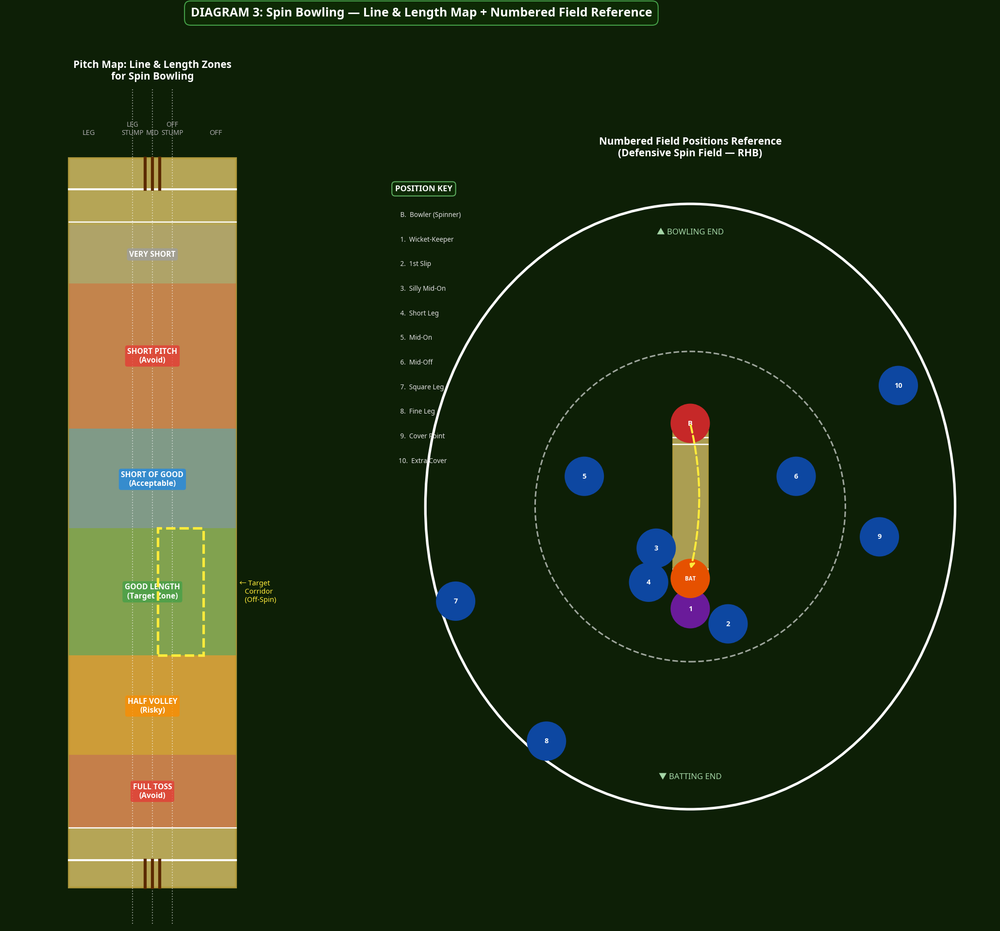
Player Positions (Right-Arm Off-Spin to Right-Hand Batsman):
- Bowler
- Wicket-Keeper
- 1st Slip (Optional, often replaced by a deep fielder in ultra-defensive setups)
- Point (Saving 1)
- Cover (Saving 1)
- Mid-Off (Saving 1 or pushed back to Long-Off)
- Mid-On (Saving 1 or pushed back to Long-On)
- Midwicket (Saving 1)
- Square Leg (Saving 1 or deep)
- Deep Square Leg / Deep Midwicket (Boundary rider)
- Deep Point / Deep Cover (Boundary rider)

3. Step-by-Step Instructions
Step 1: Assess the Match Situation and Pitch Conditions
Before deploying a defensive field, evaluate the game state. Are you defending a small total? Is the batsman well set? If the pitch is flat and not turning, a defensive field is necessary to control the run rate.
Step 2: Establish the Inner Ring
Position your fielders inside the 30-yard circle to cut off the primary single-scoring areas. Place Point, Cover, Midwicket, and Square Leg precisely on the edge of the circle. Their primary job is to stop the quick single and force the batsman to hit over the top.
Step 3: Protect the Boundaries
Identify the batsman's strong scoring areas. For a right-hand batsman facing off-spin, the primary sweep zone (deep square leg/midwicket) and the drive zone (deep cover/long-off) need protection. Place your boundary riders in these zones.
Step 4: The Bowler's Line and Length
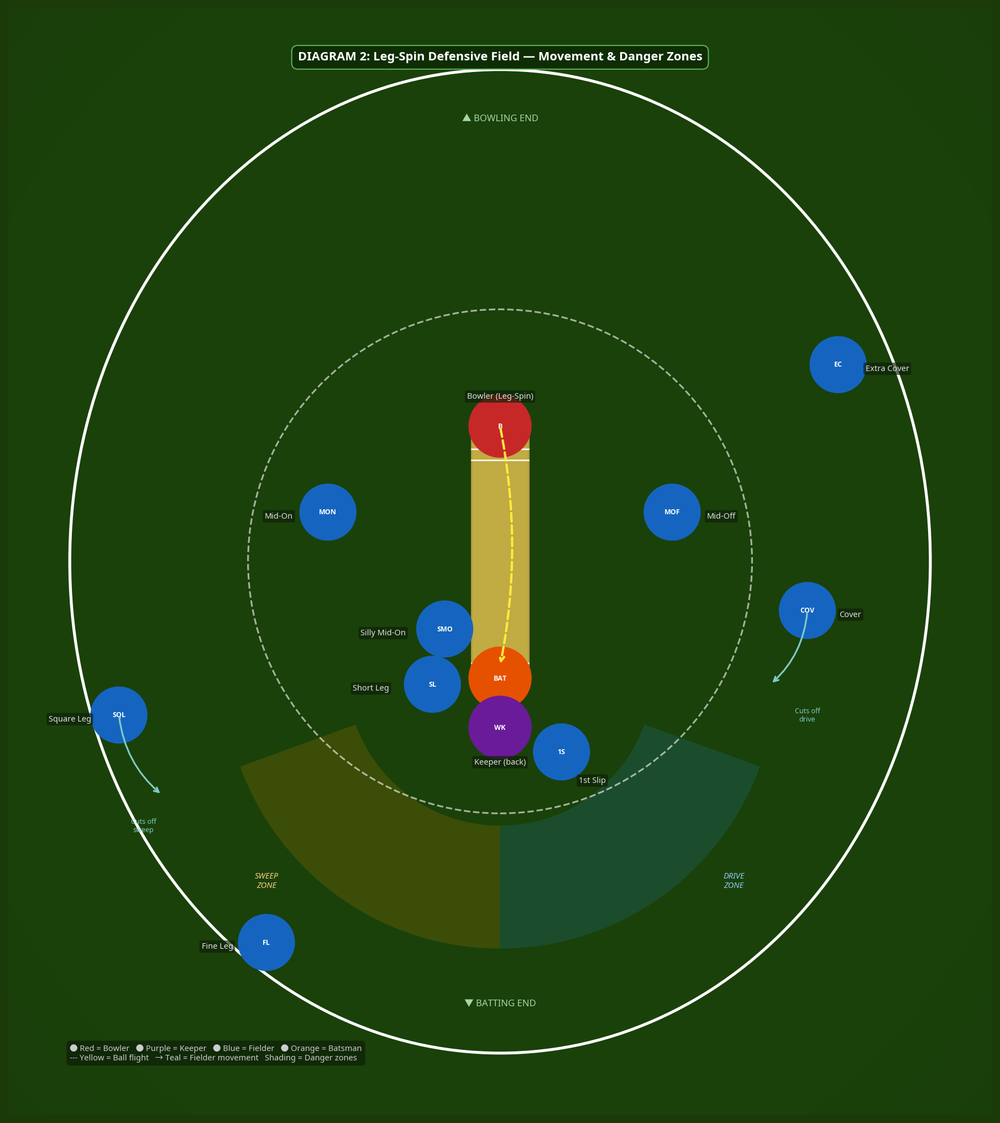
The field is only as good as the bowling. The spinner must bowl a disciplined line (middle and off stump) and a consistent good length. Bowling too full allows easy drives, while bowling too short allows the batsman to rock back and pull or cut past the inner ring.
Step 5: Adjust Based on Batsman's Intent
Watch the batsman's footwork. If they are constantly sweeping, move a fielder from the off-side to deep square leg or fine leg. If they are charging down the pitch, push Mid-Off or Mid-On back to the boundary.

4. Key Coaching Points
- Discipline is Paramount: The bowler must bowl to the field. A defensive field on the off-side is useless if the bowler bowls down the leg side.
- Energy in the Ring: Fielders inside the circle must be active, walking in with the bowler, and ready to pounce on any hesitation. This creates perceived pressure.
- Communication: The captain, bowler, and wicket-keeper must constantly communicate to adjust the field based on the batsman's subtle movements.
- Patience: A defensive field is a waiting game. Coaches must instill patience in their players; the wicket will come from the batsman's frustration, not a magic delivery.
5. Common Mistakes
- Bowling to the Wrong Field: The most common error is a bowler not executing the plan. For example, bowling short and wide with no deep point.
- Static Fielding: Fielders in the inner ring standing flat-footed. They must walk in and anticipate the ball.
- Over-Defending Too Early: Setting a deep, defensive field for a new batsman relieves pressure. Always start with some attacking intent before retreating.
- Ignoring the Match Situation: Failing to bring the field up when a new batsman arrives or when the required run rate spikes.
6. Variations & Progressions
- The "In-Out" Field: A common progression is to have fielders on the boundary edge but bring them into the circle for the first few balls of the over to build pressure, then push them back.
- The Leg-Side Trap: For a batsman who sweeps heavily, stack the leg side with a deep square leg, deep midwicket, and fine leg, forcing them to play unfamiliar shots on the off-side.
- Pace Variation Drill: In practice, have the spinner bowl with a defensive field but vary their pace significantly. This teaches the bowler how to use flight and speed changes to deceive the batsman even when the field is spread.
7. Age Adaptations
- Under 10s/12s: Focus purely on the bowler hitting a consistent length. Complex field changes are confusing. Teach the basics of stopping the single (Point, Cover, Midwicket).
- Under 14s/16s: Introduce the concept of "bowling to a plan." Teach the captain how to move one or two fielders based on where the batsman is scoring.
- Open/Senior: Full implementation of complex, adaptive defensive fields. High emphasis on bowler discipline and inner-ring fielding intensity.
