

Basketball
Diamond Press Break: Defeating Full-Court Pressure
Learn how to systematically dismantle full-court pressure using strategic spacing, diagonal cuts, and rapid ball movement to create high-percentage scoring opportunities.

What you need
1 Basketball, Full court (28m x 15m FIBA standard), Optional: Cones to mark trap zones during practice
1. Overview
The "Diamond Press Break" is a structured, reliable set play designed to safely advance the basketball against aggressive full-court man-to-man or zone pressure. Rather than relying solely on the point guard's dribbling ability to beat the press, this play utilizes strategic spacing, diagonal cuts, and rapid ball movement to systematically dismantle the defense. When executed correctly, it not only secures possession but frequently creates a numbers advantage (2-on-1 or 3-on-2) in the offensive half, leading to high-percentage scoring opportunities. This set is particularly effective against trapping defenses because it establishes multiple passing angles and a deep safety outlet.
2. Setup
Equipment Needed:

- 1 Basketball
- Full court (28m x 15m FIBA standard)
- Optional: Cones to mark trap zones during practice
Court Setup & Player Positions:
The initial alignment resembles a diamond or a modified 1-4 flat setup to maximize spacing and confuse the defense's trapping angles.
- Player 1 (Point Guard - PG): Out of bounds on the baseline, ready to inbound the ball.
- Player 2 (Shooting Guard - SG): Positioned on the ball-side sideline, roughly at the free-throw line extended.
- Player 3 (Small Forward - SF): Positioned on the ball-side sideline, near the half-court line.
- Player 4 (Power Forward - PF): Positioned on the weak-side (opposite) sideline, near the half-court line.
- Player 5 (Center - C): Positioned in the middle of the court, typically near the center circle, acting as the safety valve and primary connector.

3. Step-by-Step Instructions
Phase 1: The Inbound and Initial Read
- The play initiates when the referee hands the ball to Player 1 (PG) on the baseline.
- Player 2 (SG) and Player 3 (SF) must read their defenders. If the defense is playing tight man-to-man, they use V-cuts to get open. If it is a zone press, they find the gaps in the coverage.
- Player 1 (PG) looks to make a crisp, two-handed chest pass or an overhead pass to Player 2 (SG) on the ball-side sideline.
- As the pass is in the air, Player 3 (SF) immediately begins a hard diagonal cut toward the middle of the floor to provide an immediate secondary passing option.
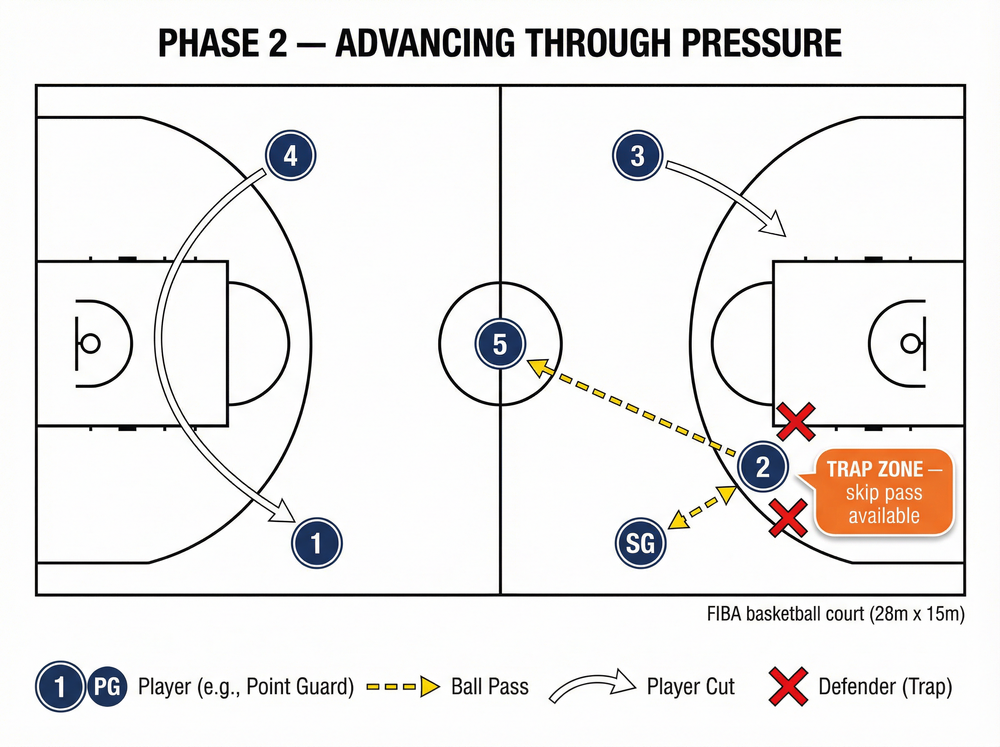
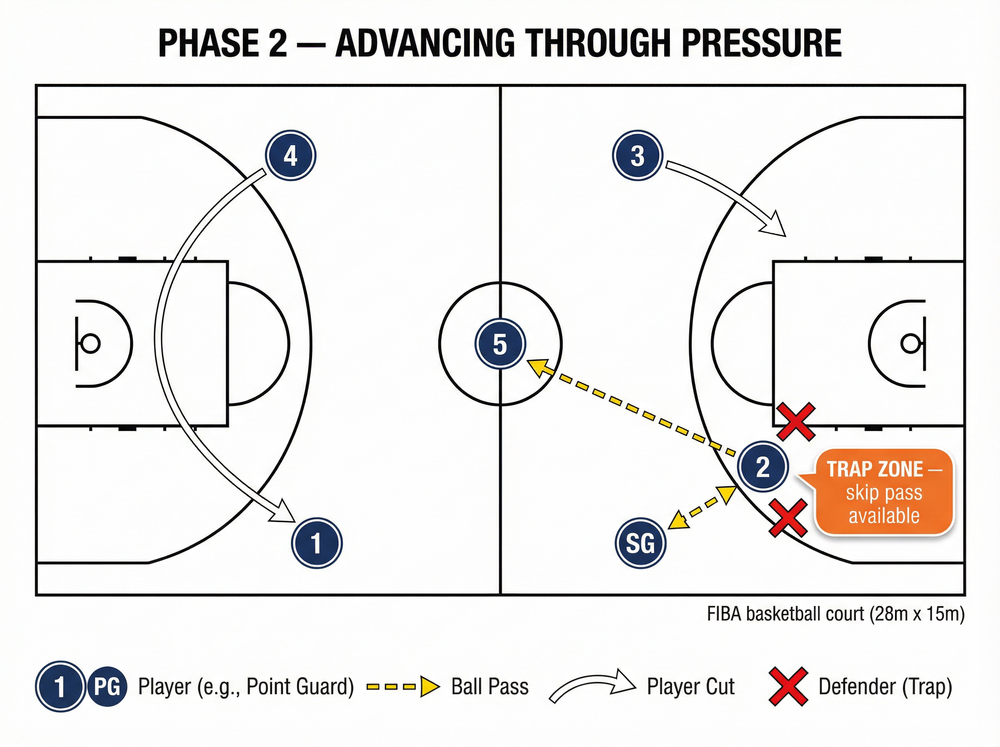
Phase 2: Advancing Through the Trap Zone
5. Upon receiving the ball, Player 2 (SG) must immediately pivot to face up the court (the "triple threat" position). They must not put the ball on the floor immediately, as this invites the trap.
6. The defense will likely attempt to trap Player 2 (SG) near the sideline.
7. Player 5 (C) flashes toward the ball to offer a short, safe outlet pass. Player 4 (PF) sprints wide down the opposite sideline to stretch the defense.
8. Player 2 (SG) has three options:
- Option A (Primary): Pass to Player 5 (C) in the middle.
- Option B (Secondary): Hit Player 3 (SF) cutting diagonally.
- Option C (Release): Throw a skip pass over the trap to Player 4 (PF) on the weak side.
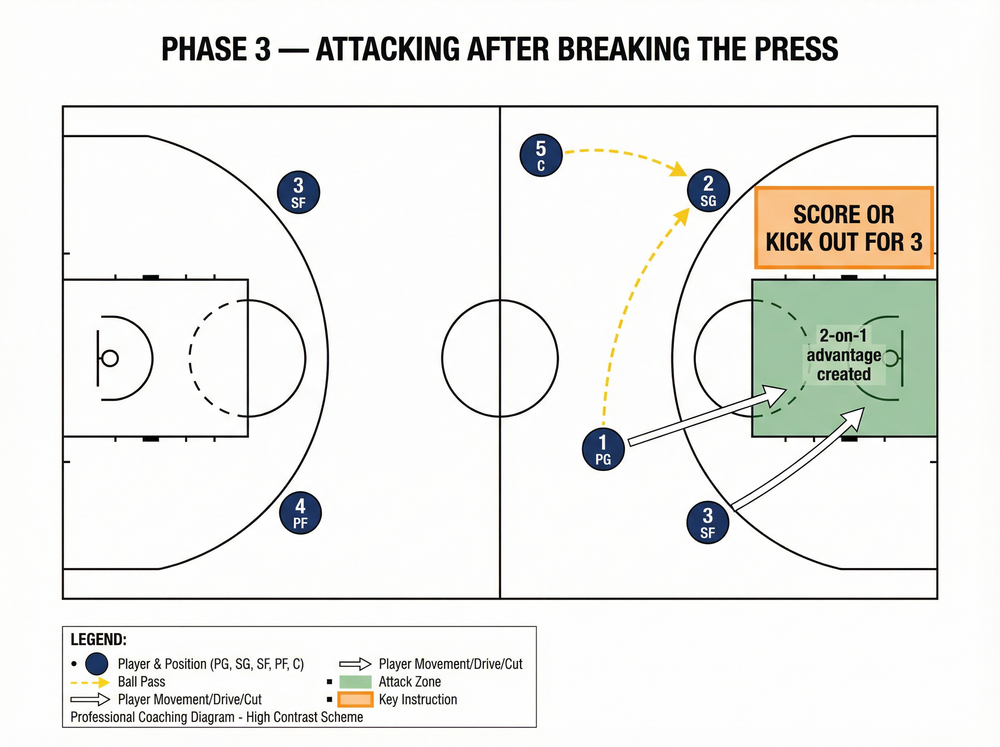
Phase 3: Attacking the Offensive Half
9. Assuming the ball is passed to Player 5 (C) in the middle, the press is effectively broken.
10. Player 1 (PG), after inbounding, sprints up the floor to join the attack, often trailing the play as a safety option.
11. Player 5 (C) immediately looks up the floor. They can pass ahead to Player 4 (PF) streaking down the left sideline or Player 2 (SG) who is now filling the right wing.
12. The team should now have a numerical advantage (e.g., a 3-on-2 or 2-on-1 fast break). The players must attack the basket aggressively.
13. If a layup is not immediately available, the ball handler should drive into the paint to draw the remaining defender and kick the ball out to the open shooter on the wing or in the corner.

4. Key Coaching Points
- Face the Court Immediately: The receiver of the inbound pass must catch and pivot to see the entire floor before dribbling. Dribbling into a trap is the most common cause of turnovers.
- Meet the Pass: Receivers must aggressively step toward the ball when catching a pass to prevent defenders from jumping into the passing lane for an interception.
- Maintain Spacing: Players must stay wide and utilize the full width of the 15m court. If players bunch together, one defender can effectively guard two offensive players.
- The Middle is the Key: Getting the ball to Player 5 in the center of the court is the most effective way to break a press, as it forces the defense to collapse and opens up passing lanes on both sides.
- Punish the Press: Once the press is broken, the team must attack the basket to score. If the defense realizes they are giving up easy layups, they will be forced to abandon the press.
5. Common Mistakes
- Panic Dribbling: The player catching the inbound pass immediately puts their head down and dribbles to the sideline, directly into the defense's designed trap zone.

- Weak Passes: Throwing slow, looping passes that allow the defense time to recover and intercept the ball. Passes must be sharp and direct.
- Standing Still: Players without the ball standing and watching rather than cutting to open space or flashing to provide an outlet for the trapped player.
- Throwing Blind: A trapped player throwing the ball wildly over their head or jumping to pass without a clear target, leading to easy turnovers.
6. Variations & Progressions
- Variation 1: The "Up and Back" Cut: If the initial pass to Player 2 is heavily denied, Player 2 can sprint up the court toward half-court, then plant hard and cut back to the baseline to receive the inbound pass.

- Variation 2: Point Guard Return: After inbounding to Player 2, Player 1 steps inbounds immediately and receives a quick return pass. Player 1 then speed-dribbles up the middle of the floor while the defense is shifting.
- Progression 1: Add Defenders: Start practicing the play 5-on-0 to learn the movements, then progress to 5-on-3, and finally 5-on-5 full-court pressure.
- Progression 2: Time Limit: Challenge the team to get the ball across the half-court line in under 4 seconds, simulating game-pressure situations.
7. Age Adaptations
- Under 10s / Under 12s: Focus heavily on the fundamentals of pivoting, passing, and catching. Simplify the play by having the inbounder always look for the middle player first. Emphasize not dribbling.

- Under 14s / Under 16s: Introduce the concept of reading the defense (man vs. zone press). Teach the players how to recognize trap zones and how to use pass fakes to move the defense.
- Open / Advanced: Incorporate complex variations, such as the inbounder running the baseline (after a made basket) to change the angle of the pass. Focus on rapid transition from breaking the press to executing a structured secondary break offense.
