

Basketball
Elite Ball Handling and Dribbling Circuit
A high-intensity, multi-station circuit designed to develop elite ball control, change of pace, and finishing skills under pressure.

What you need
Basketballs, Cones, Whistle
1. Overview
The Elite Ball Handling and Dribbling Circuit is a comprehensive, high-intensity drill designed to challenge players' ball control, ambidexterity, and cardiovascular endurance. By integrating multiple stations that focus on different aspects of dribbling—from stationary power dribbles to full-speed open-court pushes—this circuit ensures that players develop a versatile handle. It is an excellent drill to use during the early conditioning phases of practice or as a rigorous warm-up before transitioning into live competitive play. The drill emphasizes keeping the eyes up, maintaining a low center of gravity, and executing explosive changes of direction.
2. Setup

To run this circuit effectively, you will need the full length of a standard FIBA basketball court (28m x 15m). The setup involves creating five distinct stations using cones to guide player movement and dictate the required actions.
Equipment Needed:
- 1 Basketball per player
- 8-10 Cones for marking stations and weave patterns
- 1 Whistle for the coach
Court Layout:
- Station 1 (Top of the Key, Left Side): The starting point for stationary ball handling.
- Station 2 (Left Wing, 3-Point Line): The beginning of the cone weave.
- Station 3 (Half Court, Left Side): The transition point for the speed dribble.
- Station 4 (Right Wing, 3-Point Line): The setup for the crossover and change of direction.
- Station 5 (Top of the Key, Right Side): The final attack point for finishing at the rim.
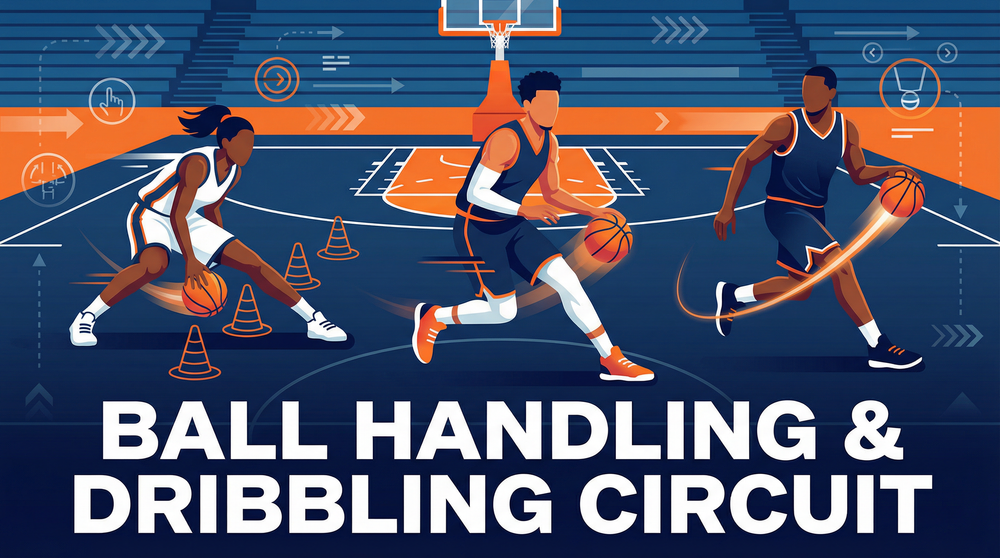
3. Step-by-Step Instructions
Station 1: Stationary Power Dribble
Players begin at the left side of the top of the key. On the coach's whistle, players execute 15 seconds of intense, low stationary dribbling (e.g., machine gun dribbles, figure eights, or heavy pound dribbles). The focus here is purely on hand speed and ball control without forward movement.Station 2: The Cone Weave
After completing the stationary segment, players explode toward the left wing where three cones are set up in a straight line, spaced approximately 1.5 meters apart. Players must weave through the cones using low, tight crossover dribbles, ensuring the ball stays below knee level to protect it from imaginary defenders.Station 3: Open Court Speed Dribble
Upon exiting the weave at the left wing, players transition into a full-sprint speed dribble toward the half-court line on the left side. Players should push the ball out in front of them, taking fewer dribbles and covering maximum ground. The goal is to simulate a fast-break scenario where speed is paramount.Station 4: Change of Direction (Crossover)
As players reach the half-court mark, they pivot and speed dribble toward the right wing of the original half-court. At the right wing cone, players must execute a sharp, explosive crossover dribble (or between-the-legs/behind-the-back move), drastically changing their pace and direction to simulate beating a primary defender.

- Station 5: Attack and Finish
Following the crossover at Station 4, players drive hard toward the basket from the top of the key on the right side. They must finish with a strong layup or a specific finishing move dictated by the coach (e.g., reverse layup, floater, or power jump stop). After rebounding their own shot, players rotate back to the start line or the back of the queue.
4. Key Coaching Points
- Eyes Up at All Times: Players must scan the floor while dribbling. If a player is looking at the ball, they cannot read the defense or find open teammates.
- Pound the Basketball: Encourage players to dribble the ball hard. A harder dribble returns to the hand quicker, giving the player better control and making it harder for defenders to steal.
- Change of Pace: A great handle isn't just about speed; it's about changing speeds. Emphasize the difference between the tight, controlled weave and the explosive open-court push.
- Low Center of Gravity: On all change-of-direction moves (Station 4), players must drop their hips. Standing tall during a crossover leaves the player off-balance and vulnerable to defensive pressure.
- Game-Speed Finishes: The final layup must be executed at full game speed. Practice finishing through imaginary contact to build in-game resilience.
5. Common Mistakes
- Carrying or Palming the Ball: In an effort to control the ball through the weave, players often let their hand slip under the ball. Correct this immediately to build legal dribbling habits.
- Floating on the Crossover: Players sometimes take a wide, looping step on their crossover instead of a sharp, angular plant step. This wastes time and space.
- Slowing Down Before the Finish: It is common for players to decelerate significantly before shooting their layup. Demand that they maintain their speed all the way to the rim.
- Dribbling Too High in Traffic: During the cone weave, a high dribble exposes the ball. Remind players that tight spaces require tight, low dribbles.
6. Variations & Progressions
- Two-Ball Circuit: For advanced players, run the entire circuit (excluding the final finish) using two basketballs. This exponentially increases the difficulty and forces ultimate ambidexterity.
- Defender Introduction: Add a token or live defender at Station 4 to contest the crossover and challenge the finish at the rim, forcing the offensive player to read and react.
- Time Constraints: Turn the circuit into a competitive race. Time each player to see who can complete the circuit the fastest without knocking over any cones or losing control of the ball.
7. Age Adaptations
- Under 10s: Shorten the distances between stations. Focus primarily on the stationary dribble and a simple straight-line speed dribble. Remove the complex cone weave until basic control is mastered.
- Under 12s to Under 14s: Run the standard circuit but allow players to use their dominant hand for the more complex moves. Gradually introduce weak-hand requirements as their confidence grows.
- Under 16s and Open: Demand perfection. Enforce strict weak-hand usage on the left side of the floor. Introduce the two-ball progression and live defenders to simulate high-level competitive environments.
