

Cricket
Elite Slip Cordon Reaction & Catching Drill
Develop lightning-fast reflexes, perfect catching technique, and seamless rotation in your slip cordon with this comprehensive reaction drill.

What you need
12-15 cricket balls, Katchet board or slip cradle (optional), Wicket keeping gloves, 1 cricket bat, 3-4 marker cones
1. Overview
Slip catching is one of the most critical defensive skills in cricket, requiring immense concentration, rapid reaction times, and flawless technique. The Elite Slip Cordon Reaction & Catching Drill is designed to simulate the unpredictable nature of edge catching. By incorporating rapid-fire feeds and structured player rotation, this drill ensures that fielders remain engaged, maintain a low center of gravity, and develop the soft hands necessary to secure sharp chances. It is an essential component of any fielding session, particularly when preparing for matches on bouncy or seaming pitches where slip catches are frequent.
2. Setup

Proper setup is vital to replicate match conditions and ensure player safety.
Equipment Needed
- 12-15 cricket balls (a mix of new and slightly worn balls is ideal)
- A Katchet board or slip cradle (optional, for unpredictable bounce)
- Wicket keeping gloves (for the designated keeper)
- 1 cricket bat (if using edge feeds)
- 3-4 marker cones
Field Setup & Player Positions

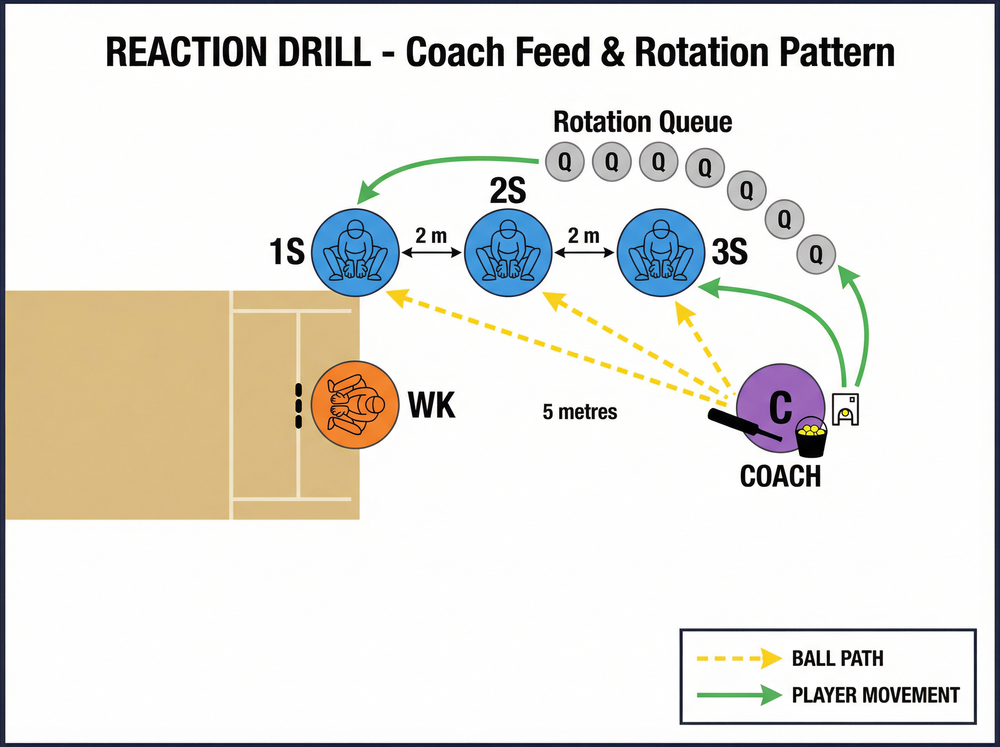
Establish a standard slip cordon setup on the edge of the square or in the nets.
- Position the Wicket Keeper (WK) exactly where they would stand for a pace bowler.
- Place 1st Slip (1S) approximately 1 meter to the right of the keeper (for a right-handed batsman).
- Position 2nd Slip (2S) 2 meters to the right of 1st Slip, slightly staggered back to ensure a clear line of sight.
- Position 3rd Slip (3S) 2 meters to the right of 2nd Slip, maintaining the staggered diagonal line.
- The Coach (C) should stand approximately 5-7 meters in front of the cordon, mimicking the angle of the batsman's edge.
- Place marker cones to indicate the starting positions for the slips to ensure consistency during rotation.
3. Step-by-Step Instructions

Execute the drill with high intensity and focus on technique over sheer volume.
- Assume the Ready Position: On the coach's call of "Bowler in," all fielders in the cordon must adopt a low, balanced stance. Feet should be shoulder-width apart, knees bent, weight slightly forward on the balls of the feet, and hands relaxed near the ground.
- The Feed: The coach strikes or throws the ball firmly toward the slip cordon. The feed should vary in height, pace, and direction to test all positions (1S, 2S, 3S, and WK).
- The Catch: The targeted fielder reacts, keeping their eyes level and tracking the ball into their hands. They must "give" with the ball, bringing it into their body to secure the catch with soft hands.
- The Return: The fielder smoothly returns the ball to the coach or a designated ball collector to maintain the flow of the drill.
- The Rotation: After every 3-5 deliveries, the players rotate. 3S moves out to join the rotation queue, 2S moves to 3S, 1S moves to 2S, and a new player from the queue steps into 1S. This ensures all players practice catching at different angles and stay mentally sharp.
4. Key Coaching Points
- Stay Low and Balanced: Fielders must start low and stay low. It is much easier to rise to catch a high ball than to drop down quickly for a low edge.
- Soft Hands: Emphasize "giving" with the ball upon impact. Fielders should cushion the ball into their body rather than snatching at it, which often leads to dropped catches.
- Head Position and Eye Level: Keep the head still and eyes level. Tracking the ball from the moment it leaves the bat (or coach's hand) all the way into the palms is non-negotiable.
- Weight Transfer: Weight should be slightly forward on the balls of the feet to allow for explosive lateral movement. Fielders should avoid being flat-footed.
- Clear Communication: In the "V" between two fielders (e.g., between 1S and 2S), the fielder who is moving forward should generally take the catch. Call "Mine!" early and loudly to avoid collisions.
5. Common Mistakes
- Standing Up Too Early: Fielders often straighten their legs before the ball is hit, losing their explosive power and making low catches impossible.
- Snatching at the Ball: Pushing hands out forcefully toward the ball creates hard hands, causing the ball to bounce out of the palms.
- Poor Spacing: Standing too close together restricts lateral movement and increases the risk of collisions, while standing too far apart creates unpluggable gaps.
- Losing Focus: In a match, a slip fielder might wait 20 overs for one chance. In practice, losing concentration between feeds builds bad habits.
6. Variations & Progressions
- The Deflection Drill: Use a Katchet board or slip cradle placed 3-4 meters in front of the cordon. The coach throws the ball firmly onto the board to create unpredictable, sharp deflections that test pure reaction speed.
- Live Edge Catching (Advanced): Move the drill to the center wicket. Have a throw-down specialist (TD) bowl to a batsman who intentionally tries to edge the ball into the slip cordon. This provides the most realistic match simulation, including the sound of the edge and the natural trajectory off the bat.
- One-Handed Focus: Challenge elite players by having them attempt catches exclusively with their dominant, and then non-dominant, hand to improve ultimate hand-eye coordination.
7. Age Adaptations
- Under 10s / Under 12s: Use softer incrediballs or tennis balls to build confidence and eliminate the fear of injury. Focus heavily on the basic ready position and catching with two hands close to the body. Reduce the distance between the coach and the fielders.
- Under 14s / Under 16s: Introduce standard cricket balls and begin using deflection aids like the Katchet board. Emphasize proper rotation and communication between fielders. Start incorporating diving catches on soft grass.
- Open / Seniors: Full match intensity. Use high-speed feeds, live edge scenarios, and focus on the micro-adjustments in stance and positioning based on the bowler's pace and the pitch conditions.
