Mastering the Fast Break: 3-on-2 Continuous Transition Drill
Develop elite decision-making, optimal spacing, and high-percentage finishing in transition with this essential 3-on-2 fast break drill.
Equipment Needed
Overview
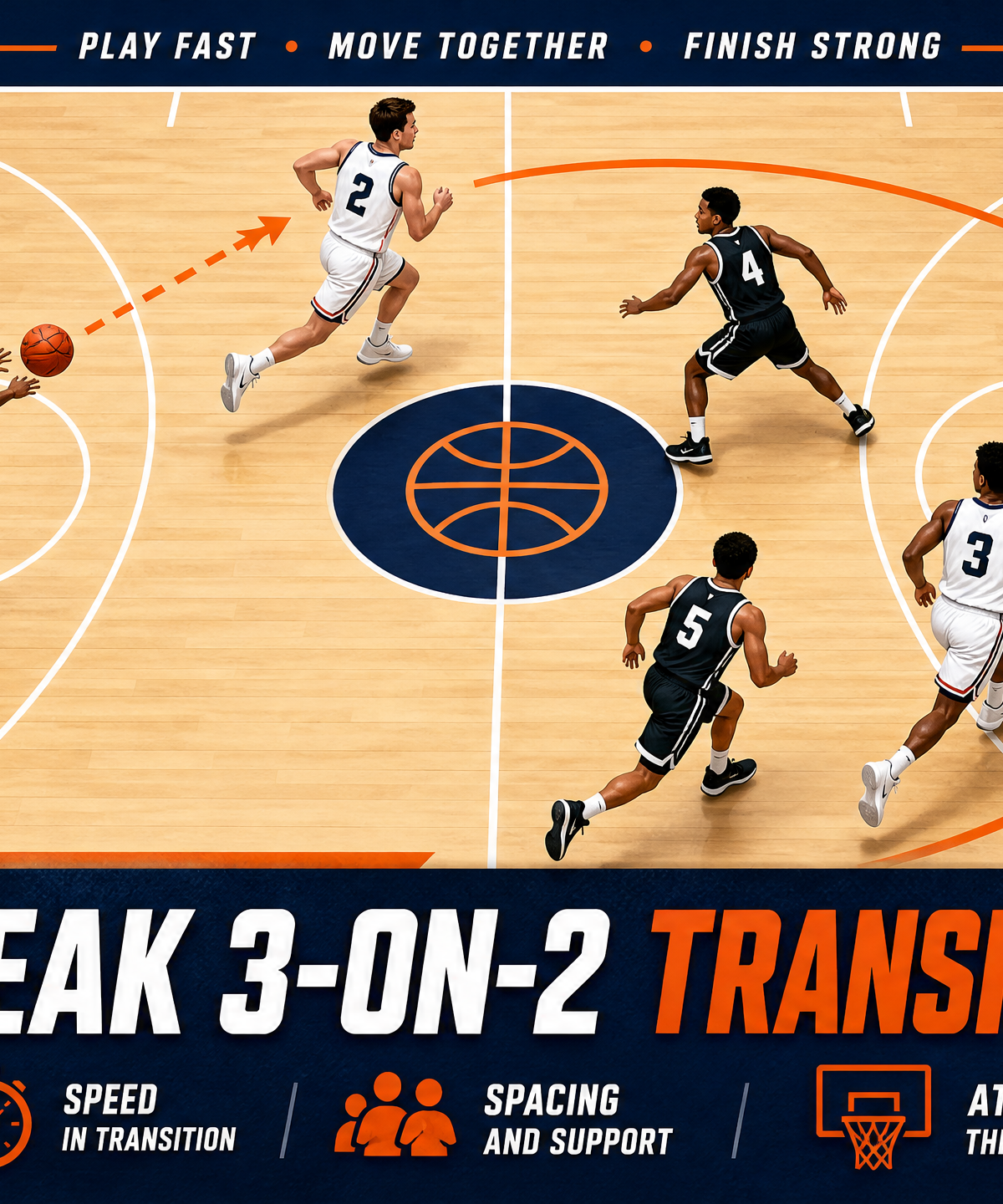
The 3-on-2 transition scenario is one of the most common and high-value situations in basketball. Capitalizing on numerical advantages before the defense can set up is the hallmark of an elite offensive team. This continuous drill forces offensive players to read the defense, maintain proper spacing, and make split-second decisions while moving at game speed. For the defense, it teaches communication, stunting, and protecting the paint while at a disadvantage.
Use this drill to condition your team, improve finishing under pressure, and develop the basketball IQ required to convert fast break opportunities into guaranteed points.
Setup
- Equipment Needed: 2-3 basketballs, cones (optional, for marking starting lanes), full FIBA regulation court (28m x 15m).
- Players: Minimum of 10 players to run continuously, but can be run with 8.
- Positions:
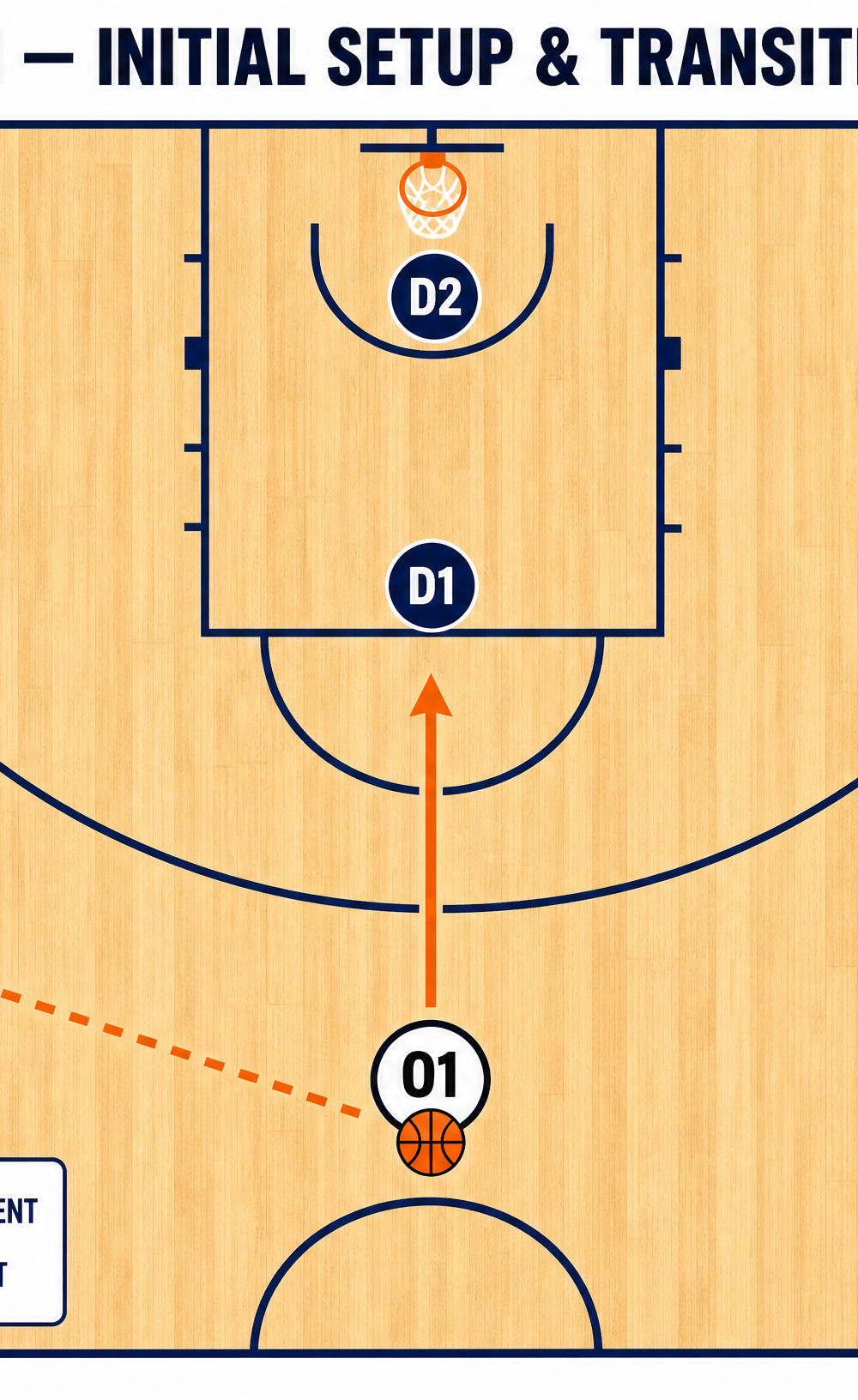
- Three offensive players (O1, O2, O3) start at one baseline or half-court, spread across three lanes (middle and two wide wings).
- Two defenders (D1, D2) start in tandem alignment in the opposite half-court. D1 (front defender) is positioned near the top of the key or free throw line. D2 (back defender) is positioned near the basket, protecting the restricted area.
Step-by-Step Instructions
- The Trigger: The drill begins with the coach passing the ball to the middle player (O1), or O1 grabbing a rebound off the backboard. O1 immediately speed-dribbles down the center of the court.
- Filling the Lanes: As O1 advances, O2 and O3 sprint hard down the wide lanes, staying as close to the sidelines as possible to stretch the defense.
- The Attack Phase: O1 must attack the front defender (D1) at full speed. O1's goal is to force D1 to commit.
- The Decision: As O1 crosses the half-court line and approaches the three-point arc, they must read D1:
- If D1 stays back or commits to a wing: O1 drives hard to the basket or pulls up for an uncontested elbow jumper.
- If D1 stops the ball: O1 must pass to either O2 or O3, depending on the angle and D2's positioning.
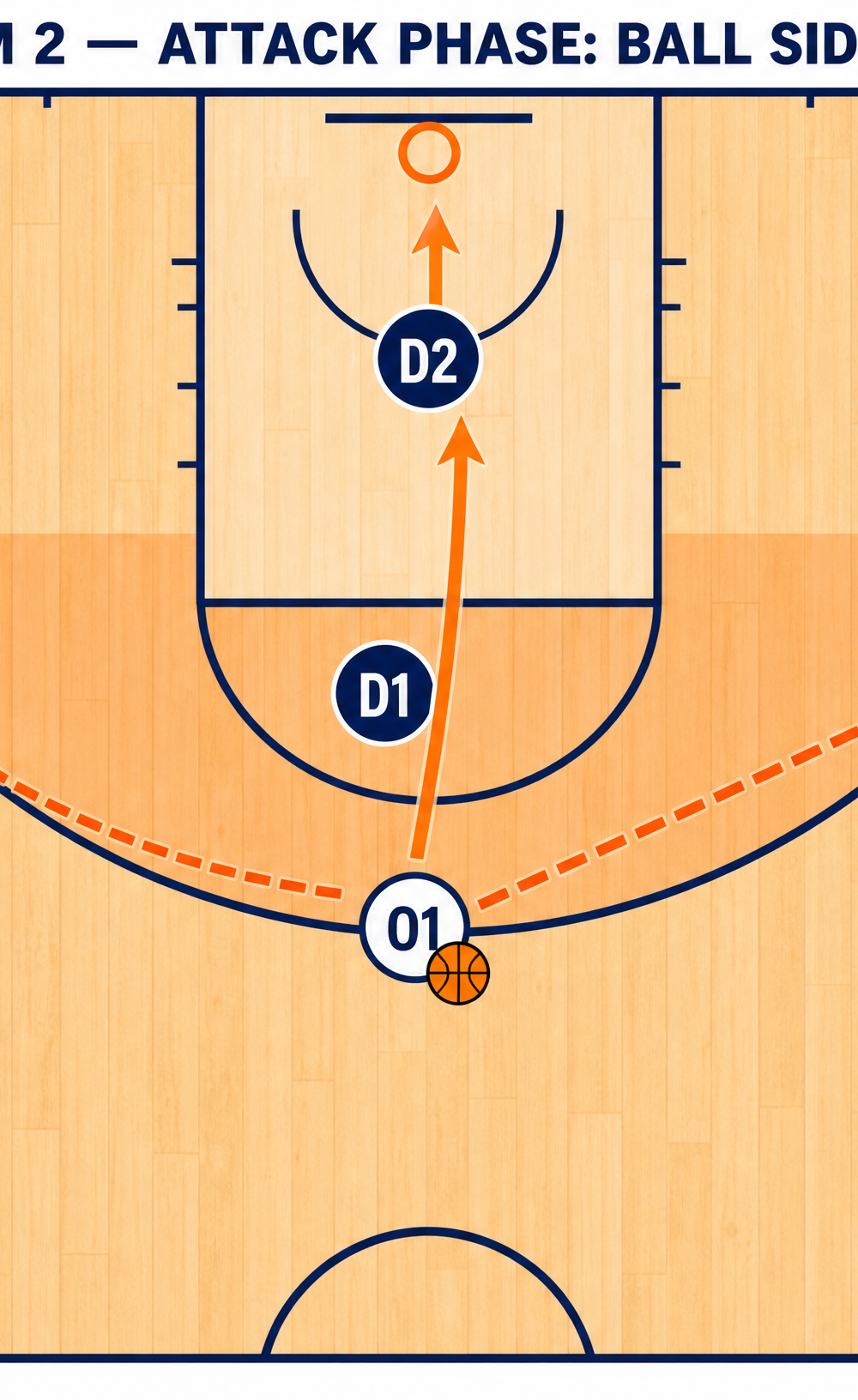
- The Finish: Upon receiving the pass, the wing player (O2 or O3) must attack the basket. The back defender (D2) will attempt to rotate and contest.
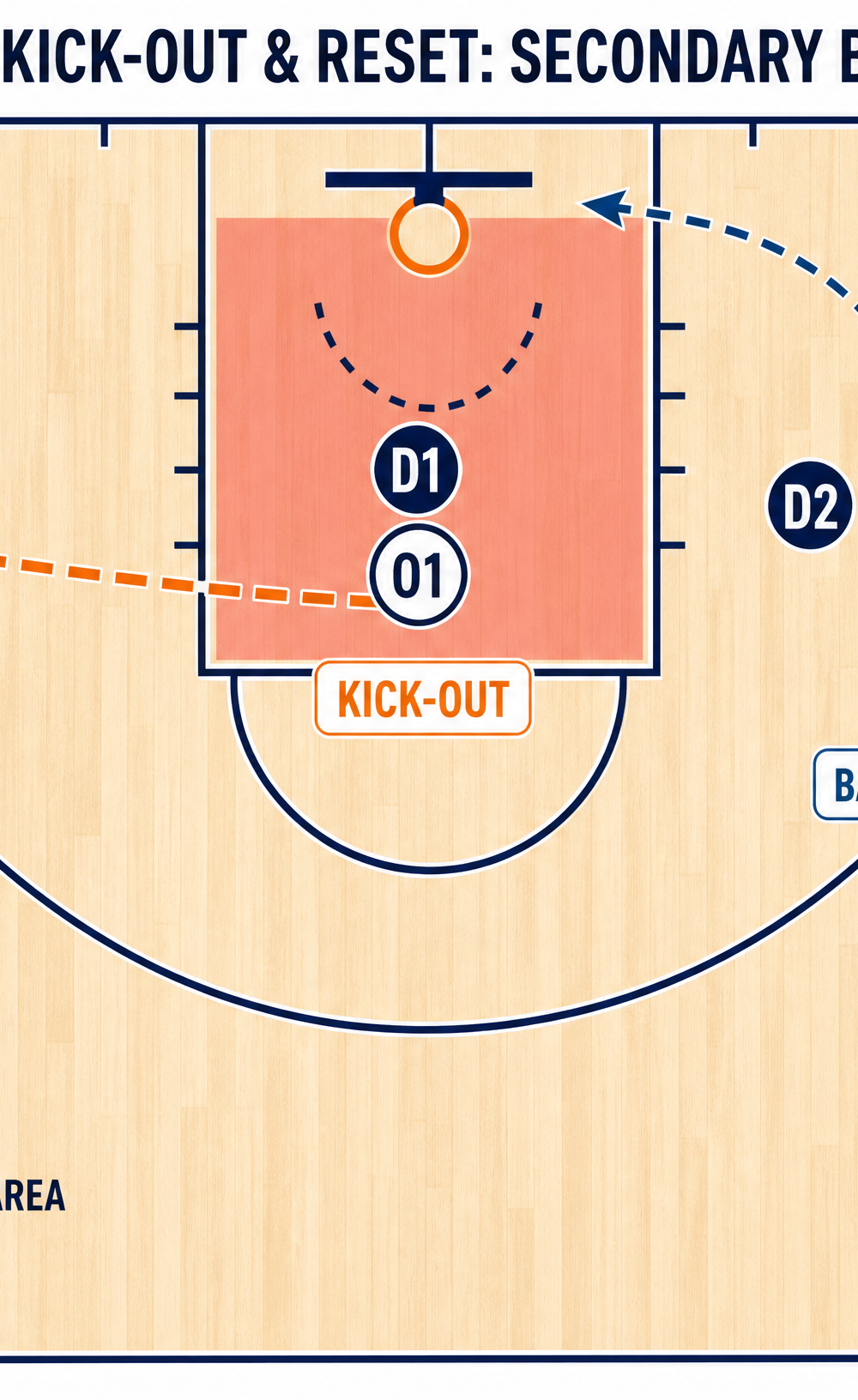
- Secondary Action (The Kick-Out): If D2 successfully cuts off the wing's drive, the wing must look to kick the ball out to the trailing O1 or the opposite wing for an open shot.
- Continuous Transition: Once the offensive possession ends (score, turnover, or defensive rebound), the two defenders and the offensive player who shot the ball transition back the other way as the new three offensive players. Two players waiting on the baseline step out to become the new two defenders. The drill continues non-stop.
Key Coaching Points
- Sprint the Wings: The wings (O2 and O3) must sprint wide and stay wide. Poor spacing allows one defender to guard two players. Run to the corners to flatten the defense.
- Attack the Front Foot: The ball handler (O1) must attack D1 aggressively, aiming for D1's front foot to force a commitment. Do not slow down and let the defense dictate the play.
- No 'Hope' Passes: Passes must be sharp, direct, and away from the defense. Avoid looping overhead passes that allow defenders to recover.
- Finish Strong: When attacking the rim, players must go up strong, expecting contact. Use the backboard on angles.
- Defensive Communication: The two defenders must talk constantly. If D1 stops the ball, D2 drops; if the ball goes to the wing, D2 takes the ball and D1 drops to the basket.
Common Mistakes
- Drifting Middle: Wing players naturally drift toward the middle of the court as they approach the basket, ruining spacing and bringing defenders closer together.
- Over-Dribbling: The point guard takes too many dribbles instead of passing ahead to the open wing, allowing trailing defenders to catch up.
- Indecision: The ball handler hesitates at the free-throw line, giving the defense time to recover and forcing a contested shot or turnover.
- Defensive Over-Committing: The front defender (D1) lunges at the ball handler near half-court, getting easily beaten and leaving D2 in an impossible 3-on-1 situation.
Variations & Progressions
- Add a Trailer (4-on-3): Introduce a trailing offensive player and a third defender to simulate secondary break actions.
- Conditioning Focus (Must Score in 5 Seconds): Put a strict 5-second shot clock on the offense once they cross half-court to force faster decision-making.
- Advantage Start: Have the defense start out of position (e.g., both on the baseline) and have them sprint to recover as the offense attacks.
Age Adaptations
- Under 10s / Under 12s: Focus purely on spacing and the basic pass-and-layup mechanic. Do not run continuously; reset the drill after each rep to ensure proper setup.
- Under 14s / Under 16s: Introduce the continuous aspect. Focus heavily on reading the defense and making the correct pass versus taking the layup.
- Open / Advanced: Implement the strict 5-second shot clock. Emphasize advanced finishes (e.g., euro steps, floaters) and secondary actions like corner kick-outs.