

Football
The 3-Second Rule: Aggressive Counter-Pressing Upon Possession Loss
Teach your team to instantly hunt the ball upon losing possession, suffocating the opponent before they can transition into attack.
What you need
10-15 footballs, Bibs (2 colours), Cones
Overview
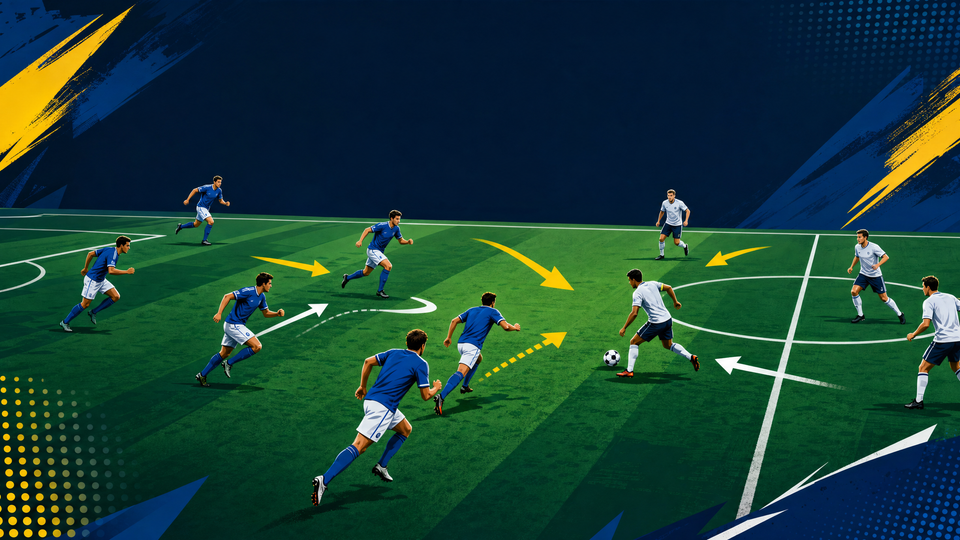
Counter-pressing (Gegenpressing) is the immediate, coordinated attempt to win the ball back within seconds of losing possession — before the opponent can establish their own attacking shape. Rather than retreating into a deep defensive block, your team becomes the aggressor the instant possession is surrendered. This set play exploits a fundamental truth of the modern game: the 3 to 5 seconds immediately after a turnover are the most chaotic and vulnerable moments for any team in possession. Their players are not yet in attacking positions, their shape is disorganized, and their decision-making is rushed. A well-drilled counter-press turns every turnover into a potential goal-scoring opportunity.
Use this set play when your team is in possession in the middle or attacking third and you want to prevent the opponent from launching a dangerous counter-attack. It is particularly effective against teams who rely on quick transitions and long balls out of defence.
Setup
Pitch: Full-size pitch (100–110m x 64–75m), or a 60m x 40m area for small-sided training.
Players Required: 11v11 (scalable to 8v8 or 9v9 for training).
Starting Formation: 4-3-3 (adaptable to 4-2-3-1 or 4-4-2).
| Position | Number | Role in Counter-Press |
|---|---|---|
| Goalkeeper | 1 | Sweeper-keeper; ready to receive back-pass under pressure |
| Right Centre-Back | 2 | Holds shape; covers space behind pressing line |
| Left Centre-Back | 5 | Holds shape; covers space behind pressing line |
| Right Full-Back | 3 | Pushes up to join press on ball side |
| Left Full-Back | 6 | Pushes up to join press on ball side |
| Defensive Midfielder | 4 | Screens; cuts central passing lanes |
| Central Midfielder | 8 | First or second presser depending on ball location |
| Attacking Midfielder | 10 | Triggers the press; closes down ball carrier |
| Right Winger | 7 | Presses wide areas; forces play inside |
| Left Winger | 11 | Presses wide areas; forces play inside |
| Centre Forward | 9 | Cuts off goalkeeper pass; forces play backwards |
Equipment Needed: 10–15 footballs, bibs in 2 colours, cones (optional for zone marking).
Step-by-Step Instructions
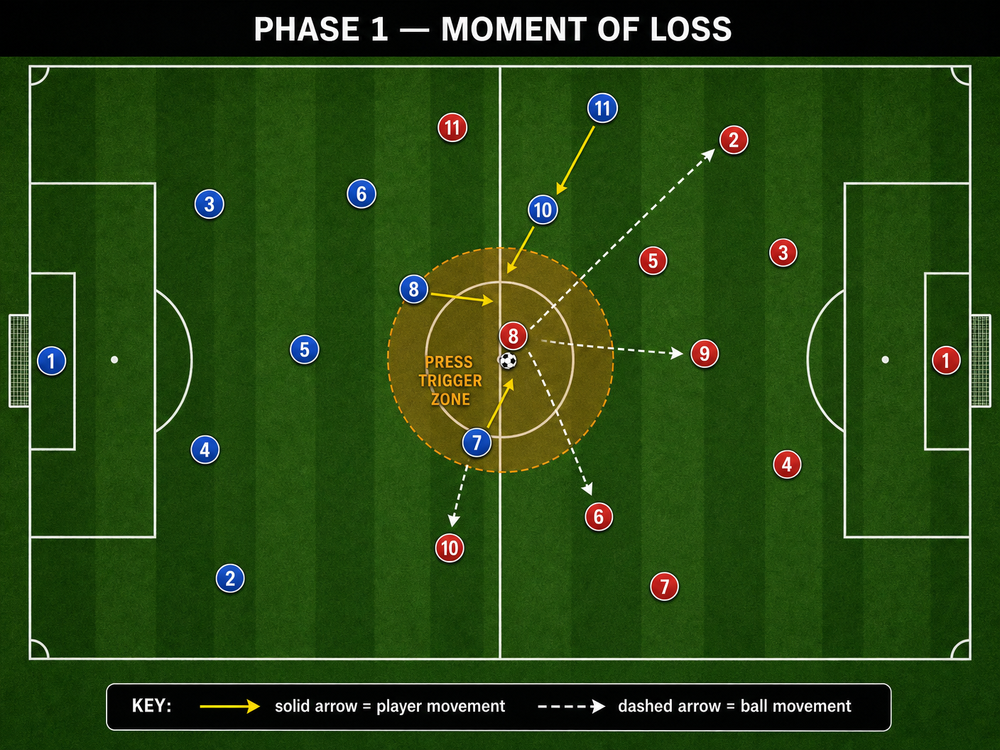
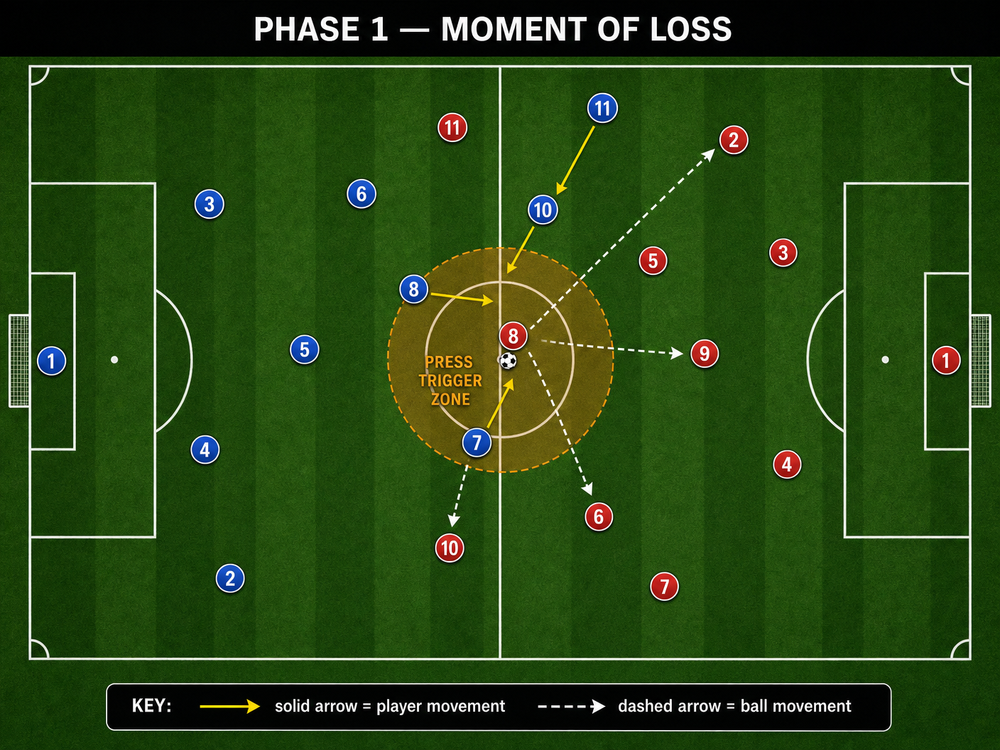
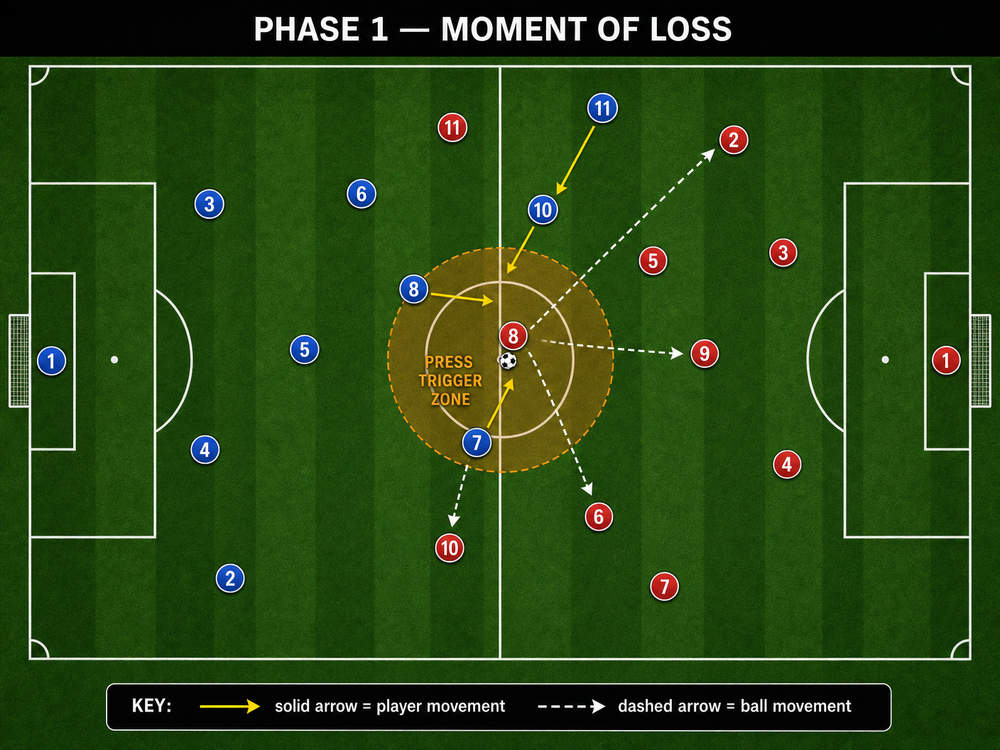
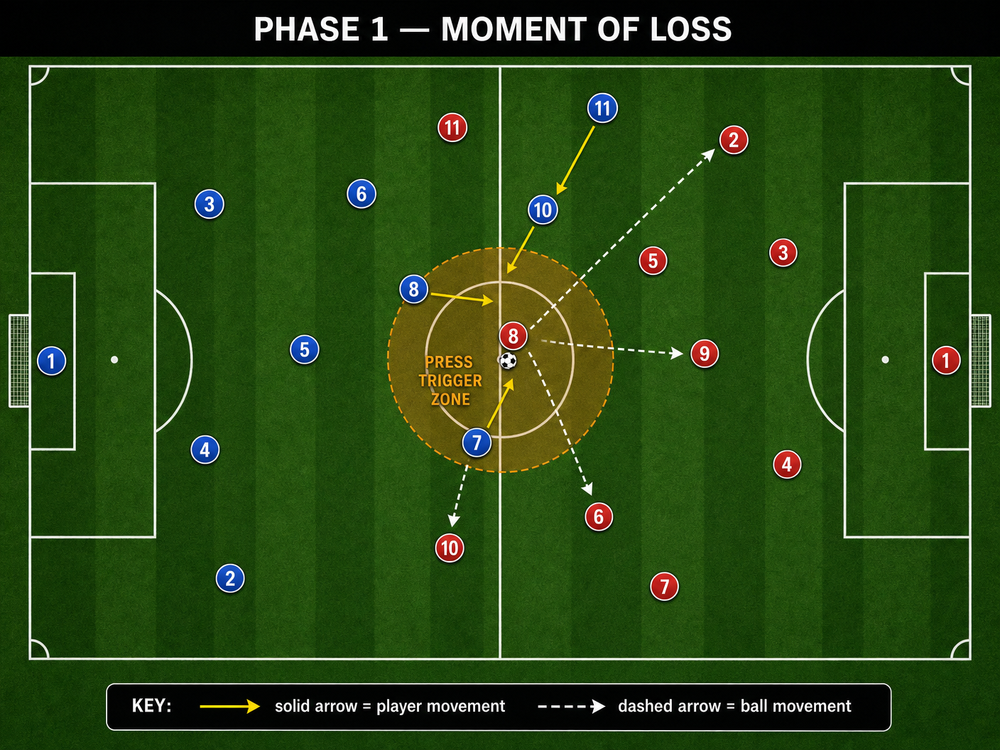
Phase 1 — The Moment of Loss (0–1 second)
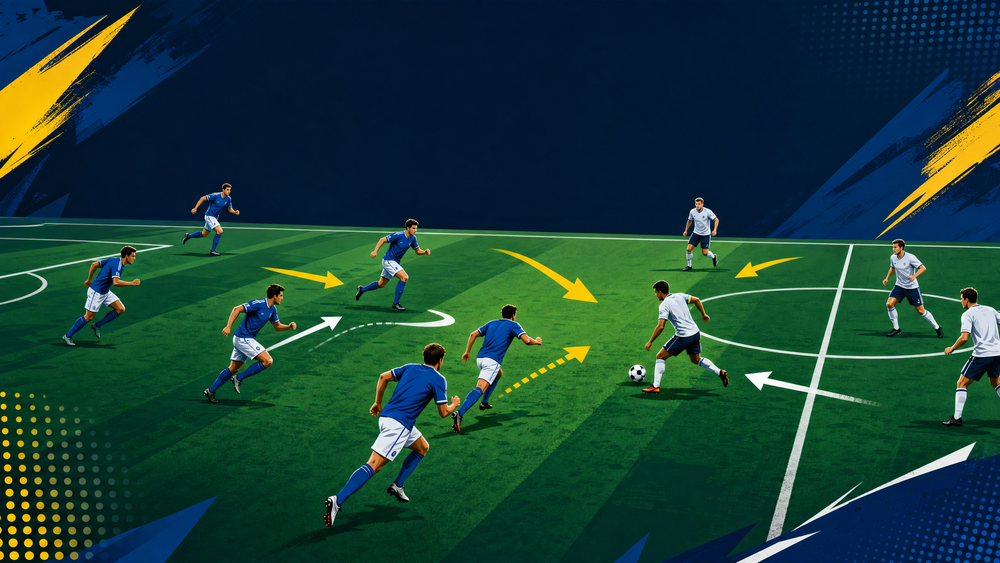
Step 1: Identify the Trigger. Every player must immediately recognise the moment possession is lost. The trigger is the sound of the opponent's first touch or the visual cue of the ball leaving your player's control. There is zero tolerance for a delayed reaction.
Step 2: Closest Player Presses Immediately. The player nearest to the ball carrier sprints directly at them within one second of the turnover. Their job is not necessarily to win the ball cleanly — it is to apply pressure, reduce the opponent's time and space, and force a rushed decision.
Step 3: Cut the First Pass. The next two closest players simultaneously sprint to block the most obvious passing lanes. They should position their bodies to screen the pass rather than diving in recklessly. Think of it as building a wall around the ball carrier.
Step 4: Compact the Space. Every other outfield player must immediately shift toward the ball, condensing the pitch horizontally and vertically. The team should aim to be within a 30m x 30m block around the ball within 3 seconds of the turnover.
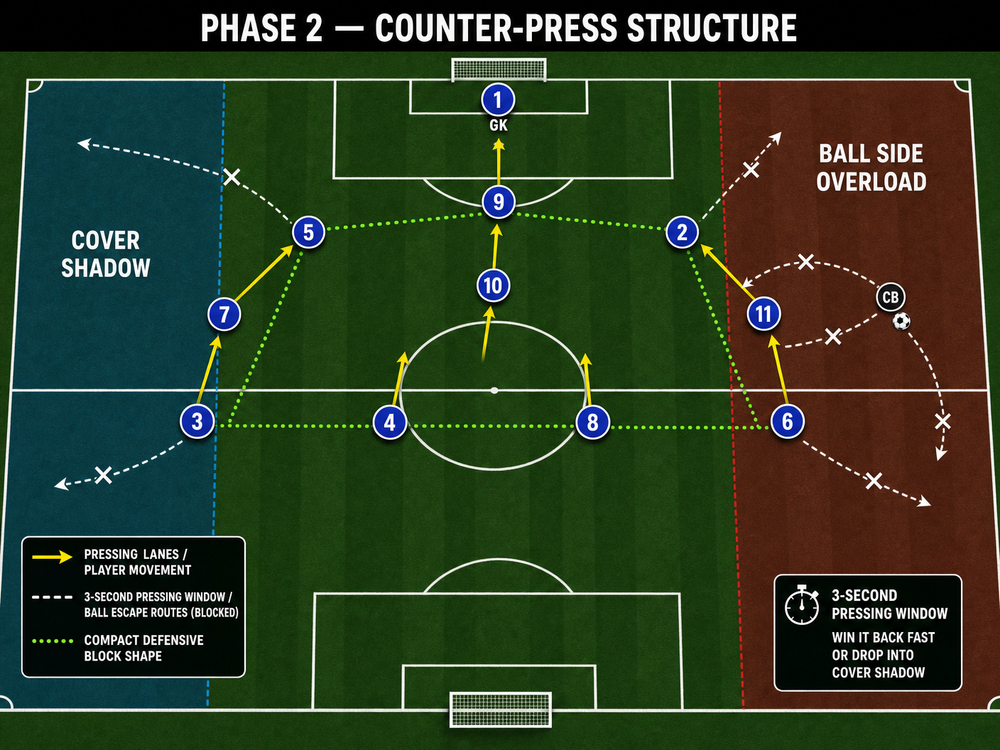
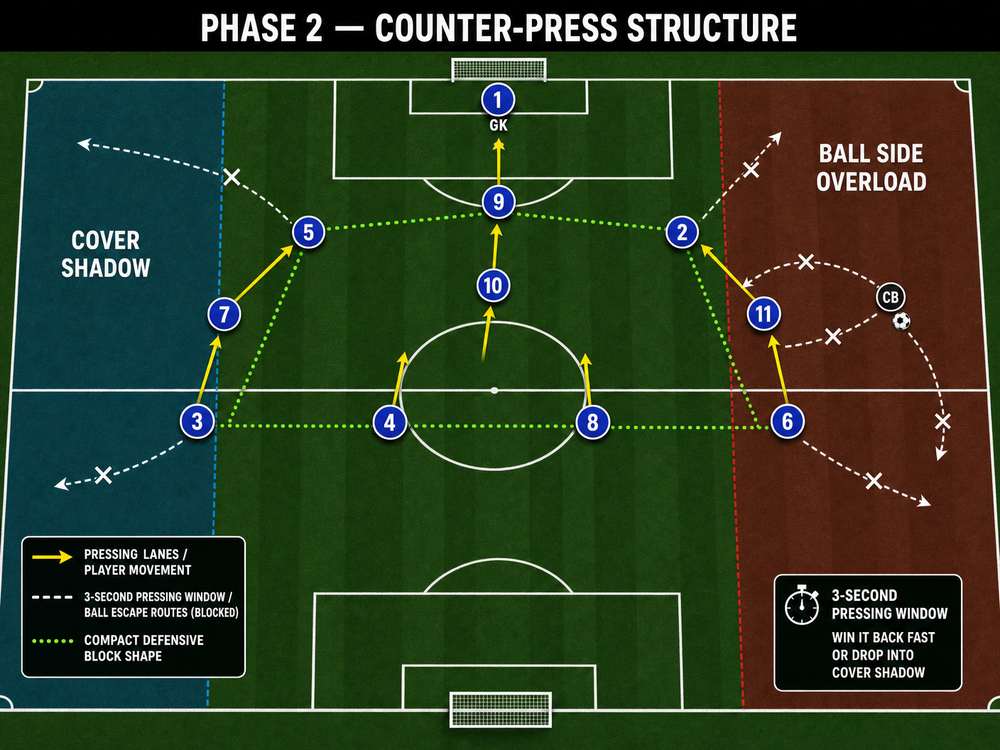
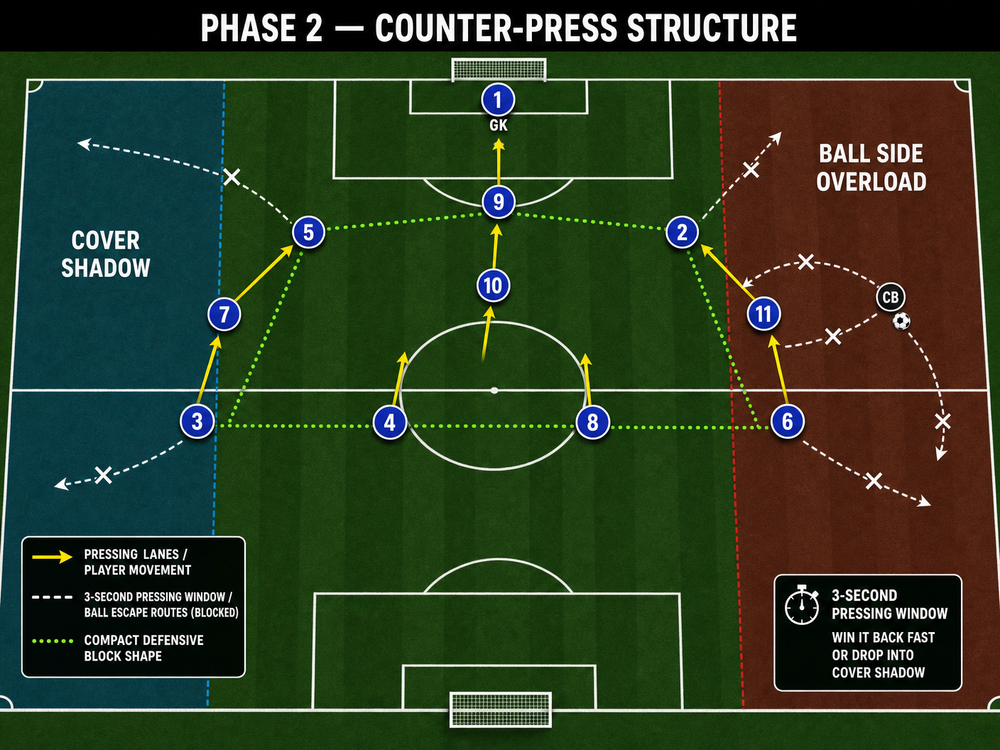
Phase 2 — The 3-Second Window (1–5 seconds)
Step 5: Hunt in Packs. Two or three players should converge on the ball carrier simultaneously, creating a numerical overload in the immediate vicinity of the ball. This is the core principle: the opponent should never feel comfortable on the ball.
Step 6: Force the Error. The objective is to force a misplaced pass, a rushed clearance, or a backpass to the goalkeeper. A clean tackle is a bonus — the primary goal is disruption. Players should be aggressive but controlled, avoiding reckless challenges that give away free kicks.
Step 7: Win it Back — or Recognise the Failure. If the ball is won back within 5 seconds, the team must immediately look to exploit the disorganized opponent with a direct forward pass or shot on goal. If the press is beaten — the opponent plays through or over the press — every player must immediately drop into a compact defensive block. There is no middle ground.
Step 8: Transition to Defence. The two centre-backs and the defensive midfielder must hold their positions throughout the press, providing the safety net if the press is bypassed. The full-backs must be disciplined enough to know when to press and when to hold.
Key Coaching Points
Reaction Time is Everything. The counter-press lives and dies on the speed of the initial reaction. Drill this in training by using a verbal or visual cue (coach shouts "PRESS!") to simulate the moment of loss. Players must be conditioned to react before they think.
Compactness in Possession Enables the Press. A team that is spread out and disorganized in possession will never be able to counter-press effectively. The foundation of a good counter-press is a compact, connected team shape before the ball is lost.
Press as a Unit, Not as Individuals. A single player pressing alone is easily bypassed with a simple lay-off. The press only works when 2–3 players coordinate their movements to eliminate all immediate passing options simultaneously.
Aggressive Mindset, Controlled Actions. Players must have a predatory, aggressive mentality — but they must avoid reckless challenges. The goal is to force errors through pressure, not to lunge in and give away free kicks in dangerous positions.
Know When to Stop. If the press is beaten, players must immediately recognise this and drop. A failed press that leaves the team exposed is far more dangerous than no press at all. Teach your players to read the cues: if the ball is played over or through the press, the trigger to drop is immediate.
The Goalkeeper as the 12th Outfield Player. The goalkeeper must be vocal, commanding the defensive line and being available as a back-pass option. They should also be positioned to act as a sweeper if the opponent attempts to play in behind the pressing line.
Common Mistakes
Pressing Individually. The most common error. One player sprinting at the ball carrier while teammates stand and watch is not a counter-press — it is a gift to the opponent. Drill the coordinated response until it becomes automatic.
Poor Starting Positions. If the team is too spread out in possession, the distances between players when the ball is lost are too great to close quickly. Emphasise compactness and connectivity in all possession-based training.
Half-Hearted Intensity. A slow, half-hearted press is the worst possible outcome. It commits players forward without applying enough pressure to force an error, leaving the team exposed to a counter-attack. The press must be 100% committed or not attempted at all.
Failing to Drop After a Failed Press. When the press is beaten, some players continue pressing while others drop, creating a disjointed, vulnerable defensive shape. The entire team must respond to the same cue simultaneously.
Pressing the Wrong Player. Players must press the ball carrier, not the nearest opponent. Chasing a player who does not have the ball wastes energy and creates gaps in the pressing structure.
Variations & Progressions
Progression 1 — The 6-Second Rule. Once the team has mastered the 3-second press, extend the pressing window to 6 seconds. This demands sustained high-intensity effort and greater coordination, as the opponent has more time to play through the press.
Progression 2 — Zone-Based Scoring. In a small-sided game, award 3 points for winning the ball back in the opponent's half and scoring within 5 seconds, 2 points for a standard goal, and 1 point for a goal scored after dropping into a defensive block. This incentivises the counter-press and rewards quick transitions.
Variation 1 — Directional Pressing. Rather than pressing the ball carrier directly, instruct players to press at an angle that forces the opponent towards the touchline or into a congested central area. This is a more sophisticated pressing trap that requires greater tactical understanding but is far more difficult to escape.
Age Adaptations
Under-8 to Under-10: Keep it simple. Focus on the immediate reaction to losing the ball — "when we lose it, we chase it." Use the cue "PRESS!" and reward players who react quickly. Do not introduce complex tactical structures at this age.
Under-12 to Under-14: Introduce the concept of pressing in pairs and cutting passing lanes. Use small-sided games (5v5 or 6v6) to create frequent turnovers and practise the press in a realistic context. Begin to introduce the idea of compactness in possession.
Under-16 and Open Age: Implement the full tactical structure, including triggers, coordinated pressing traps, directional pressing, and the transition back to a defensive block if the press fails. Use video analysis to show examples of successful and unsuccessful counter-presses at the professional level.
