

Football
Mastering the Build-Up from the Back: A Comprehensive Tactical Guide
Learn how to effectively transition the ball from your goalkeeper through the thirds, creating overloads and breaking the opposition's high press.
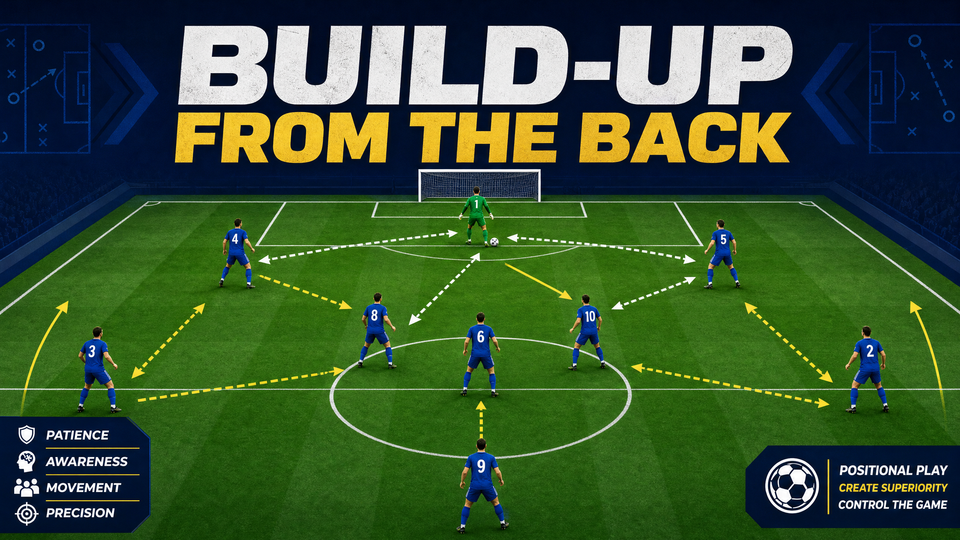
What you need
1 full-size goal, 10-15 footballs, Bibs (2 colors), Flat markers (optional)
1. Overview
Building out from the back is a fundamental tactical approach in modern football designed to draw the opposition press, create numerical superiorities (overloads), and progress the ball cleanly into the midfield and attacking thirds. By starting the attack with the Goalkeeper (1) and Centre-Backs (4, 5), teams can dictate the tempo of the game and exploit spaces left by a high-pressing opponent.
This play is highly effective against teams that employ an aggressive high press, as it invites them forward, thereby creating space behind their midfield line. It requires high technical proficiency, spatial awareness, and patience.
2. Setup
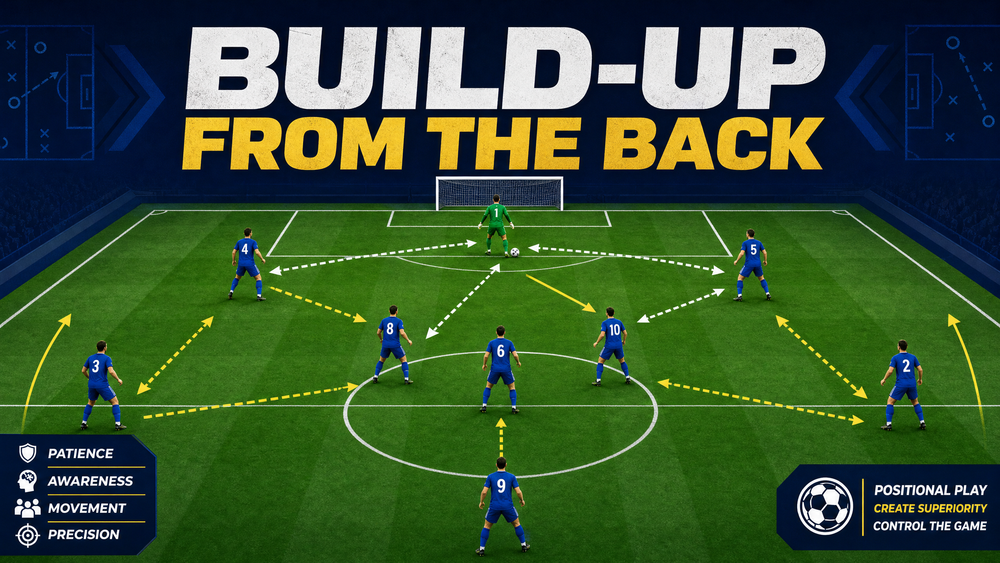
Pitch Dimensions: Standard 11v11 pitch (100-110m x 64-75m).
Players: Full 11 players (focus on GK, Back 4, and Defensive Midfielder).
Equipment: 1 full-size goal, 10-15 footballs (placed in or around the goal for quick restarts), bibs for two teams (if running as a contested drill), and flat markers to designate zones (optional).
Player Positioning:
- Goalkeeper (1): Starts with the ball inside the 6-yard box.
- Centre-Backs (4 & 5): Split wide, positioned at the edge of the penalty area.
- Full-Backs (2 & 3): Push high and wide, almost touching the touchline near the halfway line.
- Defensive Midfielder (6): Drops into the central space just outside the penalty arc, creating a passing triangle with the CBs.
- Central Midfielders (8 & 10): Positioned higher up, ready to drop into half-spaces to receive or create space for the DM.
3. Step-by-Step Instructions
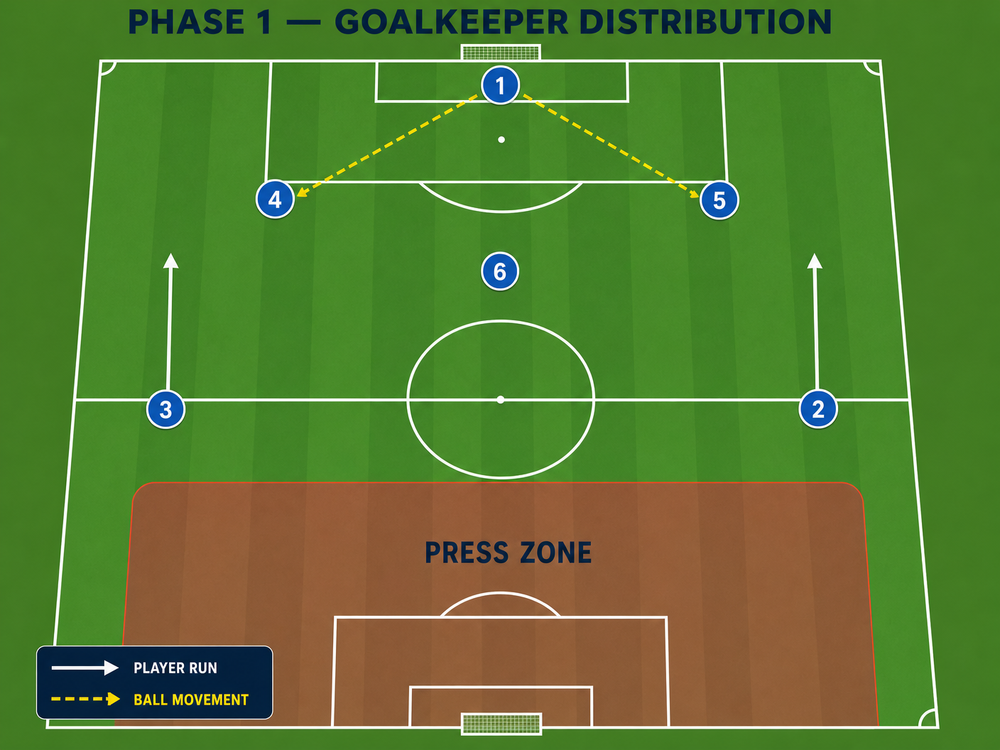
Phase 1: Goalkeeper Distribution
- Initial Setup: The Goalkeeper (1) places the ball for a goal kick or holds it in open play. The Centre-Backs (4 & 5) immediately split wide to the edges of the penalty box.
- Trigger: The Full-Backs (2 & 3) push high up the pitch, dragging the opposition wingers with them or forcing the opposition full-backs to make a decision.
- The First Pass: The Goalkeeper assesses the press. The primary option is a firm, flat pass to the open Centre-Back (e.g., 4 on the left).
- Creating Angles: As the ball travels, the Defensive Midfielder (6) drops slightly to offer a central passing option, ensuring they are not marked tightly.
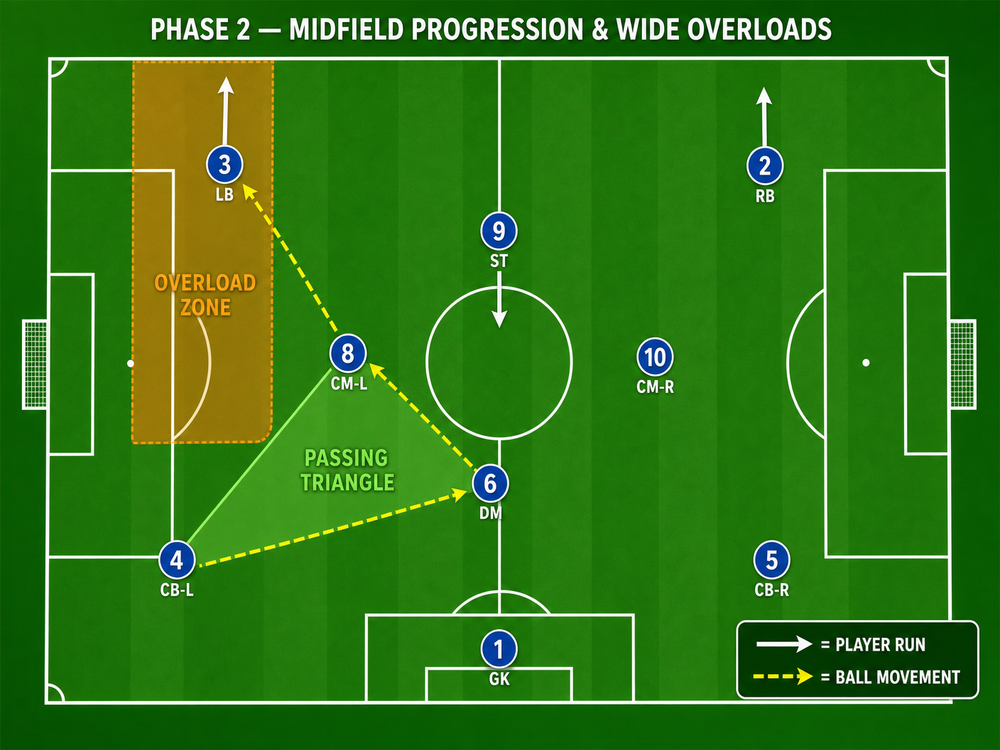
Phase 2: Midfield Progression & Wide Overloads
- Receiving the Ball: The receiving Centre-Back (4) takes a positive first touch forward or towards the touchline, opening their body to see the whole pitch.
- The Triangle: The CB (4) now has three main options: pass back to the GK (1) if under severe pressure, pass inside to the dropping DM (6), or play a longer pass to the advanced Full-Back (3).
- Breaking the First Line: The preferred route is to find the DM (6). The DM receives on the half-turn and immediately looks to play forward to the Central Midfielders (8 or 10).
- Wide Overload: If the central route is blocked, the CB (4) plays to the advanced Full-Back (3). The nearest Central Midfielder (8) shifts across to create a 2v1 or 3v2 overload on the flank.
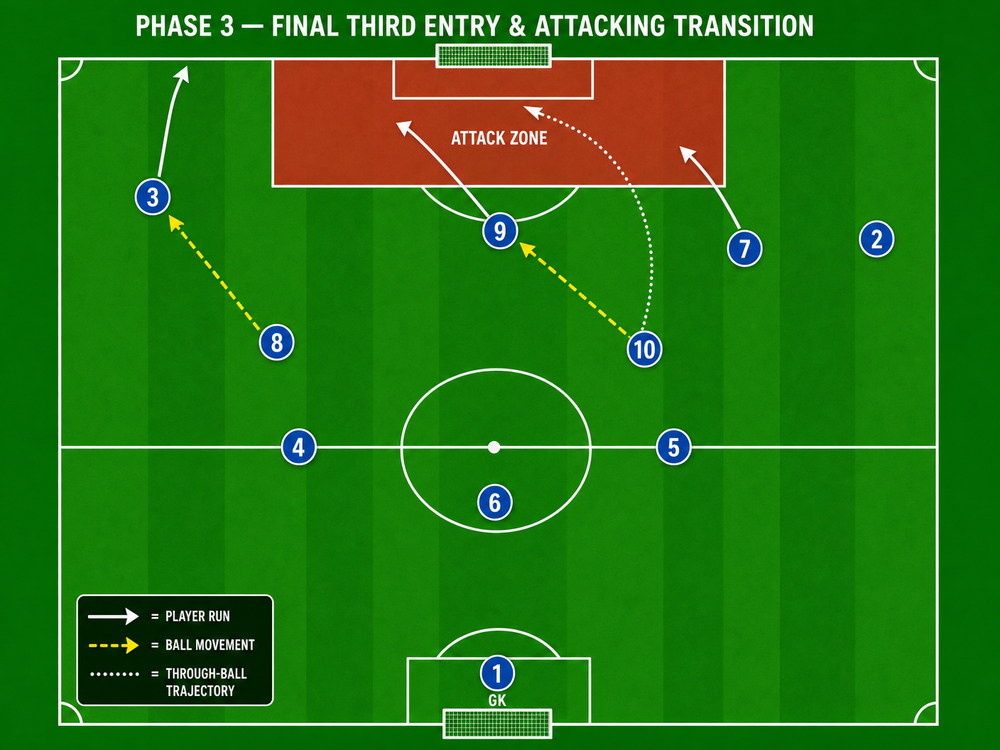
Phase 3: Final Third Entry
- Exploiting the Space: Once the ball reaches the midfield line (either via the DM or the Full-Back), the team must quickly transition into attack.
- Forward Runs: The Striker (9) makes a diagonal run behind the opposition's defensive line.
- The Final Pass: The Central Midfielder (8 or 10) looks to thread a through-ball into the path of the Striker (9) or play the ball out wide for a cross.
4. Key Coaching Points
- Body Shape: Players must receive the ball on the half-turn (open body shape) to see the next pass immediately.
- Patience and Composure: Do not force the forward pass. If the passing lane is blocked, recycle the ball through the Goalkeeper and switch the point of attack.
- Passing Speed and Weight: Passes must be firm and to the correct foot (usually the back foot) to allow for quick progression.
- Movement Off the Ball: Players must constantly adjust their positioning to maintain passing triangles and create clear passing lanes.
- Recognizing the Press: Players must quickly identify the opposition's pressing trigger (e.g., man-to-man vs. zonal) and adjust their positioning accordingly.
5. Common Mistakes
- Slow Ball Speed: Moving the ball too slowly allows the opposition to shift and set their defensive block.
- Poor First Touch: A heavy first touch immediately invites pressure and often leads to a turnover in a dangerous area.
- Lack of Communication: Failure to communicate pressure (e.g., "Man on!", "Time!") leads to poor decision-making.
- Forcing the Pass Central: Playing a risky pass into a congested central area when the wide option is open.
6. Variations & Progressions
- Progression 1: Add Opposition: Start with passive opposition (shadow defending) and gradually increase the intensity to a full, live press.
- Progression 2: Time Limit: Introduce a rule where the team must progress the ball past the halfway line within 10 seconds to encourage quick decision-making.
- Variation 1: The 'False Full-Back': Instead of pushing high, the Full-Backs invert into central midfield positions, creating an overload in the middle and opening passing lanes to the wingers.
7. Age Adaptations
- Under 8 - Under 10: Focus heavily on the technical aspects: first touch, passing accuracy, and basic positioning (just getting the CBs to split wide).
- Under 12 - Under 14: Introduce the concept of the Defensive Midfielder dropping in to create triangles. Begin teaching how to recognize basic pressing triggers.
- Under 16 - Open: Implement the full tactical setup, focusing on high-speed ball circulation, complex movements (e.g., third-man runs), and adapting to different pressing structures (e.g., 4-4-2 vs. 4-3-3 press).
