

Football
Mastering Build-Up Play from the Back: Breaking the First Line of Pressure
Learn how to effectively build up from the back, utilizing the goalkeeper and defenders to draw pressure and create numerical advantages in midfield.
What you need
Full-size football pitch, Standard goals, Football balls (size 5), Training bibs (2 colors), Cones (optional, for marking zones)
1. Overview
Building up from the back is a foundational tactical concept in modern football. This set play focuses on utilizing the goalkeeper as an active participant in possession to create numerical superiority (an overload) against the opposition's first line of pressure. By inviting the opposition to press high, you can stretch their shape and exploit the space left behind their forwards and midfield lines.
This pattern is highly effective when facing a team that presses with one or two strikers. The goal is not simply to keep possession for the sake of it, but to progress the ball cleanly into the middle third with control and purpose, setting up attacking opportunities in the final third.
2. Setup

Pitch Area: Defensive third to the middle third (approximately 50m x 70m of a standard 105m x 68m pitch).
Players: 11v11 (focusing on GK, Back 4, and Defensive Midfielder).
Equipment: Full-size goal, balls, cones to mark zones (optional).
Player Positions:
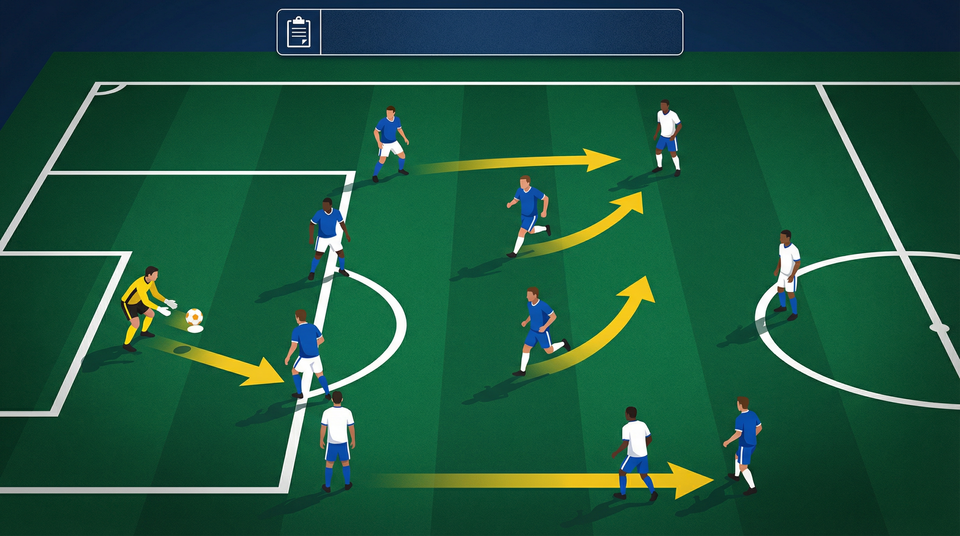
- Goalkeeper (1): Central, top of the 6-yard box.
- Centre-Backs (4 & 5): Split wide, positioned just outside the penalty area, level with the penalty spot.
- Full-Backs (2 & 3): Pushed high and wide, hugging the touchlines near the middle third.
- Defensive Midfielder (6): Positioned centrally, just above the penalty arc, acting as the pivot.
- Central Midfielders (8 & 10): Positioned in the half-spaces, ready to drop or make third-man runs.
3. Step-by-Step Instructions

Phase 1: Goalkeeper Distribution and Inviting Pressure

- Starting Position: The play begins with the Goalkeeper (1) in possession at the top of the 6-yard box. The Centre-Backs (4 & 5) split wide to the edges of the penalty area.
- Initial Pass: The GK plays a firm, flat pass to either CB (e.g., CB 5 on the right).
- Drawing the Press: CB 5 receives the ball on the back foot, opening their body to the field. They take a deliberate touch forward to invite the opposition striker to press.
- The Pivot's Movement: As the ball travels to CB 5, the Defensive Midfielder (6) drops slightly, checking their shoulder to ensure they are available for a pass while dragging an opposition midfielder with them.
Phase 2: Midfield Progression and Third-Man Runs

- Breaking the First Line: Once the opposition striker commits to pressing CB 5, a passing lane opens up. CB 5 plays a crisp, line-breaking pass into the feet of the dropping CDM (6).
- One-Touch Layoff (The Trigger): CDM 6, facing their own goal and under pressure from behind, plays a quick, one-touch layoff to the opposite Central Midfielder (10) who has drifted into the half-space.
- Third-Man Run: As the ball is played to CM 10, the opposite Full-Back (3) or the advanced Central Midfielder (8) makes a dynamic 'third-man run' into the space vacated by the opposition's pressing midfield.
- Progression: CM 10 receives the ball facing forward and immediately plays a progressive pass into the path of the running player (LB 3 or CM 8), successfully bypassing the opposition's midfield line and entering the attacking phase.
4. Key Coaching Points

- Body Shape and First Touch: Defenders must receive the ball on their back foot with an open body shape. This allows them to see the whole pitch and play forward quickly.
- Patience and Provocation: Do not force the pass. The Centre-Backs must be patient on the ball to deliberately provoke the opposition into pressing, which creates the spaces behind them.
- Weight and Accuracy of Pass: Line-breaking passes must be firm and played directly to the receiving player's safe foot (away from the defender). The layoff from the pivot must be soft and perfectly weighted for a one-touch forward pass.
- Scanning: The Defensive Midfielder (6) must constantly scan over their shoulder before receiving the ball to know where the pressure is coming from and where their next pass will go.
- Timing of the Third-Man Run: The player making the forward run (CM 8 or LB 3) must time their movement to arrive in the space exactly as CM 10 receives the ball facing forward.
5. Common Mistakes

- Panic Under Pressure: Defenders clearing the ball long at the first sign of pressure instead of trusting the structure and playing the prepared pass.
- Poor Spacing: Centre-Backs not splitting wide enough, or Full-Backs dropping too deep, which compresses the playing area and makes it easier for the opposition to press.
- Static Midfield: The pivot (6) remaining static behind the opposition strikers. They must constantly adjust their position to create passing angles.
- Telegraphing Passes: Staring at the intended target before passing, allowing the opposition to anticipate and intercept the ball.
6. Variations & Progressions
- Progression 1: Add a High Press. Introduce an active front three for the opposition who aggressively press the GK and CBs to test the team's composure and decision-making under real match conditions.
- Progression 2: The 'Up, Back, and Through'. If the CDM (6) is heavily marked, the CB plays a longer pass directly into the feet of a dropping Striker (9), who lays it off to an advancing CM (8 or 10) facing forward.
- Variation 1: Using the Full-Back. If the central areas are completely blocked, the CB can play wide to the Full-Back (2 or 3), who then plays a line-breaking pass down the line to the winger or inside to a CM.
7. Age Adaptations
- Under 10 - Under 12: Focus heavily on the technical execution: receiving on the back foot, passing accuracy, and basic spacing. Reduce the pressure from the opposition (e.g., passive or delayed press).
- Under 14 - Under 16: Introduce the concept of the 'third-man run' and timing of movements. Increase the intensity of the opposition press to develop composure.
- Open / Senior: Full match realism. Focus on reading the opposition's pressing triggers and adapting the build-up pattern dynamically based on how the opponent defends.
