

Football
Mastering the Counter-Press: Immediate Reaction to Losing Possession
Teach your team to win the ball back instantly upon losing possession by establishing aggressive pressing traps, cutting off passing lanes, and dominating the transition phase.
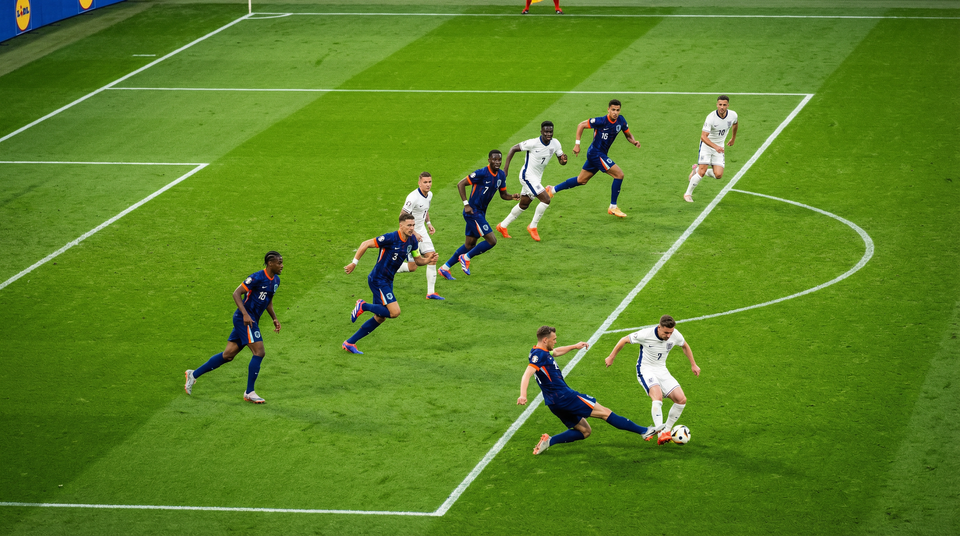
What you need
1 full-size goal, 2-3 mini goals, Cones, Bibs (2 contrasting colours), Footballs
1. Overview
Counter-pressing (Gegenpressing) is the immediate, aggressive attempt to win the ball back within seconds of losing possession, rather than dropping back into a defensive shape. This set play resource focuses on the crucial 3-5 seconds after a turnover in the opponent's half or the middle third. By executing a coordinated counter-press, your team not only prevents the opponent from launching a quick counter-attack but also creates high-quality goal-scoring opportunities against a disorganised defence.
Use this tactical approach when your team dominates possession, plays with a high defensive line, and has the physical conditioning to sustain high-intensity sprints. It is particularly effective against teams that try to play out from the back or lack technical composure under immediate pressure.
2. Setup

Pitch Dimensions: 100-110m x 64-75m (Full pitch or modified middle-to-attacking third).
Players Required: 22 (11v11) or modified for smaller sided games (e.g., 8v8 on a reduced pitch).
Equipment Needed:
- 1 full-size goal
- 2-3 mini goals (for the defending team to counter-attack into)
- Cones to mark specific pressing zones (Trigger Zone)
- Bibs in two contrasting colours (e.g., Dark Blue and Red)
- Supply of footballs placed around the pitch to maintain high tempo
Player Positions: Standard 4-3-3 or 4-2-3-1 formations work best. Key roles involve the Central Midfielders (8, 10), Wingers (7, 11), and the Striker (9) acting as the primary pressing unit, while Defensive Midfielders (6) and Centre-Backs (4, 5) provide cover and balance.
3. Step-by-Step Instructions


Step 1: The Trigger (Immediate Reaction)
The moment possession is lost, the player closest to the ball (e.g., the Central Midfielder, 8) must instantly sprint towards the new ball carrier. There is no hesitation. The objective is to apply immediate, intense pressure within a 5-metre radius, forcing the ball carrier to put their head down and restricting their vision.
Step 2: Surrounding the Ball (The Swarm)
Simultaneously, the next 2-3 closest players (e.g., the Attacking Midfielder, 10, and the near-side Winger, 7) sprint to close down the immediate passing options around the ball carrier. They must angle their runs to cut off the most dangerous forward passes, effectively creating a 'pressing trap' or 'swarm' around the ball.
Step 3: Establishing Cover Shadows
Players slightly further away from the ball (e.g., the far-side Winger, 11, and the Striker, 9) adjust their positioning to block passing lanes to the opponent's wider or deeper options. They use their 'cover shadow'—positioning their body between the ball and the potential receiver—to intercept any forced passes.

Step 4: The Defensive Block (Balance and Depth)
While the front players press aggressively, the Defensive Midfielder (6) and the backline (Centre-Backs 4, 5, and Full-Backs 2, 3) must step up to compress the space. They form a compact 'Cover Zone' behind the press, ready to win any long clearances or 'second balls' that bypass the initial pressing wave.
Step 5: Winning the Ball and Transitioning to Attack
Once the ball is won back, the team must immediately look to exploit the opponent's disorganised shape. The first pass should ideally be forward, penetrating the space left by the transitioning opponent, aiming for a quick shot on goal.
4. Key Coaching Points

- Mental Switch: The transition from attack to defence must be instantaneous. Players must react to the loss of possession with aggression, not disappointment.
- Intensity and Speed: The initial press must be a full sprint. A slow or half-hearted press will easily be bypassed, exposing the defence.
- Body Shape and Angled Runs: Pressing players must approach the ball carrier on an angle, forcing them onto their weaker foot or towards the touchline, rather than allowing them to play through the middle.
- Compactness: The entire team must move as a cohesive unit. The distance between the furthest forward pressing player and the deepest defender must be compressed to deny the opponent space to play out.
- Anticipation (Reading the Game): Players not directly pressing the ball must anticipate the opponent's next pass and proactively position themselves to intercept.
5. Common Mistakes

- Pressing Individually: One player pressing aggressively while the rest of the team drops back. This leaves the pressing player isolated and easily bypassed.
- Failing to Secure the Second Ball: The initial press forces a long clearance, but the defensive line has not stepped up to win the aerial duel or the ensuing loose ball.
- Over-Committing: Too many players diving in to win the ball directly, allowing the opponent to play a simple pass around the pressure and exploit the massive space left behind.
- Lack of Communication: Players not talking to each other, leading to confusion about who is pressing the ball and who is covering the passing lanes.
6. Variations & Progressions
- Progression 1: Time Limit on the Press: Introduce a 5-second rule. If the team hasn't won the ball back or forced a mistake within 5 seconds of losing possession, they must immediately drop back into their organised defensive shape.
- Progression 2: Overload the Press: Start the drill with an artificial overload (e.g., 6v4 in a specific zone) to encourage successful pressing and build confidence before moving to even numbers.
- Variation 1: Touch Restrictions: Limit the team in possession to 2 or 3 touches. This forces quicker decision-making and increases the likelihood of turnovers, creating more counter-pressing opportunities.
7. Age Adaptations
- Under 8 - Under 10: Focus primarily on the immediate reaction to losing the ball. Encourage the closest player to chase the ball immediately. Keep it simple: 'Lose the ball, win it back fast!'
- Under 12 - Under 14: Introduce the concept of supporting the press. Teach players to close down the nearest passing options while the closest player pressures the ball carrier. Begin working on basic body shape and angled runs.
- Under 16 - Open: Implement the full tactical structure, including cover shadows, pressing traps, and the coordinated movement of the defensive line to maintain compactness. Focus on high-intensity, sustained pressing and rapid transitions.
