

Football
Counter-Pressing After Possession Loss: Win the Ball Back in 5 Seconds
Master the art of the immediate counter-press — teach your players to transform a moment of vulnerability into a high-percentage ball-recovery opportunity within seconds of losing possession.

What you need
Full-size or 3/4 training pitch (100-110m x 64-75m), 6-8 footballs, Coloured bibs (2 sets of 11), 20 flat disc cones, 4-6 mannequins or poles (optional), Coaching board, Stopwatch or whistle
Overview
The counter-press (or Gegenpressing, as popularised by Jürgen Klopp at Borussia Dortmund and Liverpool) is one of the most powerful transition tools in modern football. The core principle is deceptively simple: the moment your team loses the ball, the nearest 2–4 players do not retreat — they immediately press the opponent with maximum intensity to win possession back before the opposition can organise.
Why does it work? In the 3–5 seconds immediately after a team wins the ball, their players are mentally and physically disorganised. They are still in their attacking shape, their heads are down, and their first touch is often poor. This is the optimal window to press. A well-drilled counter-press exploits this chaos, recovers the ball high up the pitch, and creates immediate goal-scoring opportunities — often in positions far more dangerous than a structured attack would produce.
When to use it: Deploy the counter-press when your team loses possession in the opponent's half or the central third, when the ball is played into a congested area, or when the opposition's ball-carrier has their back to goal. Avoid committing to a full counter-press when your team is stretched, fatigued, or when the ball is played behind your defensive line.
Setup

Equipment Required
| Item | Quantity | Purpose |
|---|---|---|
| Full-size or 3/4 pitch | 1 | 100–110m × 64–75m (or 70m × 50m for training) |
| Footballs | 6–8 | Multiple balls to maintain session tempo |
| Coloured bibs (2 colours) | 22 | Distinguish pressing team from opposition |
| Cones (flat discs) | 20 | Mark press trigger zones and pitch boundaries |
| Mannequins or poles | 4–6 | Optional: simulate passive defenders |
| Coaching board | 1 | Pre-session tactical walkthrough |
Pitch Setup
For the full tactical drill, use a 70m × 50m training pitch divided into three horizontal zones:
- Zone 1 (Attacking Third): 0–23m — where possession is ideally lost to trigger the press
- Zone 2 (Middle Third): 23–47m — the primary counter-press engagement zone
- Zone 3 (Defensive Third): 47–70m — the recovery zone if the press is beaten
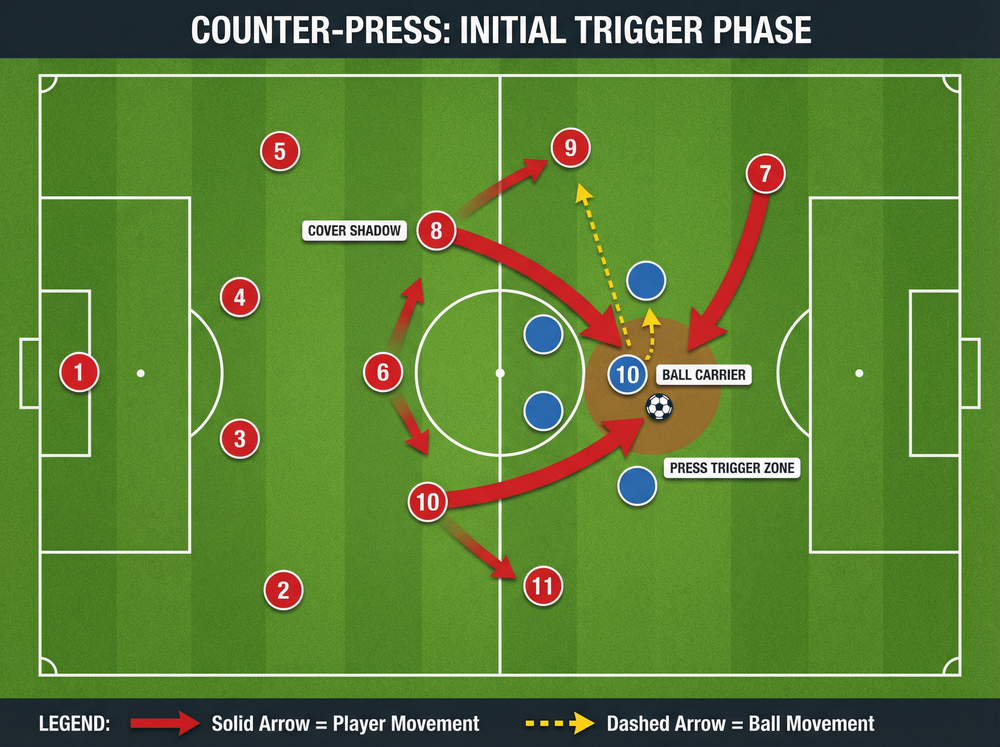
Mark the Press Trigger Zone with flat cones in a 15m × 15m box in the central area of Zone 2. This is where players learn to recognise the cue to press.
Player Positions (4-3-3 Formation)
| Number | Position | Counter-Press Role |
|---|---|---|
| 1 | Goalkeeper (GK) | Organises defensive line, sweeps behind press |
| 2 | Right Back (RB) | Tucks in, blocks wide escape route |
| 3 | Left Back (LB) | Tucks in, blocks wide escape route |
| 4 | Centre Back (CB) | Holds shape, does NOT commit to press |
| 5 | Centre Back (CB) | Holds shape, covers space behind press |
| 6 | Defensive Midfielder (DM) | Second-press anchor, covers central channel |
| 7 | Right Midfielder (RM) | First-press trigger on right side |
| 8 | Central Midfielder (CM) | First-press trigger in central zone |
| 9 | Centre Forward (CF) | Leads press, cuts passing lane to goalkeeper |
| 10 | Attacking Midfielder (AM) | First-press trigger, covers shadow |
| 11 | Left Midfielder (LM) | First-press trigger on left side |
Step-by-Step Instructions


Step 1 — Establish the Trigger Signal (Pre-Session)
Before any live play, define your press trigger clearly with the squad. The trigger is the moment the ball is lost AND the ball-carrier's first touch is heavy, they receive with their back to goal, or they receive under pressure. Use the verbal cue "Press!" or a hand signal during training. Players must understand: the trigger is not simply losing the ball — it is losing the ball in a pressable situation.
Step 2 — Nearest Player Becomes the Ball-Chaser
The player who lost the ball (or the nearest player within 5m) becomes the primary presser immediately. They sprint at the ball-carrier at 90–100% intensity, approaching at a slight angle (not straight on) to channel the opponent toward the touchline or a congested area. Their body shape should force the opponent away from the centre of the pitch.
Step 3 — Second and Third Players Form the Press Triangle
The two nearest players to the ball (within 8–12m) sprint to form a press triangle around the ball-carrier. Player positions within the triangle:
- Press Leader: Directly on the ball-carrier, applying immediate pressure.
- Cover Shadow Player: Positions between the ball-carrier and their nearest passing option, blocking the easy escape.
- Interception Runner: Anticipates the forced pass and sprints to intercept the likely outlet.
Step 4 — Remaining Players Compact and Shift
All other outfield players (those not in the press triangle) must immediately shift toward the ball to reduce space. The rule of thumb: every player not pressing should be within 10–15m of the ball in the central and near zones. Full-backs tuck in 5–8m. The defensive midfielder drops 3–5m to cover the channel behind the press.
Step 5 — Execute the Press for Maximum 5 Seconds
The counter-press window is 3–5 seconds. If the ball is not won within this window, the team must immediately transition into a structured defensive shape — dropping into a mid-block or low-block depending on the game situation. Pressing beyond 5 seconds without winning the ball leaves dangerous space behind.

Step 6 — Win the Ball and Transition Forward
When possession is recovered, the player winning the ball should look forward immediately. If a forward run is available, play the ball in behind the disorganised opposition. If not, play short to the nearest teammate and reset into a structured attack. The goal of the counter-press is not just recovery — it is to create a direct attacking opportunity from the turnover.
Step 7 — If the Press is Beaten — Immediate Recovery Shape
If the opposition plays through the press, every player must sprint back into their defensive block within 3–4 seconds. The DM (No. 6) drops between the centre-backs to form a temporary back three. Full-backs recover to their defensive positions. The team resets into a compact 4-4-2 or 4-5-1 mid-block.
Key Coaching Points

React in the Moment of Loss, Not After It. The biggest mistake players make is waiting to see what happens after losing the ball. Drill the mindset: the moment the ball leaves your foot under pressure, your body should already be turning to press. Reaction time is everything.
Press with Purpose — Angle Matters. A straight sprint at the ball-carrier gives them an easy escape either side. Teach players to approach at a 30–45° angle, cutting off the most dangerous passing lane first. The press should funnel the opponent into a corner or toward a teammate.
Cover Shadows Are as Valuable as the Press Itself. The player cutting off the passing lane (the cover shadow) is often more important than the player pressing the ball. If the ball-carrier has no easy pass, they are forced into a mistake. Emphasise that not every player needs to sprint at the ball — some need to block the escape.
Compactness Behind the Press Is Non-Negotiable. The two centre-backs must hold their position and must NOT be dragged into the press. If they step out, the space behind is exposed. Reinforce: "CBs hold the line, everyone else shifts."
Recognise When NOT to Press. A critical coaching point often overlooked. If the ball is played into space behind the press, or if the opposition has a free man in a dangerous position, the team must immediately abandon the press and recover. Pressing blindly leads to catastrophic counter-attacks against you.
Communicate Constantly. The press only works as a collective. Players must call "press!", "hold!", "mine!", and "drop!" throughout the transition. Silence during a press is a sign of poor organisation. Build communication habits from the first session.
Common Mistakes
Mistake 1 — Ball-Watching Instead of Pressing
Players stop and watch the ball after losing possession instead of immediately pressing. This gives the opposition 2–3 extra seconds to organise. Correction: Run a dedicated drill where players must sprint toward the ball within 1 second of losing it, regardless of outcome. Use a stopwatch to time reaction.
Mistake 2 — All Players Chasing the Ball (Ball-Hunting)
Multiple players sprint at the ball-carrier, leaving massive gaps elsewhere. This is especially common in younger age groups. Correction: Assign clear roles before each rep — "You press, you cover shadow, you intercept." Reinforce that only 2–3 players should engage the ball directly.
Mistake 3 — Centre-Backs Stepping Into the Press
Centre-backs are drawn out of position by the intensity of the press, leaving the space behind completely exposed. Correction: Place a target mannequin or cone 15m behind the CBs. If a CB steps out and the ball gets past the press, the coach plays a ball into that space to demonstrate the danger immediately.
Mistake 4 — Pressing Too Long Without Winning the Ball
The team continues pressing beyond the 5-second window, becoming increasingly disorganised and fatigued. Correction: Use a stopwatch or whistle at 5 seconds during training. When the whistle blows, every player must immediately drop into their recovery shape. This builds the habit of recognising when to abandon the press.
Mistake 5 — Poor Body Shape on the Press
Players sprint directly at the ball-carrier with open body shape, allowing easy dribbles past them. Correction: Emphasise low centre of gravity, side-on approach, and slowing down the final 2m of the press to stay on their feet and force the opponent into a decision.
Variations & Progressions

Progression 1 — Passive to Active Opposition (Beginner → Intermediate)
Begin the drill with the opposition playing passively (walking pace, no dribbling). This allows pressing players to learn the correct angles and roles without the chaos of live play. Once the shape is consistently correct, introduce active opposition who can dribble and pass freely.
Progression 2 — Conditioned Game with Press Zones (Intermediate)
Play a 9v9 or 11v11 game on a 70m × 50m pitch. Place flat cones to mark the central third as the "press zone." Award 2 points for a goal scored within 10 seconds of winning the ball via a counter-press. This rewards the desired behaviour and makes the tactical objective game-realistic.
Progression 3 — Full 11v11 with Live Transitions (Advanced)
Run a full 11v11 game on a full-size pitch (100–110m × 64–75m) with no conditions. The coach observes and pauses play (using a freeze coaching method) when the counter-press is triggered — either to praise correct execution or correct errors in real time. This bridges the gap between drill and match application.
Age Adaptations

| Age Group | Key Modifications |
|---|---|
| Under 10 | Simplify to 1 presser only. Focus purely on the ball-loser turning to chase. Use a 4v4 or 5v5 small-sided game. No tactical shape required — just the habit of chasing. |
| Under 12 | Introduce the press pair (2 players). Use a 7v7 format on a 50m × 35m pitch. Teach the cover shadow concept with walking demonstrations before live play. |
| Under 14 | Introduce the full press triangle (3 players). Use a 9v9 format. Begin teaching compactness behind the press. Introduce the 5-second rule explicitly. |
| Under 16 | Full 11v11 counter-press with all roles defined. Introduce the concept of press triggers vs. non-pressable situations. Begin video analysis of their own pressing patterns. |
| Open/Senior | Full tactical implementation including press triggers, cover shadows, recovery shape, and in-game decision-making on when to press vs. drop. Use GPS data or video to measure press intensity and ball-recovery rates. |
