

Football
Counter-Pressing: Win the Ball, Win the Moment
Master the art of the counter-press to immediately win back possession and launch devastating transitions before the opponent can organize.
What you need
1 full-size goal, 2 mini-goals, Footballs, Bibs (2 colors), Cones
1. Overview
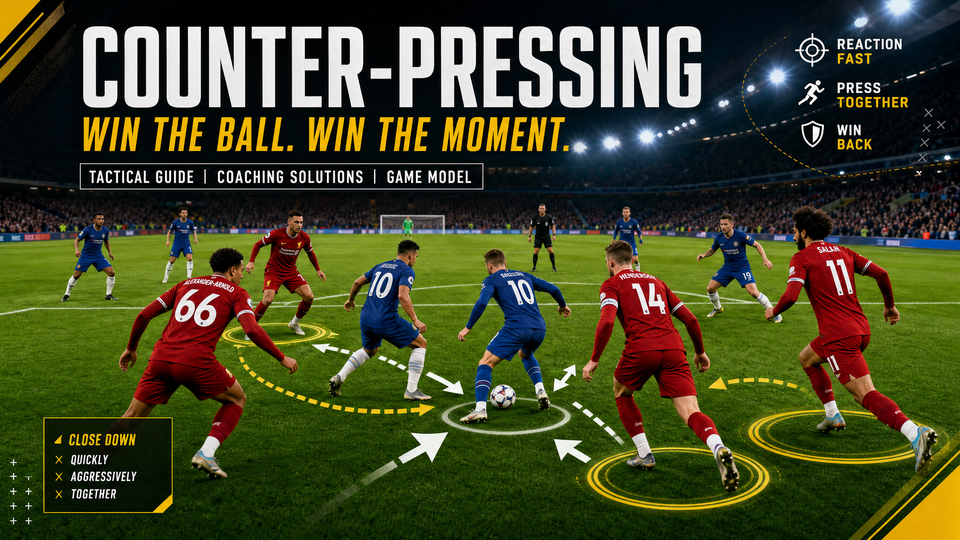
The counter-press (Gegenpressing) is a tactical approach where a team immediately attempts to win back possession of the ball right after losing it, rather than falling back into a defensive shape. This set play resource focuses on the collective triggers and coordinated movements required to execute an effective counter-press in the attacking half. By applying immediate pressure within the first 3-5 seconds of losing the ball, teams can disrupt the opponent's transition, prevent counter-attacks, and create high-quality goal-scoring opportunities against a disorganized defense.
2. Setup
- Pitch Dimensions: Full pitch (100-110m x 64-75m) for 11v11 match realism, or scale down to a 60m x 40m area for focused small-sided games.
- Equipment: 1 full-size goal, 2 mini-goals (for the defending team to counter-attack into), plenty of footballs, bibs in 2 contrasting colors, and cones to mark the pressing zones.
- Player Positions: 11v11 setup, focusing on the attacking unit (Forwards: 9, 10, 7, 11) and the midfield block (6, 8) as the primary pressers. The defensive line (2, 3, 4, 5) must hold a high line to maintain compactness.
3. Step-by-Step Instructions
Step 1: The Trigger Moment
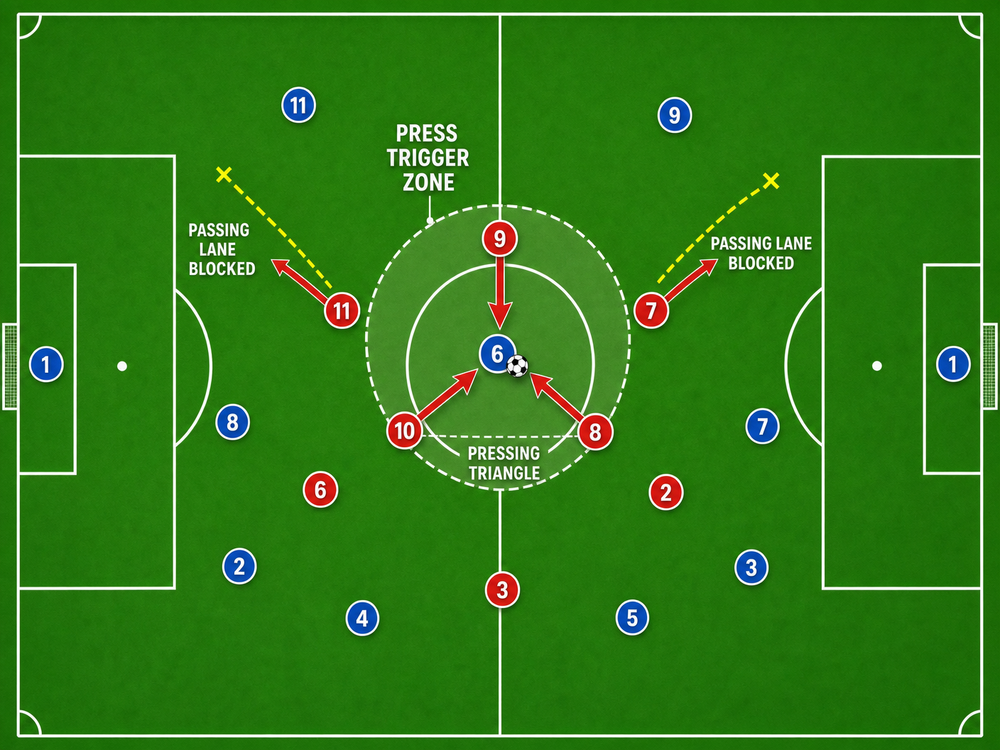
As soon as possession is lost in the attacking third, the nearest player must immediately sprint to the ball carrier to apply intense pressure. The goal is not necessarily to win the ball instantly, but to force the ball carrier's head down and prevent a forward pass.
Step 2: Forming the Pressing Triangle
The next two closest players sprint to support the initial presser, forming a tight triangle around the ball carrier (within 5 meters). This cuts off immediate short passing options and suffocates the player in possession.
Step 3: Compacting the Space
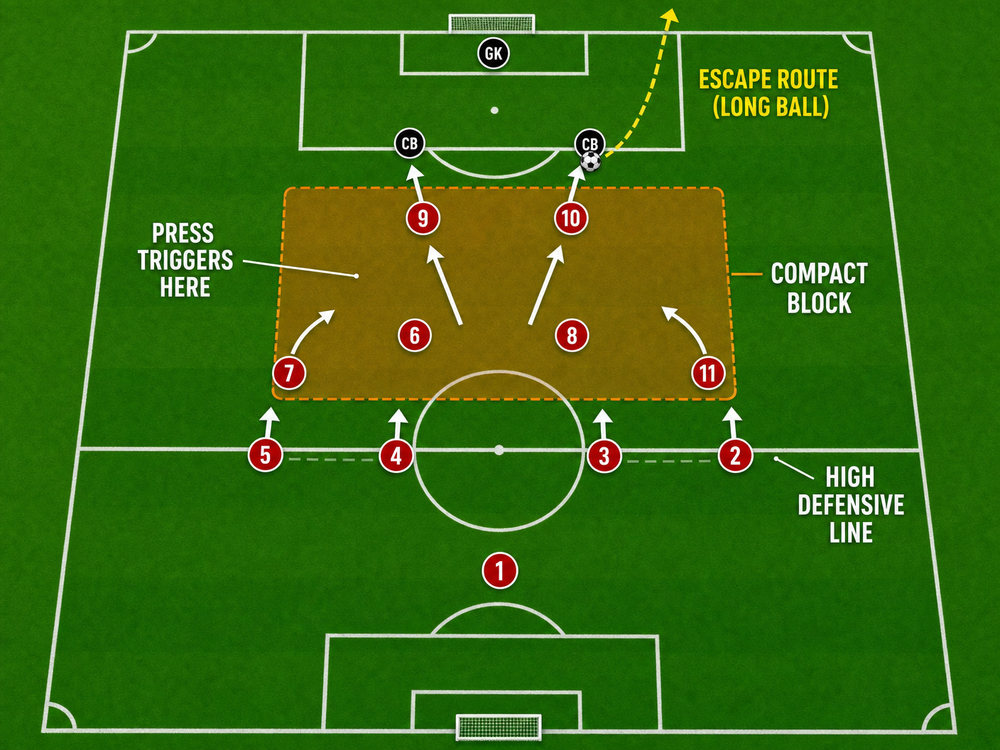
Simultaneously, the rest of the team must push up. The defensive line steps up to the halfway line to compress the space between the lines. Wide players tuck inside to block diagonal passing lanes, creating a compact pressing block.
Step 4: Winning the Ball and Transitioning
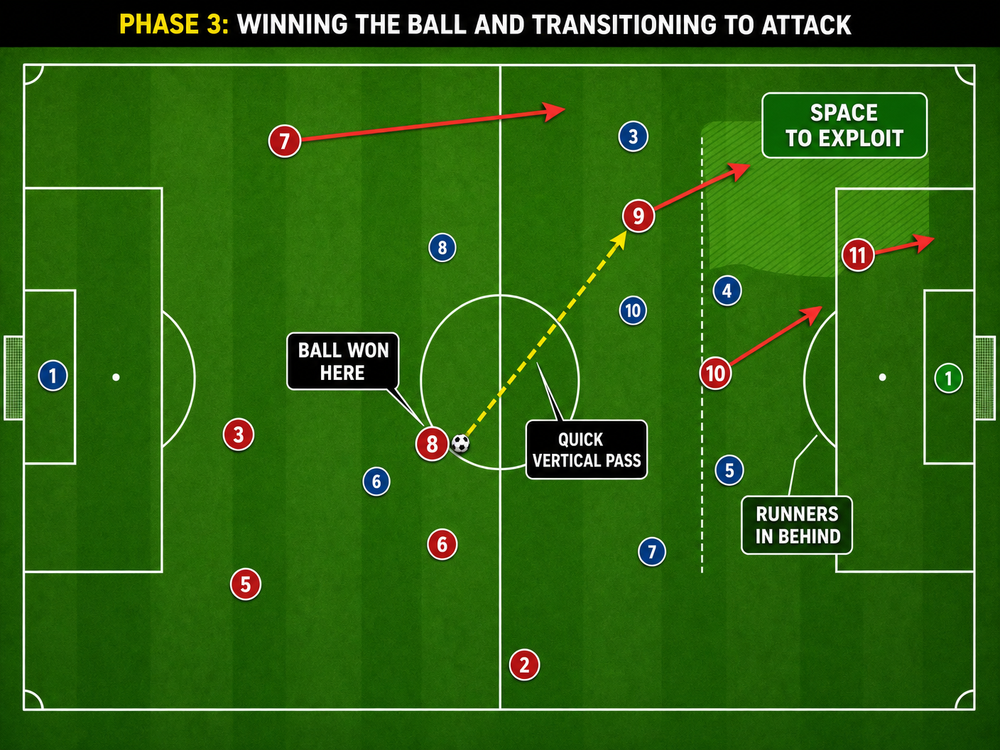
Once the ball is won back, the team must immediately transition into attack. Look for the quickest vertical pass to exploit the disorganized opponent. Runners should dart into the space left behind the defensive line.
4. Key Coaching Points
- Reaction Speed: The press must begin within 1 second of losing the ball. Delay allows the opponent to set their shape.
- Aggression and Intent: Players must press with the genuine intent to win the ball, not just to contain.
- Compactness: The entire team must move as a unit. If the forwards press but the defense drops, huge gaps will appear in midfield.
- Body Shape: Pressers should angle their runs to force the opponent into congested areas or toward the touchline.
- The 5-Second Rule: If the ball is not won back within 5 seconds, the team must recognize the failure of the press and drop into their organized defensive block.
5. Common Mistakes
- Pressing Alone: One player sprinting at the ball while others watch is easily bypassed. It must be a collective effort.
- Stopping After the Pass: Players often stop pressing once the ball is passed. They must continue to press the new receiver or block passing lanes.
- Defensive Line Dropping: Defenders instinctively dropping deep when possession is lost destroys the compactness required for a successful counter-press.
- Foul Trouble: Over-aggressiveness leading to unnecessary fouls, which gives the opponent a chance to relieve pressure and reorganize.
6. Variations & Progressions
- Progression 1: Overload Pressing (Rondo Style)
Start with a 6v3 rondo in a tight grid. If the 3 defenders win the ball, the 6 attackers must instantly counter-press to win it back before the defenders can complete 3 passes or score in mini-goals. - Progression 2: Phase of Play
Play 8v8 on a half-pitch. The attacking team tries to score. If the defending team wins the ball, they have 10 seconds to score in two mini-goals placed on the halfway line. The attacking team must counter-press to stop them. - Variation: Directed Pressing
Instead of pressing the ball carrier directly, players press the passing lanes to force the ball into a specific trap area (e.g., the touchline) before aggressively closing down.
7. Age Adaptations
- Under 8 - Under 10: Focus purely on the reaction to losing the ball. Play small-sided games (3v3 or 4v4) and encourage the "closest player goes" rule immediately after a turnover.
- Under 12 - Under 14: Introduce the concept of collective pressing and cutting off passing lanes. Teach the 5-second rule and the transition from attack to defense.
- Under 16 - Open: Implement full tactical counter-pressing structures. Focus on the height of the defensive line, compactness, and specific pressing triggers based on the opponent's setup.
