The Decoy Direct: Free Kick Wall and Delivery Play
Master a deceptive free kick routine that utilizes a dummy runner to freeze the defensive wall and goalkeeper, opening up a direct shot or a second-phase delivery into the box.

Equipment Needed
1. Overview
The 'Decoy Direct' is a highly effective free kick routine designed for central or slightly offset positions approximately 20 to 25 metres from the goal. The primary objective of this set play is to manipulate the defensive wall and disrupt the goalkeeper's positioning and timing. By employing a convincing dummy runner who steps over the ball, the attacking team creates a moment of hesitation in the defense. This split-second freeze opens up the opportunity for a direct, curling shot into the exposed side of the goal, or a driven pass into the penalty area for an advancing teammate. This play is best utilized when the opposition has set a robust, organized wall that is difficult to bypass with a conventional strike.
2. Setup
Pitch Dimensions: Standard 100-110m x 64-75m football pitch.
Equipment: 5-6 footballs, bibs (two colours), cones for marking the free kick spot and defensive wall distance if practicing without opposition.
Player Positions:
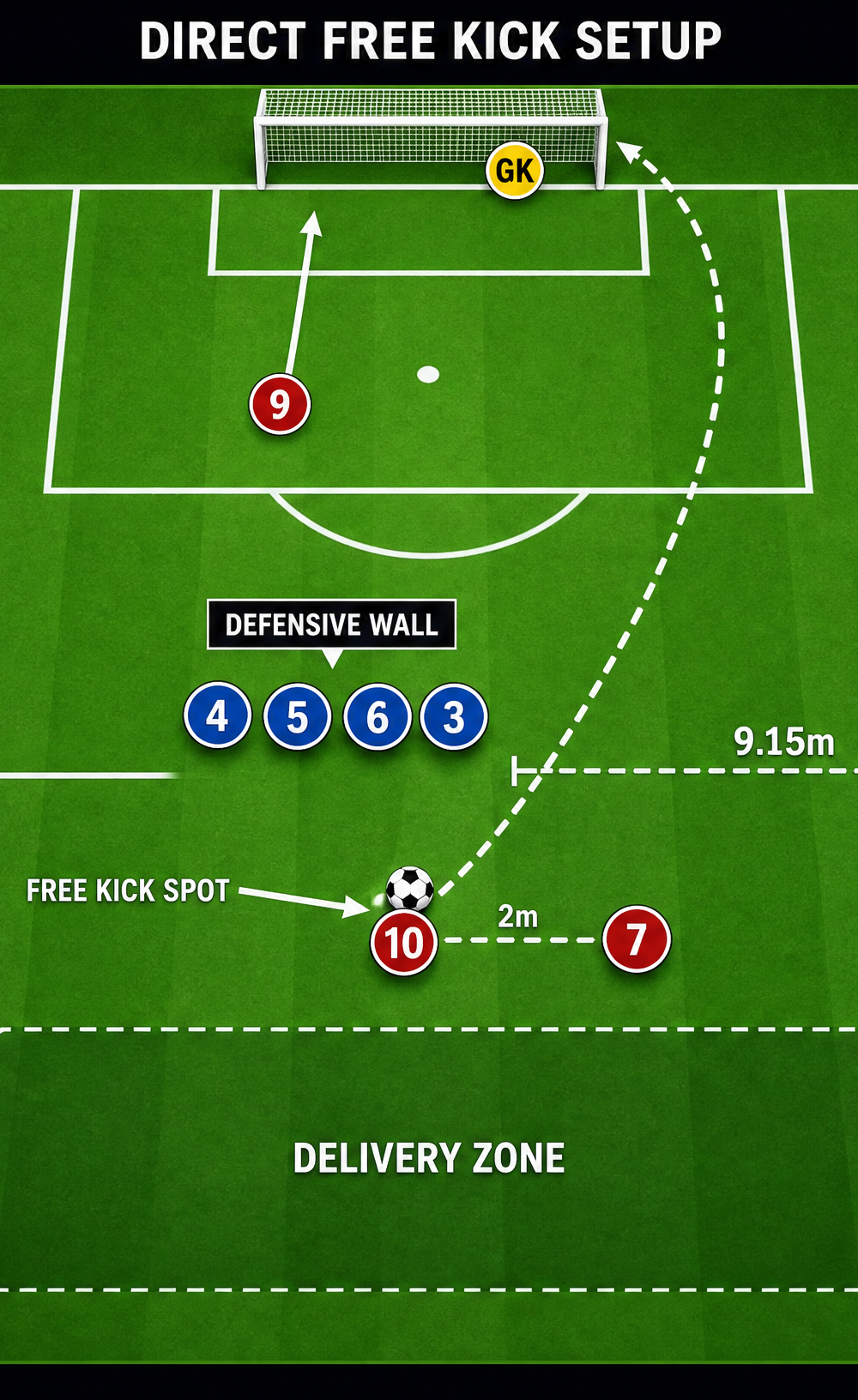
- Player 10 (Primary Taker): A player with excellent striking technique, capable of curling the ball over or around the wall.
- Player 8 (Dummy Runner / Second Taker): A player positioned slightly behind and to the side of the ball, acting as the decoy.
- Player 9 (Target Forward): Positioned centrally in the penalty area, approximately 12 metres from goal.
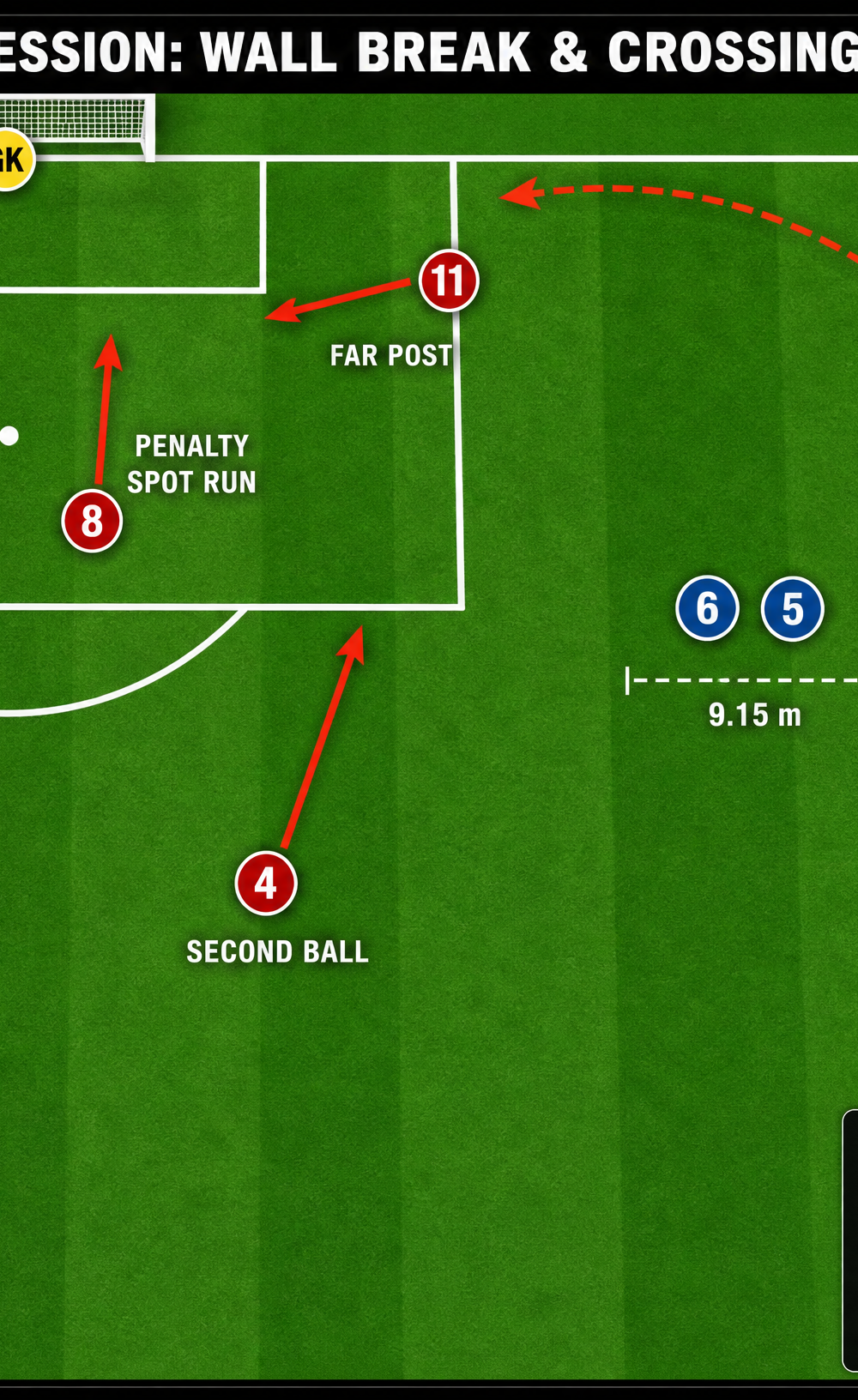
- Player 11 (Far Post Runner): Positioned on the edge of the penalty area, ready to attack the back post.
- Player 7 (Short Option): Positioned 2-3 metres to the side of the ball, ready for a short lay-off or to distract the wall.

3. Step-by-Step Instructions
- The Setup: Place the ball at the designated free kick spot (e.g., 22 metres from goal). Player 10 and Player 8 stand over the ball, discussing the play to sell the deception to the defense.
- The Trigger: The referee blows the whistle. Player 10 gives a subtle, pre-agreed signal (e.g., a nod or adjusting their socks) to initiate the movement.
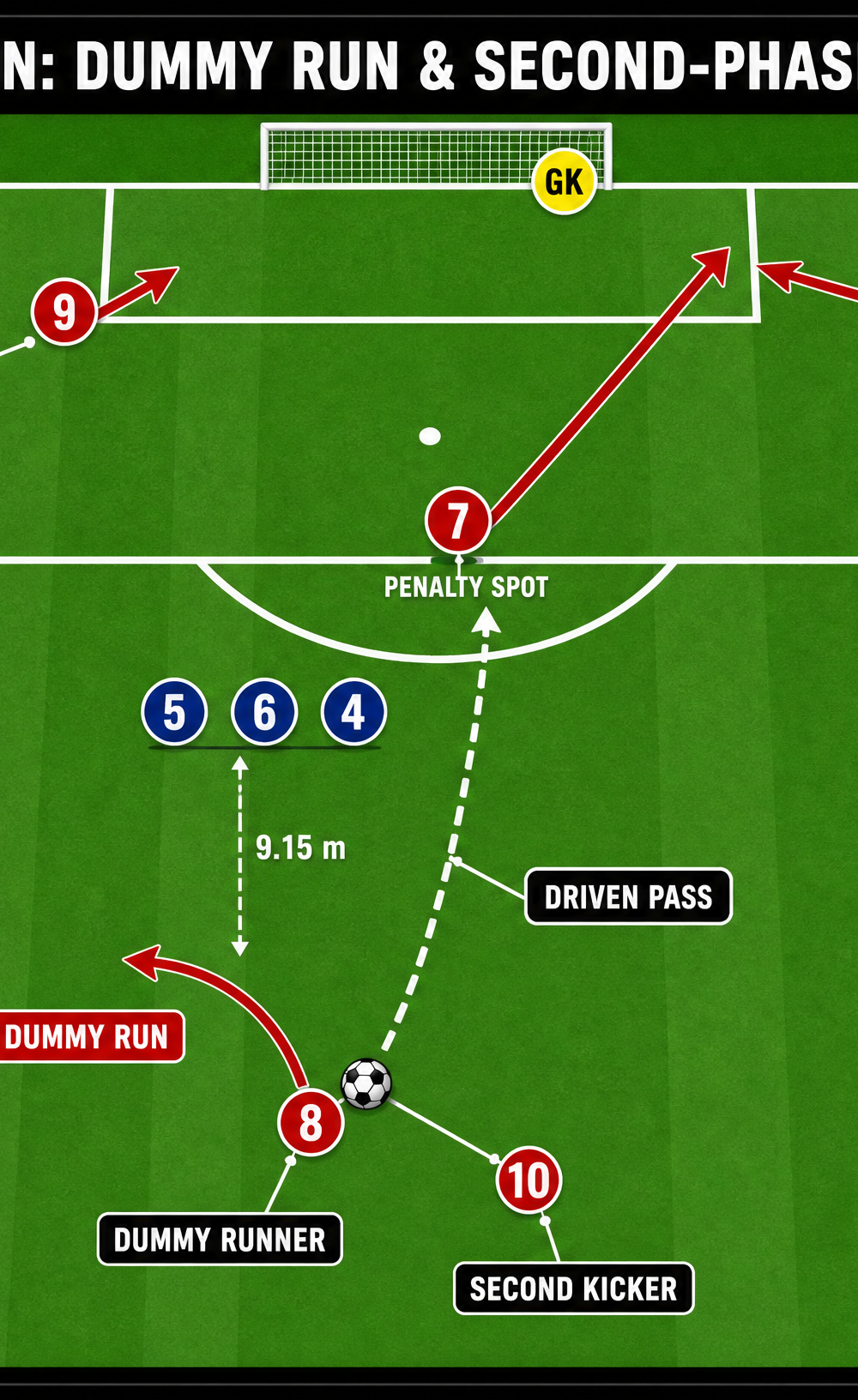
- The Dummy Run: Player 8 begins a dynamic, aggressive run toward the ball, simulating a powerful strike. Crucially, Player 8 steps over the ball without making contact and continues their run toward the defensive wall or into the penalty area.
- The Strike: As the defensive wall instinctively braces or jumps in reaction to Player 8's run, and the goalkeeper shifts their weight, Player 10 immediately steps up and strikes the ball. The strike should be aimed at the side of the goal left vulnerable by the goalkeeper's shifted positioning, often curling over the wall.
- The Follow-Up: Simultaneously, Player 9 makes a darting run toward the near post, and Player 11 attacks the far post. This ensures that any rebound from the goalkeeper or the woodwork is contested by the attacking team.
4. Key Coaching Points
- Convincing Deception: The success of the play hinges entirely on the realism of the dummy run. Player 8 must approach the ball with genuine intent, matching the body shape and speed of a real strike.
- Timing is Everything: Player 10 must strike the ball immediately after Player 8 steps over it. If there is a delay, the goalkeeper and wall will recover their balance and positioning.
- Goalkeeper Observation: The primary taker (Player 10) should observe the goalkeeper's initial position and weight distribution before the trigger. The shot should exploit any movement the goalkeeper makes in anticipation of the dummy runner.
- Aggressive Rebounding: Attackers (Players 9 and 11) must anticipate a save or a deflection. They should be at full sprint toward the goal as the ball is struck, not waiting to see the outcome.
- Wall Manipulation: If the defensive wall is prone to jumping, the primary taker can opt for a low, driven shot under the wall instead of a curled effort over it.
5. Common Mistakes
- Weak Dummy Run: If the dummy runner jogs or lacks conviction, the defense will not react, rendering the play useless.
- Poor Communication: A lack of a clear trigger signal leads to mistimed runs and a disorganized execution.
- Ignoring the Rebound: Attackers becoming spectators and failing to follow in on the shot, missing crucial second-phase opportunities.
- Predictability: Overusing the same routine in a single match. Coaches must ensure the team has variations to keep the opposition guessing.
6. Variations & Progressions
- The Lay-Off (Progression): Instead of stepping over the ball, the dummy runner (Player 8) taps the ball slightly to the side for Player 10 to strike a moving ball. This alters the angle and can disrupt the wall's alignment.
- The Driven Pass (Variation): If the defense anticipates a direct shot, Player 10 can disguise their strike and instead play a firm, low pass into the feet of Player 9 or Player 7, who have made late runs into the penalty area for a first-time finish.
7. Age Adaptations
- Under 10 - Under 12: Focus heavily on the technique of the strike and the basic concept of a dummy run. Keep the distances shorter (15-18 metres). Do not worry excessively about complex secondary runs.
- Under 14 - Under 16: Introduce the importance of timing and reading the goalkeeper's movement. Begin incorporating the specific runs for rebounds (Players 9 and 11).
- Open/Senior: Execute the full routine with all variations. Emphasize the psychological aspect of the deception and the speed of execution to exploit minor defensive errors.