

Football
Elite Goalkeeper Shot-Stopping & Angle Play Masterclass
Develop your goalkeeper's reflexes, angle management, and second-ball reactions with this comprehensive multi-phase shot-stopping drill.
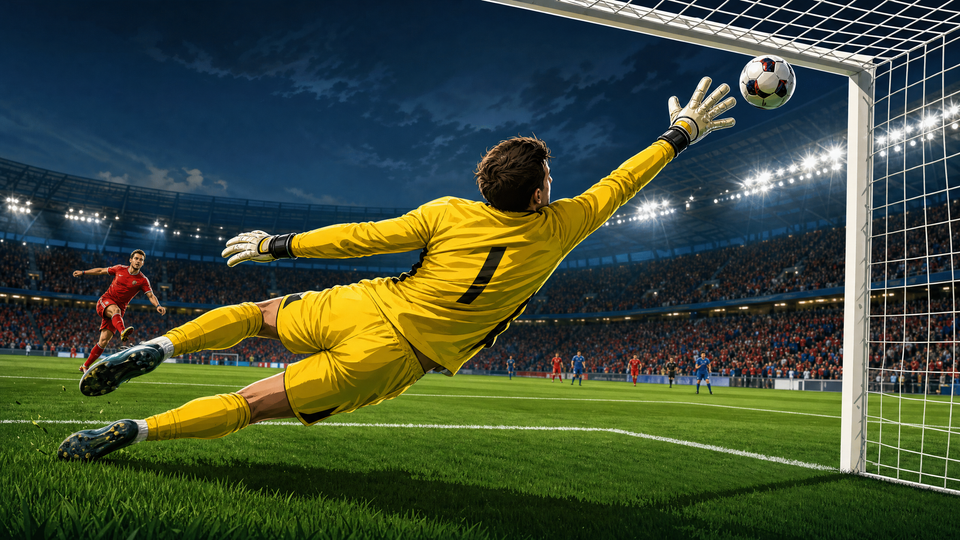
What you need
Full-size goal, 8-10 footballs, 4-6 marker cones
1. Overview
Shot-stopping is the fundamental cornerstone of goalkeeping, but modern football demands more than just basic saves. Goalkeepers must excel at rapid recovery, precise angle management, and handling unpredictable second balls under pressure. This comprehensive drill resource is designed to build these essential skills through three progressive phases, starting with foundational positioning and culminating in high-intensity match-realistic scenarios. It challenges the goalkeeper's footwork, handling, and decision-making, ensuring they are prepared for the chaos of the penalty area.
2. Setup
Pitch Area: Penalty area (18-yard box) and goal line on a standard 100-110m x 64-75m pitch.
Equipment: Full-size goal, 8-10 footballs, 4-6 marker cones (orange).
Players Required: 1 Goalkeeper (GK) and 3-4 Servers/Attackers (S1, S2, S3, CF).
Initial Setup:
- Position the Goalkeeper (GK) centrally in the goal mouth, approximately 1-2 yards off the goal line.
- Place three servers (S1, S2, S3) around the edge of the penalty area, roughly 18 yards from goal.
- S1 should be positioned on the left at a 45-degree angle.
- S2 should be positioned centrally.
- S3 should be positioned on the right at a 45-degree angle.
- Ensure an adequate supply of footballs is available with the servers to maintain a high tempo.
3. Step-by-Step Instructions
Phase 1: Basic Shot Stopping
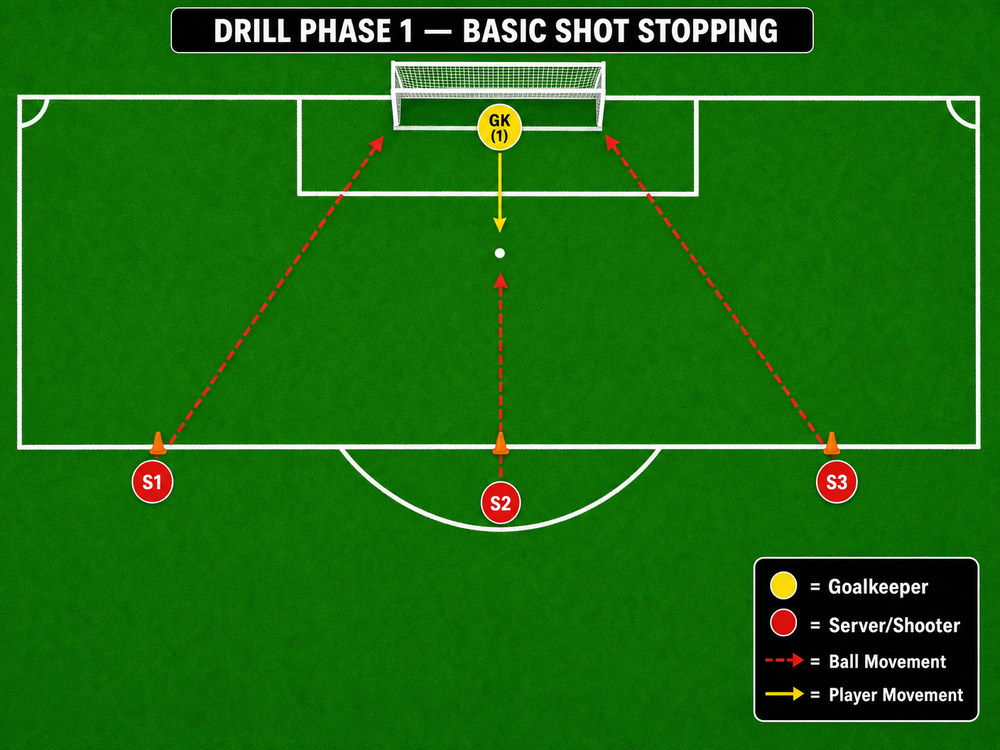
- Starting Position: The GK starts in a central set position, slightly off the goal line, focused on the central server (S2).
- The First Shot: On the coach's whistle, S2 strikes a firm, realistic shot towards the goal.
- The Save & Recovery: The GK executes the save, focusing on handling or parrying to a safe area. Immediately after the save, the GK must recover to their feet and re-establish their set position.
- Angle Adjustment: S1 or S3 then prepares to shoot. The GK must quickly adjust their position along the arc to cover the new angle before the shot is taken.
- Continuous Cycle: Rotate through the servers (e.g., S2, S1, S3, S2...) for 6-8 repetitions per set, ensuring the GK has a brief moment to reset between each shot.
Phase 2: Rapid-Fire Reaction Saves
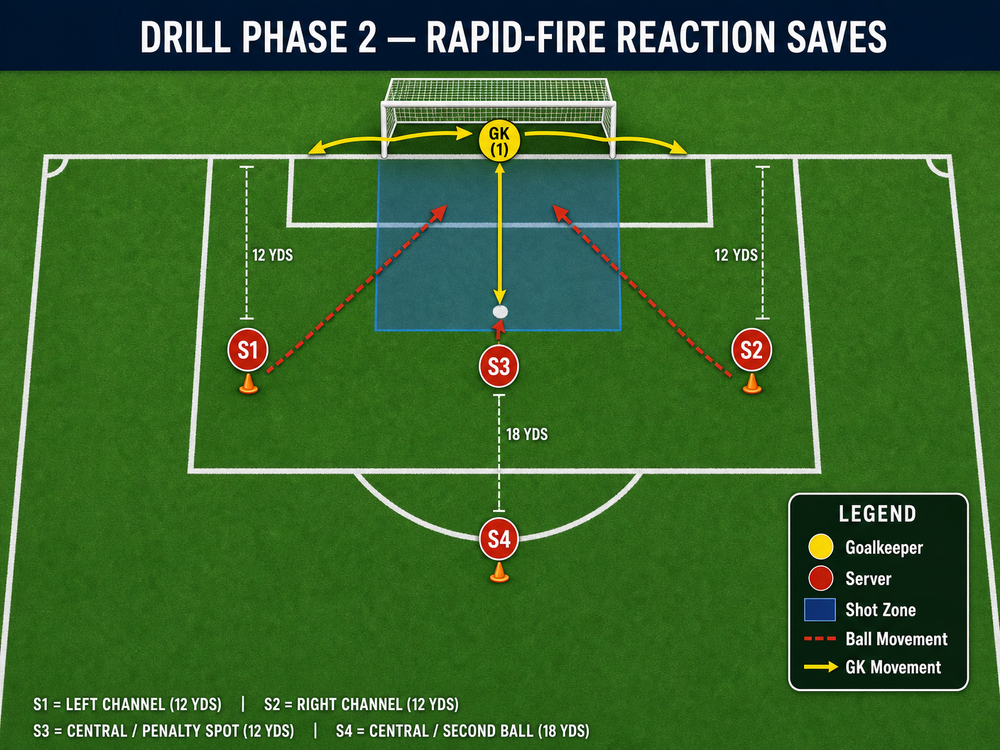
- Advanced Setup: Move the servers closer. S1 and S2 are now 12 yards out in the left and right channels. S3 is central at the penalty spot (12 yards). S4 is central at 18 yards.
- The Initial Save: The drill begins with a rapid shot from S3. The GK must react instantly.
- Lateral Recovery: Immediately following the first save, S1 or S2 fires a second shot. The GK must execute a rapid lateral recovery movement across the goal mouth to make the second save.
- The Second Ball: As the GK is recovering from the second shot, S4 delivers a third, less predictable shot. This simulates a chaotic second-ball scenario.
- High Intensity: Perform 4-5 rapid sequences per set, followed by adequate rest.
Phase 3: Angle Play & Second-Ball Pressure
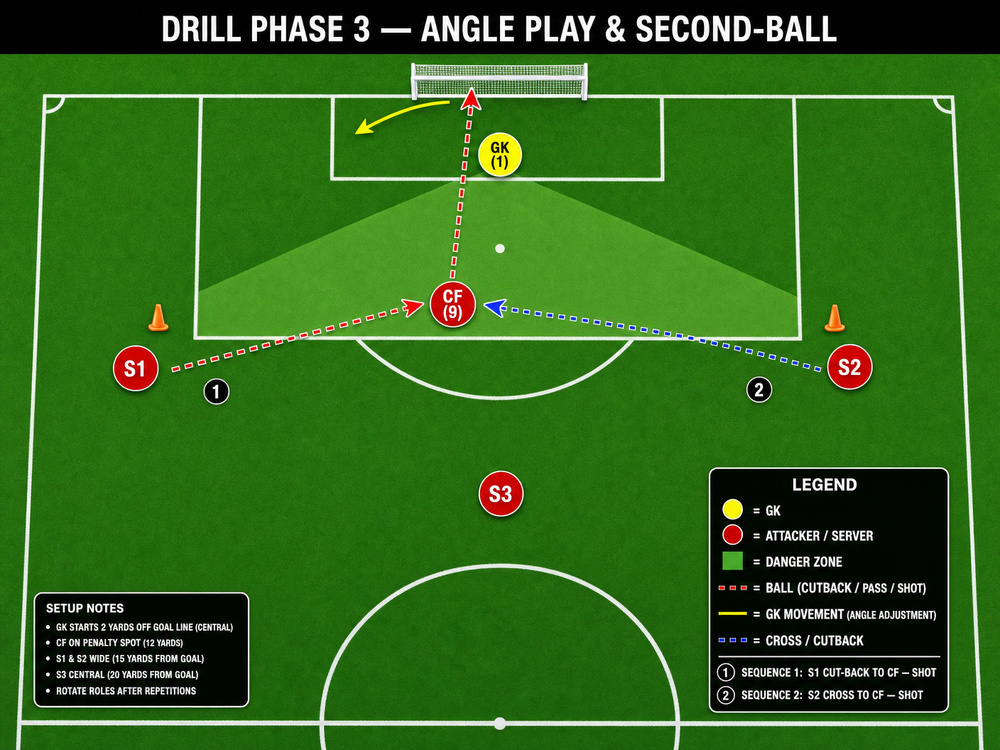
- Match-Realistic Setup: Introduce a Centre-Forward (CF) at the penalty spot. Position S1 and S2 wide on the edges of the penalty area (15 yards out). S3 is central at 20 yards.
- The Cut-back: S1 drives down the left side and delivers a cut-back pass to the CF.
- Angle Management: The GK must adjust their angle to cover the near post as S1 moves, then rapidly shift focus to face the CF as the pass is made.
- The Finish: The CF attempts a first-time finish. The GK must make the save under pressure.
- The Cross: Alternate the sequence. S2 delivers a cross from the right towards the CF.
4. Key Coaching Points
- Set Position: The goalkeeper must be completely balanced and stationary just before the shot is struck. Weight should be slightly forward on the balls of the feet.
- Angle Play: Emphasize the importance of moving along an imaginary arc between the ball and the centre of the goal.
- Handling & Parrying: Prioritize catching the ball cleanly. If a catch is not possible, the GK must actively parry the ball away from the Danger Zone.
- Rapid Recovery: The speed at which a goalkeeper gets back to their feet after a dive is crucial.
- Communication: Encourage the GK to communicate loudly and clearly (e.g., "Keeper's!", "Away!").
5. Common Mistakes
- Cheating the Angle: Anticipating the shot direction and moving before the ball is struck.
- Parrying Back into Play: Pushing the ball straight back into the central Danger Zone.
- Slow Recovery: Staying on the ground too long after a save.
- Poor Footwork: Crossing the legs when moving laterally.
6. Variations & Progressions
- Visual Impairment: Introduce a passive defender to obscure the GK's vision.
- Uneven Surface: Place flat cones in the Shot Zone to create unpredictable deflections.
- The Transition: After a clean catch, the GK must immediately initiate a counter-attack.
7. Age Adaptations
- Under 8 - Under 10: Focus purely on Phase 1 with softer shots and smaller goals.
- Under 12 - Under 14: Introduce Phase 2 with age-appropriate power.
- Under 16 - Open: All three phases at full match intensity with counter-attack progression.
