

Football
The Near-Post Crash: High-Percentage Corner Kick Set Play
Master the near-post corner kick with this comprehensive guide, featuring precise player movements, timing cues, and flick-on variations to exploit zonal marking systems.

What you need
10-12 footballs, Training bibs (two colours), Full-size goal, Cones
1. Overview
The near-post corner kick is statistically one of the most effective set plays in modern football. By attacking the space immediately in front of the goalkeeper and the first line of defenders, attacking teams can create high-percentage scoring opportunities. This set play is particularly effective against teams employing a heavy zonal marking system, as it exploits the space in front of the defensive block.
The primary objective is to deliver a fast, in-swinging or out-swinging cross to a designated runner who attacks the near post area (typically 5-6 metres from the goal line). This player can either attempt a direct header on goal or execute a flick-on to the back post or penalty spot where secondary runners are arriving. This resource breaks down the exact setup, movements, and coaching cues required to execute this play flawlessly.
2. Setup
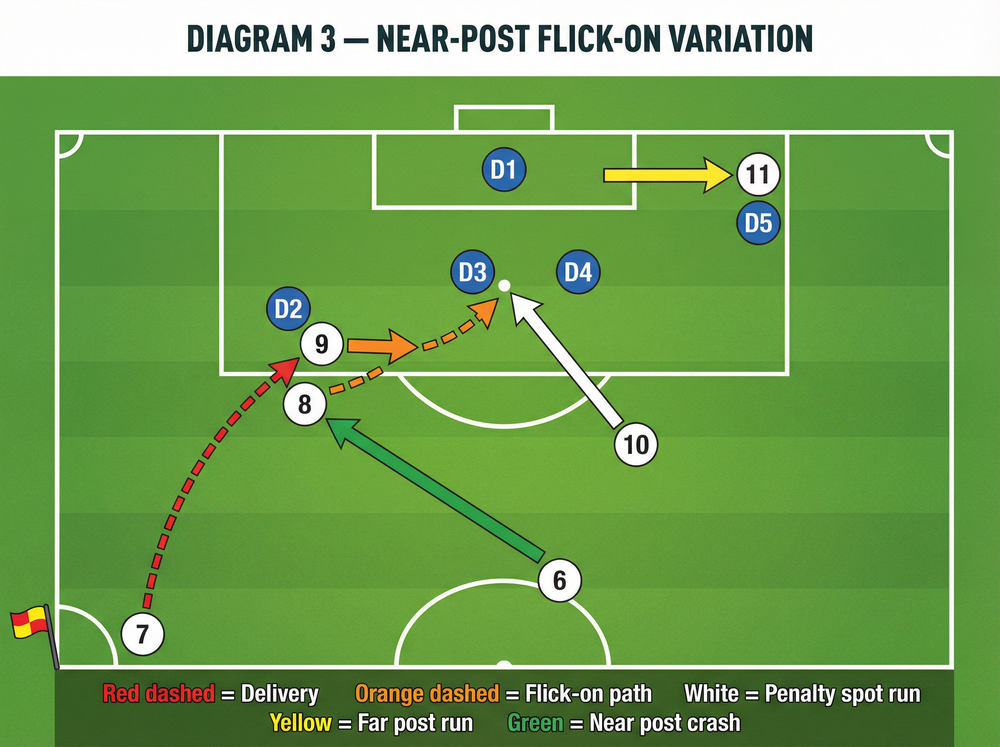
Proper setup is crucial for the success of the near-post crash. The pitch should be standard size (100-110m x 64-75m) to ensure realistic delivery distances.
Equipment Needed:
- 10-12 footballs
- Training bibs (two distinct colours)
- Full-size goal with a goalkeeper
- Cones to mark starting positions if necessary
Player Positions:
- Player 7 (The Taker): Positioned at the corner arc. Must be capable of delivering a driven ball with pace.
- Player 9 (Primary Target): The best header of the ball, starting centrally and making a darting run to the near post.
- Player 8 (The Screen/Blocker): Positioned near Player 9 to impede the progress of tracking defenders.
- Player 10 (Second Ball/Flick-on Target): Positioned near the penalty spot to capitalise on flick-ons or rebounds.
- Player 11 (Far Post Runner): Starts deep and attacks the far post area.
- Player 6 (Edge of Box): Positioned at the top of the 18-yard box to recycle clearances and prevent counter-attacks.

3. Step-by-Step Instructions
Executing this set play requires precise timing and coordination. Follow these steps to drill the movement patterns:
- The Signal: Player 7 raises one arm to signal the near-post routine. The attacking players hold their starting positions to avoid giving away the intended target area early.
- The Trigger Movement: As Player 7 begins their run-up, Player 8 makes a short, sharp movement to block or screen the nearest zonal defender (D1 or D2).
- The Primary Run: Simultaneously, Player 9 makes an explosive, curved run toward the near post, aiming to arrive exactly as the ball enters the 6-yard box.
- The Delivery: Player 7 delivers a driven cross, aiming for the space roughly 5 metres from the near post and 5 metres out from the goal line. The ball must have pace; a floated cross gives the goalkeeper time to claim it.
- The Secondary Runs: As the ball is in flight, Player 10 attacks the penalty spot area, and Player 11 makes a late, looping run to the far post.
- The Finish: Player 9 attacks the ball aggressively, aiming to direct a header on target or flick it on toward Player 10 or Player 11.

4. Key Coaching Points
To ensure your team executes this set play effectively, focus on these critical coaching points during training sessions:
- Delivery Pace is Paramount: A slow, looping cross will be easily claimed by the goalkeeper or cleared by the first defender. The delivery must be driven with pace and whip.
- Timing of the Run: Player 9 must not arrive too early. The run must be timed so that the player meets the ball at the peak of their jump, maintaining forward momentum.
- Aggressive Attack on the Ball: The near-post runner must attack the ball with conviction. Hesitation will allow the defender to win the aerial duel.
- The Importance of the Screen: Player 8's role is subtle but vital. They must legally impede the defender's path without committing a foul, creating a split-second advantage for Player 9.
- Anticipate the Second Ball: Players 10, 11, and 6 must be fully committed to their secondary runs. Many goals from this routine come from flick-ons or rebounds rather than the initial header.
5. Common Mistakes
Watch out for these frequent errors when implementing the near-post corner kick:
- Telegraphing the Run: Attackers making their runs too early, allowing defenders to track them easily and close down the space.
- Poor Delivery Trajectory: Hitting the first defender. The taker must clear the first man while keeping the ball low enough to be attacked with a header.
- Lack of Commitment at the Far Post: Player 11 failing to arrive at the far post, missing out on easy tap-ins from flick-ons.
- Overcrowding the Near Post: Too many players attacking the same space, leading to confusion and making it easier for the defence to clear.
6. Variations & Progressions
Once your team has mastered the basic near-post crash, introduce these variations to keep the opposition guessing:
- The Flick-On Routine: Instead of aiming for goal, Player 9 deliberately flicks the ball backward toward the penalty spot for Player 10, or across the face of goal for Player 11. This is highly effective against teams that over-commit to defending the near post.
- The Short Corner Setup: Start with a player showing short to draw a defender out of the penalty area, creating more space in the near-post zone before delivering the cross.
- The Dummy Run: Player 9 makes the near-post run but ducks under the ball, allowing it to travel to Player 10 arriving late at the penalty spot.

7. Age Adaptations
This set play can be adapted for various age groups and skill levels:
- Under 10s / Under 12s: Focus heavily on the quality of the delivery and the basic timing of the near-post run. Simplify the secondary runs and eliminate complex screening tactics.
- Under 14s / Under 16s: Introduce the screening concept and emphasize the importance of the second ball. Begin working on the flick-on variation.
- Senior / Open Age: Implement the full routine with all variations. Focus on marginal gains, such as the precise angle of the screen and the disguise of the initial runs.
