

Football
The Near-Post Flick: A High-Percentage Corner Kick Routine
Master a highly effective near-post corner routine designed to disrupt zonal marking and create high-quality scoring chances through a flick-on.
What you need
Footballs, Corner flags, Training bibs (two colors), Full-size goal
1. Overview
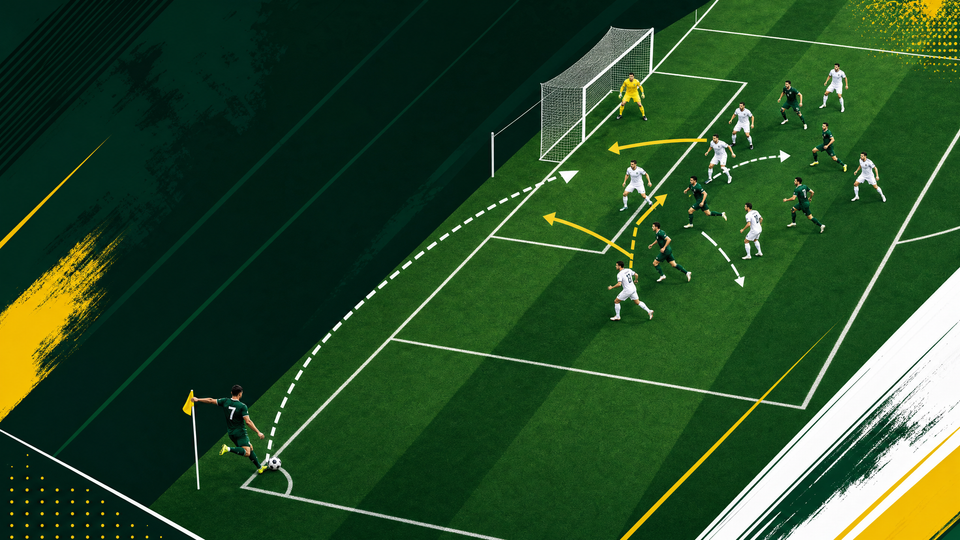
The near-post flick is a classic, highly effective corner kick set play designed to bypass heavily congested central areas. By targeting the near post, the attacking team forces the defense to react early. The primary objective is not necessarily a direct shot on goal from the initial header, but rather a flick-on that redirects the ball across the face of the goal, creating chaos and high-percentage scoring opportunities for runners arriving at the far post or penalty spot. This routine is particularly effective against teams employing zonal marking systems, as it attacks the seams between zones.
2. Setup
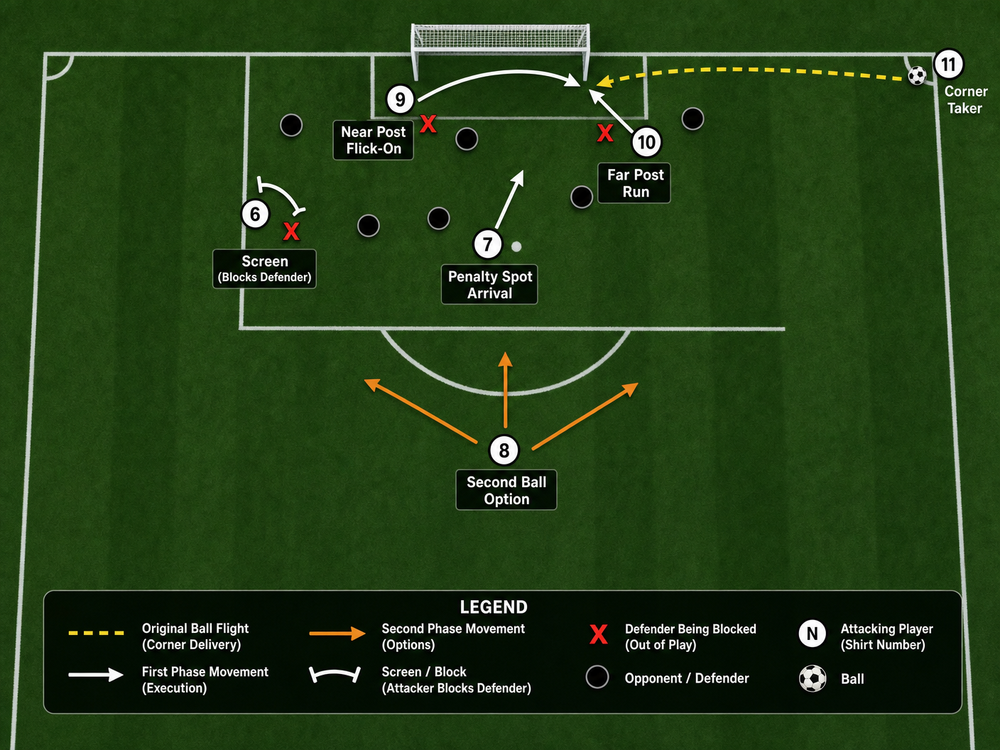
- Pitch Area: Attacking corner to the near post area (approximately the intersection of the six-yard box and the goal line extended).
- Players Involved: 6-7 attacking players inside/around the penalty area, plus the corner taker.
- Key Roles:
- Player 11 (Corner Taker): Must deliver an in-swinging cross with pace and dip, targeting the near-post zone.
- Player 9 (Near-Post Runner): The target man. Needs excellent timing, aerial ability, and the awareness to flick the ball backward rather than heading directly at goal.
- Player 10 (Far-Post Runner): Anticipates the flick-on and attacks the back post.
- Player 7 (Penalty Spot Arrival): Arrives late to the penalty spot area to capitalize on knock-downs or cut-backs.
- Player 6 (Blocker/Screen): Positions themselves to impede the run of a key defender, creating space for the primary runners.
- Player 8 (Second Ball): Positioned at the edge of the penalty area to collect clearances and prevent counter-attacks.
3. Step-by-Step Instructions
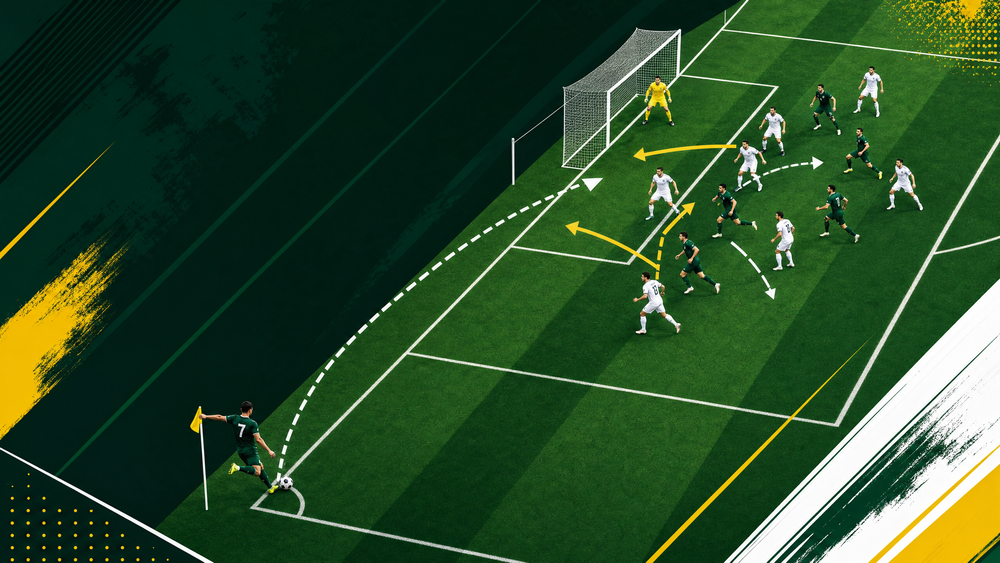
- The Signal: The corner taker (Player 11) raises one arm to signal the near-post routine. This ensures all attacking players are synchronized.
- The Starting Positions: Players 9, 10, and 7 start tightly bunched near the penalty spot or just outside the six-yard box to disguise their intended runs.
- The Movement Trigger: As Player 11 begins their run-up, the attacking players initiate their movements.
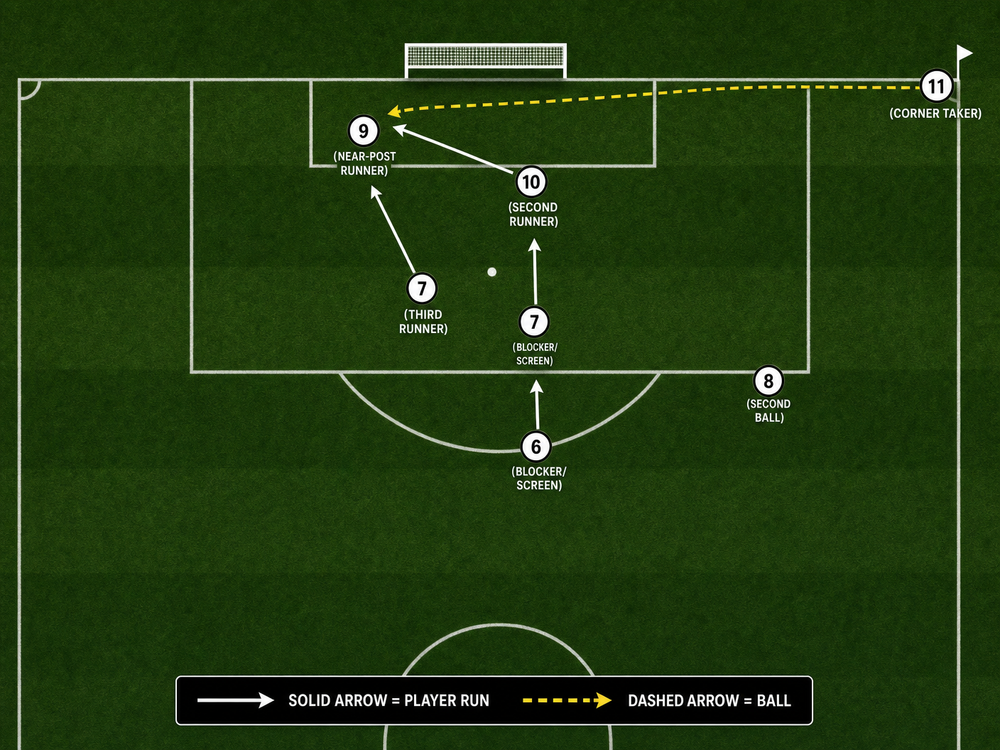
- The Primary Run: Player 9 makes a sharp, explosive sprint toward the near corner of the six-yard box, aiming to meet the ball at its highest point.
- The Screen: Simultaneously, Player 6 steps into the path of the primary near-post defender, executing a legal basketball-style screen to prevent them from challenging Player 9.
- The Delivery: Player 11 strikes an in-swinging cross, driven with pace. The trajectory should be slightly flat, dropping sharply as it reaches the near-post area.
- The Flick-On: Player 9 jumps and, rather than heading for goal, uses the pace of the cross to flick the ball backward across the face of the goal toward the far post.
- The Secondary Runs: Player 10 attacks the far post, anticipating the flick-on. Player 7 holds their run slightly, arriving at the penalty spot to clean up any loose balls or weak clearances.
4. Key Coaching Points
- Delivery is Paramount: The cross must be driven with pace. A floated, looping cross allows the goalkeeper or defenders time to adjust and claim the ball.
- Timing of the Run: The near-post runner (Player 9) must not arrive too early. They should aim to meet the ball in stride, maximizing their jumping momentum.
- The Angle of the Flick: Player 9 must focus on redirecting the ball, not overpowering it. A subtle glance is often enough to send the ball into the dangerous far-post zone.
- Commitment to Secondary Runs: Players 10 and 7 must anticipate the flick-on as a certainty. Hesitation will result in missed opportunities.
- Legal Screening: Ensure the blocker (Player 6) establishes position and holds their ground. Moving screens will be penalized as fouls.
5. Common Mistakes
- Poor Delivery: Hitting the first defender or floating the ball too high, rendering the near-post run useless.
- Arriving Too Early: The near-post runner gets under the ball, resulting in a weak header that goes out of play or is easily cleared.
- Lack of Anticipation: Far-post runners waiting to see if the flick-on is successful before starting their runs, arriving too late to capitalize.
- Illegal Blocking: The screen player actively grappling or moving to block a defender, resulting in an offensive foul.
6. Variations & Progressions
- The Short Option Dummy: Have a player show short for the corner. As the defense adjusts, the corner taker delivers the ball to the near post as originally planned, exploiting the momentary distraction.
- Direct Shot Option: If the defense begins to over-anticipate the flick-on and leaves the near post vulnerable, Player 9 can attempt a direct header on goal at the near post.
- Out-Swinging Delivery: While less common for a near-post flick, an out-swinging delivery can be used if the team lacks a proficient in-swinging taker, though it requires more power on the flick-on.
7. Age Adaptations
- Under 8 - Under 10: Focus on the basic mechanics of the corner kick delivery and the concept of running toward the ball. The complex flick-on is generally too advanced; encourage direct attempts on goal or simple knock-downs.
- Under 12 - Under 14: Introduce the concept of the near-post run and the specific roles of the runners. Begin practicing the flick-on technique, emphasizing timing over power.
- Under 16 - Open: Implement the full routine, including the screening tactics and the precise timing required for the secondary runs. Emphasize the tactical awareness needed to read the defense and adjust the play accordingly.
