

Football
Near Post Flick-On: The Ultimate Corner Kick Routine
Master the near post flick-on corner routine to bypass zonal marking systems and create high-quality goal-scoring opportunities at the far post.
What you need
5-6 Footballs, Bibs (2 colors), Full-size goal, Corner flags
1. Overview
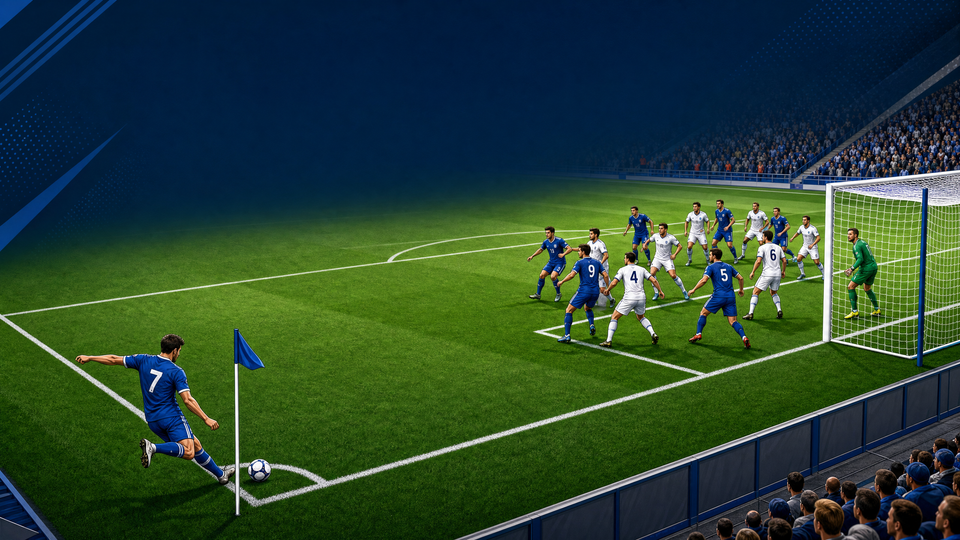
The near post flick-on is one of the most effective and widely used corner kick routines in modern football. This set play is designed to exploit the space at the near edge of the six-yard box, drawing defenders toward the ball and creating chaos in the penalty area. By delivering an inswinging ball to a designated near-post runner, the attacking team aims to either score directly with a glancing header or flick the ball across the face of the goal for an arriving teammate to finish at the far post.
This routine is particularly effective against teams that employ a heavy zonal marking system, as it attacks the space just outside their defensive block before they can react. It requires precise delivery, aggressive movement, and coordinated timing.
2. Setup
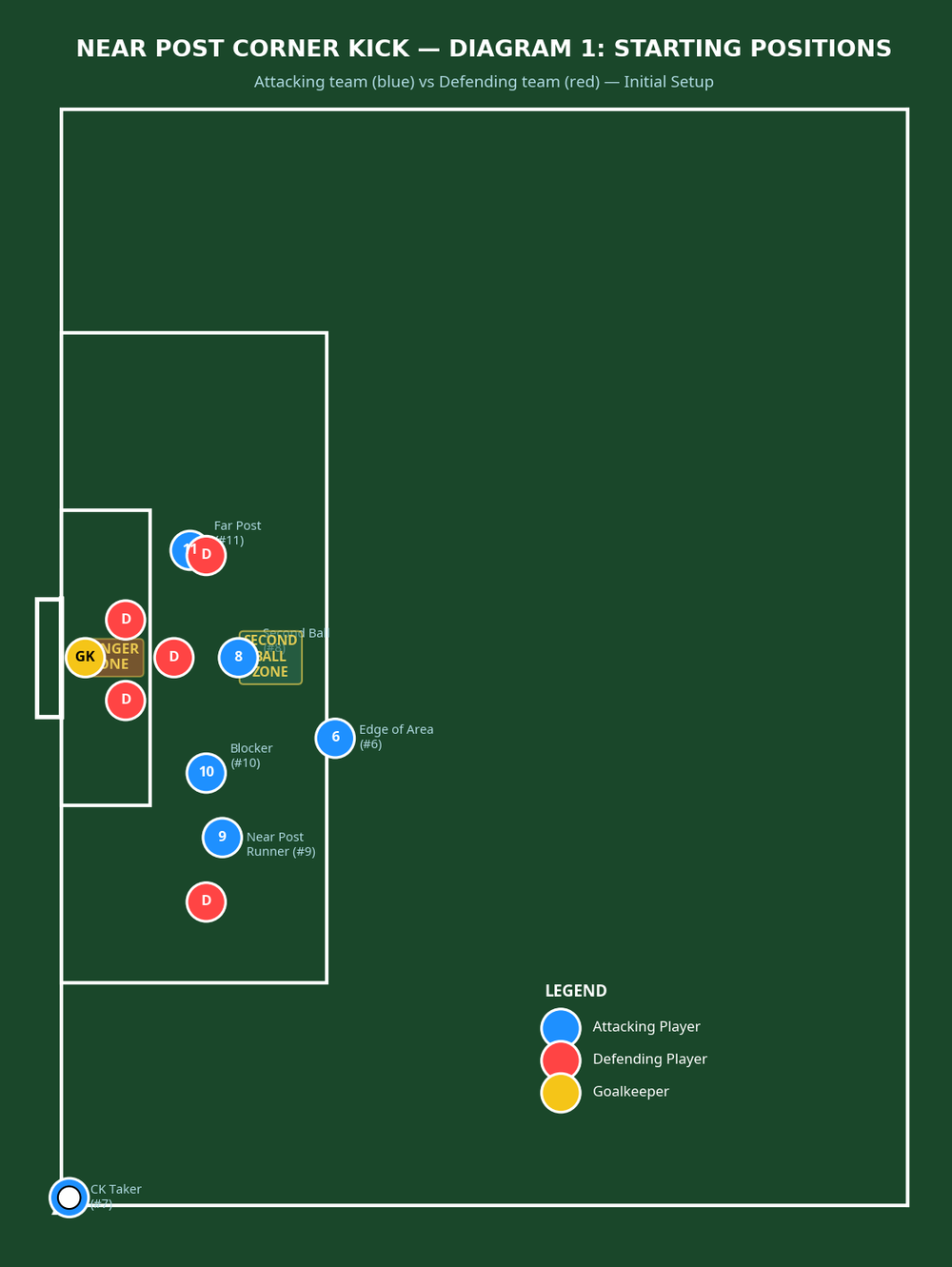
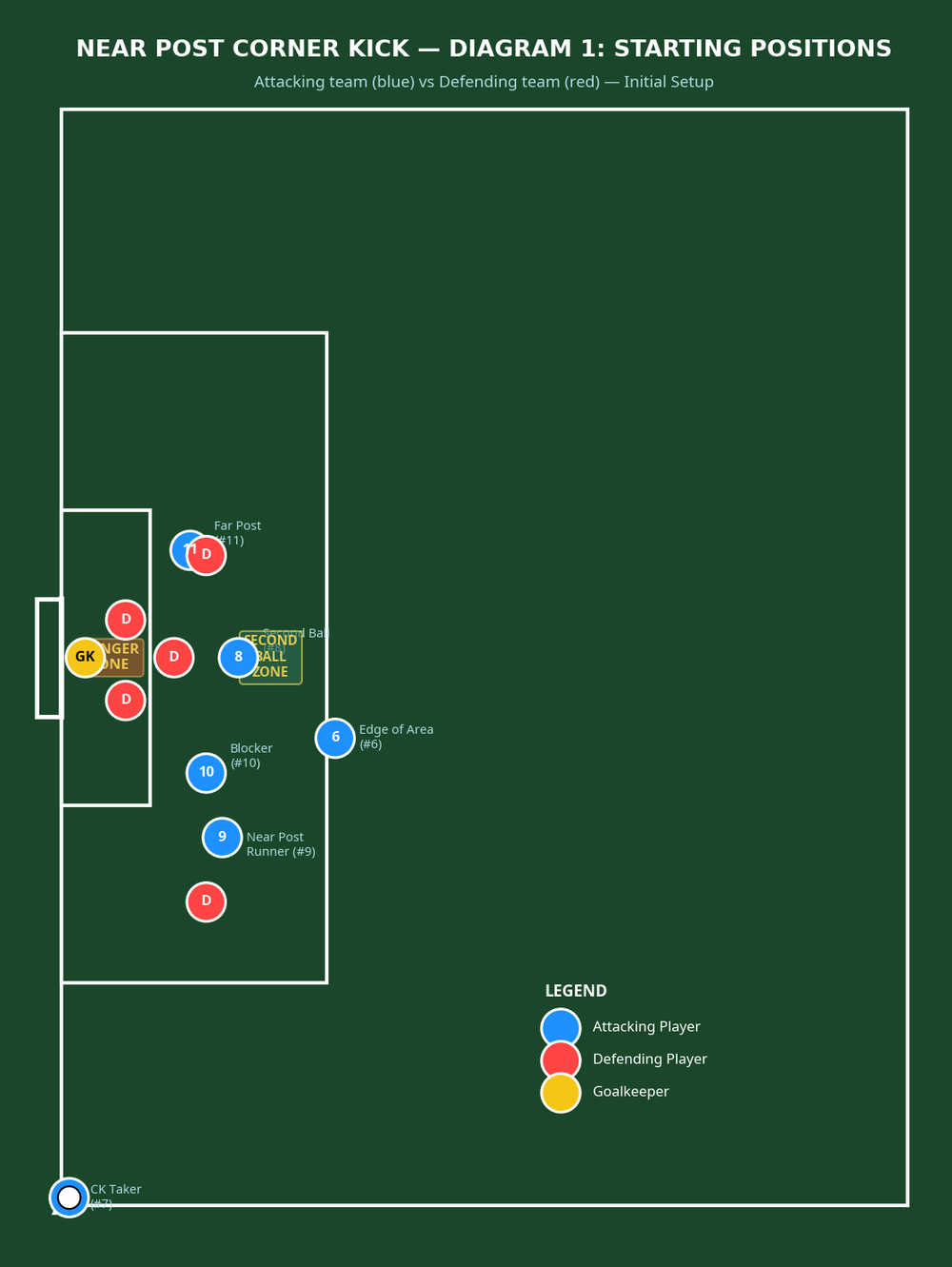
Pitch Area: Attacking third, specifically the corner arc and the penalty area (on a standard 100–110m × 64–75m pitch).
Equipment: 5–6 footballs at the corner flag, bibs for attackers and defenders, and a full-size goal.
Player Roles:
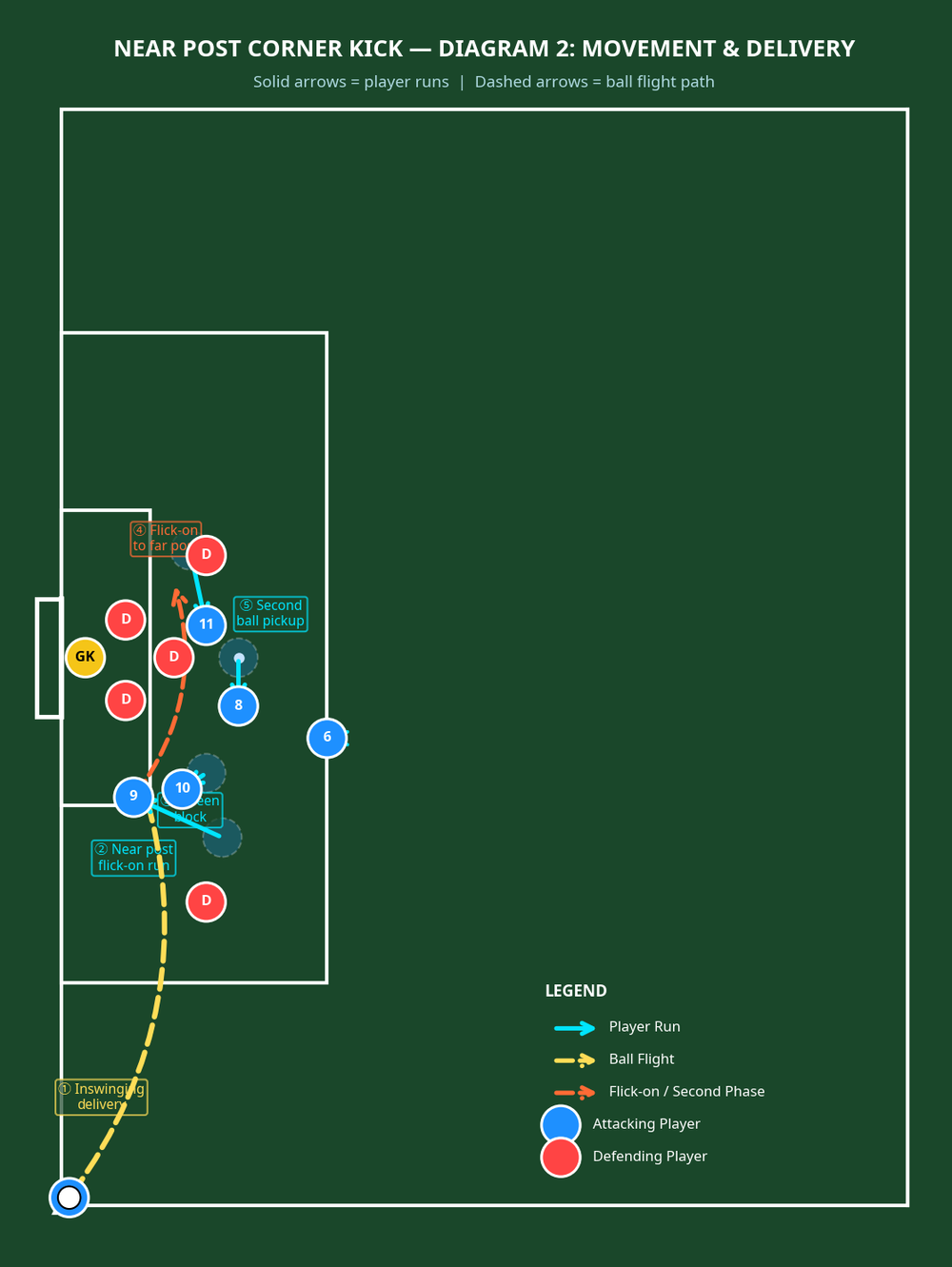
| # | Position | Role |
|---|---|---|
| 7 | Wide Midfielder / Winger | Corner Taker — delivers inswinging cross |
| 9 | Centre Forward | Near Post Runner — primary flick-on target |
| 10 | Attacking Midfielder | Blocker — screens the near-post zonal defender |
| 11 | Left Winger | Far Post Runner — attacks the flick-on |
| 8 | Central Midfielder | Second Ball — covers penalty spot |
| 6 | Centre Back / Defensive Mid | Edge of Area — prevents counter-attacks |
3. Step-by-Step Instructions
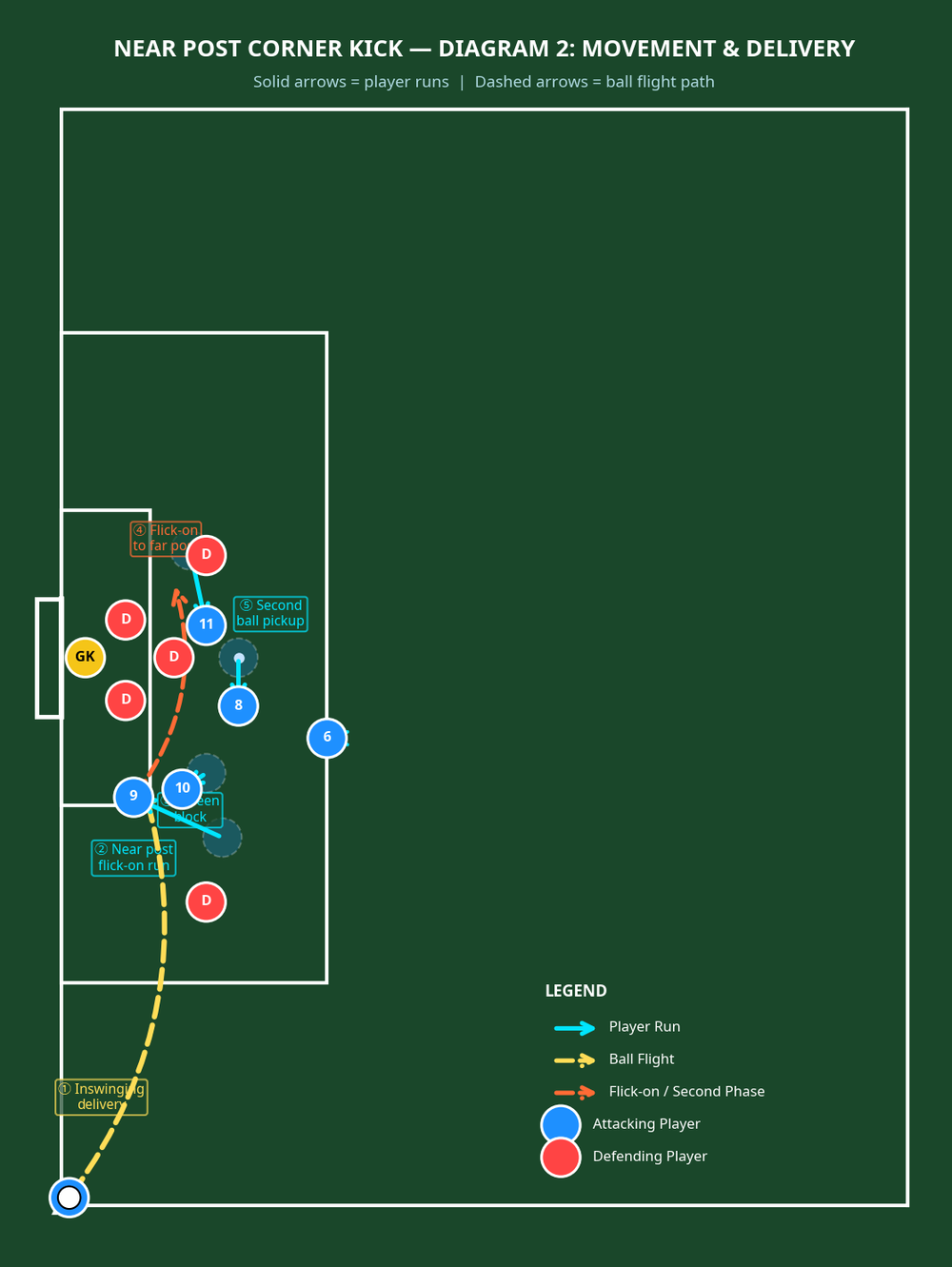
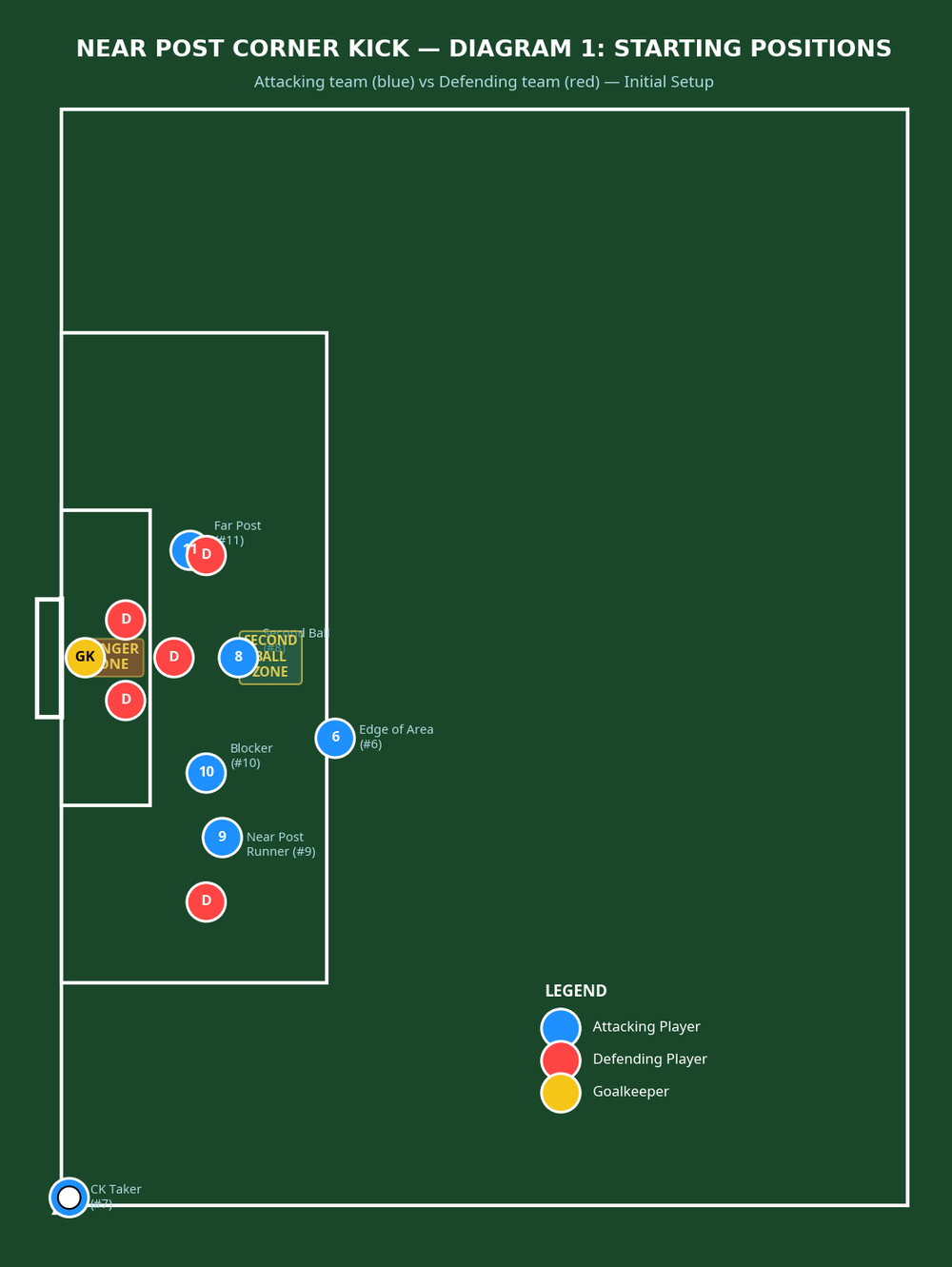
- The Signal: The corner taker (#7) raises one arm to signal the near-post routine. This ensures all attackers are synchronized and ready to initiate their movements on the same trigger.
- The Trigger: As the taker begins their run-up (approximately 3–4 steps), all movement inside the penalty area begins simultaneously. Timing is critical — moving too early allows defenders to adjust, while moving too late means the ball arrives before the runners.
- The Block: The blocker (#10) makes a subtle, legal screen on the defender guarding the near-post zone, occupying the space the defender wants to attack. The goal is to impede the defender's momentum just enough to give the runner a clean jump.
- The Run: The near-post runner (#9) starts from a deeper position approximately 12 metres from goal and sprints aggressively toward the near corner of the six-yard box, aiming to meet the ball at its highest point.
- The Delivery: The taker delivers a hard, driven, inswinging cross aimed at the near corner of the six-yard box — at head height, approximately 5–6 metres from the goal line. The ball should arrive within 1.5–2 seconds of the taker's foot striking it.
- The Flick-On: The runner (#9) attempts to glance the header across the face of the goal, redirecting the ball toward the far post area. The contact should be firm but controlled — the aim is redirection, not power.
- The Finish: The far-post runner (#11) and the second-ball attacker (#8) crash the net, anticipating the flick-on or any spilled saves by the goalkeeper to tap the ball home.
4. Key Coaching Points
- Pace on the Delivery: The corner must be driven with pace. A floated cross gives the goalkeeper and defenders too much time to react and attack the ball. Aim for a delivery that travels 20–22 metres in under 2 seconds.
- Timing of the Run: The near-post runner must arrive as the ball arrives — not before, not after. If they get there too early, they lose their momentum and jumping advantage. Use the phrase "meet the ball at the top" to reinforce this.
- Legal Screening: The blocker must stand their ground rather than actively grappling the defender. They should occupy the space the defender wants to attack. Coach them to make contact with their back, not their arms.
- Commitment to the Far Post: The far-post runners must believe the flick-on is going to happen every single time. They must attack the space aggressively, even if the ball is cleared 9 times out of 10. Use the coaching cue: "if in doubt, attack the back post."
- Edge-of-Area Discipline: The player at the edge of the area (#6) must resist the temptation to drift forward. Their primary job is to win the second ball and prevent a fast counter-attack.
- GK Communication: Remind attackers that the goalkeeper will call for the ball. Encourage runners to get their body between the keeper and the ball to make that claim more difficult.
5. Common Mistakes
- Over-hitting the Cross: The most frequent error is the taker putting too much height or distance on the ball, bypassing the near post entirely and delivering a routine cross that the goalkeeper can claim.
- Static Starting Positions: Attackers starting their runs from a standing position directly in the six-yard box. They must generate momentum from deeper areas (10–12 metres out) to out-jump static defenders.
- Fouling on the Block: The blocker using their hands or actively moving into the defender, resulting in an offensive foul. Reinforce that they must be stationary when contact is made.
- Lack of Second Ball Readiness: Players watching the flight of the ball rather than anticipating the knockdown or clearance. The second-ball player should be moving toward the ball before the flick-on happens.
- Taker Starting Too Close: The corner taker standing too close to the corner flag, reducing the angle and arc available for an inswinging delivery.
6. Variations & Progressions
- Short Corner Variation: Two players position at the corner flag. The taker passes to the second player who has moved into space, drawing a defender out of the penalty area. This creates a 2v1 on the flank before delivering to the near post — ideal against teams that send a defender to press the corner taker.
- The Dummy Run: The designated near-post runner sprints aggressively to the near post but deliberately ducks under the ball at the last moment, allowing it to travel to a second runner arriving just behind them. This is highly effective once defenders have been conditioned to track the first runner.
- Outswinging Delivery: Use an outswinging delivery to the same near-post area. This makes the flick-on harder to execute but is much safer against goalkeeper claims and creates a different visual challenge for defenders.
7. Age Adaptations
| Age Group | Focus | Modifications |
|---|---|---|
| Under 10s / Under 12s | Delivery and aggressive near-post run | Remove blocking assignments; focus on one runner and the taker. Use a smaller goal if needed. |
| Under 14s | Introduce the flick-on concept and far-post runners | Add the far-post runner and second-ball player. Keep blocking simple. |
| Under 16s / Open | Full routine with blocking and variations | Implement all roles, blocking assignments, and introduce the short corner and dummy run variations. |
For younger age groups, reduce the pitch area by working in a smaller zone and use a size 4 ball to make delivery easier. The core principle — aggressive near-post movement and a redirected header — remains the same at all levels.
