

Football
Penalty Box Movement Play for Crosses
Master the art of attacking crosses with coordinated, multi-layered penalty box runs to dismantle any defense.
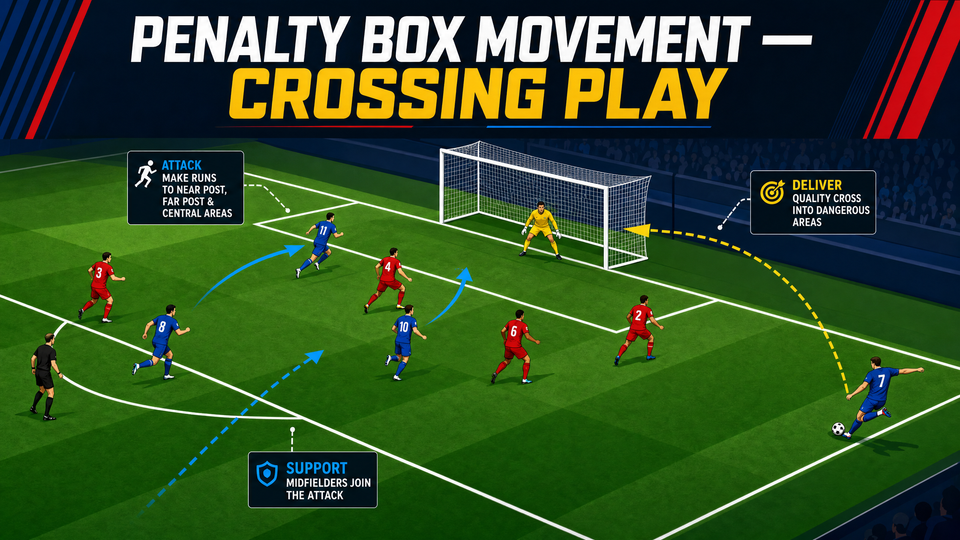
What you need
1 full-size goal, 10-12 footballs, Cones or markers, Training bibs
1. Overview
Crossing situations are among the most frequent attacking phases in modern football, yet they often yield low conversion rates due to static or predictable penalty box movement. The Penalty Box Movement Play for Crosses is designed to solve this by introducing coordinated, multi-layered runs that overload specific defensive zones, drag defenders out of position, and create high-quality goal-scoring opportunities.
This play is highly effective against deep blocks or organized defenses where simply lofting the ball into the box is insufficient. By synchronizing the timing of the runs—near post, far post, penalty spot, and edge of the box—you force defenders to make split-second decisions, often resulting in unmarked attackers in dangerous areas. Use this set play when your wingers or full-backs have established a strong wide presence and are ready to deliver quality service.
2. Setup
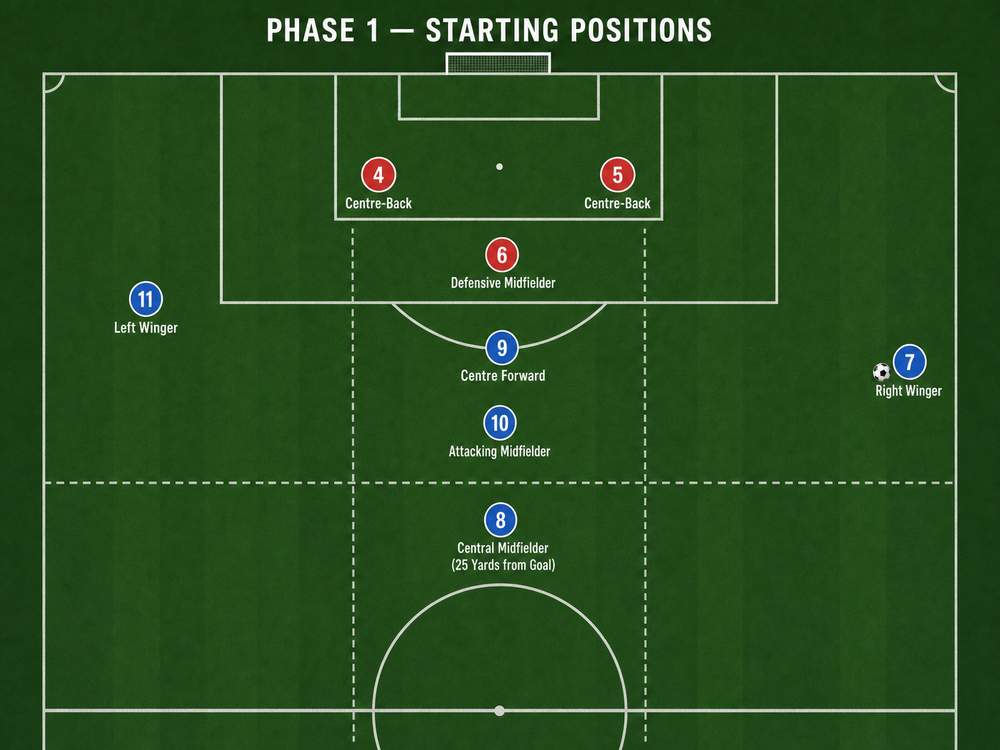
To effectively practice and execute this set play, proper pitch setup and player positioning are crucial. This drill should be run on a standard pitch (100-110m x 64-75m) to ensure spatial awareness and timing translate directly to match day.
Equipment Needed
- 1 full-size goal
- 10-12 footballs placed with the wide players
- Cones or markers to outline specific attacking zones (near post, far post, penalty spot, edge of the box)
- Training bibs (two contrasting colors for attackers and defenders)
Player Positions
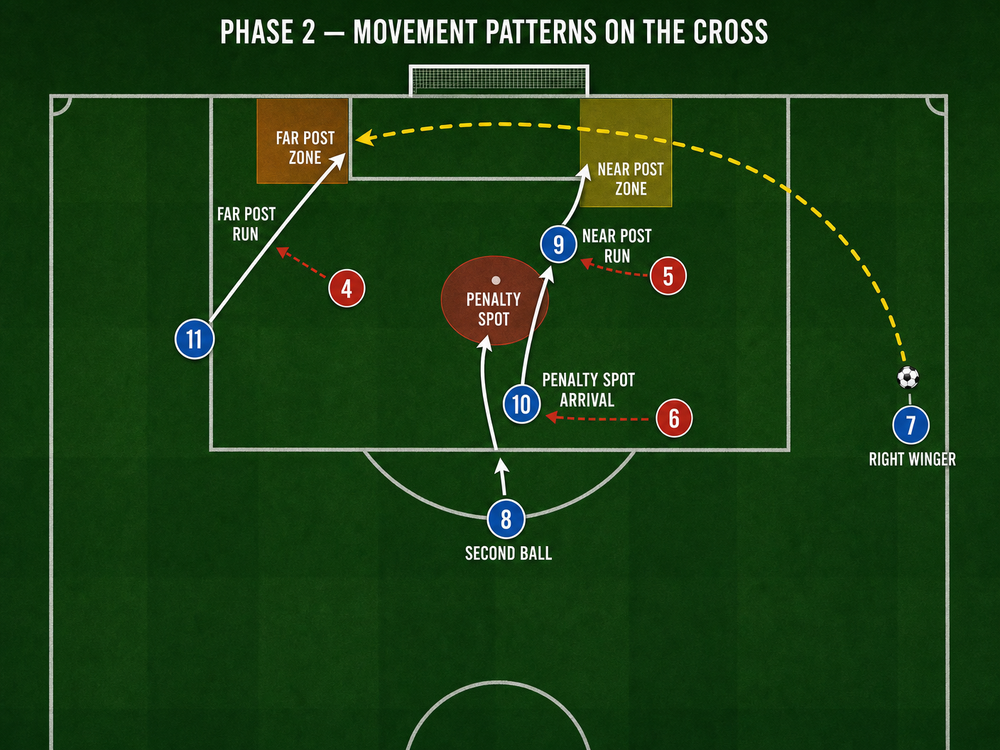
- No. 7 / No. 11 (Wingers/Full-backs): Positioned wide near the touchline, responsible for delivering the cross.
- No. 9 (Centre Forward): Starting central, ready to make the primary near-post run.
- No. 11 / No. 7 (Opposite Winger): Starting wide on the opposite flank, responsible for the far-post run.
- No. 10 (Attacking Midfielder): Starting deeper, tasked with arriving late at the penalty spot.
- No. 8 (Central Midfielder): Positioned around 25 yards out, ready to sweep up second balls at the edge of the area.
- Defenders: 2 Centre-Backs and 1 Defensive Midfielder to provide active resistance.
3. Step-by-Step Instructions
Execution relies on precise timing and clear communication. Follow these steps to drill the movement patterns until they become second nature to your players.
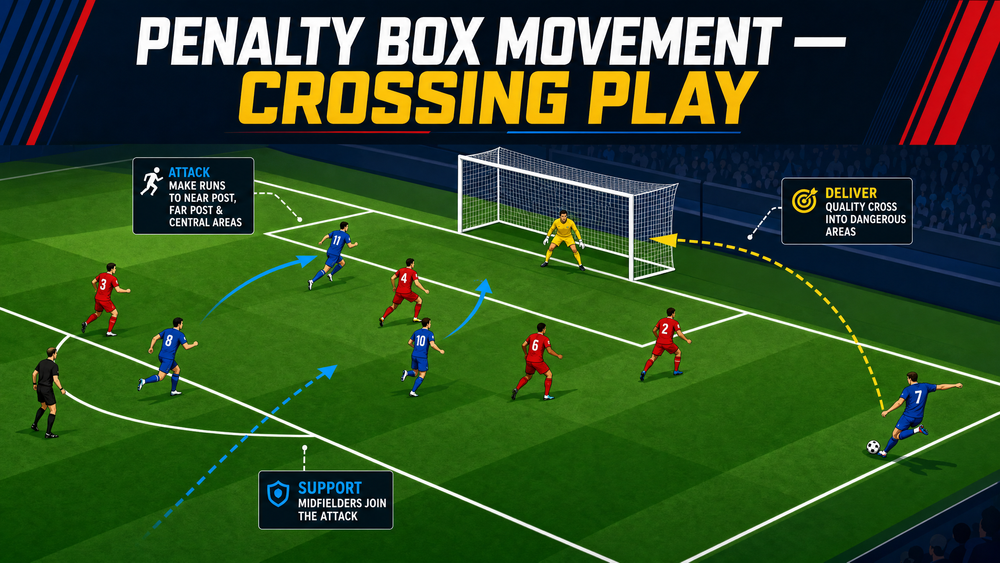
- The Trigger: The wide player (No. 7) receives the ball and takes a positive touch out of their feet, signaling they are ready to cross. This touch is the visual trigger for all attackers to begin their movements.
- The Near-Post Run (The Decoy/Primary Target): The Centre Forward (No. 9) makes an aggressive, explosive sprint across the face of the near-post Centre-Back. The goal is to arrive in the 6-yard box just as the ball is delivered. This run must drag the defender with them.
- The Far-Post Run (The Overload): Simultaneously, the opposite winger (No. 11) drifts in from the weak side, targeting the space behind the far-post Centre-Back. They must time their arrival to meet any ball that clears the near-post traffic.
- The Cut-Back Run (The Late Arriver): As the No. 9 clears the central space, the Attacking Midfielder (No. 10) makes a delayed, deliberate run to the penalty spot. They should arrive exactly as the ball is cut back, ensuring they are unmarked.
- The Second Ball Support: The Central Midfielder (No. 8) holds their position at the edge of the D (18-yard line). Their role is to intercept clearances, recycle possession, or take a first-time shot if the ball drops loose.
- The Delivery: The crosser must read the runs and select the best option. They should aim for the near post if No. 9 has a yard of space, cut it back to No. 10 if the defenders drop too deep, or float it to the far post if the goalkeeper overcommits.
4. Key Coaching Points
To ensure this set play translates from the training ground to a competitive match, focus on these critical teaching elements during your sessions:
- Timing Over Speed: Arriving too early makes the attacker static and easy to mark; arriving too late means missing the cross entirely. Players must learn to pace their runs based on the crosser's body language.
- Explosive Changes of Direction: Attackers should not run in straight lines. Teach them to use double movements (e.g., feinting to the far post before sprinting near) to lose their markers.
- Quality of Delivery: The cross must match the run. A near-post run requires a hard, driven cross, while a far-post run may need a lofted, floated delivery. A cut-back requires a precise, grounded pass.
- Zonal Discipline: Players must not occupy the same space. If the No. 9 and No. 10 end up in the same 5-yard radius, the defense has an easy job. Maintain spatial discipline.
- Anticipation of the Second Ball: The No. 8 must be proactive, not reactive. They should anticipate where the clearance will land and attack the ball aggressively to sustain pressure.
5. Common Mistakes
Watch for these frequent errors and correct them immediately to maintain the effectiveness of the play:
- Static Starts: Attackers waiting flat-footed inside the box before the cross is delivered. They must start deeper and arrive onto the ball with momentum.
- Crowding the Near Post: Multiple players making the same run, making it easy for one defender to clear the ball. Ensure distinct, separate runs.
- Poor Cross Selection: The winger crossing blindly into the box without looking up to see which run has successfully lost its marker.
- Neglecting the Edge of the Box: Forgetting to position a player for the second ball, leaving the team vulnerable to a quick counter-attack if the cross is cleared.
6. Variations & Progressions
Once the basic pattern is mastered, introduce these variations to keep the defense guessing and challenge your players further.
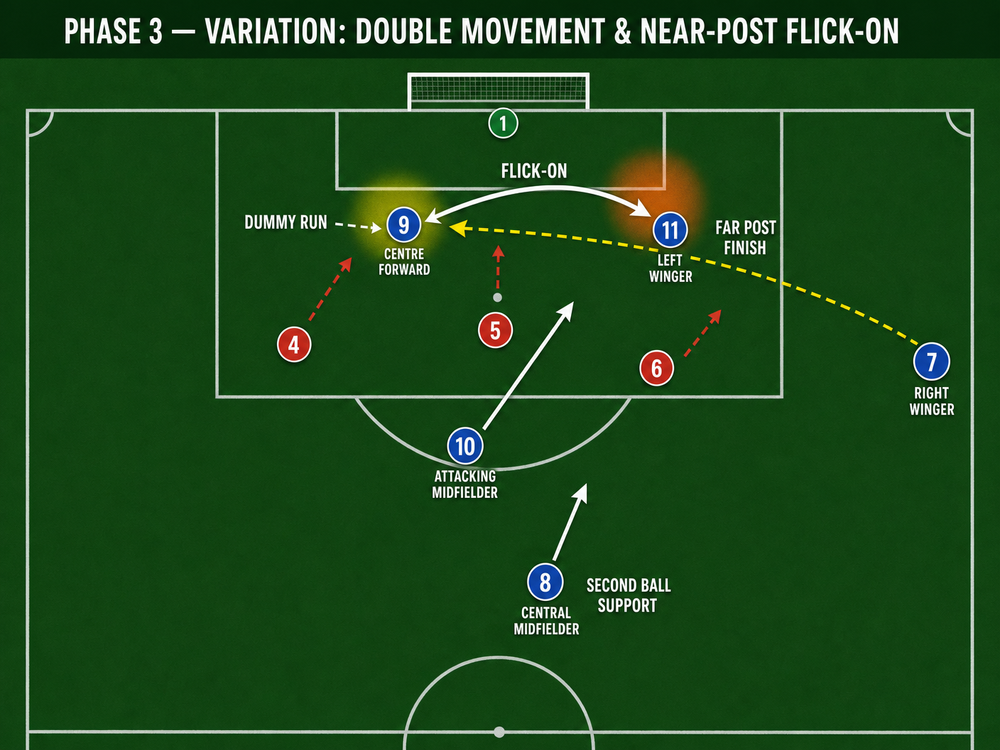
Variation: The Near-Post Flick-On
Instead of the No. 9 trying to score directly, they make a darting run to the near post specifically to flick the ball on with their head or heel. The No. 11 anticipates this and adjusts their far-post run to attack the central 6-yard box for a tap-in.
Progression 1: Active Defenders
Start the drill with passive defenders (shadowing only), then progress to fully active, tackling defenders who are instructed to clear the ball at all costs. This tests the attackers' timing and bravery under pressure.
Progression 2: The Overlap/Underlap
Introduce a full-back overlapping or underlapping the winger before the cross. This forces the defense to shift laterally, creating larger gaps in the penalty box for the central attackers to exploit.
7. Age Adaptations
Tailor the complexity of this set play based on the age and skill level of your squad:
- Under 10s: Focus purely on the concept of "one player goes near, one player goes far." Keep it simple and prioritize the technique of striking a moving ball.
- Under 12s - Under 14s: Introduce the timing of the runs and the cut-back option to the penalty spot. Begin emphasizing the importance of not running in straight lines.
- Under 16s - Open Age: Implement the full multi-layered system, including double movements, specific delivery types (driven vs. lofted), and strict positional discipline for second balls.
