

Football
Quick Advantage Throw-In: The Wall & Go Combination
Master the Wall & Go throw-in combination to instantly convert a dead-ball restart into a dangerous attacking opportunity, exploiting defensive disorganisation in the attacking third.

What you need
footballs (4-6), flat cones (8-10), bibs in 2 colours (14), full-size or 3/4-size pitch
Overview
The Wall & Go throw-in set play is a structured, rehearsed combination designed to turn a routine dead-ball restart into an immediate attacking threat. Unlike corner kicks or free kicks, throw-ins are frequently undervalued by coaches at every level — yet statistics from professional football consistently show that teams who execute organised throw-in routines in the attacking third create measurably more chances per possession than those who simply return the ball to the nearest player.
This play is most effective when the throw-in is awarded in the attacking third, specifically within 35 metres of the opponent's goal line and within 10 metres of the penalty area. The core principle exploits a universal defensive vulnerability: in the seconds immediately following a throw-in, defending teams are rarely in a compact, organised shape. The Wall & Go uses a short layoff, a sharp decoy run, and a well-timed overlapping sprint to create a 2v1 or 3v2 overload on the flank before the defence can reorganise.
Use this play when your team wins a throw-in in the attacking third, when the opposition defence is retreating or disorganised, or when you want to shift the point of attack quickly and create width. It is equally effective against both high-pressing and deep-defensive opponents.
Setup

Equipment Required
| Item | Quantity | Purpose |
|---|---|---|
| Full-size footballs | 4–6 | Primary play + spare balls for flow |
| Cones (small, flat) | 8–10 | Mark player starting positions |
| Bibs (2 colours) | 14 | Distinguish attacking and defending units |
| Full-size or 3/4-size pitch | 1 | Attacking third only required for drill |
Pitch Setup
Work in the attacking third of a standard pitch (100–110m × 64–75m). Mark the throw-in position on the left touchline, approximately 25–30 metres from the opponent's byline. Place flat cones at the starting positions for each attacking player as described below. If running as a drill rather than in a match context, use the area from the halfway line to the opponent's goal, with defenders positioned to simulate a mid-block.
Player Positions (Attacking Unit)
| Number | Position | Starting Location |
|---|---|---|
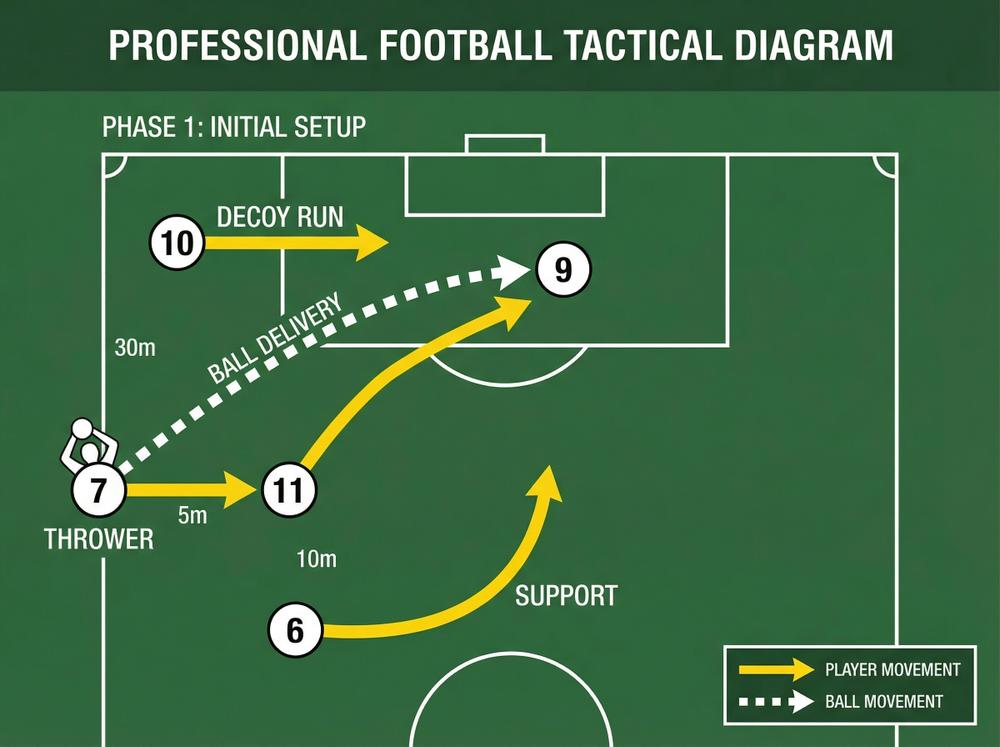
| 7 | Right Winger / Thrower | Left touchline, throw-in spot, 28m from byline |
| 11 | Left Winger / First Receiver | 4–5m infield from touchline, level with thrower |
| 10 | Attacking Midfielder | 8–10m infield, 3m ahead of throw-in spot |
| 9 | Centre Forward | Central channel, 15–18m ahead, near penalty area |
| 6 | Central Midfielder | 10–12m behind throw-in spot, central support |
Step-by-Step Instructions

Step 1 — Signal the Play (Pre-Throw)
Before retrieving the ball, Player 7 (the thrower) raises one arm to signal the set play. All five players move to their designated starting cones. This signal must be established in training so players recognise it instantly under match pressure. Allow 3–4 seconds for everyone to get into position.
Step 2 — Decoy Run by Player 10 (0–1 second)
As Player 7 picks up the ball and steps to the touchline, Player 10 makes a sharp, convincing forward run of 6–8 metres toward the penalty area. This run must look like the intended target — it is designed to pull at least one defender out of position and create space for the real combination. Timing is critical: the run begins just as Player 7's hands go overhead.
Step 3 — Short Throw to Player 11 (1–2 seconds)
Player 7 delivers a firm, flat throw to Player 11's feet. The throw should travel no more than 4–5 metres. Player 11 must check their shoulder before receiving and be ready to play one-touch. The ball should arrive at a comfortable height — waist to chest — to allow a clean first touch.
Step 4 — Layoff to Player 10 (2–3 seconds)
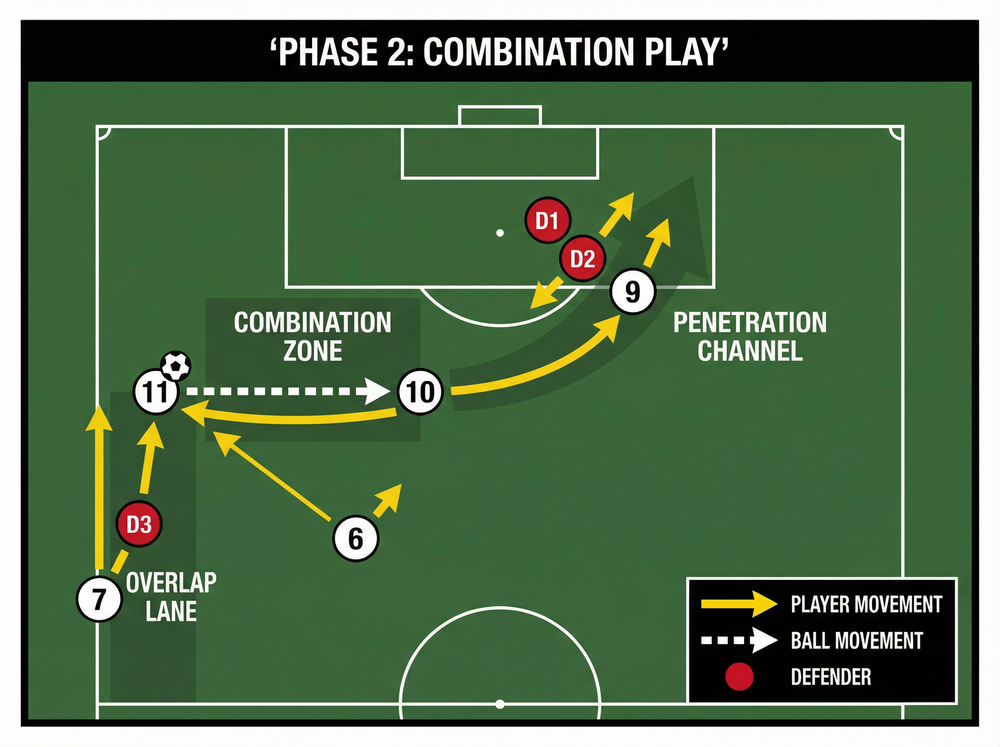
Player 11 plays a first-time or second-touch layoff into the path of Player 10, who has now checked back from their decoy run. The pass should be played into space 2–3 metres ahead of Player 10, not to feet, so they can move forward at pace. Player 10 receives facing forward with their back to the touchline.

Step 5 — Player 7 Overlaps (2–4 seconds)
Immediately after releasing the throw, Player 7 sprints into the pitch and makes an overlapping run down the left flank, outside Player 11. This is the key movement that creates the overload. Player 7 should be running at full pace by the time Player 10 receives the layoff, arriving in the overlap lane approximately 3–4 seconds after the throw.
Step 6 — Player 9 Times the Penetrating Run (3–5 seconds)
Player 9 holds their starting position until Player 10 receives the layoff, then makes a diagonal run into the channel between the centre-back and the full-back. This run should be timed to arrive in the penalty area as the ball is played forward. Player 9 must not make the run too early — patience here is the difference between an offside flag and a clear scoring opportunity.
Step 7 — Decision Point for Player 10 (4–5 seconds)
Player 10 now has three options, in order of priority:
- Play the through ball to Player 9's diagonal run into the penalty area.
- Slip the overlap to Player 7 running down the left flank for a cross.
- Recycle back to Player 6 if both forward options are closed down.
Coach Player 10 to scan before receiving and make the decision early. The play succeeds because the defence must choose between covering the diagonal run, the overlap, and the central option — they cannot cover all three simultaneously.
Step 8 — Player 6 Provides Depth (Ongoing)
Player 6 moves forward to the edge of the attacking third to provide a recycling option and to be available for a second-ball situation if the initial combination breaks down. Player 6 should not advance beyond the throw-in spot until the ball is in play.
Key Coaching Points
Speed of execution is everything. The play only works if it is executed before the defence can reorganise. Encourage players to move to their starting positions quickly and decisively. The moment the signal is given, the clock is ticking.
The decoy run must be convincing. Player 10's initial forward run is the engine of the whole play. If it is half-hearted, no defender will follow it, and the space for the layoff and overlap disappears. Demand full commitment — arms pumping, head up, sprint pace.
Player 7 must enter the pitch immediately. The most common failure point is the thrower standing on the touchline after delivering the throw. Emphasise in every repetition that Player 7's job is not finished at the moment of release — the overlap is their primary attacking contribution.
Player 9's timing is the difference between a goal and an offside. Work specifically on this timing in isolation. Player 9 should use Player 10's first touch as the trigger to begin their run, not the moment of the throw.
Player 10 must receive on the half-turn. If Player 10 receives the layoff facing the touchline, the play slows down and the defence recovers. Insist on body shape — open hips, head up, weight on the front foot.
Communicate the trigger word. Establish a single verbal trigger (e.g., "Go!") that Player 10 calls to Player 11 to initiate the layoff. This removes hesitation and synchronises the combination.
Common Mistakes

Mistake 1 — Throwing to the wrong player. Some throwers, under pressure, instinctively throw to the player who is most open rather than executing the set play. Reinforce in training that Player 11 is always the first receiver, regardless of what the defence does. Use repetition under pressure to build this habit.
Mistake 2 — Player 11 holding the ball too long. The layoff must be immediate — one or two touches maximum. If Player 11 takes three or more touches, Player 7's overlap is wasted and the defence has time to recover. Drill the one-touch layoff in isolation before adding it to the full sequence.
Mistake 3 — Player 9 running too early. If Player 9 makes their diagonal run before Player 10 receives the layoff, they will be offside or will have to check back, losing the run's momentum. Use a cone as a visual trigger in training: Player 9 does not move until the ball reaches Player 10.
Mistake 4 — Player 6 pushing too high. If the central midfielder advances too aggressively, the team loses its defensive cover and its recycling option. Player 6 should hold their position until the play has developed past the combination zone.
Mistake 5 — Telegraphing the play. If all five players sprint to their cones simultaneously and obviously, the opposition will read the play before the throw is taken. Encourage players to drift casually into position, with only Player 11 making a clear, deliberate move to the receiving spot.
Variations & Progressions


Variation 1 — The Long Throw Direct (Advanced)
If your team has a player capable of a long throw of 20+ metres (common at U16 and above), use the same signal but deliver the ball directly into the penalty area. Player 9 attacks the near post, Player 10 attacks the far post, and Player 11 positions for the second ball at the edge of the box. Player 6 holds at the top of the penalty area for a shooting opportunity from a flick-on. This variation is most effective when the opposition defence is not set and cannot organise a zonal marking structure in time.
Variation 2 — The Reverse (Intermediate)
Instead of Player 7 overlapping, Player 11 — after playing the layoff — makes the overlapping run down the flank, while Player 7 moves infield to occupy the space Player 11 vacated. Player 10 now has the option to play the overlap to Player 11 or to turn infield and find Player 7 in a central position. This variation is particularly effective against teams that aggressively track the original thrower's overlap.
Variation 3 — The Switch (Intermediate–Advanced)
After Player 10 receives the layoff, instead of playing forward, they switch the ball quickly to Player 8 (right midfielder) on the opposite flank, who has made a late run into space. This variation is used when the opposition has overloaded the left side to defend the initial combination. It requires a higher level of spatial awareness and communication but can be devastatingly effective against teams that commit heavily to one side.
Age Adaptations

| Age Group | Key Modifications |
|---|---|
| Under 10 / Under 12 | Reduce to a 3-player version: thrower, receiver, and forward runner only. Remove the decoy run and overlap. Focus purely on the short throw and immediate forward pass. Use a smaller pitch area (30m × 20m). |
| Under 14 | Introduce the full 5-player structure but allow 2–3 touches for each player. Add the decoy run but do not require it to be at full pace. Focus on the positional concept rather than the timing. |
| Under 16 | Run the full play at match pace with passive defenders first, then progress to semi-active defenders who can intercept but not tackle. Introduce the Long Throw Direct variation for players with the physical capability. |
| Open / Senior | Run the full play against an active defensive unit. Add a goalkeeper and shoot at goal. Introduce all three variations and allow players to choose based on what the defence presents. Time the play and challenge the team to complete the combination in under 5 seconds from signal to shot. |
This set play is designed to be drilled in 15–20 minutes of focused practice before being introduced in a small-sided game context. Once players have internalised the movement patterns, it can be rehearsed in as little as 5 minutes as part of a pre-match warm-up.
