

Football
Front Three High Press: Forcing the Touchline Trap
Master the art of the high press by coordinating your front three to cut off central passing lanes, force the opponent wide, and spring a touchline trap to win the ball in dangerous areas.

What you need
1 full-size goal, 2 mini-goals, 10-12 footballs, Cones, Bibs (3 colors)
1. Overview
The Front Three High Press is an aggressive defensive strategy designed to disrupt the opponent's build-up play from the back. Instead of retreating into a defensive block, the team actively engages the opponent deep in their own half. The primary objective is to cut off central passing lanes, force the ball out wide to the full-backs or isolated centre-backs, and then spring a coordinated "trap" using the touchline as an extra defender. When executed correctly, this play leads to high turnovers, creating immediate numerical advantages and goal-scoring opportunities in the final third.
This tactic is highly effective against teams that insist on playing out from the back but lack elite technical composure under pressure.
2. Setup
- Pitch Area: Full pitch or a marked 70m x 60m area focusing on the attacking half.
- Equipment: 1 full-size goal, 2 mini-goals (placed on the halfway line for the defending team to target), 10-12 footballs, cones/bibs.
- Players Required: Minimum 14 players (7v7 for the drill). The pressing team requires a front three (LW, CF, RW), a midfield three (LCM, CM, RCM), and at least one full-back stepping up. The defending team requires a GK, back four, and holding midfielders.
- Starting Positions: The pressing team sets up in a 4-3-3 shape. The front three start high, just outside the opponent's penalty area.
3. Step-by-Step Instructions
Phase 1: The Initial Trigger

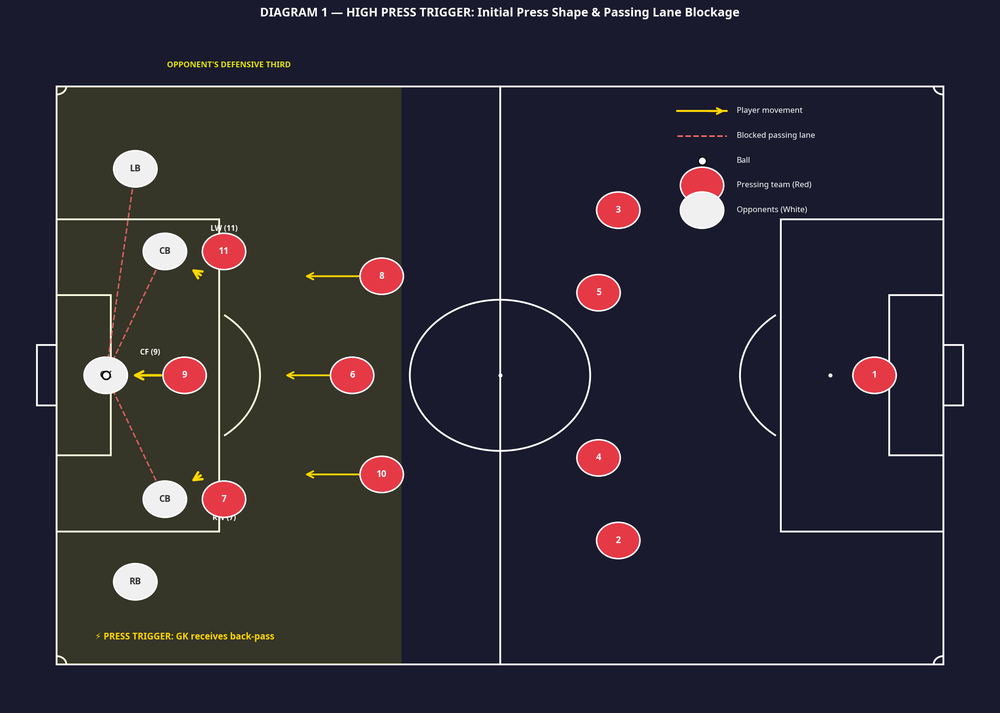
- The Trigger: The press is initiated the moment the opponent's Goalkeeper plays a short pass to a Centre-Back (CB), or when a back-pass is played to the GK.
- Central Denial: The Centre Forward (9) initiates the press by curving their run to cut off the passing lane between the two CBs or the GK. The CF's body shape must force the ball-carrier to play towards one side of the pitch.
- Wingers Tuck In: The Left Winger (11) and Right Winger (7) start slightly inverted. They do not press the Full-Backs immediately. Instead, they position themselves to intercept passes into the central midfielders while being ready to sprint towards the CB if the ball is played there.
Phase 2: Springing the Touchline Trap
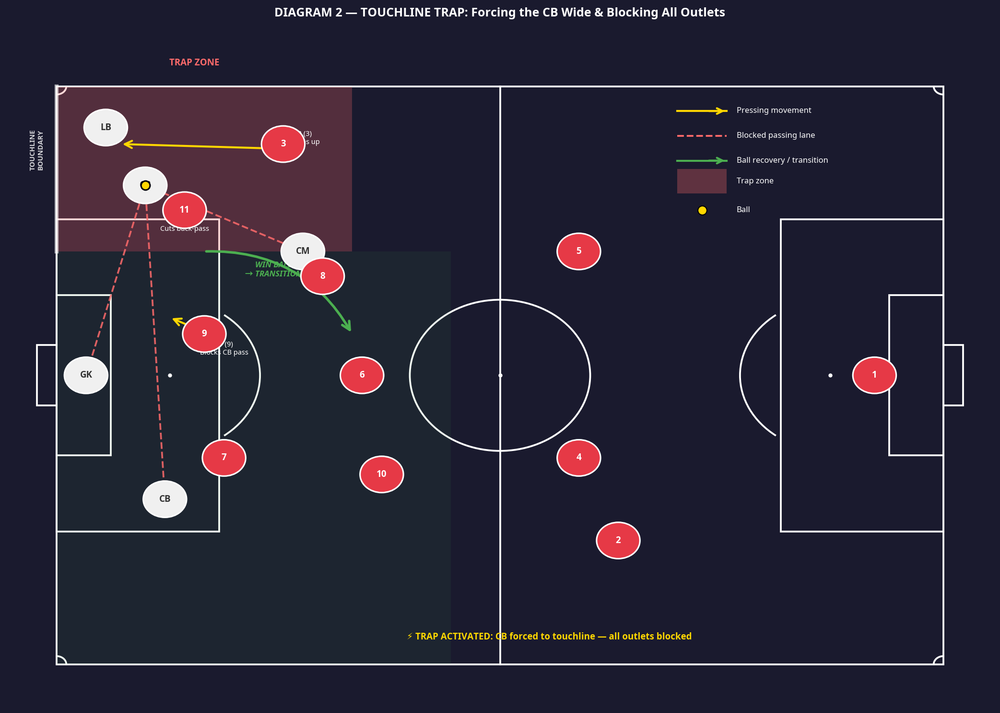
- Forcing it Wide: As the CF cuts the pitch in half, the opponent is forced to play the ball to the wide CB or the Full-Back near the touchline.
- The Trap Closes: Once the ball travels wide, the trap is sprung. The near-side Winger (e.g., LW 11) aggressively presses the ball-carrier, angling their run to cut off any pass back to the GK or inside to the central midfielder.
- Midfield Support: The near-side Central Midfielder (LCM 8) steps up tight to mark the opponent's near-side midfielder, preventing an easy out-ball.
- Full-Back Aggression: The pressing team's Full-Back (LB 3) must push high up the pitch, stepping in front of the opponent's winger to anticipate and intercept any hopeful ball played down the line.
- The Touchline is a Defender: The combination of the Winger, Midfielder, and Full-Back creates a triangle around the ball-carrier, using the touchline to restrict their movement and force a turnover.
Phase 3: The Counter-Attack
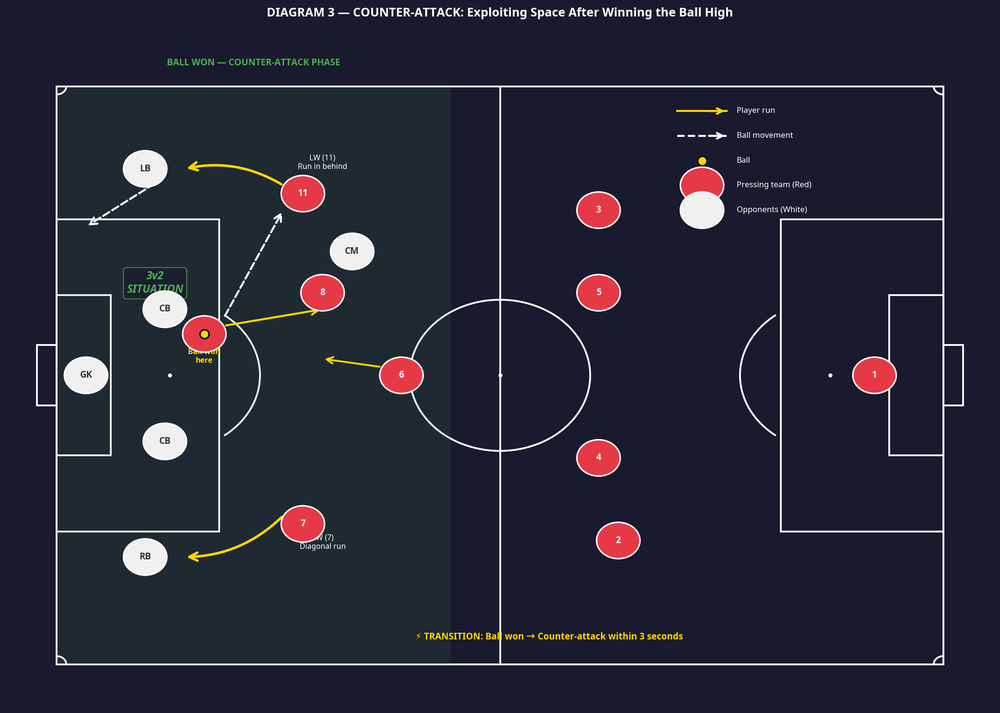
- Winning the Ball: The aggressive press results in a tackle, an interception, or a forced error (e.g., a misplaced pass).
- Immediate Transition: Upon winning the ball, the pressing team has a maximum of 3 seconds to transition into an attack.
- Exploiting the Space: The CF and the far-side Winger immediately make diagonal, penetrating runs into the space left by the out-of-position defenders.
- The Finish: The player who won the ball plays a quick, decisive pass to a forward runner, creating a 3v2 or 1v1 situation leading to a shot on goal.
4. Key Coaching Points
- Curved Runs: Attackers must use curved runs to cut off passing lanes. A straight run allows the defender to easily pass around the press.
- Body Shape: Players must dictate the direction of play using their body orientation. Show them the touchline, hide the center of the pitch.
- Compactness: The midfield and defensive lines must step up as the front three press. If the lines are stretched, the opponent will easily play through the press.
- Intensity and Aggression: The press must be executed with maximum sprint speed once the trigger is identified. Half-hearted pressing will be easily bypassed.
- Anticipation: Defenders (especially the full-backs) must read the game and anticipate the next pass, rather than just reacting to it.
5. Common Mistakes
- Pressing Individually: One player pressing while the rest of the team drops back. This creates massive gaps for the opponent to exploit.
- Straight Runs: Running directly at the ball-carrier without cutting off passing angles.
- Failing to Squeeze: The defensive line dropping deep while the forwards press high, creating a huge disconnect in the middle of the pitch.
- Not Using the Touchline: Allowing the player trapped out wide to turn back inside rather than keeping them pinned against the touchline.
6. Variations & Progressions
- Progression 1: Time Limit on Counter: Once the ball is won, the pressing team has only 5 seconds to score. This encourages rapid, decisive counter-attacks.
- Progression 2: Overload the Trap: Add an extra neutral player who always plays for the team in possession, making it harder for the pressing team to win the ball and requiring even greater coordination.
- Variation 1: Midfield Press: Instead of triggering the press on the CB, allow the opponent to play into the holding midfielder, and use the front three to collapse inwards on the midfielder.
7. Age Adaptations
- Under 10s: Focus simply on the concept of "hunting in packs" and forcing the ball wide. Do not worry about complex curved runs; just encourage high energy and winning the ball near the opponent's goal.
- Under 12s - Under 14s: Introduce the concept of triggers (e.g., "press when the ball goes to the full-back"). Start teaching curved runs to cut off passing lanes.
- Under 16s+: Implement the full tactical setup. Demand high tactical understanding, compactness between lines, and rapid transitions upon winning the ball.
