

Football
High-Intensity Counter-Pressing: Immediate Ball Recovery
Master the art of immediate ball recovery upon losing possession with this structured counter-pressing set play.
What you need
1 full-size goal, 2 mini-goals, 10-15 footballs, Cones, Training bibs (2 colors)
1. Overview
Counter-pressing (or Gegenpressing) is the immediate tactical reaction of a team to win the ball back within seconds of losing possession. Rather than dropping back into a defensive shape, the team aggressively swarms the ball carrier and cuts off passing lanes. This set play is designed to trigger an immediate, coordinated press the moment the ball is lost in the attacking or middle third. It exploits the opponent's momentary disorganization during their transition from defense to attack.
2. Setup
- Pitch Size: 100-110m x 64-75m (Full pitch or adapted 3/4 pitch for smaller sided games).
- Players: 22 players (11v11) or scaled down to 8v8 depending on squad size.
- Equipment: 1 full-size goal, 2 mini-goals (or target zones) for the defending team to counter-attack into, 10-15 balls placed around the pitch for quick restarts, and cones to mark the trigger zones.
- Positions: Standard 4-3-3 formation for the pressing team (Red), facing a 4-4-2 or 4-2-3-1 (Blue).
3. Step-by-Step Instructions
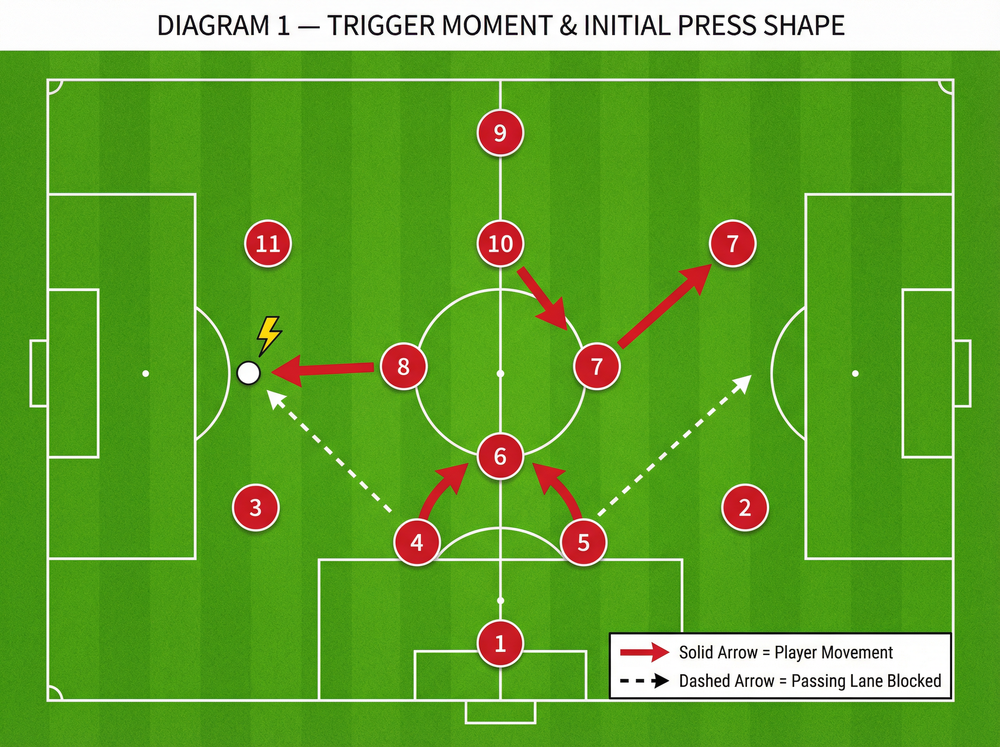
- The Trigger Moment: The drill begins with the Red team in possession in the attacking half. A deliberate misplaced pass or tackle results in the Blue team winning the ball. This is the 'trigger'.
- Immediate Aggression: The 2-3 Red players closest to the ball (e.g., #8, #10, #7) must immediately sprint towards the Blue ball carrier. The goal is to apply maximum pressure within the first 3 seconds.
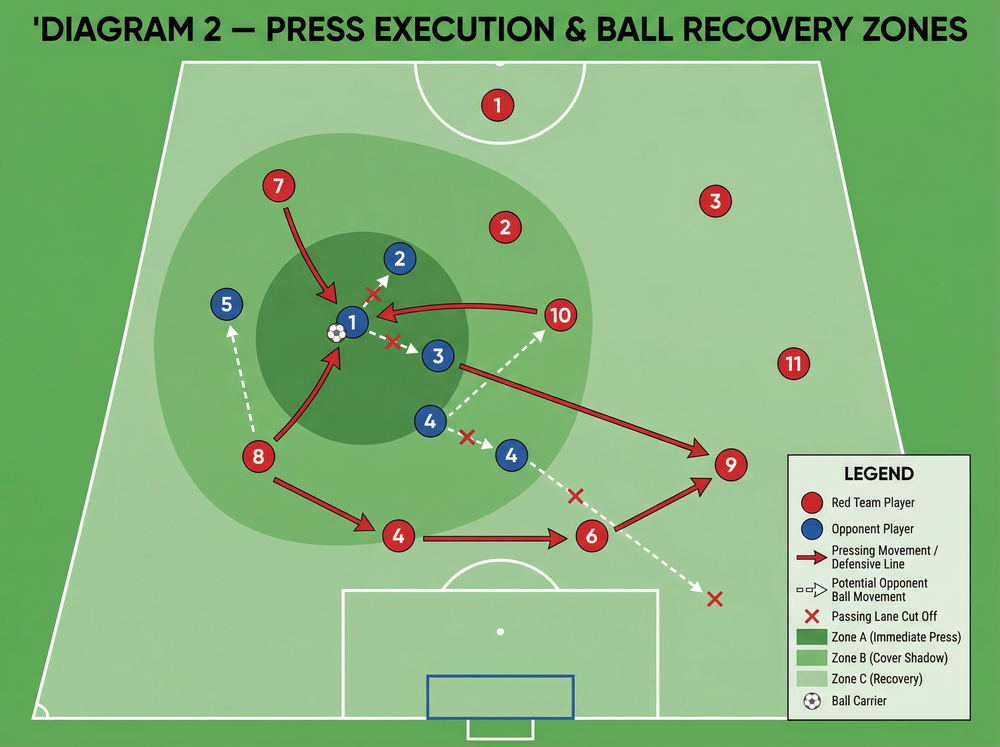
- Cutting Passing Lanes (Cover Shadow): As the primary pressers close down the ball, the secondary layer of players (#4, #6, #9) must position themselves to cut off the immediate forward and lateral passing options. They use their 'cover shadow' to block lanes rather than just marking players man-to-man.
- Compressing the Space: The defensive line (#2, #3, #4, #5) steps up 10-15 meters to compress the playing area, reducing the space the Blue team has to play out.
- Recovery or Reset: If the ball is won back within 5-7 seconds, the Red team immediately transitions into an attacking phase to score. If the Blue team successfully breaks the first line of the press or 7 seconds elapse, the Red team must drop and reorganize into their standard defensive block.
4. Key Coaching Points
- Reaction Time: The transition from attack to defense must be instantaneous. There can be no hesitation or disappointment over losing the ball.
- Intensity and Aggression: The initial press must be executed at maximum sprint speed to overwhelm the ball carrier.
- Compactness: The entire team must move as a cohesive unit. If the forwards press but the defense drops deep, massive gaps will appear in midfield.
- Body Shape: Pressing players must approach at an angle that forces the ball carrier towards the touchline or into a congested area, cutting off the switch of play.
- Anticipation: Players not directly pressing the ball must anticipate the next pass and position themselves to intercept.
5. Common Mistakes
- Pressing Alone: One player pressing without support is easily bypassed. It must be a coordinated effort by at least 2-3 players.
- Failing to Step Up: The defensive line dropping off instead of stepping up, creating space for the opponent to play into.
- Poor Approach Angle: Running straight at the ball carrier allows them to easily pass around the presser. Players must curve their runs to cut off options.
- Over-Committing: Diving in for a tackle and being easily beaten. The goal is to force an error or intercept a rushed pass, not necessarily to win the ball directly from the player's feet.
6. Variations & Progressions
- Progression 1: Time Limit: Introduce a strict 5-second rule. If the pressing team doesn't win the ball back or force it out of bounds within 5 seconds, the defending team gets a point.
- Progression 2: Target Zones: Add specific target zones or mini-goals for the team that wins the ball to immediately attack, emphasizing the transition from winning the ball to scoring.
- Variation 1: Overload: Start the drill with an overload for the pressing team (e.g., 8v6) to build confidence and understanding of the pressing triggers before moving to even numbers.
7. Age Adaptations
- Under 8 - Under 10: Focus purely on the reaction to losing the ball. Encourage the nearest player to try and win it back immediately. Keep it simple and fun, avoiding complex tactical jargon.
- Under 12 - Under 14: Introduce the concept of supporting the press (the second player) and cutting off passing lanes. Begin working on team compactness.
- Under 16 - Open: Full tactical implementation including cover shadows, specific pressing traps, and complex transitions.
