

Football
Mastering the High Press: Front Three Coordination
Learn how to orchestrate a suffocating high press using your front three to force turnovers in dangerous areas and disrupt the opponent's build-up play.
What you need
1 full-size goal, 3 mini-goals, Footballs, Training bibs (2 colours), Cones for marking pitch boundaries
1. Overview
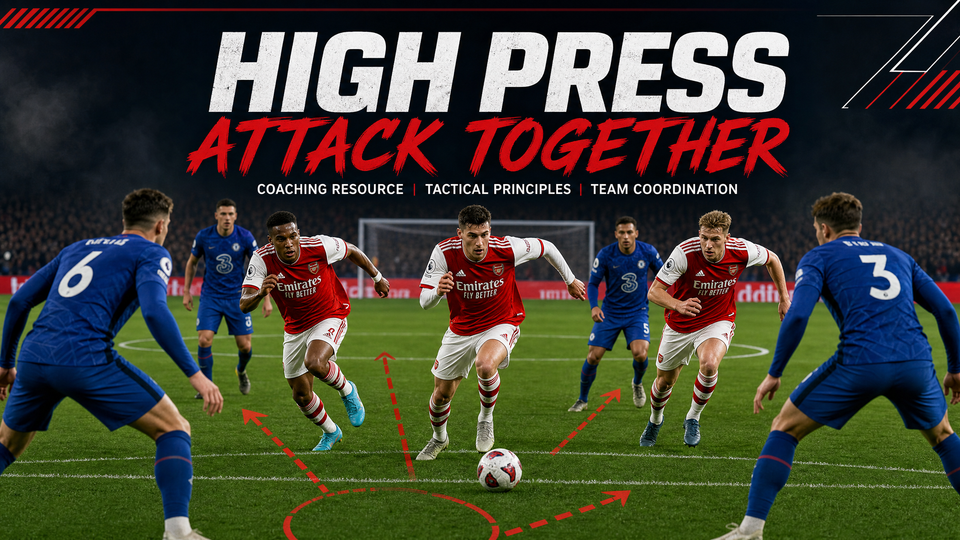
The high press is a proactive defensive strategy designed to win the ball back as close to the opponent's goal as possible. By coordinating the movements of the front three (the centre forward and two wingers), a team can disrupt the opposition's build-up play, force errors, and create immediate goal-scoring opportunities upon winning possession. This set play is most effective against teams that insist on playing out from the back and when your team has the physical conditioning to sustain high-intensity sprints.
2. Setup
To effectively practice this high press scenario, ensure your training environment replicates match conditions as closely as possible.
- Pitch Area: Use two-thirds of a standard football pitch (approximately 70m x 65m), focusing on the attacking half and the middle third.
- Players Required: 18-20 players. An attacking team (pressing team) of 10 outfield players in a 4-3-3 formation, and a defending team (building-up team) of a goalkeeper and 7-9 outfield players.
- Equipment: 1 full-size goal, 3 mini-goals placed on the halfway line, plenty of footballs, and training bibs in two contrasting colours.
3. Step-by-Step Instructions
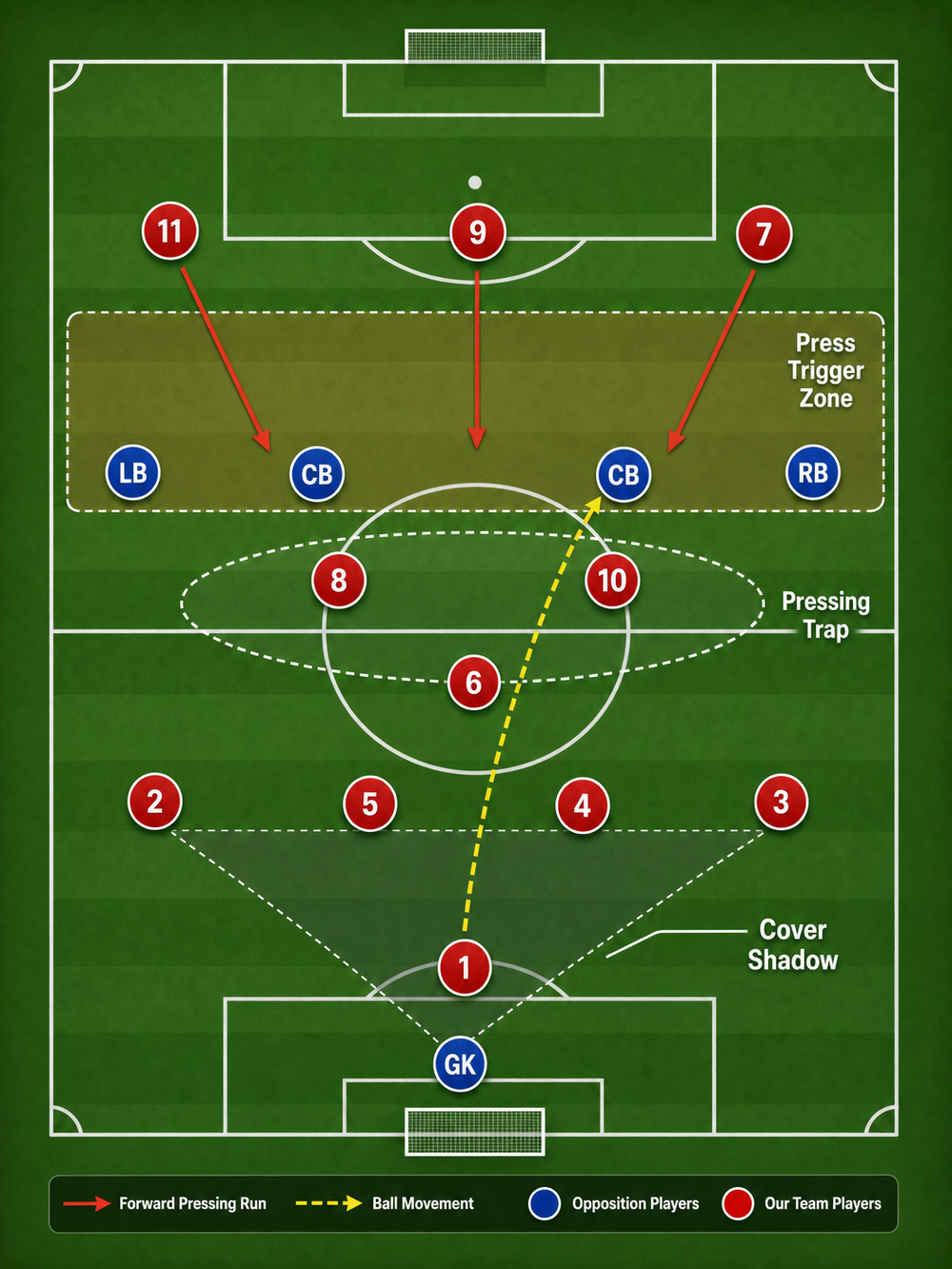
- The Trigger: The press is initiated when the opposing goalkeeper plays a short pass to one of the centre-backs. The centre forward (No. 9) must immediately recognise this trigger.
- The Curved Run: No. 9 makes a high-intensity, curved run toward the CB receiving the ball, cutting off the passing lane back to the goalkeeper.
- Locking the Flank: As the ball is forced toward the full-back (RB), the near-side winger (No. 7) sprints to close down the RB.
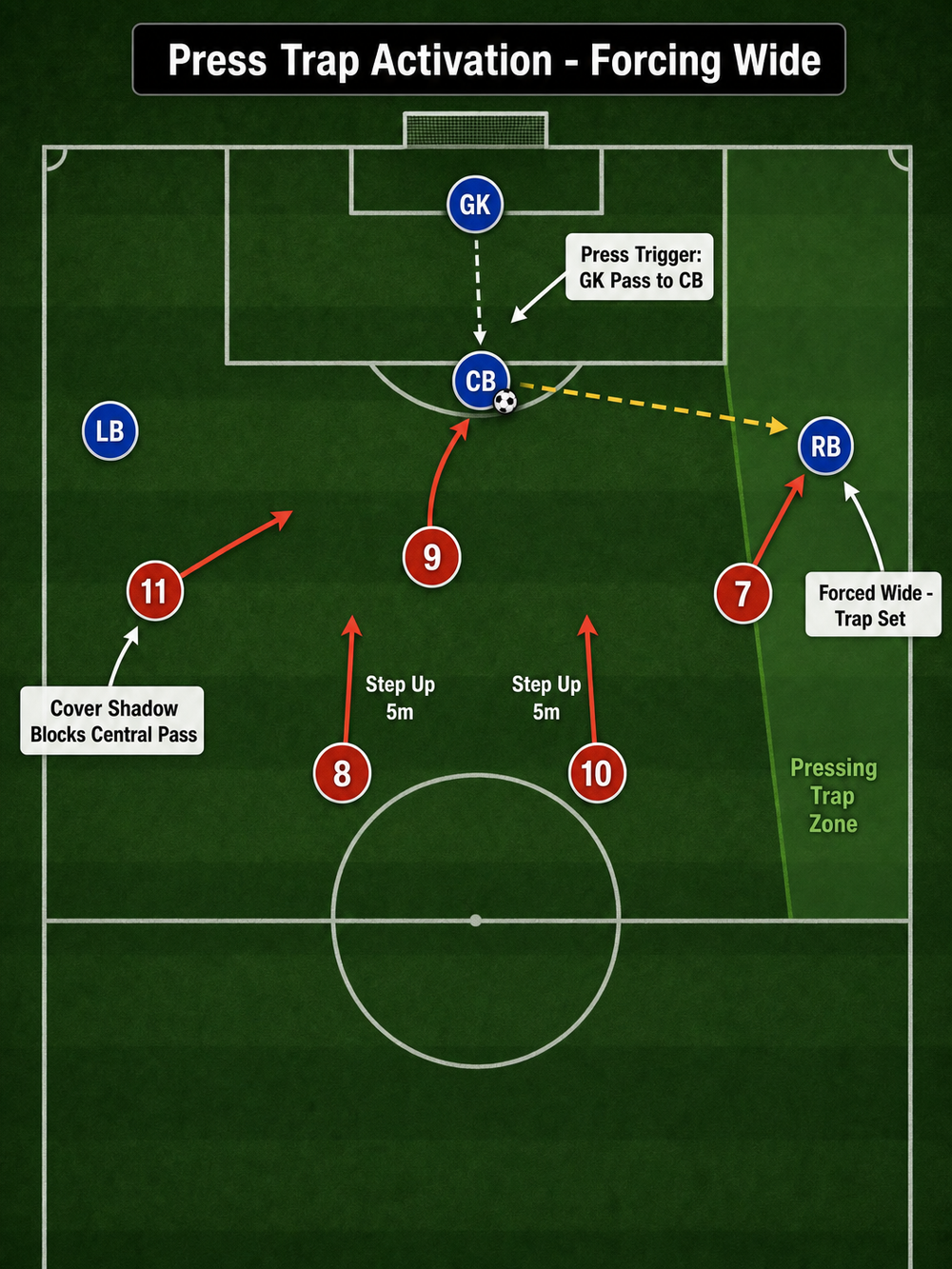
- Tucking In: The far-side winger (No. 11) tucks inside, cutting off cross-field diagonal passes and creating a 'cover shadow' over central midfield options.
- Midfield Support: Central midfielders (Nos. 8 and 10) step up aggressively (~5-10 metres) to mark opposition central midfielders and anticipate interceptions.
- The Trap: With No. 9 blocking the return pass, No. 7 applying pressure, and midfield options covered, the opponent is trapped in the wide area.
4. Key Coaching Points
- Intensity and Aggression: The initial sprint from No. 9 must be explosive. A half-hearted press will be easily bypassed.
- Body Shape: Players must approach the ball carrier with a low centre of gravity, angled to force play toward the touchline.
- Communication: Verbal cues and eye contact are essential. No. 9 signals the trigger; midfielders communicate marking assignments.
- Compactness: The entire team must move as a unit. If the front three press but the midfield drops deep, dangerous gaps will appear.
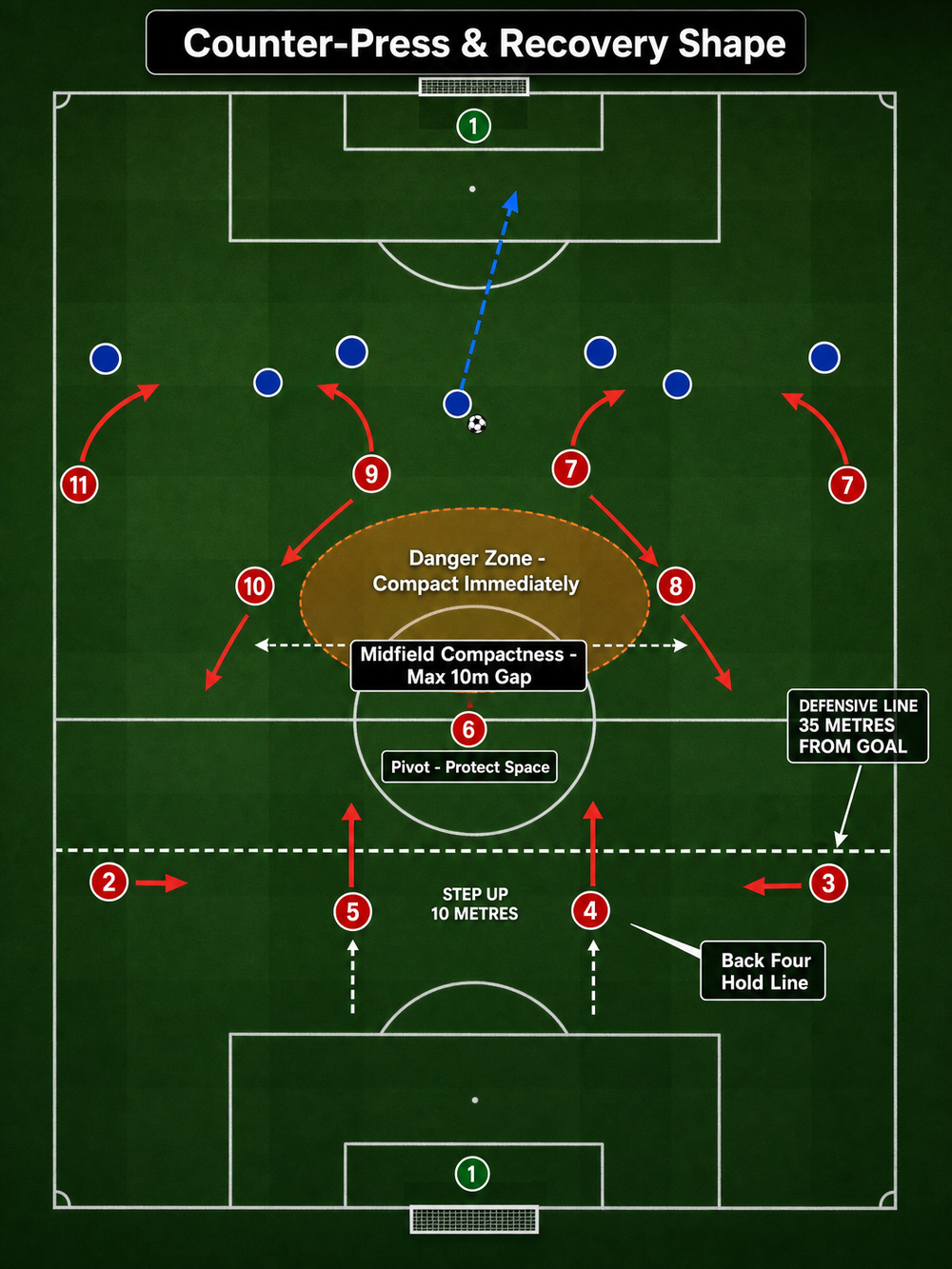
- Reaction to Transition: If the ball is won, exploit the disorganised defence immediately. If the press is beaten, transition quickly to recovery shape.
5. Common Mistakes
- Pressing Individually: A single player pressing without support is wasted energy. The press must be a coordinated team action.
- Straight Runs: Making straight runs at the ball carrier allows them to pass around the presser. Curved runs are essential to block passing lanes.
- Leaving Central Gaps: Wingers failing to tuck in or midfielders not stepping up creates dangerous central spaces for the opponent.
- Failing to Squeeze: The defensive line must step up to reduce the playing area. Staying deep leaves the midfield with too much ground to cover.
6. Variations & Progressions
- Progression 1 — Add a Holding Midfielder: Introduce an opposing No. 6 who drops deep to aid build-up, forcing the pressing team's No. 10 to make complex decisions on pressing vs. marking.
- Progression 2 — Time Limit: Give the pressing team a strict 8-second window to win the ball back or force a long pass, increasing intensity and realism.
- Variation 1 — Full-Back Trigger: Allow the CB to receive and pass to the full-back, using that pass as the trigger for a highly aggressive trapping press against the touchline.
7. Age Adaptations
- Under-10s to Under-12s: Focus on the concept of 'hunting in packs' and the initial trigger. Keep instructions simple: 'When the goalie passes, the closest player sprints and the others support.'
- Under-14s to Under-16s: Introduce curved runs, cover shadows, and specific midfield marking assignments. Emphasise communication and timing.
- Open Age / Senior: Implement the full tactical setup, focusing on body orientation, manipulating the opponent's build-up structure, and rapid transitions upon winning the ball.
