

Basketball
Mastering the 2-3 Zone: Defensive Rotation Drill
A high-intensity drill designed to perfect defensive rotations, closeouts, and communication within a 2-3 zone defense.
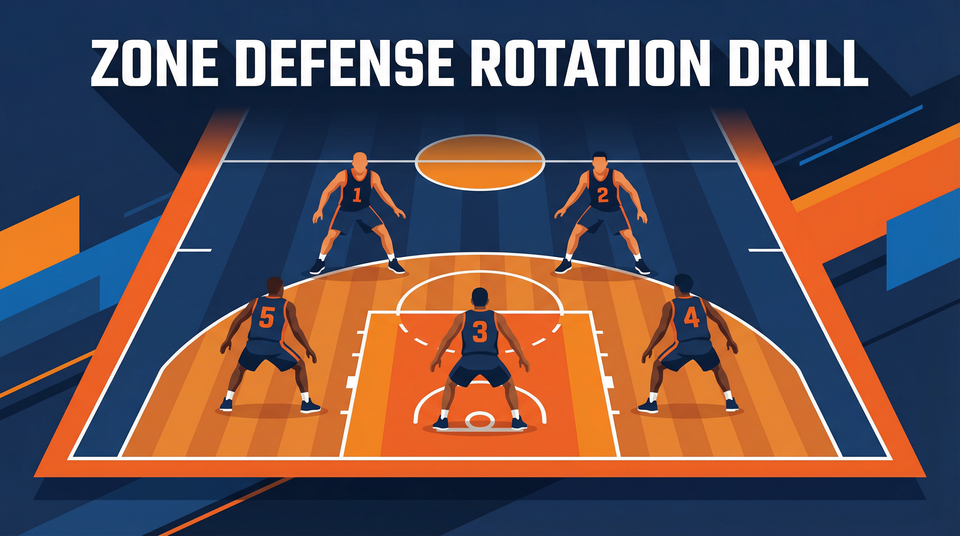
What you need
Basketballs, Cones (optional)
1. Overview
The 2-3 zone defense is a staple in basketball, but its effectiveness relies entirely on rapid, synchronized rotations and constant communication. This drill focuses on teaching players how to shift as a cohesive unit when the ball moves around the perimeter. By running this drill, coaches can build defensive chemistry, ensure players understand their specific responsibilities in different areas of the court, and eliminate the open gaps that offenses look to exploit.
Use this drill during the defensive segment of your practice, especially when preparing to face a team that relies heavily on perimeter passing and three-point shooting.
2. Setup
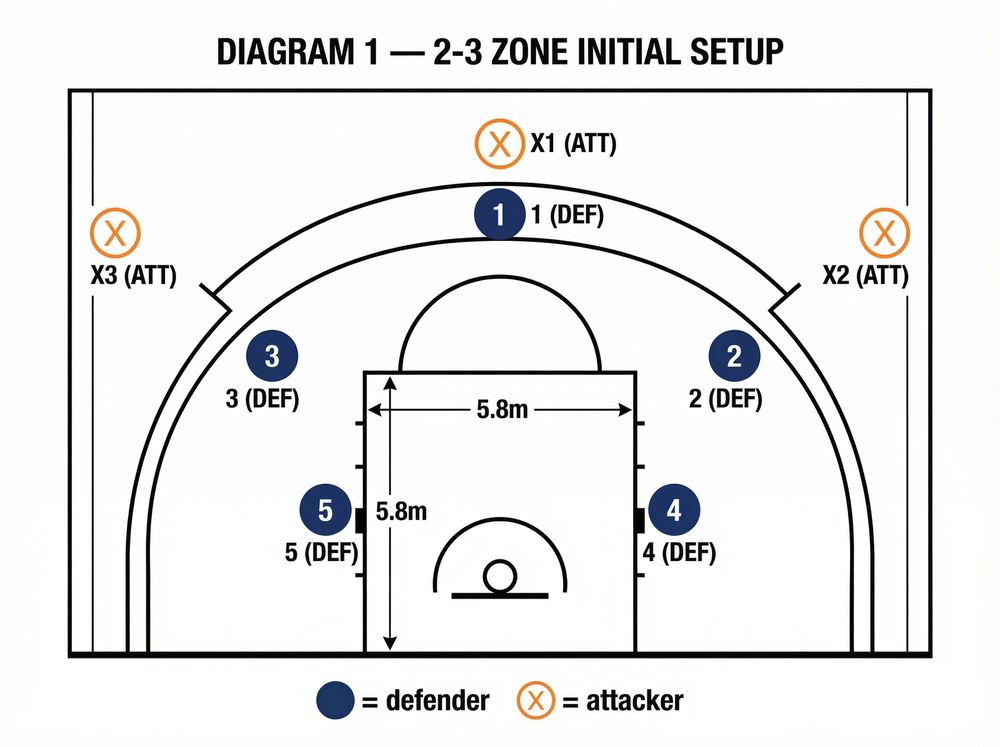
- Court Dimensions: Standard FIBA half-court (28m x 15m).
- Players: 5 defenders (numbered 1-5) and 3-5 offensive players (or coaches) acting as passers.
- Equipment: 1 basketball, cones (optional, to mark offensive spots).
- Positions:
- Player 1 & 2 (Guards): Positioned at the top of the key and the wing.
- Player 3 (Small Forward): Positioned on the opposite wing.
- Player 4 & 5 (Forwards/Centers): Positioned on the low blocks.
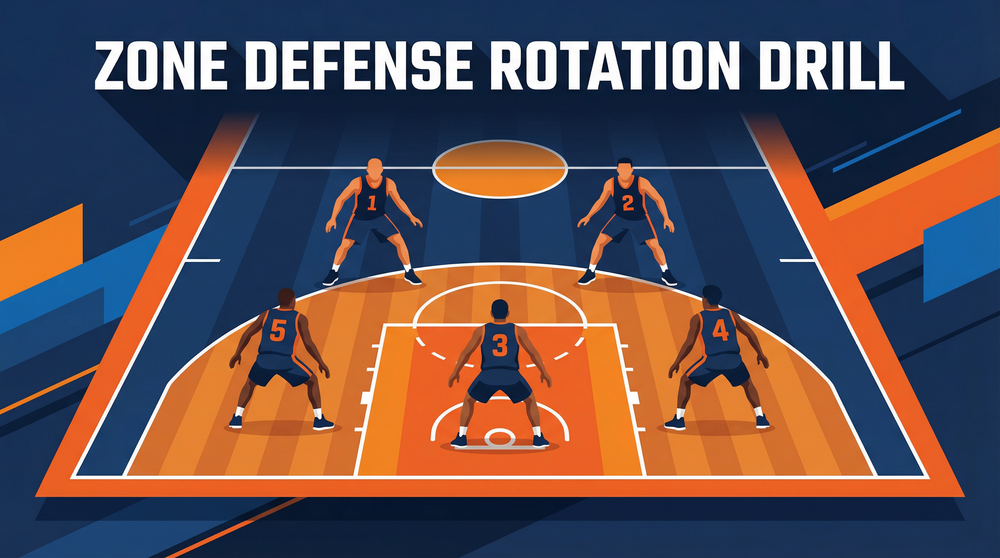
3. Step-by-Step Instructions
- Initial Positioning: Set up your 5 defenders in a standard 2-3 zone formation. Place 3 offensive players (or coaches) around the perimeter: one at the top of the key, and one on each wing (or corner).
- The First Pass: The offensive player at the top of the key holds the ball. The top two defenders (1 and 2) must communicate to determine who takes the ball and who drops to cover the high post.
- The Swing Pass: The ball is passed to the right wing.
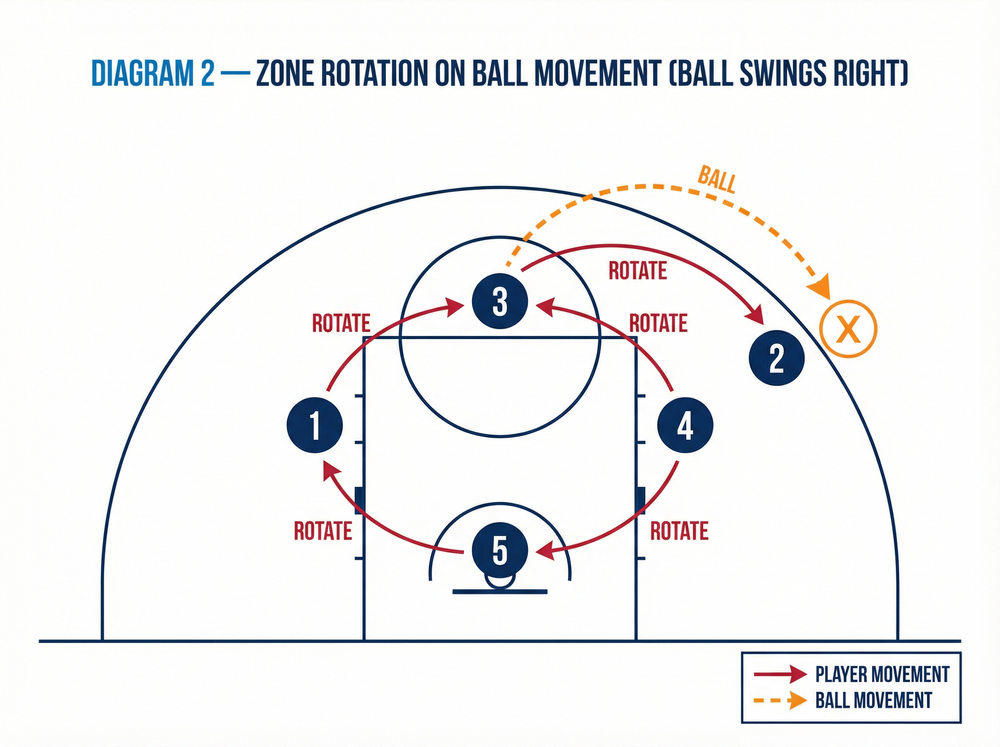
- The Rotation:
- Player 2 sprints to close out on the ball handler.
- Player 1 drops to the high post area to deny any entry passes.
- Player 4 (ball-side block) steps out slightly to prepare for a corner pass or baseline drive.
- Player 5 (weak-side block) slides over to protect the front of the rim.
- Player 3 (weak-side wing) drops down to the weak-side elbow/block area to prevent skip passes.
- Continuous Movement: The offense quickly reverses the ball back to the top and then to the left wing. The defense must immediately rotate back to their initial spots and then shift to the left side in the same synchronized manner.
- Live Play (Optional): After 4-5 passes, the coach blows the whistle, and the offense is allowed to play live and attempt to score against the rotating zone.
4. Key Coaching Points
- Communicate Early and Loudly: Defenders must call out "Ball!", "Help!", or "Dead!" to ensure everyone knows their assignment. Silence is the enemy of a good zone.
- High Hands on Closeouts: When closing out on a shooter, defenders must arrive under control with high hands to contest the shot without fouling.
- Move on the Flight of the Ball: Defenders cannot wait for the ball to be caught before moving. They must begin their rotation as soon as the ball leaves the passer's hands.
- Protect the Paint: The primary goal of the 2-3 zone is to stop inside scoring. Ensure the low post defenders (4 and 5) are always anchoring the defense and not getting dragged too far out of position.
5. Common Mistakes
- Ball Watching: Defenders stare at the ball and lose track of offensive players cutting through their zone.
- Late Rotations: Waiting too long to shift, allowing the offense to get an open shot or a driving lane.
- Over-Committing: Perimeter defenders closing out too hard and getting blown by, forcing the bigs to step up and leave the basket unprotected.
- Poor Rebounding Position: Forgetting to box out once a shot goes up. Zone defenses are notoriously vulnerable to offensive rebounds if players don't find a man to block out.
6. Variations & Progressions
- Add Skip Passes: Force the defense to make long, cross-court rotations by having the offense throw skip passes from wing to opposite corner.
- Include the High Post: Add an offensive player at the high post (free throw line). The defense must now communicate how to bump and pass off this player as the ball moves.
- Disadvantage Drill: Run the drill with 4 defenders against 5 offensive players to force even faster rotations and extreme communication.
7. Age Adaptations
- Under 10 / Under 12: Focus purely on the basic shape of the zone and simple slides. Use cones to show them exactly where to stand when the ball is in different positions.
- Under 14 / Under 16: Introduce the concept of "bumping" (one defender taking the ball while another drops) and closing out with high hands.
- Open / Advanced: Run the drill at game speed with live offense, incorporating skip passes, high post flashes, and baseline screens.
