

Netball
Mastering Centre Pass Variations: Unlocking the Attacking Third
Equip your team with three highly effective centre pass setups to consistently break through defensive structures and deliver the ball safely into the attacking third.

What you need
1 Netball, Team bibs, Cones (optional)
1. Overview
The centre pass is one of the few guaranteed possession moments in a netball match. Maximizing its success rate is critical to building scoreboard pressure. This comprehensive drill focuses on three distinct centre pass variations designed to confuse the opposition, create reliable passing options, and seamlessly transition the ball from the centre third into the goal third. By practicing these structured setups, coaches can ensure their attacking units (Centre, Wing Attack, and Goal Attack) develop strong timing, clear communication, and the ability to read defensive structures on the fly.
2. Setup

To effectively run this drill, coaches will need to utilize a full netball court, specifically focusing on the centre third and one attacking third.
Equipment Needed:
- 1 Netball
- Team bibs (to distinguish attackers from defenders)
- Cones (optional, to mark starting positions if players are struggling with spacing)
Player Positions:
- Attackers: Centre (C), Wing Attack (WA), Goal Attack (GA), Goal Shooter (GS)
- Defenders: Wing Defence (WD), Goal Defence (GD)
Ensure players understand the court dimensions (30.5m x 15.25m) and the specific boundaries of the centre and attacking thirds. The C will start with the ball entirely within the 0.9m centre circle.
3. Step-by-Step Instructions

This drill is broken down into three distinct variations. Coaches should teach one variation at a time, ensuring players master the timing before moving to the next.
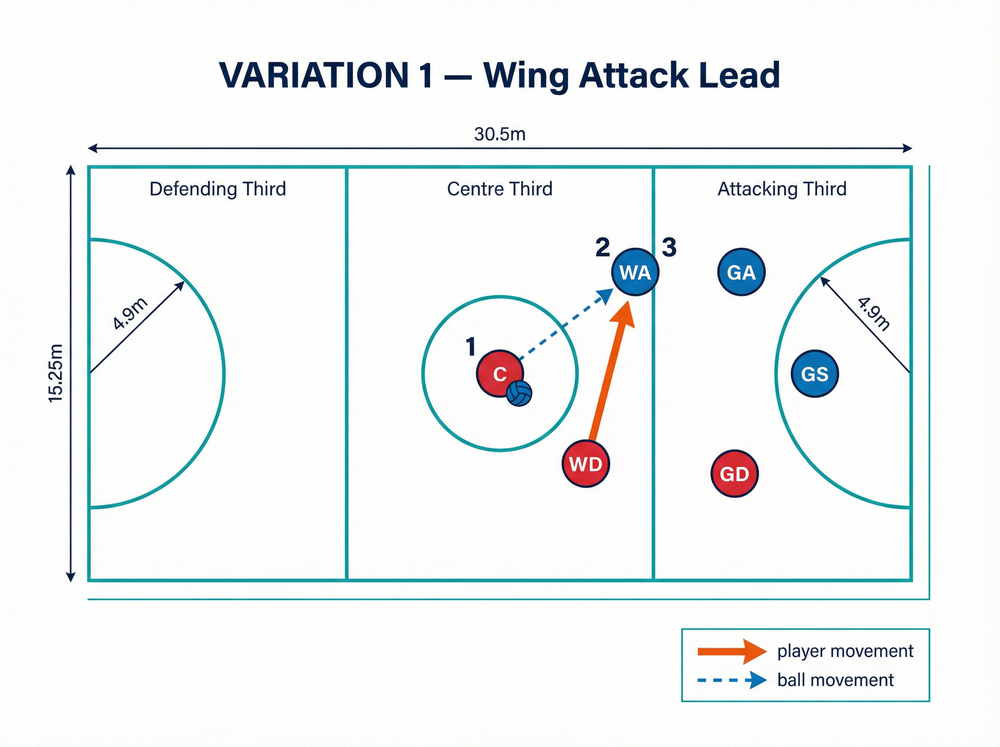
Variation 1: The Wing Attack Lead
This is the fundamental centre pass setup, relying on a strong, direct drive from the Wing Attack to receive the first pass.

- Starting Positions: The C stands in the centre circle with the ball. The WA sets up on the transverse line, typically on the right side of the court. The GA positions themselves in the attacking third, ready to offer a second phase option.
- The Drive: On the whistle, the WA makes a sharp, angled sprint (a 45-degree lead) into the centre third, aiming to receive the ball at the top of the attacking third's transverse line.
- The Pass: The C delivers a crisp, flat chest pass to the WA out in front of their driving path.
- Next Phase: As the WA receives the ball, the GA immediately drives to the top of the goal circle to receive the second pass, while the GS holds position or prepares for a baseline drive.
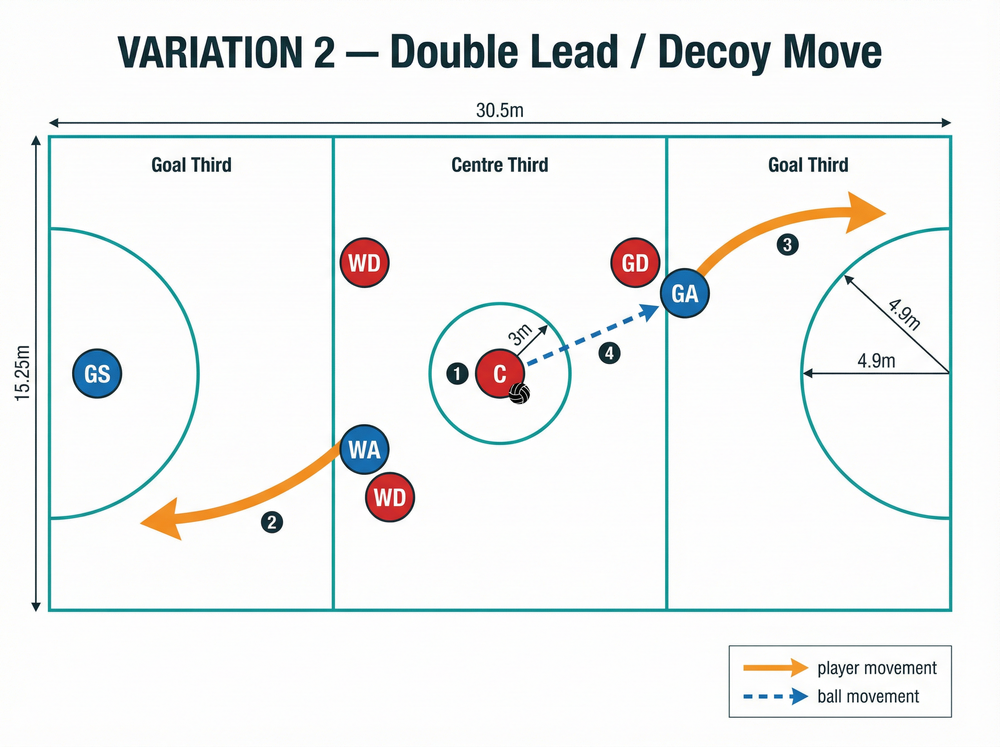
Variation 2: Double Lead / Decoy Move
When defenders begin anticipating the direct WA lead, this variation uses misdirection to open up space for the Goal Attack.

- Starting Positions: The WA starts on the left side of the centre third, while the GA starts on the right side near the transverse line.
- The Decoy: On the whistle, the WA executes a hard, aggressive drive out wide to the left. This movement is designed to pull the WD away from the central corridor.
- The Real Option: A split second after the WA moves, the GA drives forcefully into the newly created space in the middle/right of the centre third.
- The Pass: The C reads the play, ignores the decoy WA, and delivers a strong pass to the driving GA.
- Next Phase: The WA immediately re-offers by driving towards the top of the goal circle to receive the next pass from the GA.
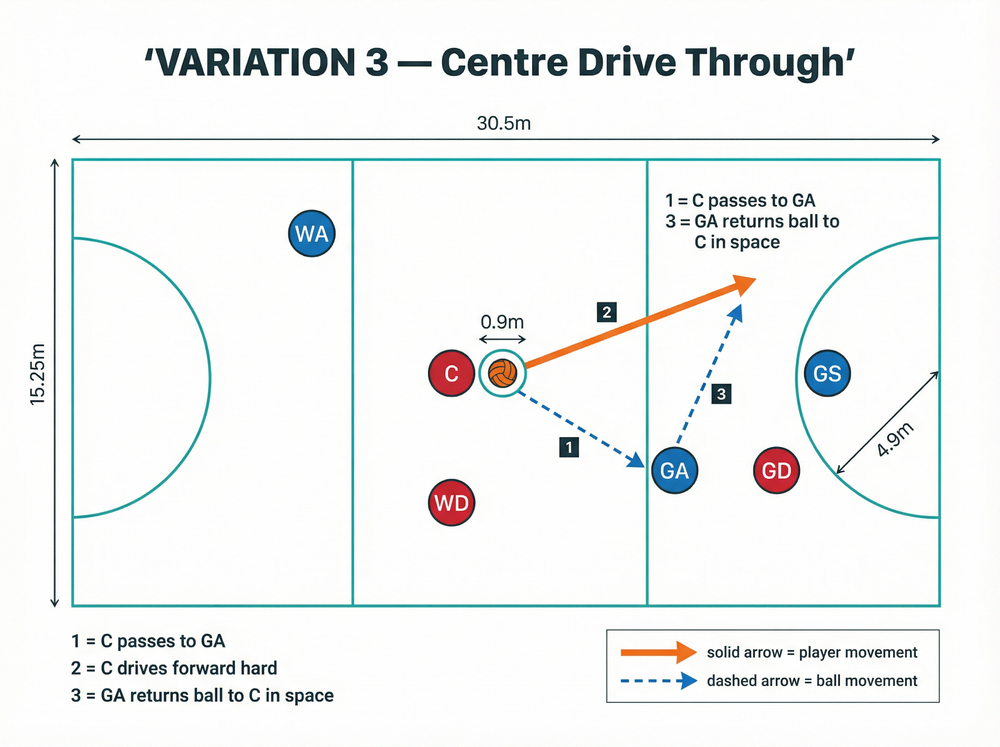
Variation 3: Centre Drive Through
This variation utilizes the Centre player as an active attacking option immediately after the initial pass, creating an overload in the attacking third.

- Starting Positions: The WA sets up wide left, and the GA sets up on the right side of the attacking third near the transverse line.
- The Initial Pass: On the whistle, the C makes a short, quick pass to the GA, who has popped slightly into the centre third to receive.
- The Drive Through: Immediately after releasing the ball, the C sprints forward aggressively through the centre third, heading straight toward the attacking transverse line.
- The Return Pass: The GA receives the ball, turns quickly, and delivers a return pass to the driving C in the space ahead.
- Next Phase: The C is now in a powerful position at the top of the goal circle, ready to feed the GS or a repositioned GA.
4. Key Coaching Points

- Timing is Everything: Players must wait for the whistle before moving. Premature movement leads to breaking the line or allowing defenders to easily intercept.
- Strong Angles: Drives should be sharp and angled (45 degrees), not flat across the court. This makes it significantly harder for defenders to intercept from behind.
- Eye Contact: The Centre must establish eye contact with the intended receiver before delivering the pass. This prevents forced passes into heavy traffic.
- Pass Placement: Passes must be delivered out in front of the driving player, allowing them to run onto the ball at full speed without breaking stride.
- Second Phase Readiness: Players not receiving the first pass must immediately prepare for the second phase.
5. Common Mistakes
- Running Too Early: Attackers moving before the whistle, resulting in a free pass to the opposition.
- Curved Runs: Players running in a curved or looping path instead of sharp, straight lines.
- Holding the Ball Too Long: The Centre taking too much time to decide, allowing the defense to set up and block passing lanes. The pass should be released within 3 seconds.
- Lack of Decoy Effort: In Variation 2, if the WA does not sprint hard on the decoy run, the defender will not be pulled away.
6. Variations & Progressions
- Add Passive Defense: Introduce a WD and GD who only shadow the attackers without attempting to intercept.
- Add Active Defense: Introduce full, competitive defense. The attackers must now read the defense and choose the correct variation.
- Time Limits: Challenge the attacking unit to move the ball from the centre pass to a shot on goal within 5 seconds.
7. Age Adaptations
- Under 10s: Focus solely on Variation 1. Emphasize basic timing and strong, straight passes. Do not use defenders initially.
- Under 12s: Introduce Variation 2. Begin teaching the concept of a decoy run and looking for the second option. Introduce passive defense.
- Under 14s & Up: All three variations should be practiced against full, active defense. Emphasize the speed of transition and decision-making under pressure.
