

Rugby
Mastering the Defensive Drift Pattern
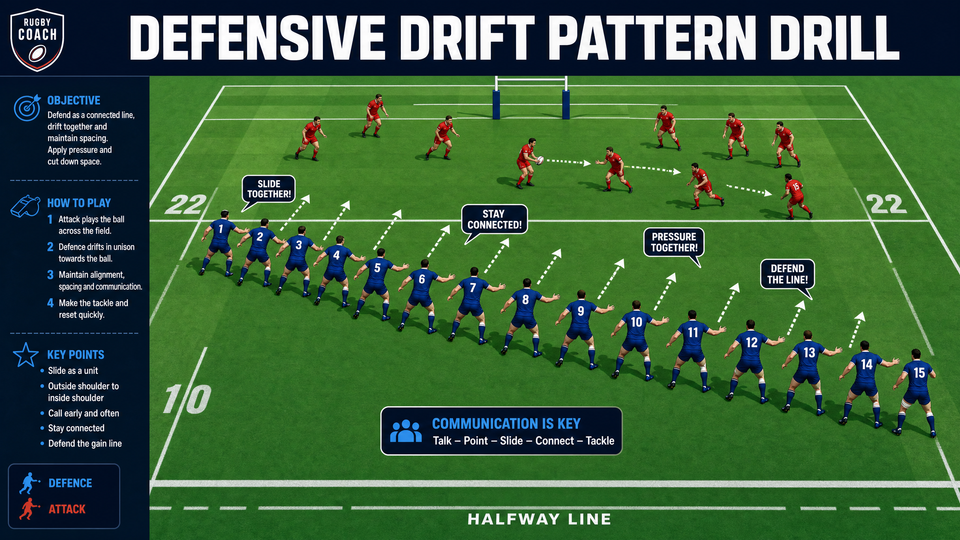
Teach your defensive line to stay connected, maintain spacing, and systematically shut down wide attacks using a coordinated drift system.
What you need
1 Rugby ball, 10-14 cones, Colored bibs
Overview
The Defensive Drift Pattern is a foundational defensive system in modern Rugby. Its primary objective is to defend against wide attacking movements by sliding the defensive line in unison toward the touchline. Instead of committing to a tackle immediately and leaving gaps, defenders maintain their spacing and connection, forcing the attacking team to run out of space on the outside. This drill is essential for teaching players how to trust their inside man, communicate effectively, and maintain a unified defensive wall under pressure.
Setup
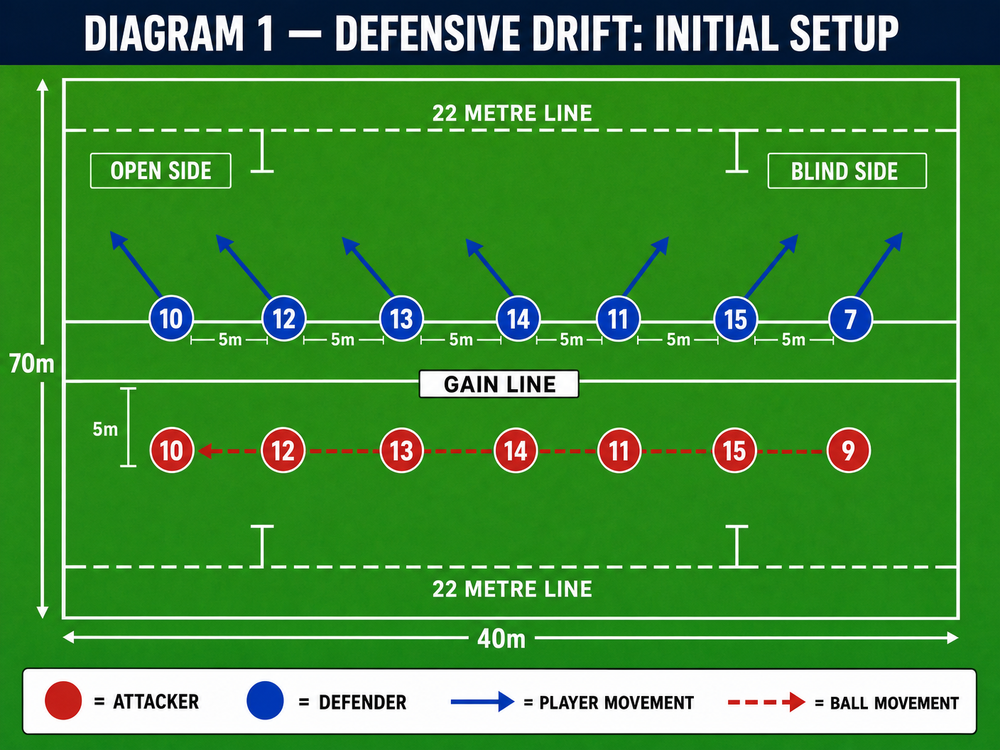
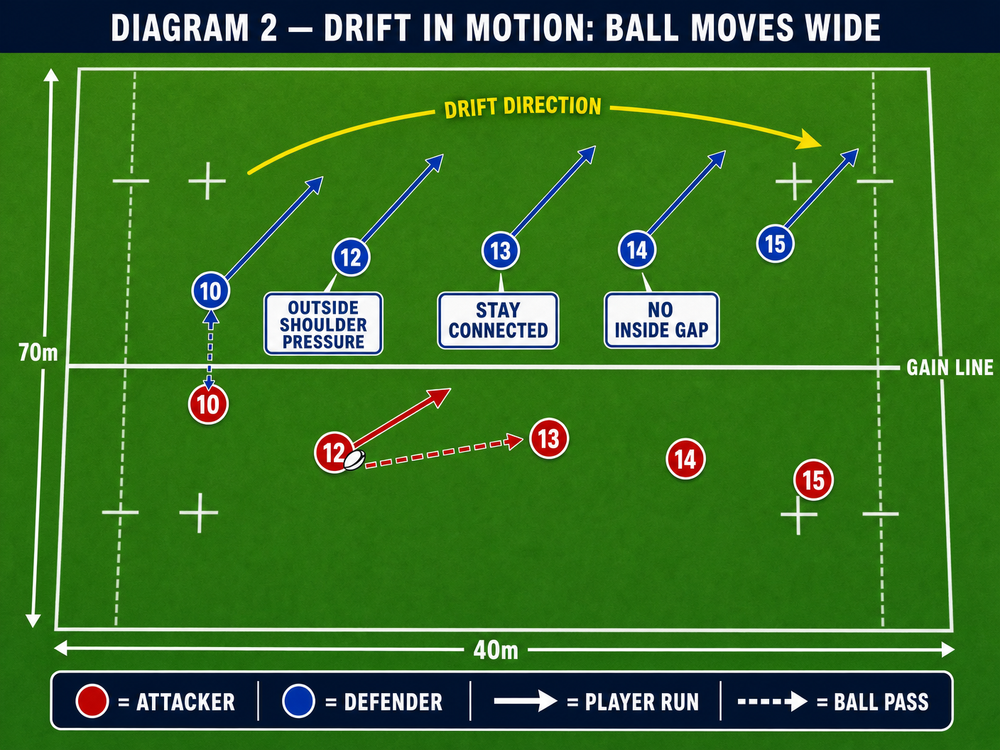
- Pitch Dimensions: 40m wide x 70m long section of the pitch (typically between the 22-metre line and halfway line).
- Equipment: 1 Rugby ball, 10-14 cones to mark the boundaries and starting positions, colored bibs for attackers and defenders.
- Player Numbers: 14 players total (7 attackers, 7 defenders).
- Positions:
- Attack (Red): Scrum-half (9), Fly-half (10), Inside Center (12), Outside Center (13), Wingers (11, 14), Fullback (15).
- Defence (Blue): Fly-half (10), Inside Center (12), Outside Center (13), Wingers (11, 14), Fullback (15), Flanker (7).
Step-by-Step Instructions
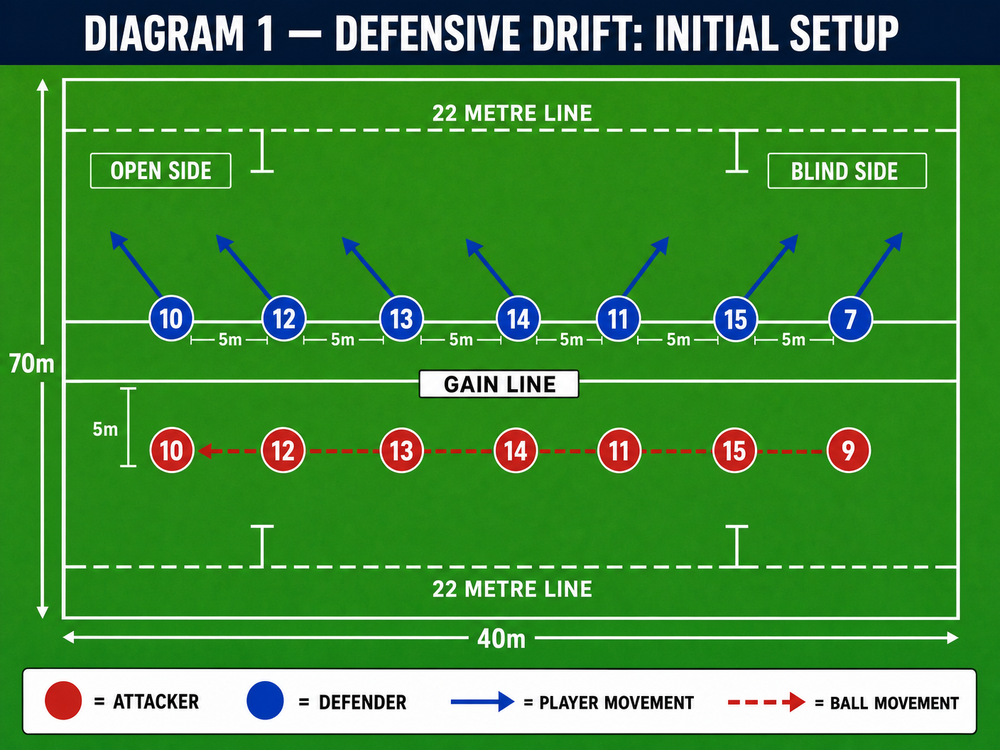
- Initial Alignment: Set the defensive line flat on the gain line. Defenders should be spaced approximately 5 metres apart. The attacking line starts 5 metres deep, staggered for a passing movement.
- The Trigger: The coach blows the whistle. The attacking scrum-half (9) passes the ball to the fly-half (10).
- Line Speed: As the ball leaves the scrum-half's hands, the entire defensive line moves forward aggressively to close down the space and cross the gain line.
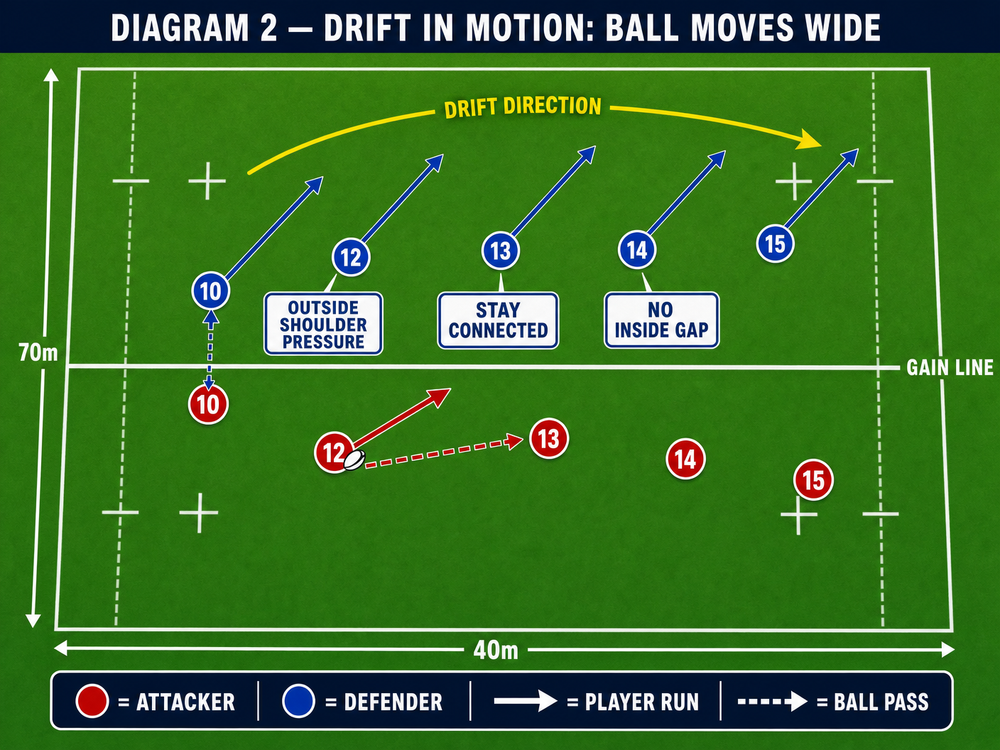
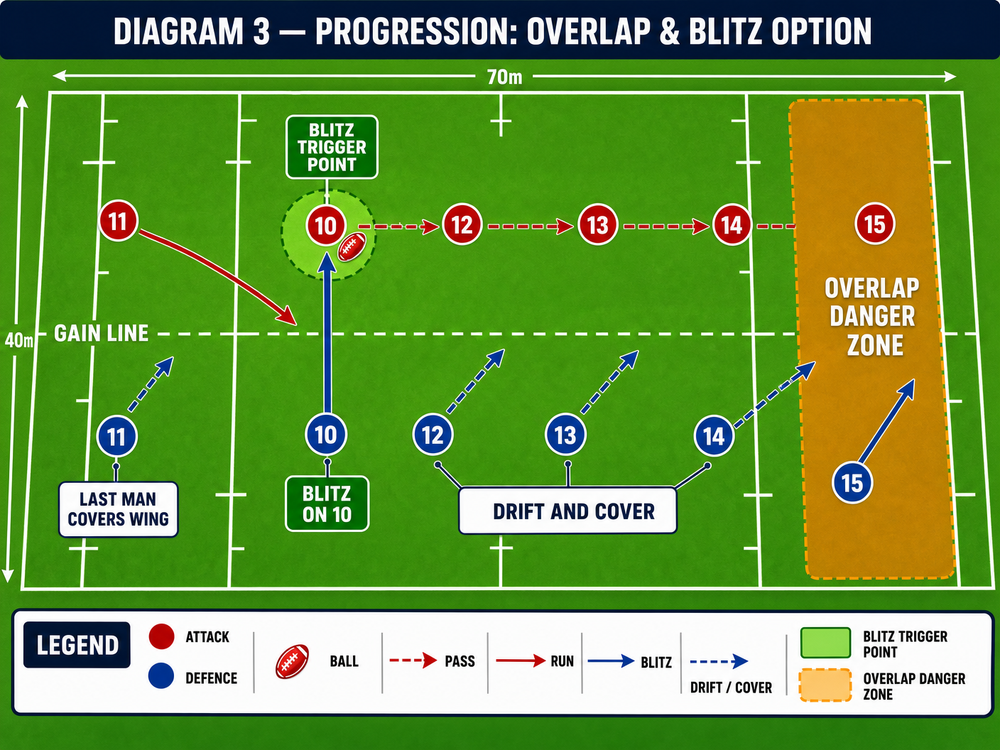
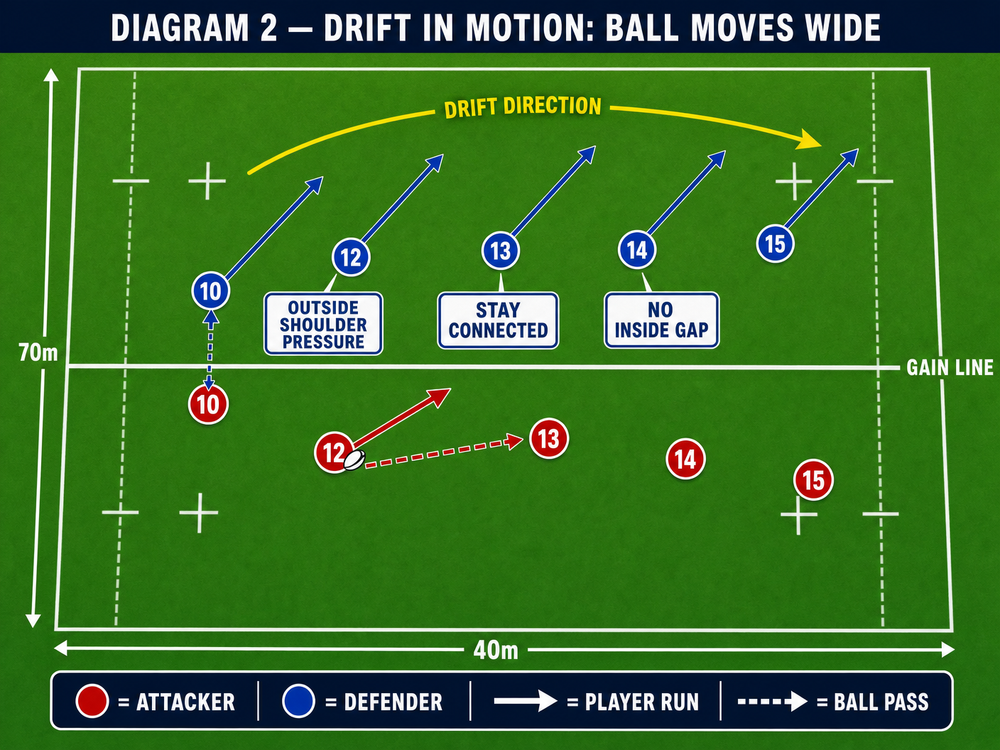
- The Drift: Once the fly-half (10) passes the ball wide to the inside center (12), the defensive line transitions from moving forward to drifting diagonally toward the touchline.
- Maintaining Connection: Each defender must keep their inside shoulder slightly ahead of their outside shoulder, tracking the outside shoulder of the attacker opposite them. They must not break the line or rush out individually.
- The Tackle: The drift continues until the ball carrier attempts to break the line or runs out of space near the touchline. The defender opposite the ball carrier executes a dominant tackle, while the adjacent defenders fold in to secure the breakdown.
Key Coaching Points
- Communicate Early and Often: Players must constantly talk to the defenders on their inside and outside. Use calls like 'Hold', 'Push', 'Slide', and 'My Man'.
- Trust the Inside Man: Defenders must trust that the player on their inside will cover any cut-back step. They should focus on pushing the attack toward the sideline.
- Outside Shoulder to Inside Shoulder: Defenders should track the outside shoulder of their designated attacker. This body positioning naturally encourages the attacker to pass wide rather than stepping inside.
- Stay Connected: The defensive line must move as a single unit. If one player rushes up or lags behind, it creates a dogleg (a gap) that the attack can exploit.
- Maintain Line Speed: The initial forward movement before the drift is crucial. If the defence is passive, the attack gains momentum and dictates the play.
Common Mistakes
- Planting Feet: Defenders stopping their feet when the ball is passed, allowing the attack to easily step around them.
- Turning Shoulders Too Early: Defenders turning their bodies entirely toward the sideline too soon, opening up massive inside gaps for cut-back runs.
- Individual Rushing (Doglegs): A single defender shooting out of the line to attempt a big hit, disconnecting from the unit and creating an easy line break opportunity.
- Poor Communication: Silence in the defensive line leads to confusion about who is taking which attacker, especially during loop plays or miss passes.
Variations & Progressions
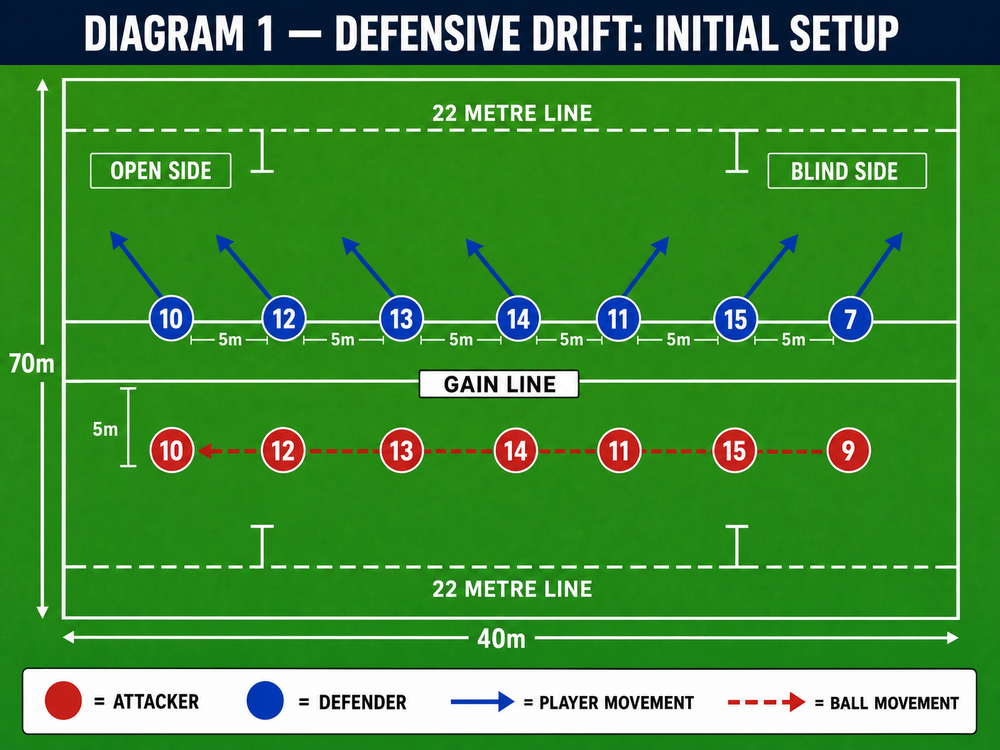
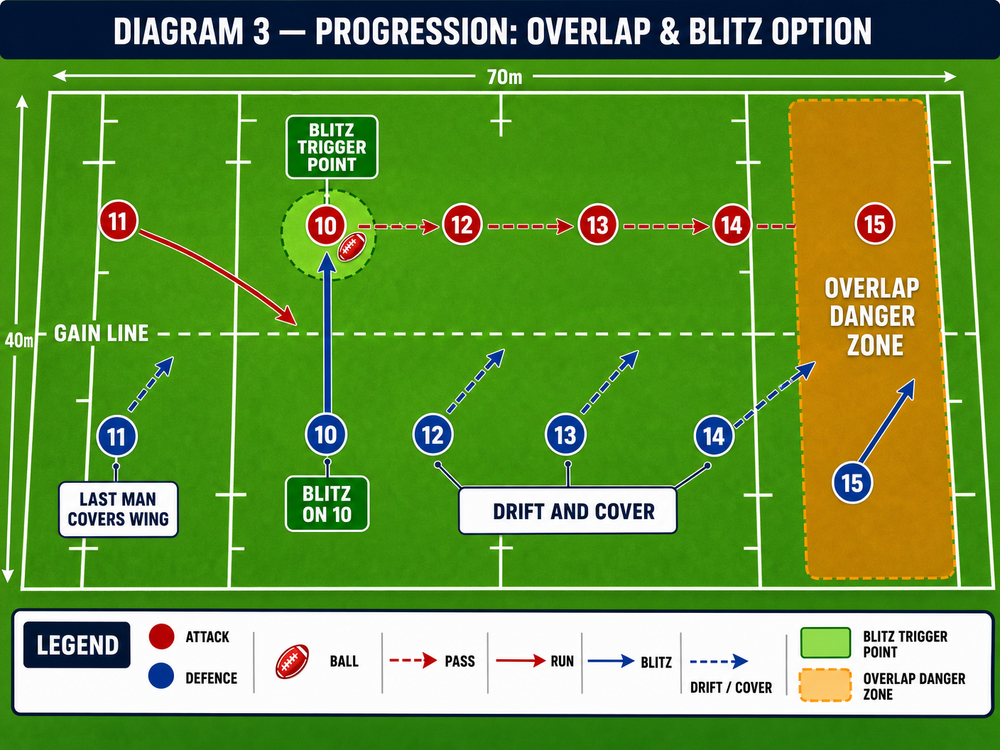
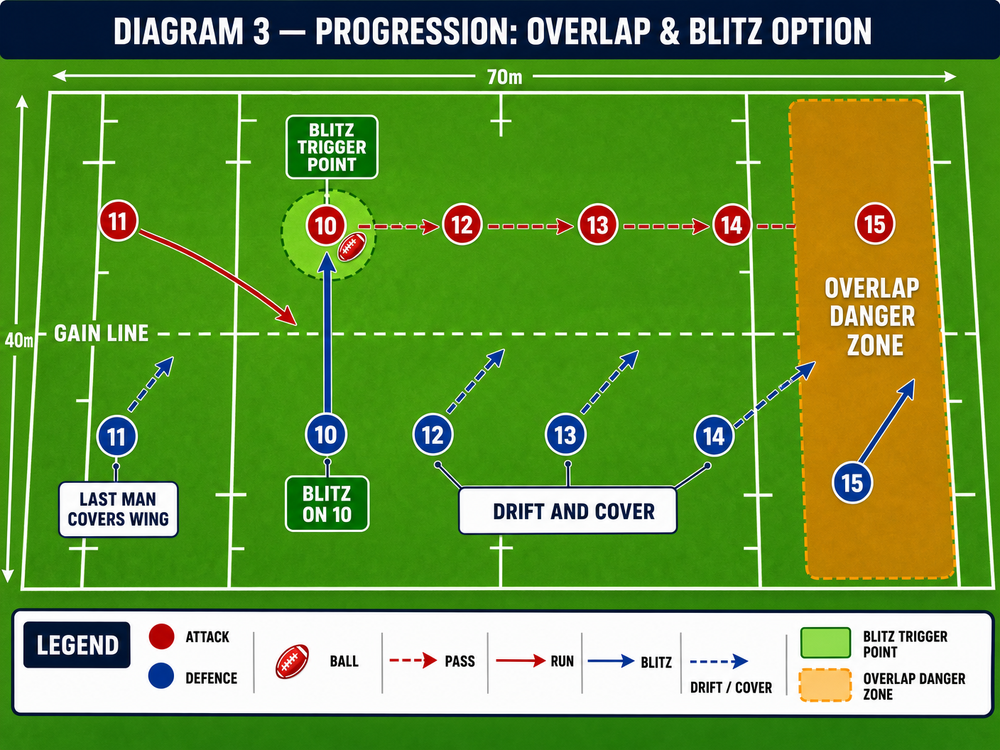
- Overload Attack (2v1 Scenarios): Introduce an extra attacking player (e.g., a fullback entering the line) to create an overlap. The defence must drift harder and rely on the last man (winger or fullback) to cover the extra man.
- The Blitz Option: Allow the defensive fly-half (10) or inside center (12) to call a 'Blitz' trigger. Instead of drifting, the designated player shoots up aggressively to shut down the play behind the gain line, while the rest of the line drifts and covers the space behind.
- Fatigue Under Pressure: Run the drill continuously for 3 minutes without stopping. After a tackle is made, the attack quickly resets and goes the other way. This tests the defence's ability to realign and drift while fatigued.
Age Adaptations
- Under 8s to Under 10s: Focus entirely on basic alignment and moving forward together. Do not introduce the drift yet; keep it simple with man-on-man defence.
- Under 12s to Under 14s: Introduce the concept of drifting slowly. Use walking or jogging pace first to ensure players understand the spatial awareness and body positioning required.
- Under 16s to Open Grade: Run the drill at full match intensity. Incorporate complex attacking moves (wraps, miss passes, dummy runners) to challenge the defensive decision-making and connection.
