

Rugby
Mastering the High Ball: Kick Chase and Catch Drill
Develop an aggressive, coordinated kick chase and secure the high ball under pressure with this essential tactical drill.

What you need
4-6 Rugby balls, 10-15 Cones, Bibs (two colours)
1. Overview
The kick chase is one of the most critical tactical elements in modern rugby. A poorly executed kick without a coordinated chase simply hands possession back to the opposition, allowing them to counter-attack against a fractured defensive line. Conversely, a well-executed kick paired with an aggressive, organised chase puts immense pressure on the receiving team, often resulting in a turnover, a penalty, or forcing a poor clearing kick.
This drill focuses on the dual responsibilities of the kicking team and the receiving team. For the kicking team, it emphasises maintaining a strong, connected line, communicating effectively, and arriving at the landing zone simultaneously to contest the ball or immediately tackle the catcher. For the receiving team, it highlights the importance of positioning, calling for the ball early, executing a secure catch under pressure, and setting up a strong support structure for the ensuing counter-attack.
2. Setup
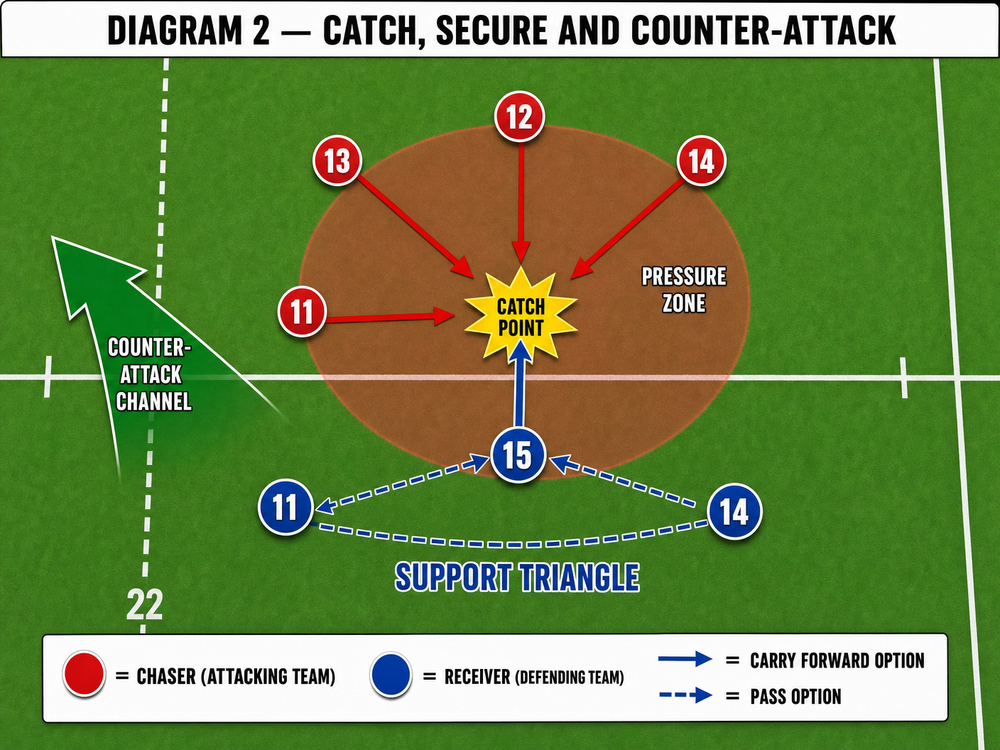
Pitch Dimensions: Half pitch (approx. 50m x 70m), utilising the halfway line to the try line or 22m line.
Equipment Needed:
- 4-6 Rugby balls
- 10-15 Cones (for marking starting positions and the landing zone)
- Bibs (two different colours to distinguish attacking and defending teams)
Player Positions:
- Attacking Team (Chasers): 1 Kicker (typically a 10 or 9), 4-5 Chasers (Wings, Centres, Flankers).
- Defending Team (Receivers): 1 Primary Catcher (Fullback or Wing), 2 Support Players (Wing or Centre).
Initial Layout:
Set up a starting line for the kicking team near the halfway line. Place the kicker centrally or slightly offset. Position the chasers in a line alongside the kicker. Mark a designated "landing zone" roughly 30-40 metres downfield using cones. Position the defending fullback deep, with the two support players slightly ahead and wide, forming a triangle.

3. Step-by-Step Instructions
- The Setup and Call: The drill begins with the kicker (10) holding the ball. The chasers align themselves, ensuring they are onside (behind the kicker). The kicker calls the play (e.g., "Up and Under, Right!").
- The Kick: The kicker executes a high, hanging kick aiming for the designated landing zone. The hang time should be sufficient (ideally 3.5 - 4.5 seconds) to allow the chasers to compete.
- The Chase: The instant the ball is kicked, the chasers sprint forward. They must maintain their lanes, communicating constantly to ensure a straight, connected defensive wall. The lead chaser (often the winger on the side of the kick) aims directly for the catcher.
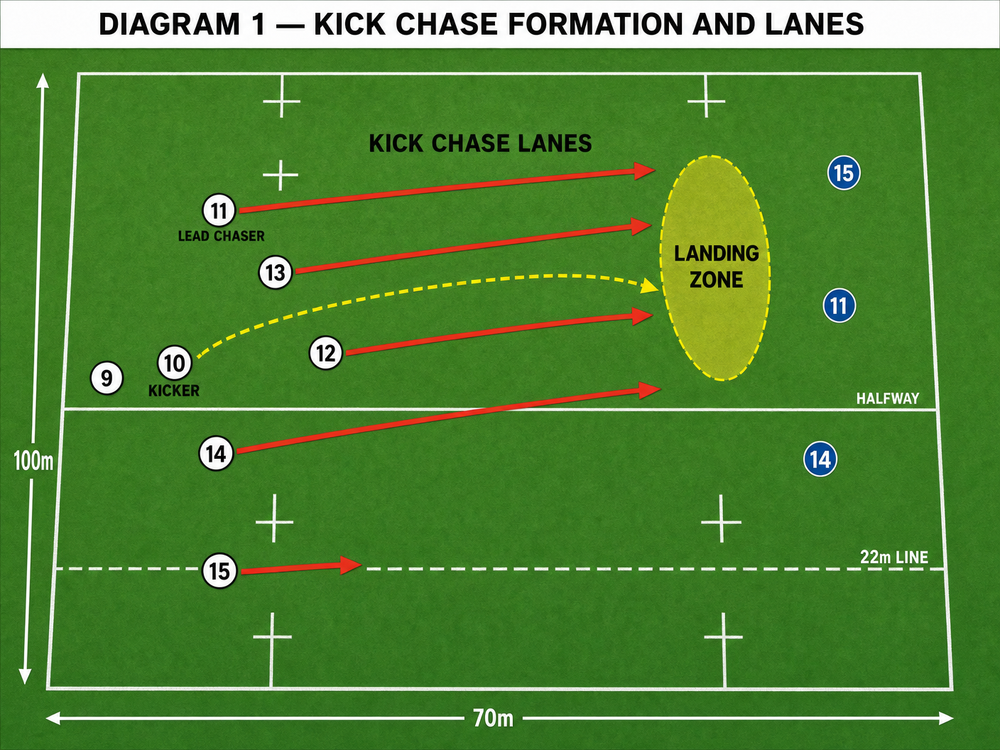
- The Catch (Receiving Team): The primary catcher tracks the ball, calling "Mine!" early and loudly. They must move quickly to get under the ball, setting their feet.
- The Support (Receiving Team): The two support players immediately sprint to position themselves slightly behind and on either side of the catcher, creating a secure "pocket" or support triangle.
- The Contest/Tackle: As the ball descends, the lead chaser either jumps to contest the ball in the air (if realistic) or prepares to make an immediate, dominant tackle on the catcher the moment their feet touch the ground.
- The Breakdown/Counter: If the catcher secures the ball, they immediately look to drive forward or pass to a support player to initiate a counter-attack. The chasers must transition instantly into a defensive line, executing a dominant tackle and competing at the breakdown.
4. Key Coaching Points
- Stay Onside: This is non-negotiable. Chasers must hold their line until the ball leaves the kicker's boot. Penalties for offside on a kick chase are easily avoidable errors.
- Maintain the Line: Chasers must run in straight lanes and stay connected. If one player sprints too far ahead, it creates a dogleg that the counter-attacking team can exploit.
- Eyes on the Prize (and the Man): The lead chaser must track the ball's flight but also be acutely aware of the catcher's position to time the tackle or contest perfectly.
- The 'W' Catch: For the receiver, hands should form a 'W' shape, elbows close together, catching the ball at eye level and immediately bringing it into the chest to secure it.
- Early Communication: Both teams must communicate. The kicker dictates the play, the chasers coordinate their line, and the receiving team must clearly call for the ball to avoid collisions.
5. Common Mistakes
- Over-chasing: A single player sprinting out of the defensive line, breaking the connection and creating gaps for the opposition to run through.
- Poor Hang Time: A kick that is too long or too low gives the chasers no time to arrive, handing the opposition an easy catch and an immediate attacking advantage.
- Waiting for the Ball: The catcher waiting for the ball to come to them rather than moving aggressively to get under its flight path.
- Lack of Support: The catcher securing the ball but being immediately isolated because the support players reacted too slowly.
6. Variations & Progressions
- Progression 1: Contested Catching: Introduce tackle shields or have a coach stand near the catcher to provide mild physical interference (bumping) as they attempt the catch, simulating match pressure.
- Progression 2: Live Breakdown: Allow the drill to continue for one or two phases after the catch. The catcher must present the ball, the support players must clear the ruck, and the chasing team must attempt to counter-ruck or realign defensively.
- Variation: The Grubbers: Instead of a high ball, the kicker executes a grubber kick behind the defensive line. The chasers must adapt their running lines, and the defenders must turn and scramble to secure the ball.
7. Age Adaptations
- Under 10s/12s: Focus primarily on the mechanics of the catch (the 'W' shape) and the safety of the player in the air. Use softer balls if necessary. The chase should focus on staying in a line rather than an aggressive tackle.
- Under 14s/16s: Introduce the contested catch in the air. Emphasise the importance of hang time for the kicker and the speed of the support players arriving at the breakdown.
- Open/Seniors: Run the drill at full match intensity. Incorporate complex kicking variations (box kicks, cross-field kicks) and demand instant, aggressive transitions at the breakdown.
