

Rugby
Mastering the Chop: Body Height & Tackle Technique Drill
A foundational drill designed to lower player body height into contact, ensuring safe, dominant tackles that stop momentum instantly.
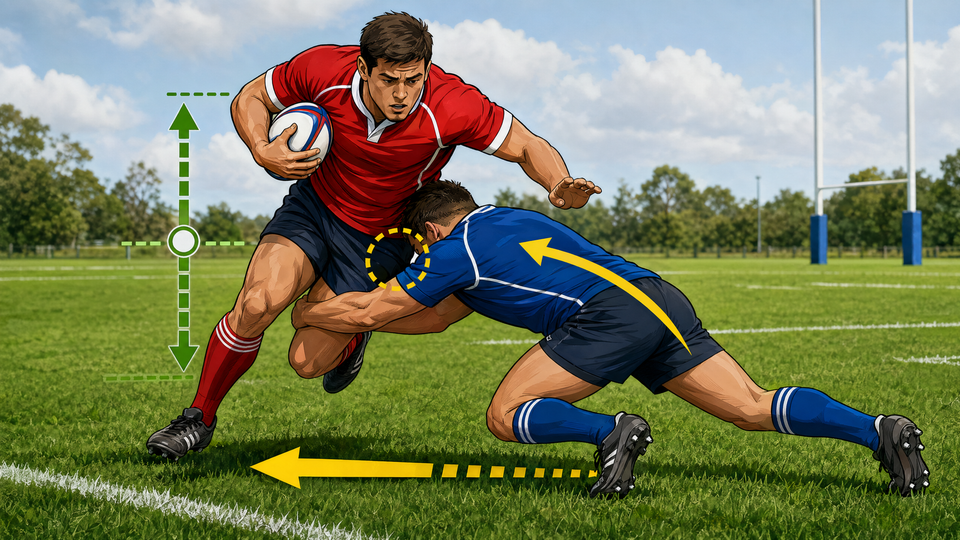
What you need
Marker cones (4-6), Rugby balls, Tackle shields (optional)
1. Overview
In the modern game, tackle height is under strict scrutiny for player safety, and high tackles are heavily penalized. Beyond safety, lowering body height in the tackle is the most effective way to chop down larger ball carriers and halt momentum. The Mastering the Chop drill is a progressive session designed to build muscle memory for the correct hip-level tackle height. It isolates the approach, the drop in height, and the execution of the tackle, making it an essential core skill drill for your weekly sessions.
2. Setup
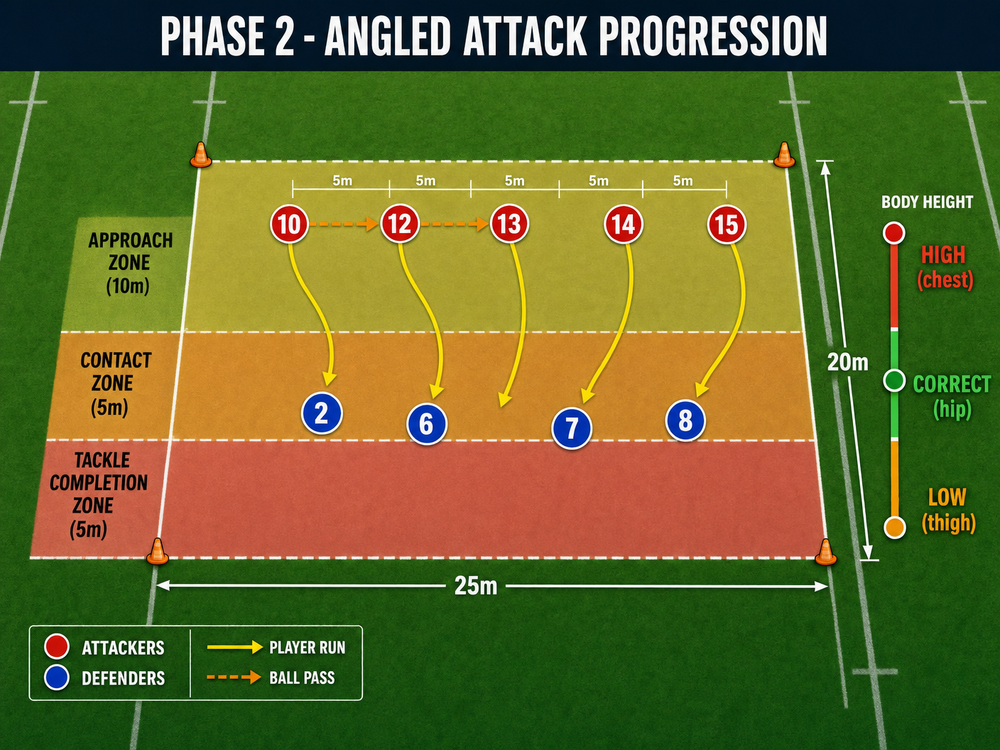
Pitch Area: 20m x 15m grid (expandable to 25m x 20m for progressions).
Equipment: 4-6 marker cones, 1 rugby ball per attacking group, tackle shields (optional for warm-up phase).
Players: Groups of 6-8 players, divided equally into Attackers and Defenders.
Initial Positioning:
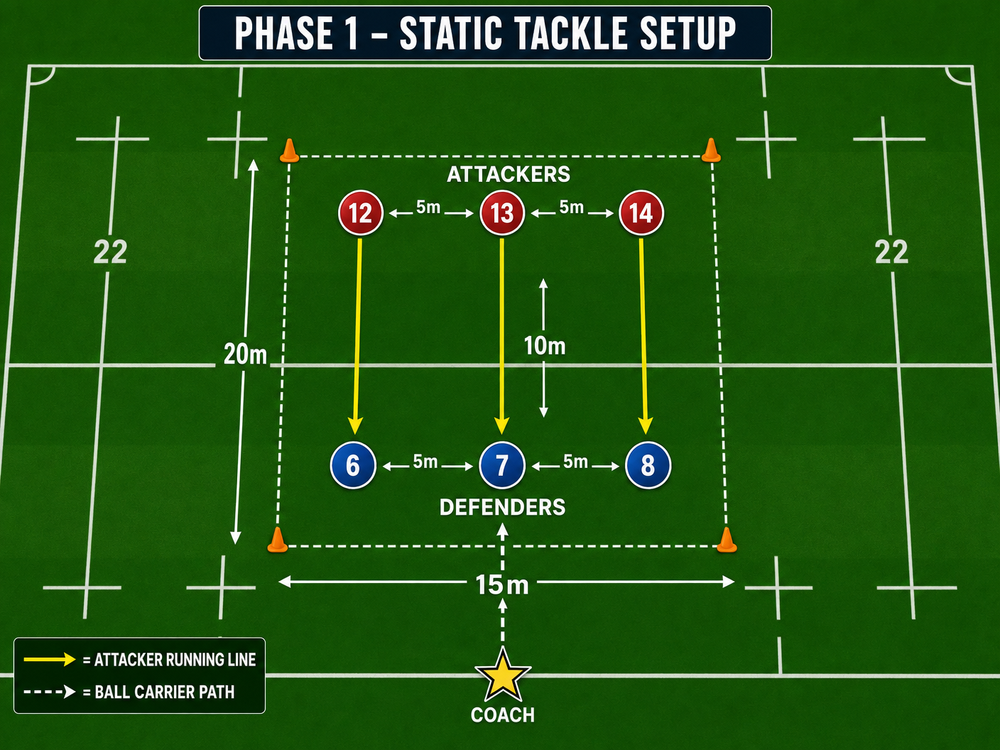
Set up a 20m x 15m grid using the marker cones. Position three defenders (e.g., players 6, 7, 8) in a flat defensive line across the bottom of the grid, spaced 5 meters apart. Position three attackers (e.g., players 12, 13, 14) 10 meters opposite the defenders. The coach should stand on the sideline to observe body angles and footwork.
3. Step-by-Step Instructions
Phase 1: Static Approach and Drop
- The Call: The coach blows the whistle or calls "Go!"
- The Advance: The attackers jog straight forward at 50% pace. The defenders advance quickly to close the space.
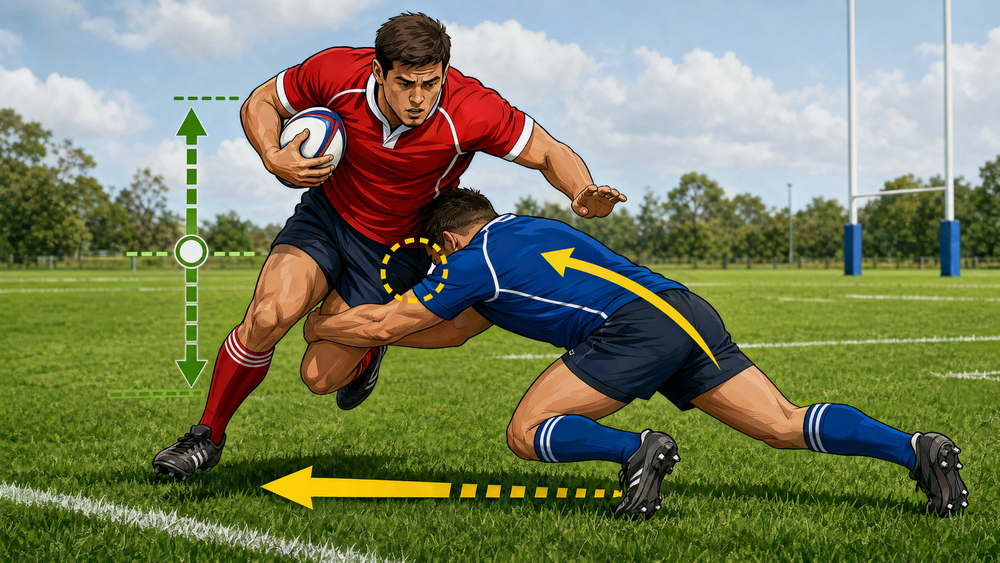
- The Drop: At 2 meters away from the attacker, the defender must visibly drop their hips, bending at the knees (not the waist), keeping their eyes up focused on the attacker's core/hips.
- The Contact: The defender makes shoulder contact at the hip/thigh level, wrapping both arms tightly around the attacker's legs.
- The Finish: The defender drives through the tackle with leg drive, bringing the attacker safely to the ground.
- Reset: Players reset quickly, swapping roles after 3 repetitions.
Phase 2: Live Angled Progression
Once the static form is perfected, introduce lateral movement.
- Expand the grid to 25m x 20m.
- Have the attackers pass the ball down the line while running at angles, forcing the defenders to drift and track their target.
- The defender must track the lateral movement, plant their lead foot close to the attacker, and execute the low tackle.
4. Key Coaching Points
- Eyes on the Target: Players must keep their eyes open and focused on the attacker's shorts/hips. "Cheek to cheek" (face cheek to glute cheek).
- Sink the Hips: The drop in height must come from bending the knees, not bowing at the waist. A straight back is crucial for safety and power.
- Foot in the Hoop: The tackler's lead foot must step in close to the attacker's feet to generate driving power.
- Punch and Wrap: Arms should punch forward aggressively and wrap tightly around the legs to prevent offloads and ensure the player goes down.
- Leg Drive: The tackle isn't finished on contact; players must continue to pump their legs to dominate the collision.
5. Common Mistakes
- Bending at the Waist: Players dropping their head and bending at the waist, leading to poor vision, weak tackles, and high risk of neck injury.
- Reaching: Trying to tackle with arms only without stepping close enough to the ball carrier.
- Planting Feet Early: Stopping foot movement before contact, resulting in a passive tackle where the attacker dictates the collision.
- High Target Area: Aiming for the chest or ball, risking high tackle penalties and allowing the attacker to leg-drive forward.
6. Variations & Progressions
- Tackle Shields to Live: Start with attackers holding tackle shields for confidence building, then progress to live, full-contact tackling.
- Fatigue Factor: Have defenders complete a down-and-up (burpee) before making the tackle to simulate game fatigue.
- Offload Threat: Allow the attacker to attempt an offload if the tackle is not dominant or wrapped tightly, forcing defenders to complete the tackle quickly.
7. Age Adaptations
- Under 8s - Under 10s: Focus entirely on the "cheek to cheek" concept and safe falling. Use tackle rings or bags exclusively before moving to player-on-player. Emphasize the "ring of steel" (tight arm wrap).
- Under 12s - Under 14s: Introduce the angled runs. Focus heavily on foot placement ("foot in the hoop") and keeping the back straight.
- Under 16s - Open (Adult): Run at high intensity. Emphasize aggressive line speed, dominating the collision, and quick recovery to the feet to contest the ruck.
