

Basketball
The 'Middle Relay' Full Court Press Break
Master a structured, high-percentage press break that uses a middle relay to safely advance the ball and punish full court pressure.

What you need
Basketball, Full Court, Cones (optional for practice)
1. Overview
Full court pressure can rattle even the most composed teams. The 'Middle Relay' press break is designed to dismantle aggressive man-to-man or zone presses by establishing clear passing lanes and utilizing the middle of the court. By placing a reliable forward (Player 4) in the center as a relay option, this set play forces the defense to contract, opening up the sidelines for quick advancement.
This play is highly effective because it minimizes dribbling in the backcourt—a common trap for turnovers—and relies on crisp passing and structured spacing to break the press and create high-percentage scoring opportunities in transition.
2. Setup
Court Dimensions: Standard FIBA Court (28m x 15m)
Player Positions:
- Player 1 (Point Guard): Primary ball handler, positioned near the inbound baseline right sideline.
- Player 2 (Shooting Guard): Positioned at the left sideline near half court, ready to sprint the wing.
- Player 3 (Small Forward): Positioned at the right sideline near half court, ready to sprint the opposite wing.
- Player 4 (Power Forward): The 'Middle Relay' man, positioned at the top of the key in the backcourt, ready to flash to the middle.
- Player 5 (Center): The inbounder, standing out of bounds near the baseline.
3. Step-by-Step Instructions
Phase 1: The Inbound Setup
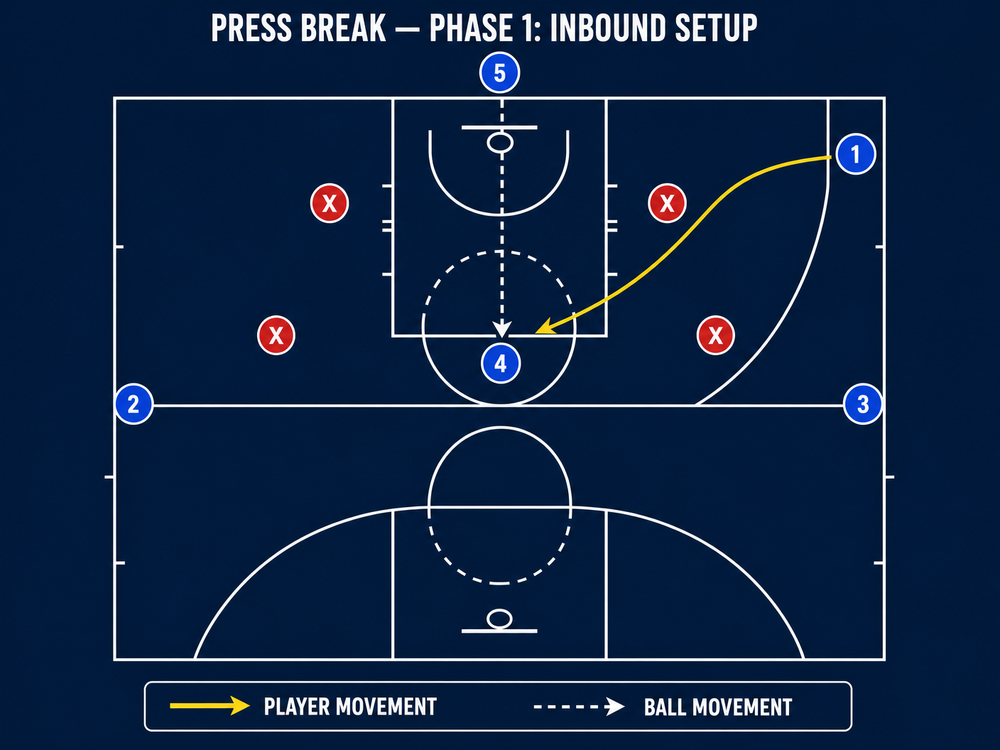
- Spacing is Key: Player 5 (C) takes the ball out of bounds. Player 1 (PG) starts on the right side, while Player 4 (PF) is stationed at the top of the key in the backcourt.
- The Initial Cut: Player 1 (PG) makes a hard V-cut to get open and receives the inbound pass from Player 5 (C).
- The Safety Valve: Immediately after inbounding, Player 5 (C) steps inbounds on the weak side to act as a safety outlet if Player 1 gets trapped.
Phase 2: Middle Relay & Advance

- Flash to the Middle: As Player 1 (PG) secures the ball, Player 4 (PF) flashes to the middle of the court, near the center circle.
- The Relay Pass: Player 1 (PG) avoids over-dribbling and delivers a crisp, two-handed chest pass or overhead pass to Player 4 (PF) in the middle.
- Wing Sprints: Simultaneously, Player 2 (SG) and Player 3 (SF) sprint hard up their respective sidelines, advancing past half court to stretch the defense.
- The Advance Pass: Player 4 (PF) pivots and immediately looks up the floor, passing ahead to either Player 2 (SG) on the left wing or Player 3 (SF) on the right wing.
Phase 3: Attack Options

- Frontcourt Attack: Once the ball is advanced to the wing (e.g., Player 2), the offense transitions into an attack mindset against a scrambling defense.
- Option A (The Layup): Player 4 (PF), after making the advance pass, cuts hard down the lane toward the basket. Player 2 looks for the quick pass to Player 4 for a high-percentage layup.
- Option B (The Pull-up/Drive): Player 1 (PG) trails the play and spots up at the top of the key. Player 2 can pass to Player 1 for an open shot or a driving lane.
- Option C (The Kick-out): If the defense collapses, Player 2 can skip the ball to Player 3 (SF) spotting up on the opposite wing for an open three-pointer.
4. Key Coaching Points
- Pass Before You Dribble: Emphasize that the ball moves faster through the air than on the bounce. Dribbling should only be used to improve a passing angle or escape a trap.
- Meet the Pass: Receivers (especially Player 1 and Player 4) must aggressively step toward the ball to prevent defensive deflections.
- The Middle is Gold: The middle of the floor is the weakest point of most presses. Player 4 must command the space and demand the ball.
- Maintain Spacing: Players 2 and 3 must stay wide on the sidelines. If they drift inside, they bring defenders into the passing lanes.
- Eyes Up on the Catch: When Player 4 catches the ball in the middle, their first instinct must be to pivot and look up the floor, not down at the ball.
5. Common Mistakes
- Panicking Under Pressure: Players rush the inbound pass or force a pass into tight coverage instead of using the safety valve (Player 5).
- Hiding Behind Defenders: Receivers failing to make strong V-cuts, resulting in easily intercepted passes.
- Over-dribbling: The Point Guard trying to beat a double-team with the dribble instead of passing out of it.
- Slow Wing Transitions: Players 2 and 3 jogging up the sidelines, allowing the defense time to recover and set up in the frontcourt.
6. Variations & Progressions
- Progression 1: Add a Trap: In practice, intentionally allow the defense to trap Player 1 on the inbound to drill the safety pass to Player 5 or the quick skip to Player 4.
- Progression 2: Time Limit: Implement a 5-second rule to cross half court in practice to simulate game pressure and encourage faster decision-making.
- Variation 1: The 'Clear Out': If the middle is heavily congested, have Player 4 clear out to the weak side, allowing Player 1 to attack the seam with a dribble drive.
7. Age Adaptations
- Under 10s / Under 12s: Focus heavily on the fundamentals of the V-cut and strong, two-handed passes. You may need to shorten the passing distances.
- Under 14s / Under 16s: Introduce reading the defense. Teach Player 4 how to recognize whether to pass ahead immediately or take a dribble to draw a defender before passing.
- Open / Advanced: Focus on the speed of execution and the transition into early offense. The press break should seamlessly flow into your secondary break or half-court set.
