

Basketball
Motion Offense Continuity Play
A foundational, continuous movement offense that teaches players how to read the defense, utilize screens, and maintain excellent floor spacing.
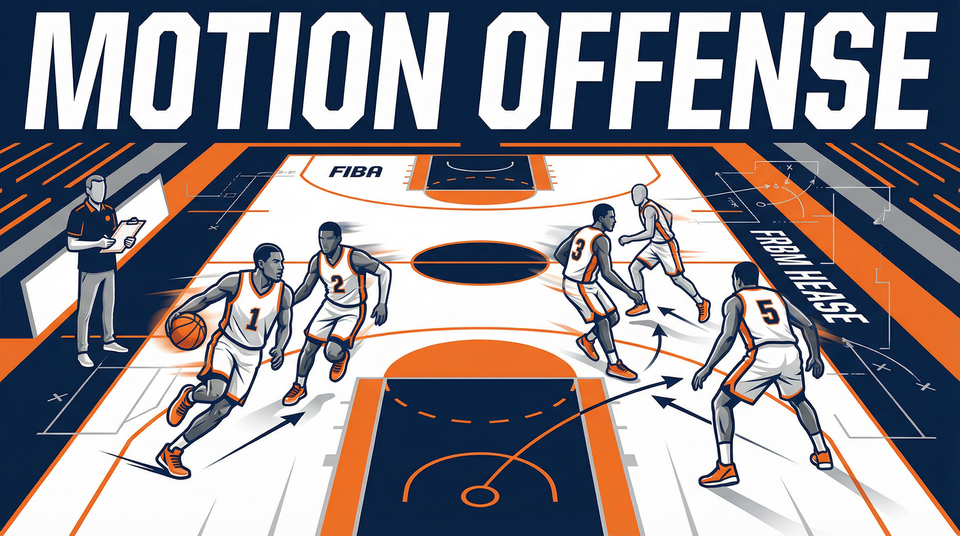
What you need
1 Basketball, Half or Full Court (FIBA dimensions: 28m x 15m)
1. Overview
The Motion Offense Continuity Play is a staple in modern basketball. Unlike rigid set plays that break down if the defense denies a specific pass, this offense relies on continuous movement, screening, and reading the defense. It is designed to keep all five players engaged, maintain optimal floor spacing, and create high-percentage scoring opportunities through ball reversals and off-ball movement. This offense is particularly effective because it teaches players the fundamental concepts of basketball—spacing, cutting, and screening—rather than just robotic memorization of a play. It can be run against both man-to-man and zone defenses with minor adjustments.
2. Setup

- Equipment Needed: 1 basketball, full or half court (28m x 15m FIBA standard).
- Court Setup: Ensure all players understand the key areas of the court: the top of the key, the wings (free-throw line extended), the corners, the elbows, and the blocks.
- Player Positions:
- 1 (Point Guard): Starts at the top of the key, initiating the offense.
- 2 (Shooting Guard): Positioned on the right wing.
- 3 (Small Forward): Positioned in the left corner.
- 4 (Power Forward): Starts near the right elbow or high post.
- 5 (Center): Positioned on the left block or short corner.

3. Step-by-Step Instructions

- Initiating the Offense: Player 1 brings the ball down the court and sets up at the top of the key. The offense begins with a pass to either the wing or the high post. In this variation, 1 passes to 4 at the high post or 2 on the wing.
- The First Cut: As soon as 1 passes the ball, they must immediately cut. If the pass goes to 2, 1 cuts hard to the basket, looking for a give-and-go return pass. If the pass goes to 4, 1 can set a screen away for 2 or cut through the lane.
- Filling the Spots: As 1 cuts through the lane and clears to the opposite side (e.g., to the left block or corner), the remaining perimeter players must rotate to fill the empty spots. If 1 cuts, 2 might rotate to the top, and 3 might lift from the corner to the wing.
- Screening Action: Player 5, positioned on the weak side block, sets a screen for the cutter (Player 1) or steps out to set a flare screen for a perimeter player.
- Ball Reversal: If there is no immediate scoring opportunity, the ball must be reversed. Player 4 or 2 passes the ball back to the top (now occupied by a rotated player) or skips it to the opposite wing. This forces the defense to shift and close out, creating driving lanes.
- Continuity: The beauty of this offense is that once the ball is reversed, the same spacing and cutting rules apply. The players are now in a mirrored setup on the opposite side of the court, ready to run the same actions (pass, cut, screen, fill) seamlessly.

4. Key Coaching Points

- Spacing is Everything: Players must maintain at least 4-5 meters of distance from each other. Poor spacing allows one defender to guard two offensive players.
- Pass and Cut Hard: Every pass must be followed by a purposeful cut. "Fake a pass to make a pass" and "cut to score, not just to move."
- Read the Defense: If the defense overplays the passing lane, the offensive player must immediately back-door cut to the basket.
- Screening Angles: When setting screens (especially down screens or flare screens), the screener must have a wide base and be stationary. The cutter must wait for the screen and run their defender into it.
- Patience: The primary goal is to get a great shot, not just a good shot. Emphasize reversing the ball at least twice before settling for a contested jumper.
5. Common Mistakes

- Standing Still: Players watching the ball instead of moving after they pass. This kills the offense's momentum.
- Poor Spacing: Players creeping too close to the ball handler, clogging driving lanes and making it easy for the defense to trap.
- Weak Screens: Setting "brush screens" where the screener doesn't make solid contact or moves before the cutter uses the screen (resulting in an offensive foul).
- Forcing Passes: Trying to force the ball into the post or through tight passing lanes instead of reversing the ball to shift the defense.
6. Variations & Progressions
- Dribble Entry: Instead of starting with a pass, Player 1 can initiate the offense with a dribble hand-off (DHO) or a dribble drive to the wing, pushing Player 2 to the corner or forcing a back-door cut.
- Pick and Roll Integration: If the continuity breaks down or the shot clock is winding down, any player with the ball on the perimeter can call for a high pick and roll from the nearest post player (4 or 5).
- 4-Out, 1-In: Adjust the setup so four players are on the perimeter and only one is in the post, creating wider driving lanes and emphasizing three-point shooting.
7. Age Adaptations
- Under 10s / Under 12s: Focus purely on the "Pass and Cut" rule. Simplify the offense to 5-Out spacing, removing complex off-ball screens. Emphasize spacing and the give-and-go.
- Under 14s / Under 16s: Introduce away screens and down screens. Teach players how to read the defense (e.g., curling off a screen if trailed, fading if the defender goes under).
- Open / Advanced: Incorporate complex reads, flare screens, and dribble hand-offs. The offense becomes less about a set pattern and more about reading the defense's rotations and exploiting mismatches.
