

Netball
Dodge, Commit & Lead: The Complete Netball Dodging and Leading Drill
Master the V-cut dodge and explosive lead to create space, beat your defender, and deliver clean ball into the attacking third every time.

What you need
netballs (4-6), coloured bibs (2 sets), cones (4), full netball court or single third
Overview
The Dodge, Commit & Lead drill is the cornerstone of every effective netball attacking system. At its heart, it teaches players the single most important skill in the game: how to create separation from a defender and present as a genuine option for the ball-carrier. This drill develops the V-cut dodge — where an attacker deliberately moves toward the defender to commit their weight, then explosively cuts away into open space — alongside the disciplined, well-timed lead that follows.
Use this drill at the start of any session focused on attacking movement, as a warm-up for mid-court or shooting-third combinations, or as a standalone 20-minute block when your team is struggling to create space under defensive pressure. It is equally valuable for beginners learning the concept of creating space and for advanced players refining the timing and deception of their movement.
Setup

Equipment
- 1 full netball court (30.5m × 15.25m) or a single third (approximately 10m × 15.25m)
- 4–6 netballs
- Coloured bibs (2 colours: attackers and defenders)
- 4 cones to mark the working zone if using a partial court
Court Setup
The drill operates primarily within the centre third and one shooting third, making use of the transverse lines as natural boundaries. Place two feeders (F1 and F2) on opposite sidelines, approximately level with the transverse line. The working area is roughly 10m × 15.25m — one full third of the court.
Player Positions
| Position | Role in Drill | Starting Location |
|---|---|---|
| Wing Attack (WA) | Primary attacker — performs the dodge and lead | Centre third, 3m from transverse line |
| Wing Defence (WD) | Active defender — applies realistic pressure | Marking WA, arm's length away |
| Goal Attack (GA) | Secondary attacker — leads into the shooting circle | Shooting third, near the transverse line |
| Goal Defence (GD) | Secondary defender — marks GA | Marking GA |
| Centre (C) | Ball distributor — initiates the sequence | Centre circle |
| Feeder (F) | Stationary ball-holder — triggers the dodge | Sideline, level with transverse line |
For smaller squads, run the drill with a minimum of 4 players: 1 attacker, 1 defender, 1 feeder, and 1 receiver.

Diagram 1 shows the basic single-channel setup. The WA (yellow) performs a V-cut dodge toward WD (blue), then leads explosively into open space to receive the pass from the Feeder (grey). The dashed blue arrow indicates ball movement; solid red arrows show player movement.
Step-by-Step Instructions

Phase 1 — The Commit (Setting Up the Defender)
- The Feeder (F) stands on the sideline holding the ball. The WA starts 3–4 metres from the Feeder, with the WD positioned between WA and the ball — the defender's natural instinct is to cut off the direct passing lane.
- On the coach's whistle (or Feeder's call of "Ready!"), the WA takes 2–3 deliberate steps toward the WD. These steps must be purposeful and sell the idea that WA is moving away from the ball. The goal is to shift the defender's weight onto their back foot or toward the sideline.
- The WD should be instructed to react naturally — this is not a passive drill. Defenders must apply genuine pressure to make the dodge meaningful.
Phase 2 — The Dodge (Creating Separation)
- After committing the defender's weight, the WA plants hard on the outside foot and drives sharply in the opposite direction — this is the V-cut. The change of direction should be explosive, covering the first 2 metres in 2 steps.
- The WA must keep their body low through the cut. Upright posture during the change of direction bleeds speed and telegraphs the move to the defender.
- As the WA plants and cuts, the Feeder reads the movement and prepares to release the ball. The pass should be timed to arrive as the WA reaches their lead position — not before.
Phase 3 — The Lead (Presenting as an Option)
- After the cut, the WA drives forward on a straight, decisive lead for 3–5 metres, hands up and in front of the body as a clear target for the Feeder.
- The Feeder delivers a firm, flat pass to WA's leading hand. WA catches, pivots, and immediately looks to pass forward to the GA, who has simultaneously performed their own dodge against GD.
- GA receives the ball near the edge of the shooting circle and either shoots or passes to the GS (if included in the drill).
Phase 4 — Reset and Rotate
- After each repetition, players rotate: WA becomes the Feeder, Feeder becomes WD, WD joins the back of the attacker queue. Run 8–10 repetitions per player before a full rotation. Allow 30 seconds of rest between sets.

Diagram 2 shows the two-channel progression. Two attacker-defender pairs work simultaneously in parallel channels — A1 (left) performs a V-cut dodge while A2 (right) uses a roll dodge. Both receive from their respective Feeders (F1 and F2) and link to GA in the shooting third.
Key Coaching Points

1. The Commit Must Be Convincing
A dodge only works if the defender believes the initial movement is real. Coach your attackers to use their full body — shoulders, hips, and eyes — when moving toward the defender. A half-hearted shuffle will not shift a quality defender's weight.
2. Plant and Explode — Not Plant and Drift
The foot plant on the change of direction is everything. Players should drive off the outside foot with maximum force, not simply redirect their momentum. Drill this in isolation if necessary: two cones, 3 metres apart, plant-and-drive between them until the movement is automatic.
3. Timing the Lead to the Pass
The most common breakdown in this drill is the attacker leading too early. The lead must begin as the Feeder's arm comes forward, not before. Teach players to read the Feeder's shoulder and elbow as the trigger for their explosive drive.
4. Hands Up, Target Clear
Once the lead is committed, both hands must come up in front of the body as a clear, confident target. A player who leads with their hands at their sides is communicating uncertainty to the ball-carrier and inviting an interception.
5. Land and Look Forward Immediately
Receiving the ball is not the end of the skill — it is the beginning of the next decision. Coach players to land in a balanced two-foot landing, pivot immediately, and scan forward before the defender has recovered. The ball should be moving within 3 seconds of receipt.
6. Defenders Must Work
This drill loses its value if defenders are passive. Instruct WD and GD to apply realistic pressure: body positioning, arms active, footwork competitive. A dodge earned against a genuine defender is worth ten repetitions against a cone.
Common Mistakes

Mistake 1: The Flat Lead (No Dodge)
Many players, particularly beginners, simply run in a straight line toward the ball without any deceptive movement. The result is a predictable lead that a competent defender will intercept. Correction: Return to the basics — walk through the V-cut pattern slowly, emphasising the two-step commit before the cut. Use the phrase: "Sell it first, then go."
Mistake 2: Leading Across the Body of the Defender
Some attackers cut in front of the defender rather than around them, running directly into the defender's space and drawing a contact call or losing the ball. Correction: Teach players to cut away from the defender's body, using the outside shoulder as a pivot point. Cue: "Go around the outside, not through the middle."
Mistake 3: Telegraphing the Direction of the Lead
Attackers who look at the space they intend to lead into before they make the cut give the defender a full second of warning. Correction: Instruct players to keep their eyes on the ball (or Feeder) throughout the commit phase. The head should only turn toward the lead space after the plant foot has driven off.
Mistake 4: Receiving Off-Balance
Players who arrive at the ball at full sprint with no control will fumble the catch or land out of court. Correction: Emphasise the two-foot landing in the final step of the lead. Drill the "jump-stop" landing in isolation: sprint 5 metres, jump-stop on two feet, catch a soft toss. Repeat until it is instinctive.
Mistake 5: Holding the Ball Too Long After Receipt
After receiving, some players pause to compose themselves before looking to pass, giving the defender time to recover and the team's attacking momentum to stall. Correction: Introduce a 3-second countdown rule in training. If the ball is not moving within 3 seconds of receipt, the possession is turned over. This creates urgency without sacrificing composure.
Variations & Progressions


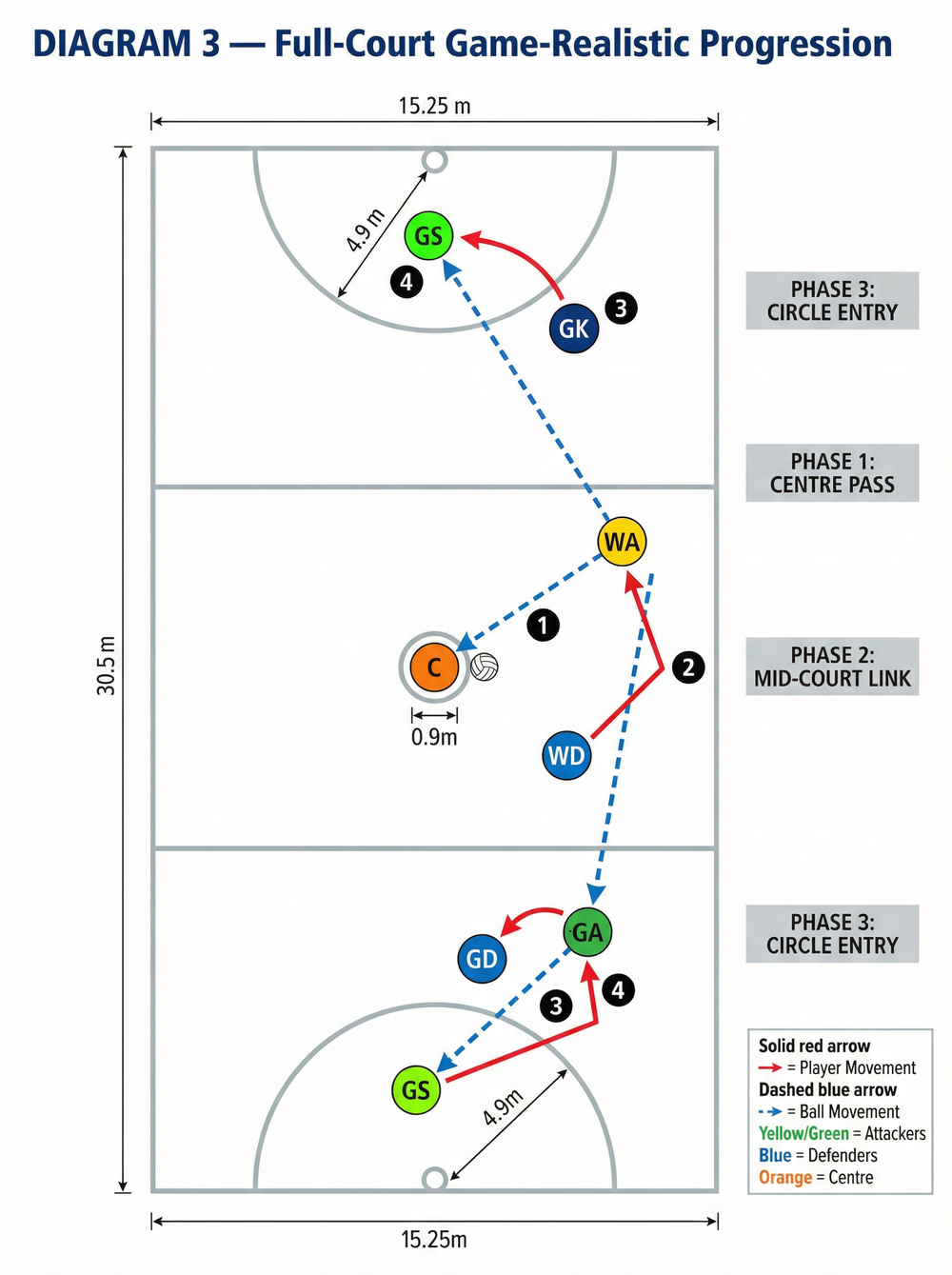
Diagram 3 shows the full-court game-realistic progression. The sequence flows from a centre pass (Phase 1) through a mid-court link via WA (Phase 2) into circle entry via GA and GS (Phase 3), with each attacker performing a dodge before receiving.
Variation 1 — Roll Dodge (Intermediate)
Replace the V-cut with a roll dodge: the attacker moves toward the defender, plants, and spins 180° around the defender's outside shoulder before leading away. This is harder to execute cleanly but more effective against defenders who anticipate the V-cut. Introduce this once players are comfortable with the basic drill.
Variation 2 — Two-Ball Continuous (Intermediate–Advanced)
Introduce a second ball so that while WA is performing their dodge-and-lead sequence, GA is simultaneously performing theirs. The two sequences must be timed so that the ball arrives at each attacker in sequence, creating a continuous flow. This replicates the game demand of multiple attackers working in combination and forces players to read each other's timing.
Progression 1 — Add a Second Defender (Advanced)
Introduce a second defender (e.g., GD marking GA) and require the ball to move through two dodge-and-lead sequences before a shot is taken. The WA must dodge to receive from the Feeder, then the GA must dodge to receive from WA, and then GS leads in the circle. This is a direct replication of a full attacking sequence from centre pass to shot.
Progression 2 — Conditioned Game (Advanced)
Move the drill into a 4v4 or 5v5 conditioned game in one half of the court. Award bonus points (2 points instead of 1) for any goal scored from a sequence that included a clearly executed dodge-and-lead. This incentivises the skill in a game-realistic environment and gives players the opportunity to make their own decisions about when and how to use the dodge.
Age Adaptations
Under 10s and Under 12s — Simplify the Concept
For younger players, remove the active defender entirely in the first instance. Use a cone or a bib on the ground to represent the defender's position. The attacker walks through the V-cut pattern — 2 steps toward the cone, plant, 3 steps away — before progressing to jogging pace. Introduce a passive (shadow) defender only once the movement pattern is consistent. Keep repetitions short (5–6 per player) and rotate frequently to maintain engagement.
Under 14s — Introduce Decision-Making
At this age, players are ready to make decisions under pressure. Add a simple constraint: the Feeder can choose to pass to either the WA or the GA, and both attackers must be performing their dodge simultaneously. This forces players to lead with genuine intent rather than waiting to see where the ball goes.
Under 16s and Open Age — Full Game Integration
Older players should be challenged to apply the skill in full-court, full-pressure scenarios. Run the drill as described in Progression 2, but add a turnover rule: if the attacking team fails to execute a recognisable dodge before receiving in any third, possession is awarded to the defence. This creates accountability for technique under competitive pressure and directly bridges the gap between drill and game.
