

Netball
Fast Break Centre Pass: Transition Attack from the Centre Circle
Master the fast break centre pass to exploit defensive disorganisation and convert possession into a shooting opportunity within three passes.
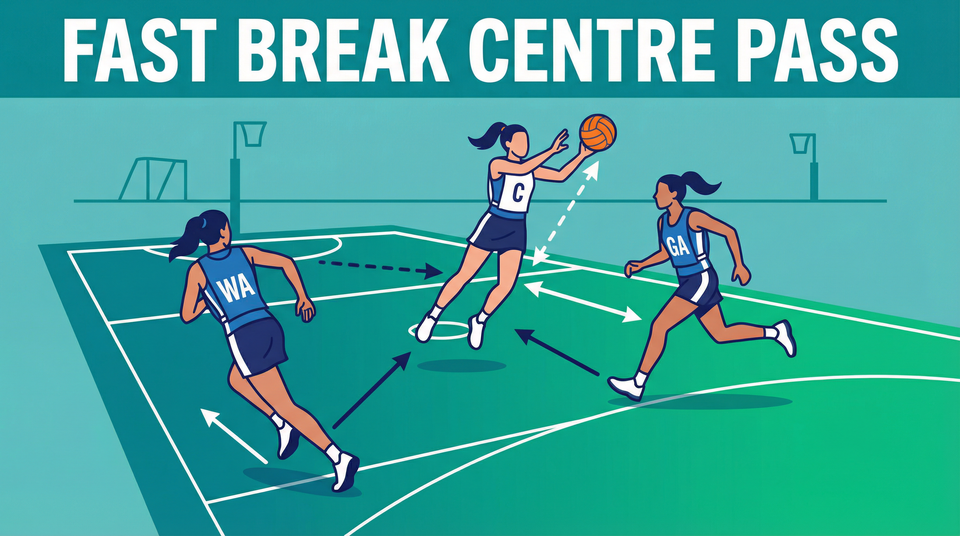
What you need
netball, bibs/training vests (2 colours), full-size court (30.5m x 15.25m), cones for zone marking
Overview
The Fast Break Centre Pass is a high-tempo, structured set play designed to move the ball from the centre circle into the attacking shooting circle in three purposeful passes before the opposition defence has time to reset and organise. It is most effective immediately after your team wins possession from a centre pass, particularly when the defending team is still transitioning back into their defensive positions.
This play is built on the principle of width, depth, and timing — the three pillars of effective transition netball. When executed with precision, it creates a clear shooting opportunity for the Goal Shooter (GS) or Goal Attack (GA) within the first five seconds of play. Coaches should use this play as a primary attacking weapon at every centre pass, and as a default structure from which all other centre pass variations branch.
Setup

Equipment Required: One netball, bibs or training vests in two colours (one per team), a full-size court (30.5m × 15.25m), cones for marking zones during practice.
Player Positions at the Centre Pass:
| Position | Location at Whistle | Role in the Play |
|---|---|---|
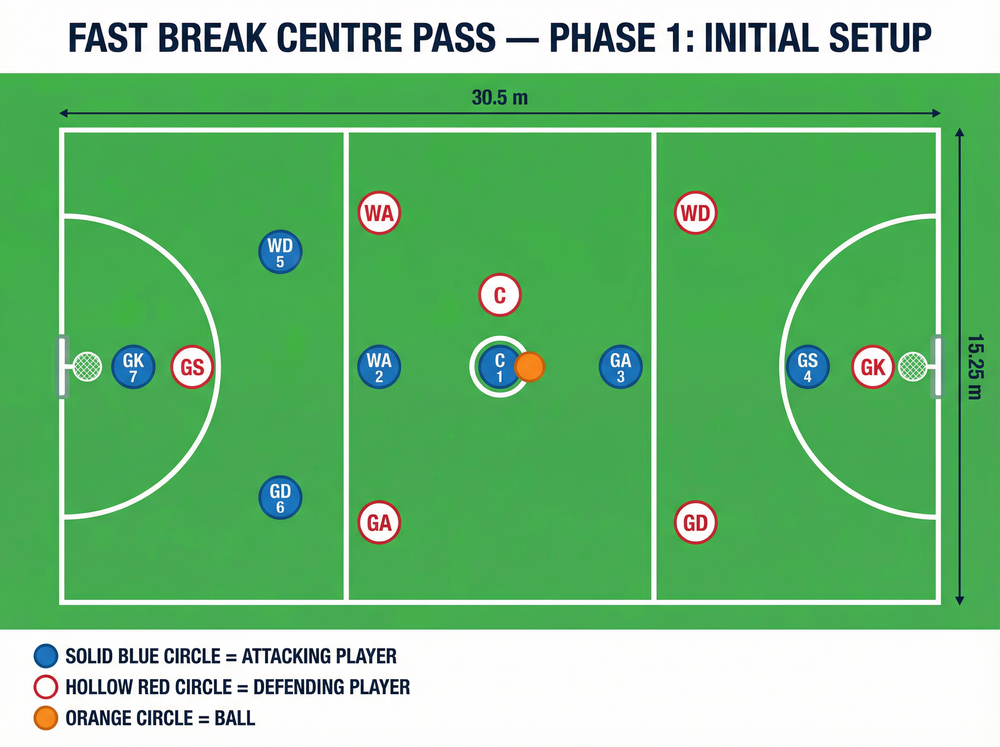
| Centre (C) | Centre circle (0.9m diameter) | Initiates the play; delivers Pass 1 |
| Wing Attack (WA) | Centre third, left channel | Primary first receiver; drives to the transverse line |
| Goal Attack (GA) | Centre third, right channel | Secondary receiver; leads into the attacking third |
| Goal Shooter (GS) | Attacking shooting circle edge | Deep anchor; receives the final pass for a shot |
| Wing Defence (WD) | Defensive third, left side | Provides a safety outlet; holds width |
| Goal Defence (GD) | Defensive third, right side | Holds defensive shape; ready to counter-press |
| Goal Keeper (GK) | Defensive shooting circle | Anchors the defensive end |

Diagram 1 — Phase 1: Initial Setup. All seven attacking players (blue) are shown in their correct starting positions at the centre pass whistle, with defending players (red) in their restricted zones.
Step-by-Step Instructions
Step 1 — The Signal (Pre-Whistle)
Before the umpire blows the whistle, the Centre calls the play using a pre-agreed code word (e.g., "Blue!"). This signals WA to prepare to drive hard to the left transverse line and GA to hold their position on the right side for a split-second before making their lead. GS simultaneously begins a slow walk toward the top of the shooting circle to draw their defender deeper.
Step 2 — The Whistle and First Drive
The moment the whistle sounds, WA explodes forward from their starting position toward the left side of the transverse line, aiming to receive the ball approximately 3–4 metres inside the centre third on the left channel. WA's lead should be a sharp, straight sprint — no curved runs at this stage.
Step 3 — Pass 1: C to WA
The Centre steps out of the circle and delivers a flat, fast chest pass or bounce pass to WA on the left channel. The pass must be ahead of WA's lead — thrown into the space WA is running into, not to where they currently stand. This pass should be released within 1.5 seconds of the whistle.
Step 4 — GA's Lead Run
As soon as Pass 1 is released by C, GA makes their decisive lead run. GA drives diagonally forward from the right channel of the centre third, crossing the transverse line and penetrating into the attacking third. GA should aim to receive the ball approximately 2–3 metres over the transverse line on the right side of the attacking third.
Step 5 — Pass 2: WA to GA
WA receives the ball from C, plants their landing foot, and immediately delivers Pass 2 to GA who is now leading into the attacking third. This pass should be a long flat pass or lob pass — whichever creates the cleanest angle. WA must read GA's lead and release the ball early. The entire sequence from Pass 1 to Pass 2 should take no longer than 2 seconds.
Step 6 — GS's Timing Move
While Passes 1 and 2 are in motion, GS executes a critical timing move. From the top of the shooting circle, GS takes two steps toward GA (drawing their defender with them), then sharply changes direction and drives to one side of the shooting circle — either the post side or the wing side — to create separation from GK.
Step 7 — Pass 3: GA to GS (Shooting Position)
GA receives the ball in the attacking third and immediately delivers Pass 3 into the shooting circle to GS, who should now have 0.9m of separation from their defender. This pass must be delivered into GS's leading hand — not behind them. GS catches, lands, and shoots within the 3-second rule.
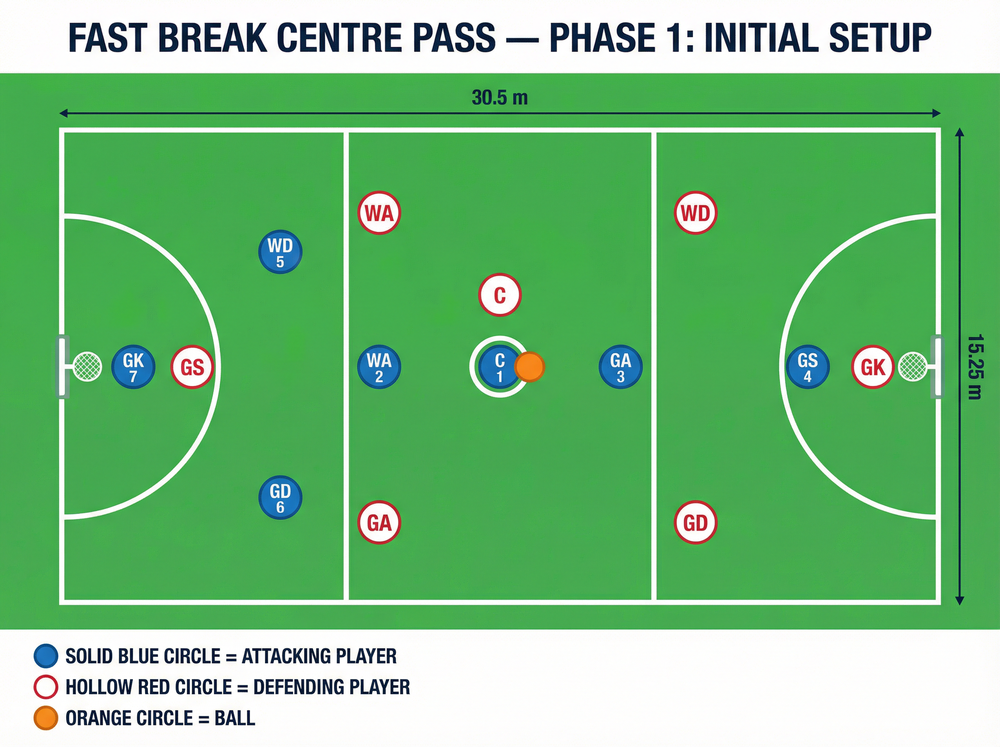
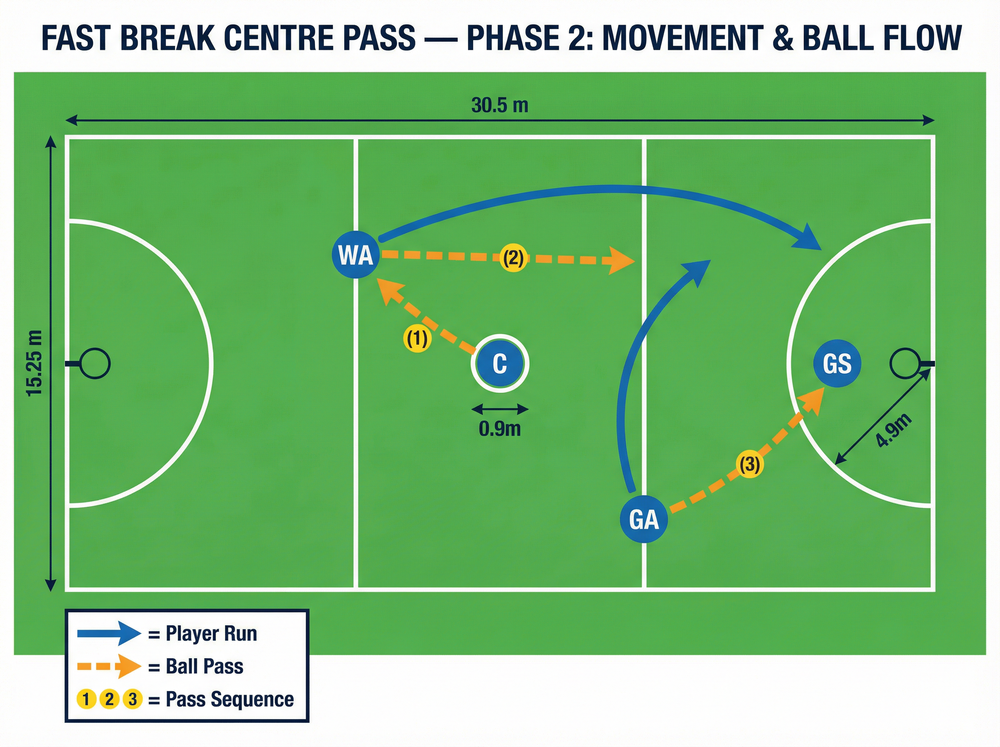
Diagram 2 — Phase 2: Movement & Ball Flow. The three-pass sequence is shown with numbered dashed arrows (ball) and solid arrows (player runs). Note the diagonal lead of GA, the timing move of GS, and the C's outlet position after Pass 1.
Key Coaching Points
1. Timing is Everything — Not Speed Alone
The most common misconception is that this play is purely about running fast. In reality, it is about the timing of each lead relative to the ball. WA must not lead too early (defender will recover), and GA must not lead until Pass 1 is in the air. Drill this with a "wait and explode" cue.
2. Width Creates Space
WA must hug the left sideline to stretch the defence horizontally. If WA drifts toward the centre of the court, they compress the space for GA's lead and allow the defending Centre to intercept. Reinforce: "Own your channel — sideline to sideline."
3. The Ball Must Travel Faster Than the Players
In a fast break, the ball should always be one step ahead of the play. Passes must be flat, fast, and forward. Any looping or hesitant pass allows the defence to recover. Use the cue: "Pass it where they're going, not where they are."
4. GS's Timing Move is Non-Negotiable
If GS stands still waiting for the ball, GK simply stands with them and blocks the pass. GS must manufacture separation through movement. Teach GS to read Pass 2 and begin their timing move as the ball travels from WA to GA.
5. C Becomes the Safety Valve
After delivering Pass 1, C does not stand and watch. C immediately moves into the centre third as a secondary outlet in case WA or GA are covered. This prevents a turnover if the primary options are denied.
6. Communicate the Play — Every Single Time
Silent centre passes lead to hesitation. Every player must know the play before the whistle. Use a verbal call system and reinforce it in every training session until it becomes automatic.
Common Mistakes

Mistake 1 — WA Leads Too Early
If WA drives before the whistle or in anticipation of it, the defending Wing Defence has time to recover and contest the pass. Correction: Drill a "whistle only" start in training. WA must react to the sound, not predict it.
Mistake 2 — GA Leads Flat Across the Court
A lateral lead by GA across the transverse line is easy for GD to intercept. GA must lead forward and diagonal, penetrating into the attacking third at an angle that takes GD away from the ball. Correction: Use cones to mark the target zone for GA's lead — 2m over the transverse line, 3m from the right sideline.
Mistake 3 — Passes Are Too Slow or Too High
Lobbed or slow passes give defenders time to recover and intercept. Correction: Introduce a "3-second rule" in practice — if the ball is not in the shooting circle within 3 seconds of the whistle, the play is reset. This creates urgency without sacrificing accuracy.
Mistake 4 — GS Moves Too Late
If GS waits until GA has the ball before moving, the timing window is lost and GK has already positioned to block. Correction: Teach GS to trigger their move when Pass 2 (WA to GA) is in the air — not after GA catches it.
Mistake 5 — C Forgets Their Outlet Role
After Pass 1, C often drifts back toward the centre circle or watches the play develop. This leaves the team with no safety option if the primary passes are denied. Correction: Assign C a specific "outlet position" — 3m forward of the centre circle on the right side — and check this in every repetition.
Variations & Progressions

Variation 1 — The Switch (WA and GA Roles Reversed)
Run the same play but with GA receiving Pass 1 on the right channel and WA making the lead into the attacking third on the left. This is particularly effective when the opposition has a strong Wing Defence on the left side. Use the code word "Switch!" to call this variation pre-whistle.
Variation 2 — The Delay (C Holds and Drives)
Instead of passing immediately to WA, C holds the ball for one beat and then drives forward into the centre third before releasing Pass 1 to GA, who has used the extra second to lose their defender. This is effective against defences that press aggressively on the first pass. Use the code word "Hold!".
Progression 1 — Add a Defender
Once the play is running cleanly unopposed, add a single defender (GD) to contest GA's lead. This forces GA to read the defender and adjust their lead angle. Gradually add all defenders to build full-game realism.
Progression 2 — Condition the Shot
Once GS receives Pass 3, add a condition: GS must shoot within 2 seconds of catching. This replicates match pressure and trains GS to shoot off a fast lead rather than settling into a comfortable stance.
Age Adaptations

Under 10 / Under 12 — Simplify to Two Passes
For younger players, reduce the play to a two-pass sequence: C to WA, then WA directly to GS at the top of the shooting circle. Remove GA's lead run to reduce cognitive load. Focus purely on timing the first pass and a clean lead from WA.
Under 14 — Introduce the Full Three-Pass Sequence
At this age group, players can manage the full play. Begin with a walk-through at half speed, then build to full pace over 3–4 sessions. Introduce the "Switch" variation once the base play is consistent.
Under 16 / Open — Add Defensive Pressure and Decision-Making
For senior players, run the play against a full defensive unit and allow the Centre to make a real-time decision: if WA is covered, C drives forward and passes to GA directly (bypassing WA). This develops the Centre's reading ability and makes the play unpredictable for the opposition.
