

Netball
Shooting Circle Movement Drill: Double Cut & Feed
Teach your GS and GA to create space through coordinated cutting movements, timing their runs to receive the ball in high-percentage shooting positions inside the circle.
What you need
netball balls (4-6), cones or markers (8-10), bibs or training vests (two colours), coaching clipboard (optional)
Overview
The Double Cut & Feed drill is a structured attacking drill designed to develop coordinated movement between the Goal Shooter (GS) and Goal Attack (GA) inside and around the shooting circle. It replicates the real-game scenario where both shooting players must work in tandem — one drawing the defender, the other exploiting the space created — to generate a clean shooting opportunity.
This drill is best used in the attacking phase of a training session, after a warm-up and before any full-court conditioned games. It is equally effective as a pre-match activation drill for experienced squads. Coaches will find it particularly valuable when their shooting end is becoming predictable or when the GS and GA are operating independently rather than as a unit.
The drill directly targets three core attacking principles: lead timing, space creation, and circle penetration. When executed correctly, players will understand how to use the full 4.9-metre radius of the shooting circle, how to read each other's movements without verbal communication, and how to present a balanced body position to receive and shoot under pressure.
Setup

Court Area: The goal third of a standard Netball court (15.25m wide × 10.17m deep), incorporating the shooting circle (4.9m radius semicircle).
Equipment Required:
- 4–6 Netball balls
- Cones or markers (8–10)
- Bibs or training vests (two colours)
- Whiteboard or coaching clipboard (optional but recommended)
Players Required: 6 players minimum (GS, GA, WA, C, GD, GK). Can be run with 4 players in the simplified version.
Player Starting Positions:
- GS (1): Starting on the right side of the shooting circle, approximately 2m from the post, facing up court.
- GA (2): Positioned on the left edge of the shooting circle, facing the feeder.
- WA (3): Standing on the right wing, just inside the goal third, approximately 3m from the transverse line.
- C (4): Positioned at the top of the goal third, 1–2m behind the transverse line, holding the ball.
- GD (X): Marking GS in a passive-to-active defensive role (progress through the drill stages).
- GK (optional): Marking GA in later progressions.

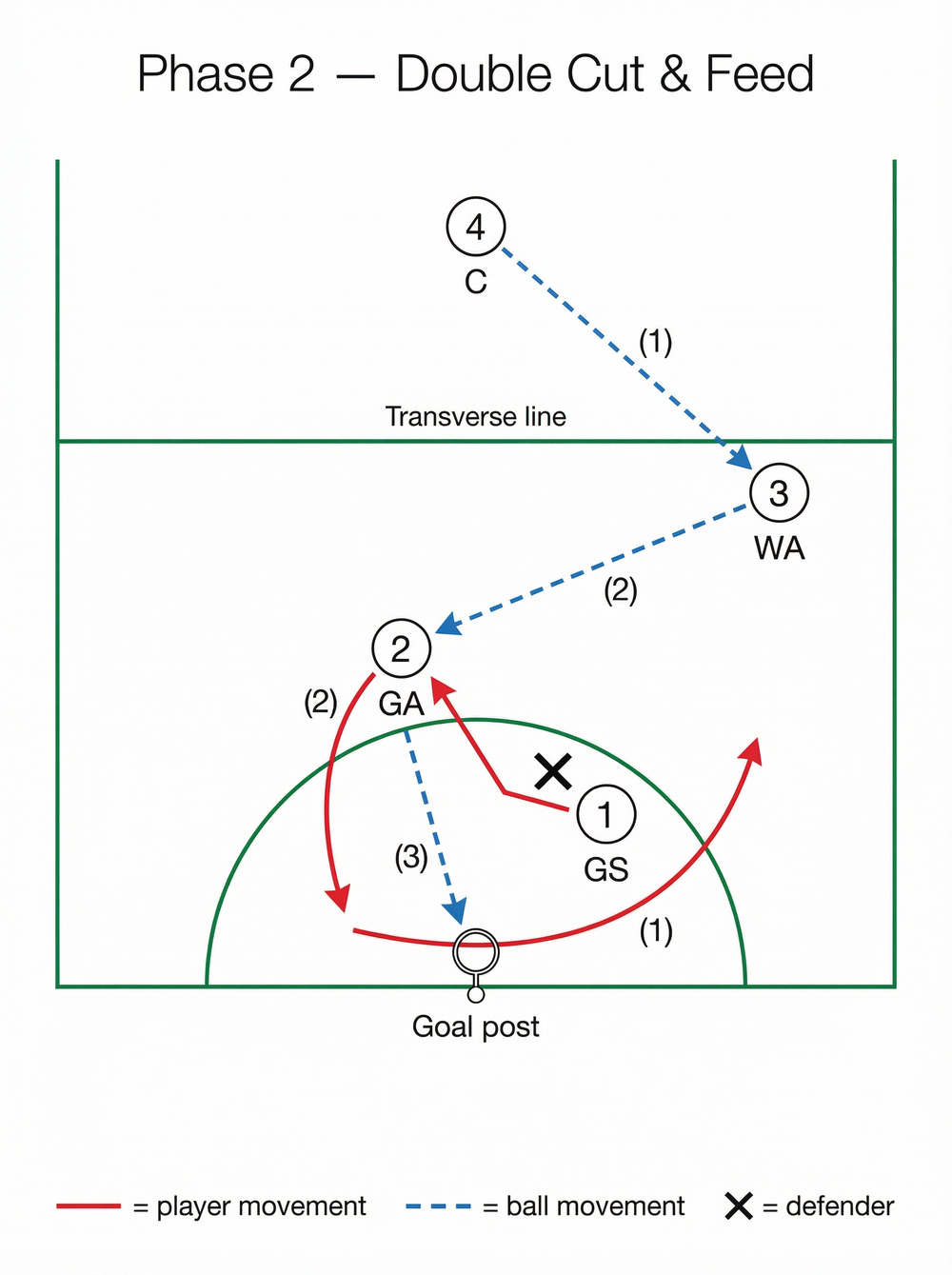
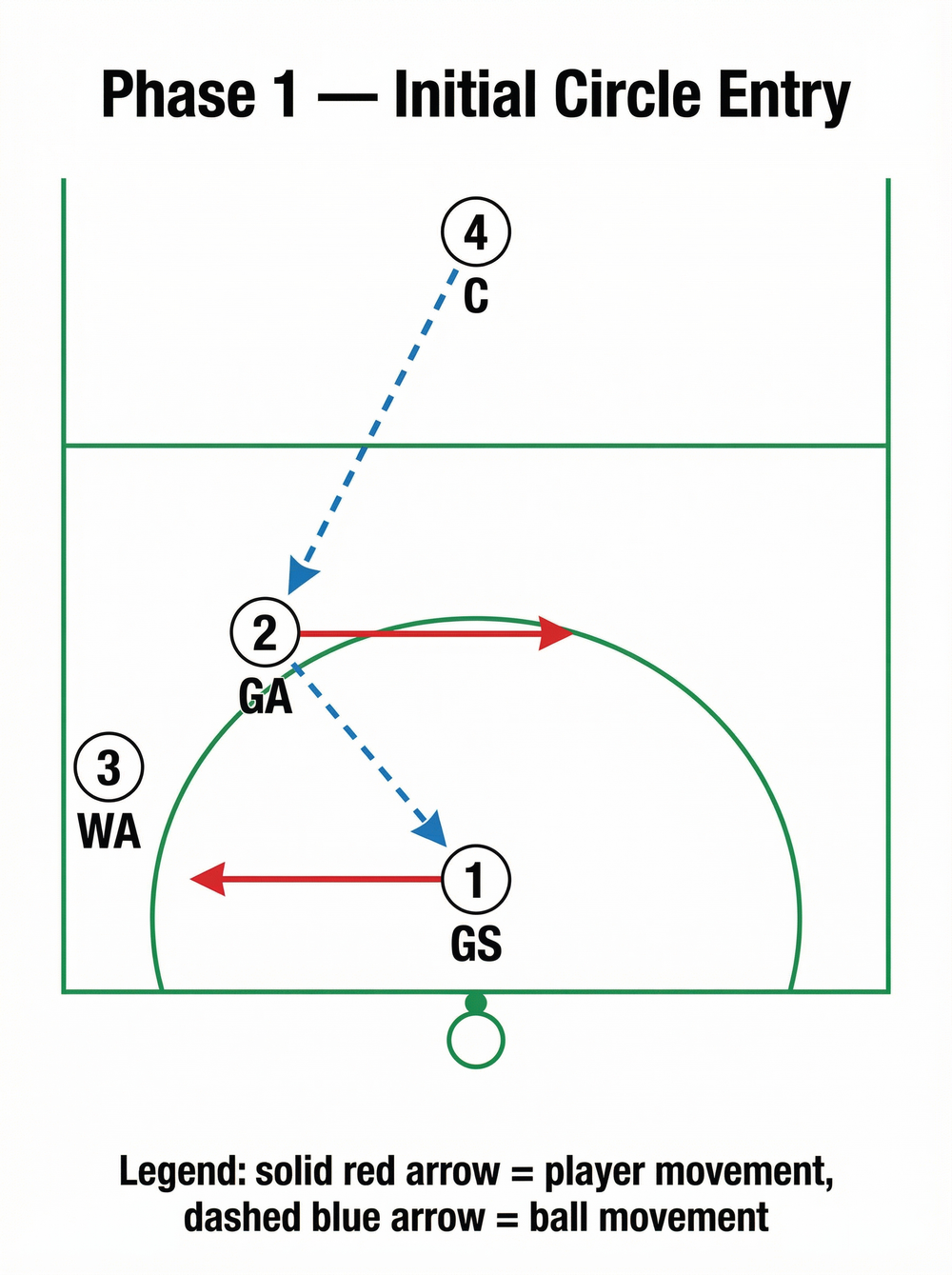
Diagram 1 — Phase 1: Initial Circle Entry. The Centre (C) drives the ball into the GA on the circle edge. GS simultaneously drives away from the post to create space, then cuts back to receive the feed from GA.
Step-by-Step Instructions

Phase 1 — Initial Circle Entry (No Defence)
- C holds the ball at the top of the goal third. GS and GA take their starting positions as described above. All players are stationary.
- C calls "Go" as the signal to initiate movement.
- GS drives hard away from the post toward the right baseline (approximately 3–4m), using a sharp change of direction to lose an imaginary defender. This is the decoy run.
- GA simultaneously cuts from the left edge of the circle toward the top of the circle, presenting hands to receive from C.
- C delivers a flat, direct pass to GA as GA reaches the top of the circle. The pass should arrive chest-height, allowing GA to catch and move in one fluid motion.
- GS, having completed the decoy run, immediately cuts back hard across the circle toward the left post area — this is the primary cut.
- GA feeds GS with a short, sharp pass into the shooting space. The feed should lead GS slightly so she can catch and shoot without resetting her feet.
- GS catches, balances, and shoots. Emphasis is on a clean catch-and-shoot with minimal additional footwork.
- Rotate positions after each successful completion: WA → C → GA → GS → WA. GD rotates in from outside.
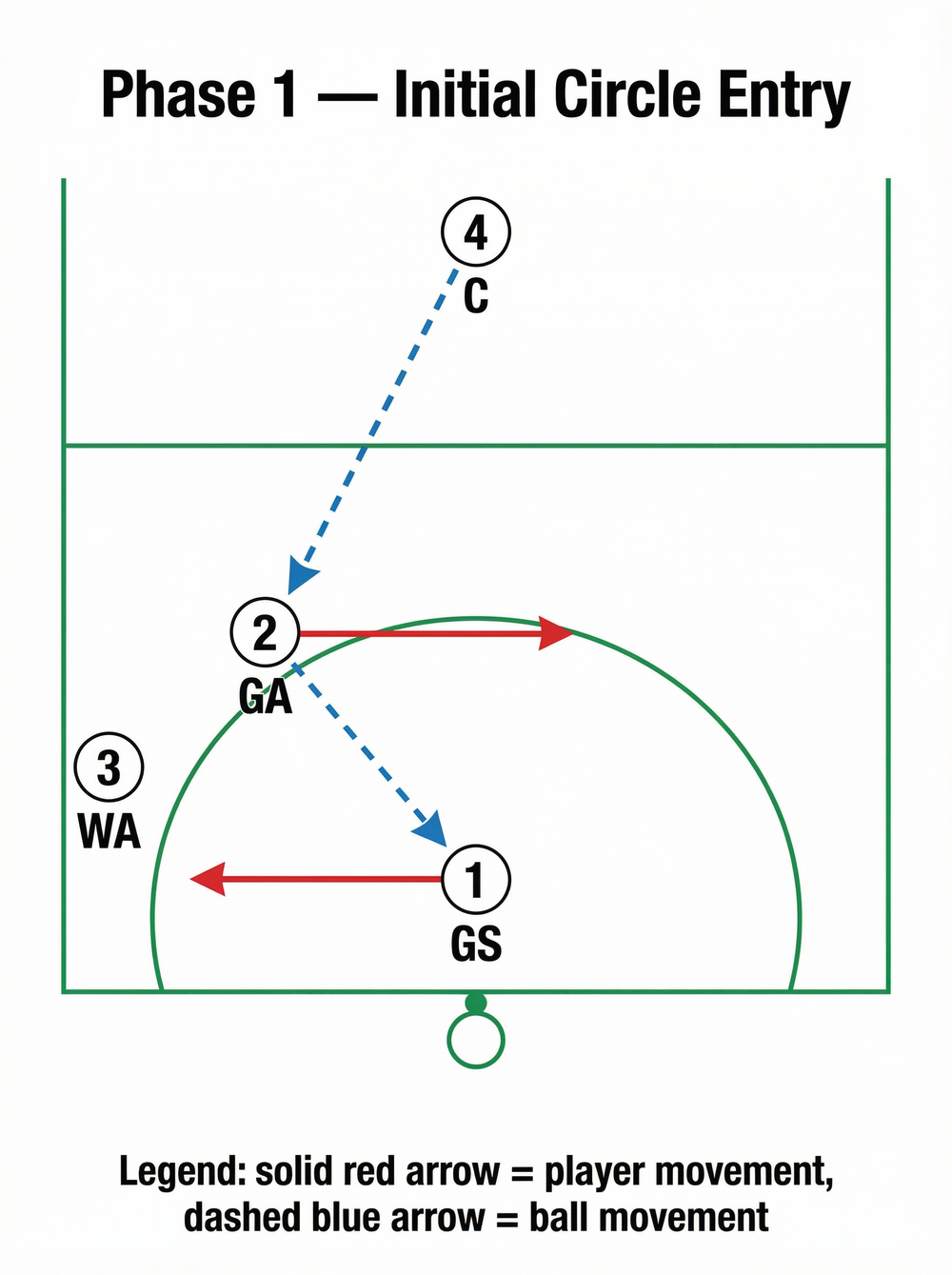
Phase 2 — Double Cut with Wing Feed (See Diagram 2)
- Repeat the setup. This time, C passes to WA first (pass 1), who has moved to a position just inside the goal third on the right wing.
- GS drives from right to left along the baseline (the baseline sweep), pulling the GD across the circle.
- GA drops back to the circle edge, then cuts sharply forward and inward to receive from WA (pass 2).
- GA receives and immediately looks to feed GS, who has now arrived at the left post area after completing the baseline sweep.
- GA feeds GS (pass 3) into the shooting position. GS catches and shoots.
- If GS is not free, GA holds the ball and shoots from her position on the circle edge — this teaches players to read the situation rather than forcing a predetermined outcome.

Diagram 2 — Phase 2: Double Cut & Feed. The ball travels C → WA → GA in sequence (dashed blue arrows). GS executes a baseline sweep (solid red arrow, step 1), drawing the defender (X) across the circle. GA cuts forward to receive, then feeds GS at the post.
Key Coaching Points

1. The Decoy Run Must Be Committed. A half-hearted lead will not move a defender. Insist that GS accelerates at full pace for at least 3 metres before changing direction. The defender must genuinely react to the first movement for the cut to be effective.
2. Timing Is Everything — Move on the Pass, Not After It. Players must learn to begin their cut as the ball is released, not when it is caught. If GA waits until C has caught the ball before moving, the timing window closes. Cue players with: "Move on the release, not the catch."
3. The Feed Must Lead the Shooter. GA should deliver the ball into the space ahead of GS's movement, not directly at her current position. A ball thrown to where GS is will always arrive late. Teach feeders to aim 0.5–1m ahead of the shooter's path.
4. Body Balance on Receipt. GS must land in a balanced, two-footed position (or controlled one-foot landing) to shoot efficiently. Watch for players who catch off-balance and then spend an extra step resetting — this gives defenders time to close down.
5. Communication Without Words. In game conditions, players cannot shout instructions. Encourage GS and GA to develop eye contact cues and pre-agreed movement patterns. The drill should eventually be run in silence to build this non-verbal understanding.
6. The Option to Shoot Must Always Exist for GA. Remind GA that she is not simply a feeder — she is a shooter too. If GS is not free, GA must be in a position and mindset to shoot herself. This dual-threat mentality keeps defences honest.
Common Mistakes
Mistake 1 — GS Starts Moving Too Early. If GS begins her decoy run before C calls "Go", the timing of the whole sequence is disrupted. Correct this by reinforcing the start signal and, if necessary, having GS count a one-second pause before moving.
Mistake 2 — GA Stands Still While GS Moves. A common error is for GA to watch GS's run rather than executing her own simultaneous movement. Both players must move at the same time. Use the cue: "Two players moving, one ball — make the defender choose."
Mistake 3 — The Feed Is Too High or Too Soft. Lobbed passes into the circle give defenders time to intercept or close down. Insist on flat, firm passes that travel quickly. A soft lob is a gift to the defence.
Mistake 4 — GS Shoots Off the Wrong Foot. After a dynamic cut, GS may arrive at the shooting position with her weight on the wrong foot, leading to an unbalanced shot. Slow the drill down and have GS practise the final two steps of her cut, focusing on landing with her shooting foot forward.
Mistake 5 — Players Repeat the Same Pattern Every Time. If GS always cuts left and GA always cuts right, defenders will read it within two repetitions in a game. Encourage players to vary the direction of their leads and discuss how to change the pattern based on where the defender is positioned.
Variations & Progressions
Progression 1 — Add a Passive Defender (GD on GS). Introduce a GD who marks GS at 0.9m (the legal defending distance) but does not contest the ball. This adds realistic body pressure and forces GS to use her body to shield the catch. Progress to an active GD who can intercept after the feed is released.
Progression 2 — Add a Second Defender (GK on GA). Once the drill runs smoothly with one defender, add a GK marking GA. Now both shooters must work harder to get free. This is the closest replication of a real match scenario and is suitable for intermediate to advanced squads. Allow the drill to become a conditioned game: attackers score a point for every goal, defenders score a point for every turnover or missed shot.
Progression 3 — Restrict the Feed to Two Seconds. Place a two-second time limit on GA once she receives the ball. If she has not fed GS or shot within two seconds, possession turns over. This replicates the pressure of a real game and discourages GA from holding the ball and waiting for the perfect moment.
Age Adaptations
Under 10 / Under 12 — Simplify to a Single Cut. Remove the double-movement element and focus only on GS making one lead and receiving from GA. Use a larger circle (you can mark a 6m practice circle with cones) and allow players to walk through the movement before attempting it at pace. Focus on the catch and a stationary shot rather than a dynamic catch-and-shoot.
Under 14 — Introduce the Decoy Run but Keep Defence Passive. Players at this age are ready to understand the concept of creating space for a teammate. Introduce Phase 1 of the drill with a passive defender and spend time discussing why the decoy run works. Use video or a whiteboard diagram to show the movement pattern before going on court.
Under 16 / Open Age — Full Drill with Active Defence and Time Pressure. Run the complete Phase 2 drill with active GD and GK, and apply the two-second feed restriction. Encourage players to self-organise the rotation and to call out what worked and what did not after each repetition. At this level, the drill should transition naturally into a conditioned 4v4 game in the goal third.
