Mastering the Two-Foot Landing: Foundation Footwork Drill
A high-repetition, structured drill designed to teach players how to absorb impact safely and establish balance using the two-foot landing technique.
Equipment Needed
1. Overview
Footwork is the foundation of Netball. Without a stable, balanced landing, players cannot execute accurate passes or pivot effectively away from defenders. This drill focuses specifically on the two-foot landing—a critical technique where a player lands simultaneously on both feet after receiving a pass.
This drill provides high repetitions in a controlled environment, allowing coaches to isolate the landing mechanics before introducing defensive pressure. It is perfect for the warm-up phase or as a technical focus block during a mid-week training session.
2. Setup
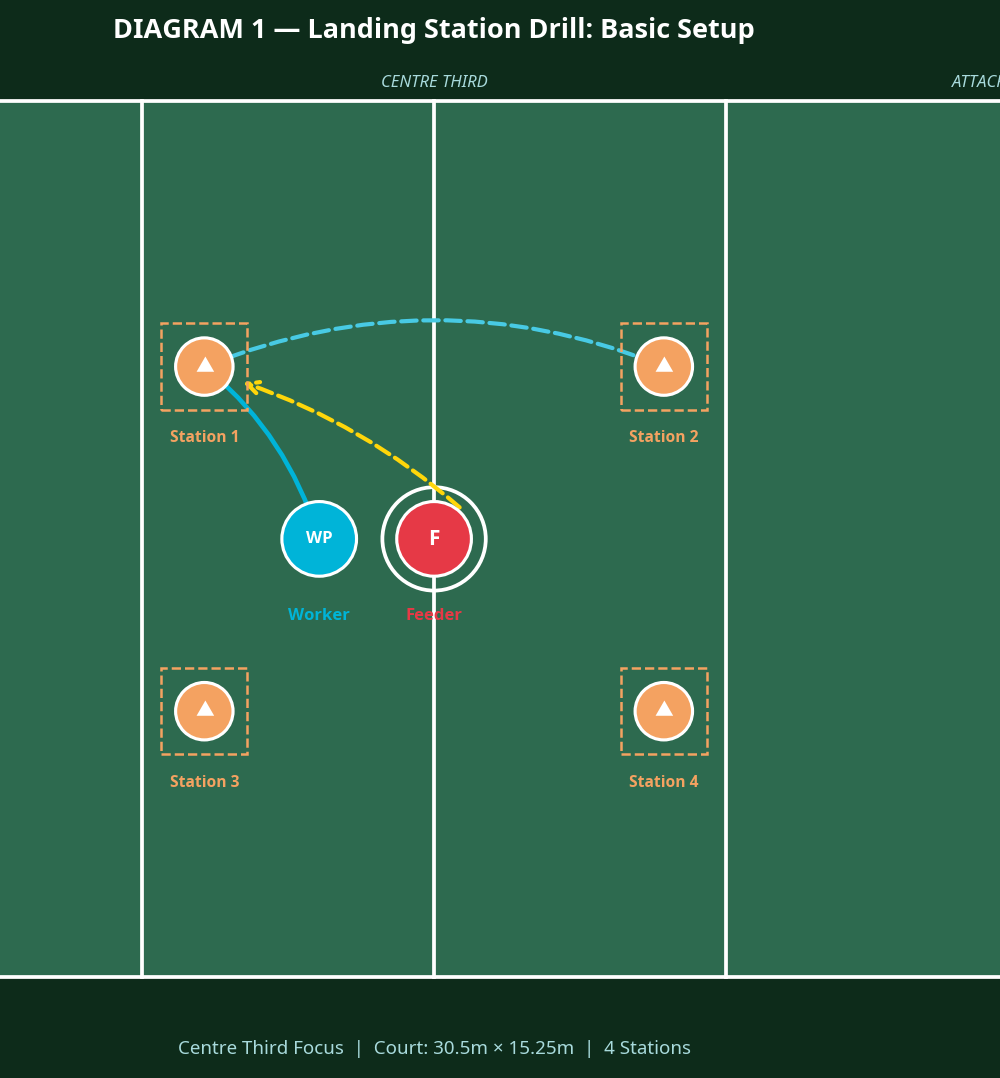
Court Area: Centre Third (using the full 15.25m width).
Players: Groups of 4-5 per station.
Equipment Needed:
- 1 Netball per group
- 4 Coloured cones (to mark landing stations)
Positions:
- Feeder (F): Stands stationary in the middle of the centre circle with the ball.
- Working Player (WP): Starts 2-3 metres away from the Feeder.
- Landing Stations: Place 4 cones in a square formation around the centre circle, approximately 4-5 metres away from the Feeder.
3. Step-by-Step Instructions
- The Drive: The Working Player (WP) drives strongly on a 45-degree angle towards Station 1.
- The Feed: The Feeder (F) delivers a firm, chest-height pass out in front of the WP, forcing them to extend and attack the ball.
- The Catch & Land: The WP catches the ball in the air and lands exactly at Station 1 using a simultaneous two-foot landing.
- The Hold: The WP must hold their landing for a full 2 seconds, demonstrating perfect balance and bent knees, before passing the ball back to the Feeder.
- The Reset: The WP quickly backpedals or side-steps to the starting position.
- The Rotation: The WP repeats the drive to Station 2, Station 3, and Station 4. After completing all four stations, the WP swaps roles with the Feeder.
4. Key Coaching Points
- "Eyes on the Ball": Players must track the ball into their hands before focusing on the landing.
- "Bend to Absorb": Hips, knees, and ankles must bend simultaneously upon impact to absorb the shock and lower the centre of gravity.
- "Equal Weight Distribution": Ensure the player's weight is spread evenly across both feet. If they lean too far forward, they will step and be called for footwork.
- "Strong Core": Players should keep their chest up and engage their core to prevent falling forward on the catch.
- "Attack the Ball": Do not wait for the ball to arrive; drive aggressively into the space.
5. Common Mistakes
- The 'Stutter Step': Landing on one foot and taking a series of small, uncontrolled steps to stop. Correction: Emphasise a strong, definitive jump into the catch to allow both feet to land together.
- Stiff Knees: Landing with straight, locked legs, which causes jarring and loss of balance. Correction: Cue the player to "sit in a chair" as they catch the ball.
- Narrow Base: Landing with feet too close together, resulting in poor lateral stability. Correction: Tell players to land with feet shoulder-width apart.
6. Variations & Progressions
Once players have mastered the basic mechanics, introduce game-like scenarios to test their footwork under pressure.
Progression 1: Add a Defender
Introduce a passive defender (GD) who shadows the WP's drive. The WP must now focus on strong angles and holding their landing while a defender is in their vision.
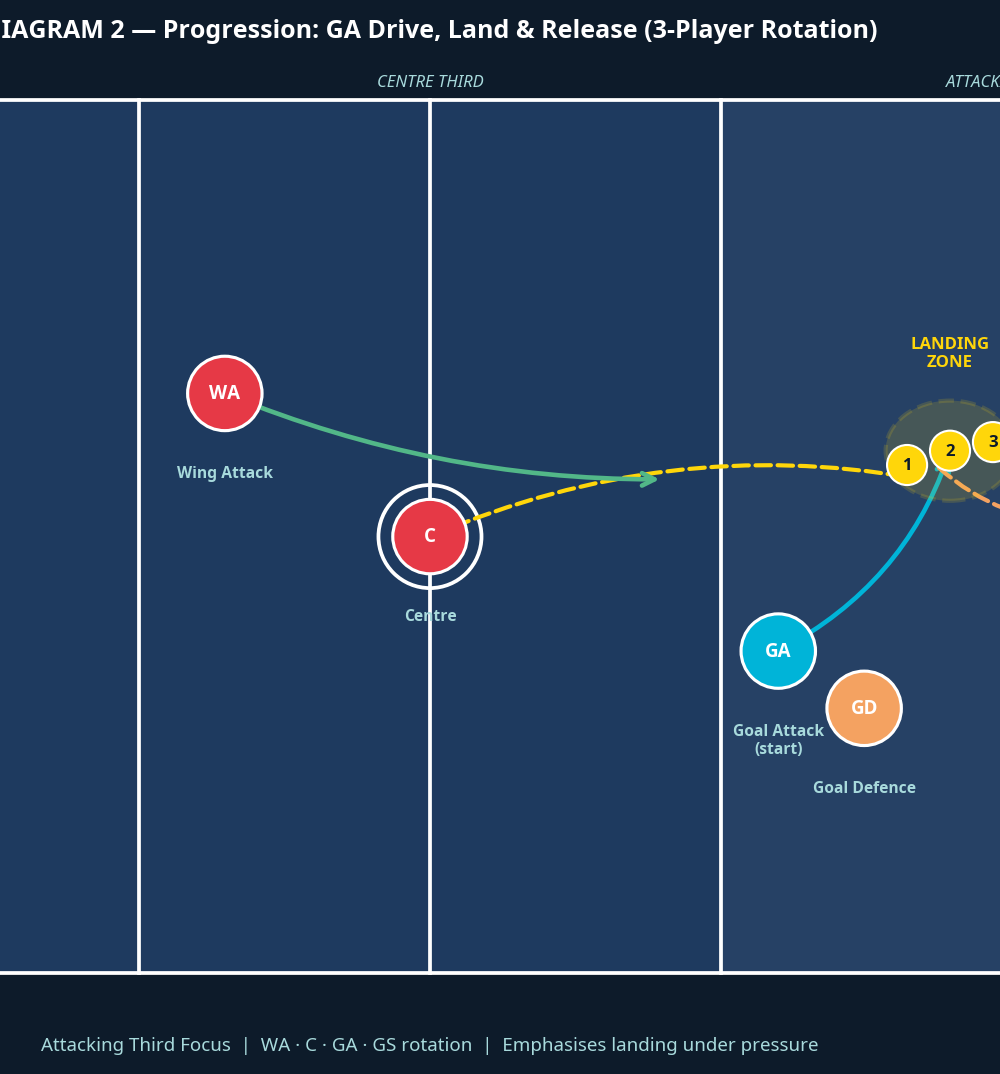
Progression 2: The 3-Player Rotation (Drive, Land & Release)
Move the drill into the attacking third. The Goal Attack (GA) drives to the top of the circle, executes a two-foot landing, pivots, and immediately feeds the Goal Shooter (GS) holding under the post. The Wing Attack (WA) balances the court.
7. Age Adaptations
- Under 8s / NetSetGO: Remove the ball initially. Have players run, jump over a line, and practice "sticking" the landing like a gymnast. Introduce a soft ball once the footwork is correct.
- Under 12s: Focus heavily on the "bend to absorb" cue. This age group is prone to growth spurts and joint stiffness; correct landing mechanics are vital for injury prevention.
- Open / Seniors: Increase the speed of the feed and mandate that the pass back to the feeder must be executed within 1 second of landing, simulating high-speed match play.