

Netball
Mastering WA Feeding Patterns: Angles, Vision, and Execution
Develop your Wing Attack's ability to hit the circle edge, read the shooting circle, and deliver precise feeds under pressure with these structured patterns.
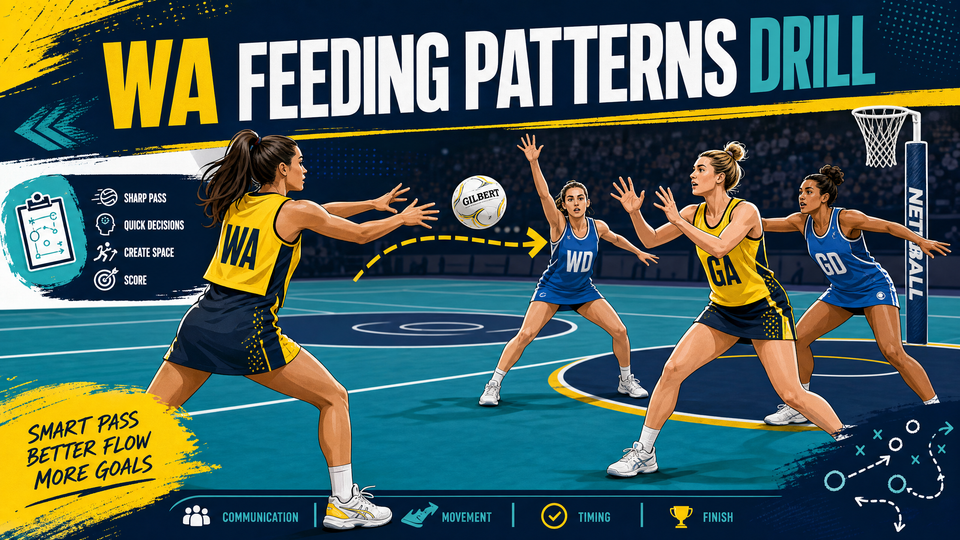
What you need
1 netball, 6 bibs (3 attacking, 3 defending), Cones (optional)
Overview
The Wing Attack (WA) is the primary playmaker in the attacking third. Their ability to consistently find the circle edge, read the movement of the shooters, and deliver pinpoint feeds is critical to an effective attack. This drill resource focuses on three core WA feeding patterns designed to improve timing, decision-making, and execution under pressure.
By running these patterns, coaches can help their midcourters develop a stronger connection with the shooting circle, understand how to manipulate defenders, and create high-percentage scoring opportunities.
Setup
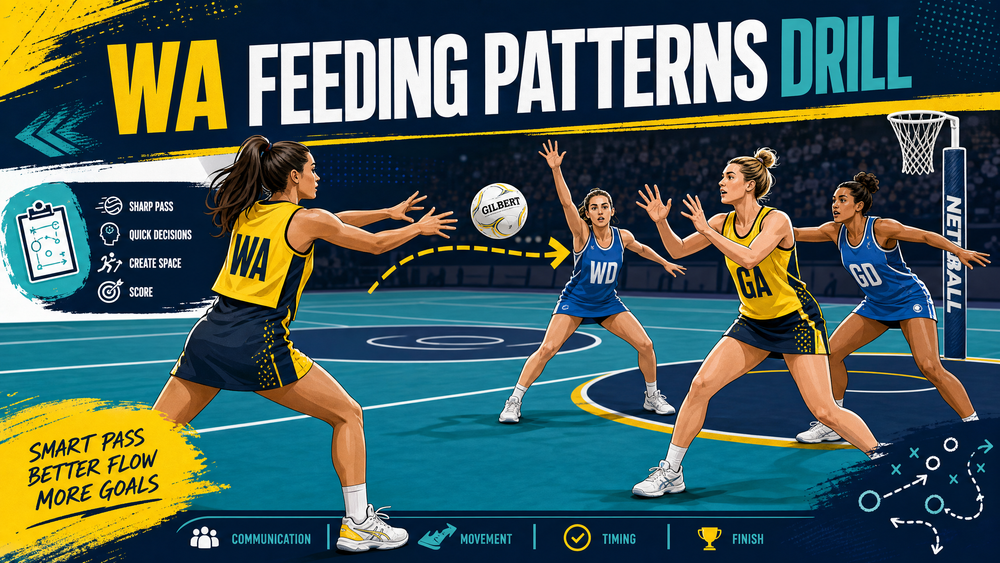
- Players Required: Minimum 6 players (C, WA, GA, GS, WD, GD).
- Equipment: 1 netball, 6 bibs (3 attacking, 3 defending), cones (optional, to mark starting positions).
- Court Area: Centre third and one attacking third.
- Positions:
- Attackers: C, WA, GA, GS.
- Defenders: WD (on WA), GD (on GA).
Pattern 1: The Basic Lead & Feed
This foundational pattern establishes the timing between the WA hitting the circle edge and the GA leading out to receive.
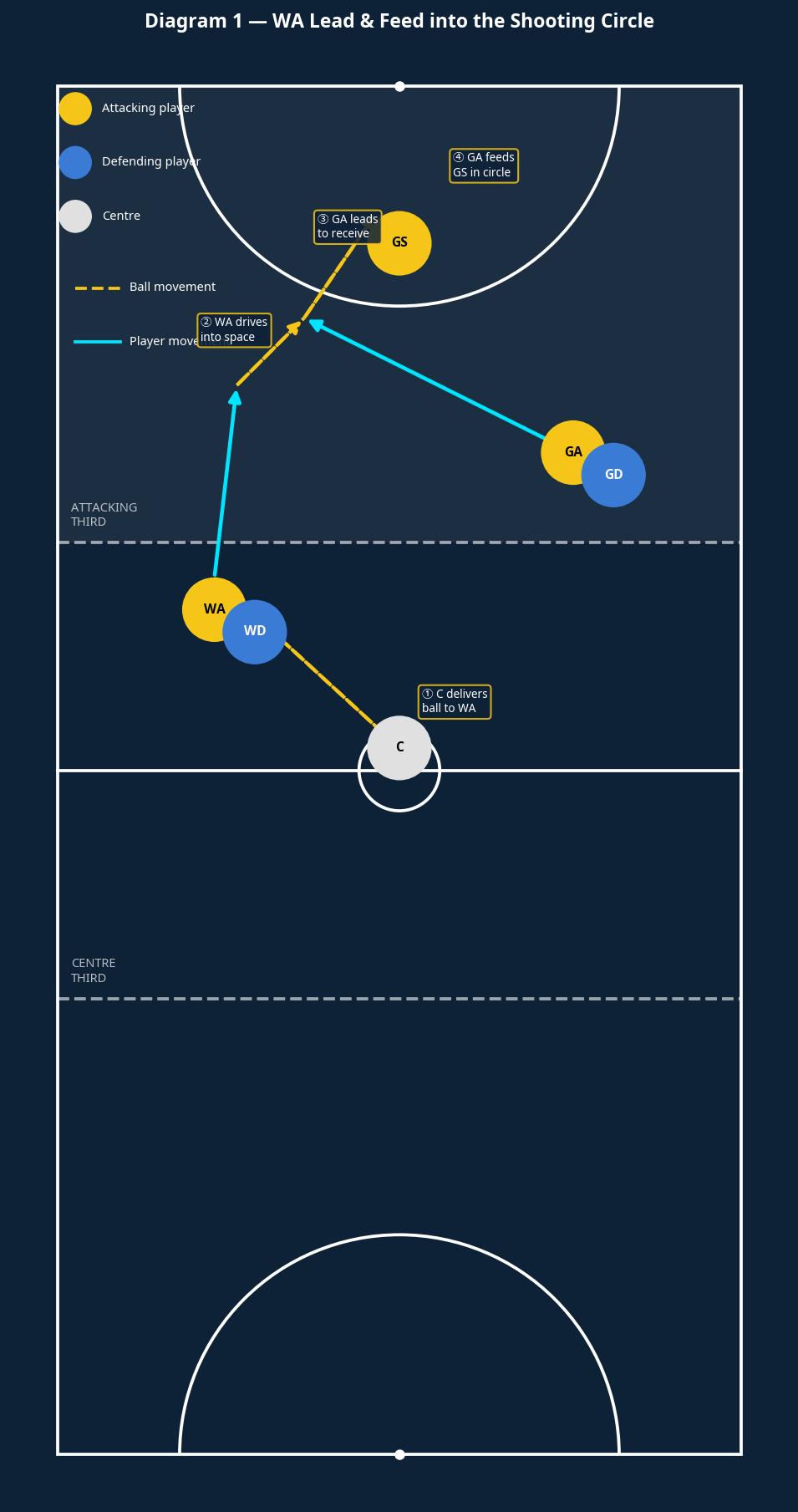
Step-by-Step Instructions
- Starting Position: The C has the ball in the centre circle. The WA starts wide in the centre third, marked by the WD. The GA starts deep in the attacking third, marked by the GD.
- The Drive: As the C prepares to pass, the WA makes a sharp, angled drive toward the circle edge, aiming for the top of the goal circle.
- The Delivery: The C delivers a firm, flat pass to the WA as they hit the circle edge.
- The GA Lead: Anticipating the WA's catch, the GA leads hard across the top of the circle to receive the next pass.
- The Feed: The WA lands, turns fully to face the post, and delivers a quick pass to the GA.
- The Finish: The GA then looks into the circle to feed the GS for a shot on goal.
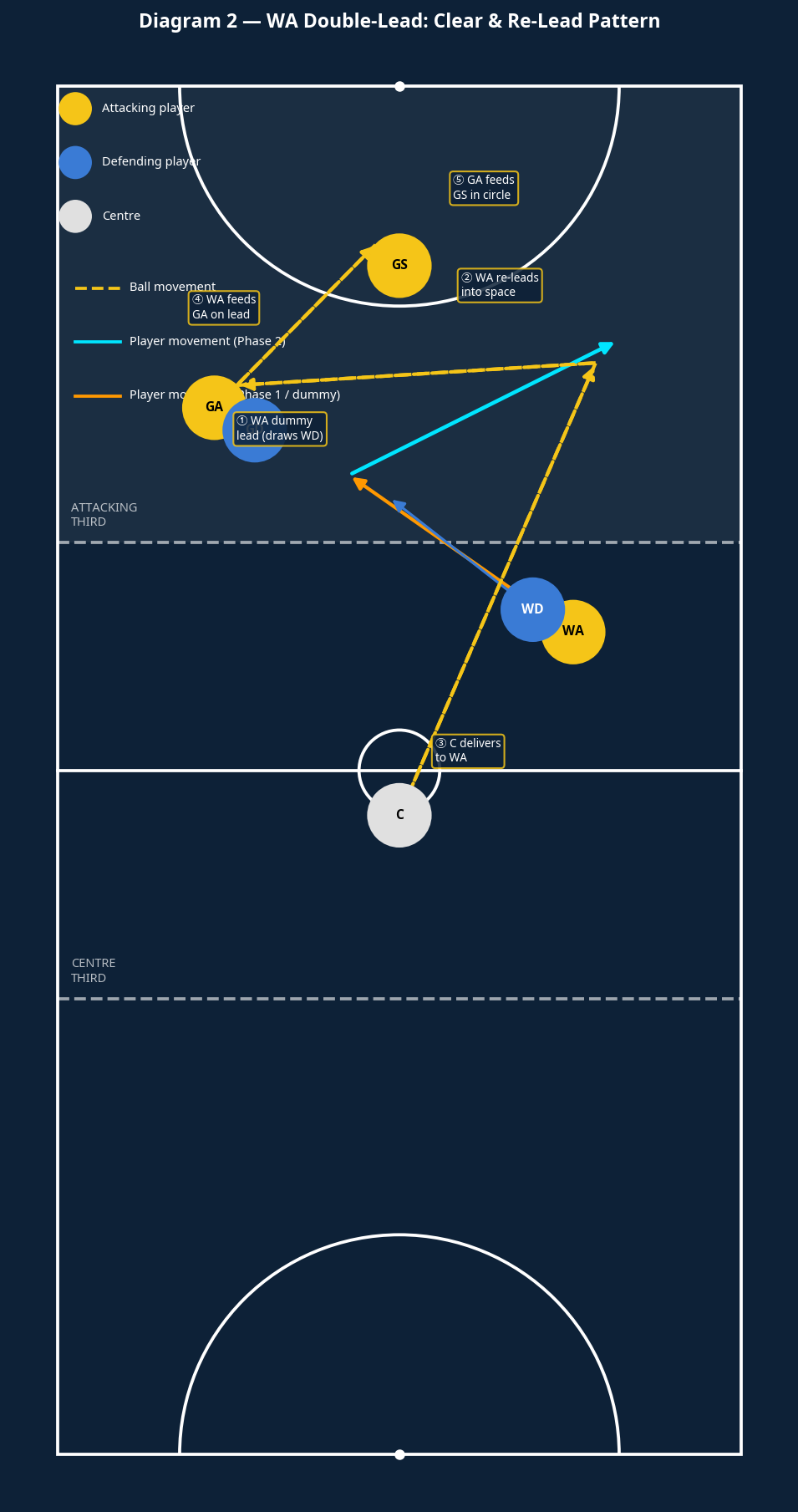
Pattern 2: The Clear & Re-Lead
When the primary drive is shut down by tight defense, the WA must learn to clear the space and re-offer.
Step-by-Step Instructions
- Starting Position: The C has the ball near the transverse line. The WA is wide right, heavily marked by the WD.
- The Dummy Lead (Clear): The WA makes a strong preliminary drive toward the middle of the court (left channel), drawing the WD with them.
- The Re-Lead: The WA abruptly changes direction, pushing off their outside foot to drive back into the space they just vacated on the right channel.
- The Delivery: The C reads the change of direction and places the ball into the open space for the WA to run onto.
- The Connection: The GA times their lead to meet the WA at the circle edge, receiving the pass and feeding the GS.
Pattern 3: The Overload Triangle
This advanced pattern uses the C to create an overload on one side of the court, confusing the defense and opening up multiple feeding options.
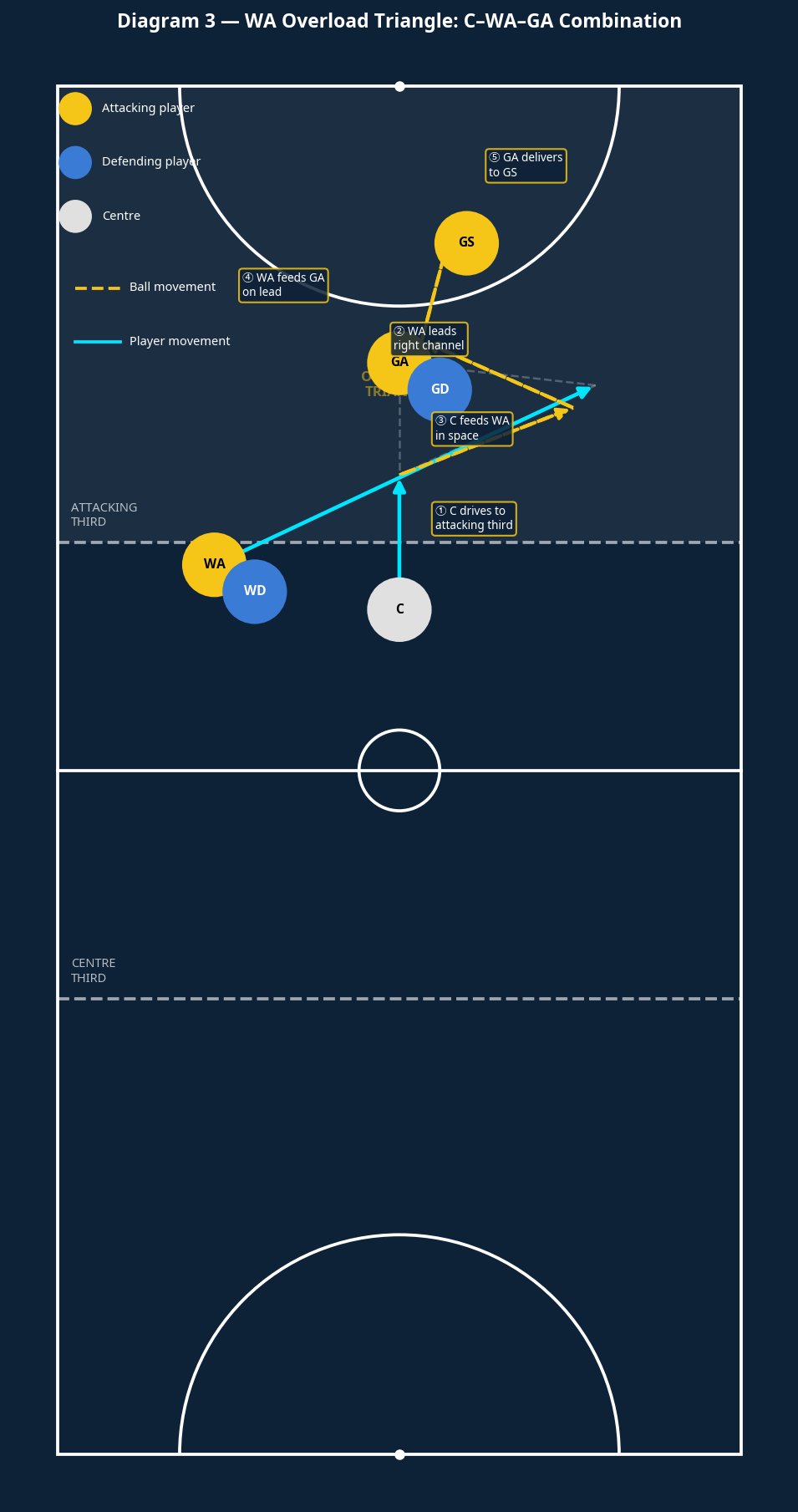
Step-by-Step Instructions
- Starting Position: The C starts with the ball near the top of the centre third. The WA is in the left channel, and the GA is central in the attacking third.
- The C Drive: The C passes to the WA and immediately drives hard into the attacking third, creating a 3v2 overload on that side of the court.
- The WA Shift: The WA receives the ball, spots the C's drive, and passes back to the C. The WA then quickly shifts across to the right channel.
- The Triangle Execution: The C now has the ball at the top of the circle. They can either feed the GA (who has lead out) or pass back to the WA in the right channel, who then feeds the GS.
- The Finish: The rapid ball movement and positional rotation should pull the GD and WD out of position, leaving an open feed into the GS.
Key Coaching Points
- Eyes Up: The WA must have their eyes up and looking into the circle before they catch the ball. This allows for first-time feeds.
- Hit the Circle Edge: Encourage the WA to drive all the way to the circle edge. Stopping short makes the feed longer and easier to intercept.
- Turn Fully: Upon catching the ball on the circle edge, the WA must turn their hips and shoulders fully to face the goal post. This opens up vision to both the GA and GS.
- Timing is Everything: The GA must time their lead to coincide with the WA's catch. If the GA leads too early, they run out of space; if too late, the WA is held up.
Common Mistakes
- Drifting: The WA drifts toward the ball rather than driving strongly, allowing the WD to easily contest the pass.
- Feeding Blind: The WA throws the ball to where the shooter was, rather than where they are leading.
- Crowding: The WA and C end up in the same space on the circle edge, bringing two defenders together and closing down passing lanes.
Variations & Progressions
- Add a GK: Introduce a Goal Keeper (GK) to mark the GS, forcing the WA and GA to make better decisions on the final feed.
- Time Limit: Challenge the attackers to get the ball from the C to a shot on goal within 5 seconds to simulate match pressure.
- Restrict the Feed: Specify that the final feed into the circle must be a bounce pass or a lob, forcing the WA to practice different types of delivery.
Age Adaptations
- Under 10s/12s: Focus purely on Pattern 1. Emphasize strong, straight drives and turning to face the post. Remove defenders initially.
- Under 14s/16s: Introduce Pattern 2 and passive defenders. Focus on the timing of the preliminary move (the clear) and the re-lead.
- Open/Seniors: Run all patterns at high intensity with full defense. Focus on the Overload Triangle and rapid decision-making under pressure.
