

Cricket
Precision Relay: Deep Fielding and Throwing Accuracy Drill
Master the art of the relay throw with this high-intensity drill designed to improve outfield throwing power, relay positioning, and run-out accuracy.
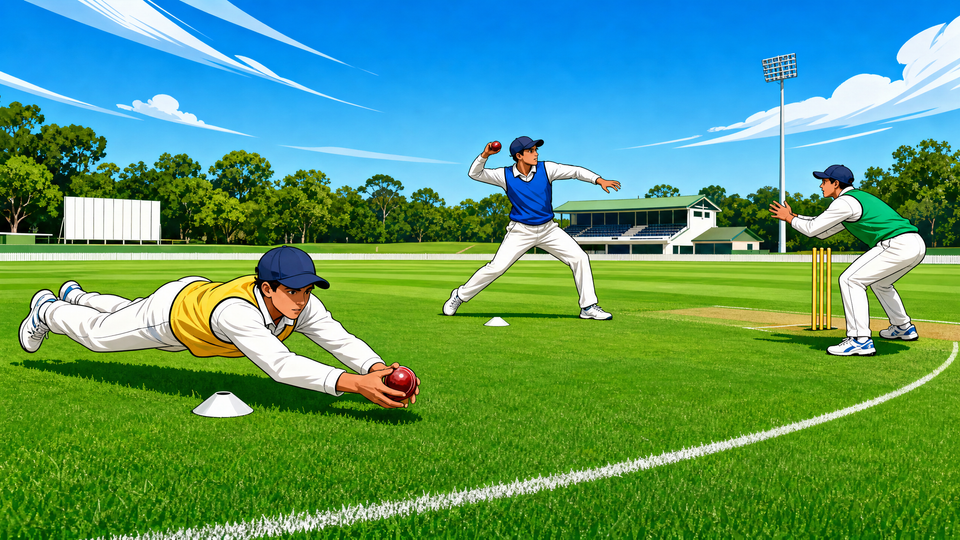
What you need
10-15 cricket balls, 2 sets of stumps, 6-8 marker cones, Wicketkeeping gloves (optional)
1. Overview
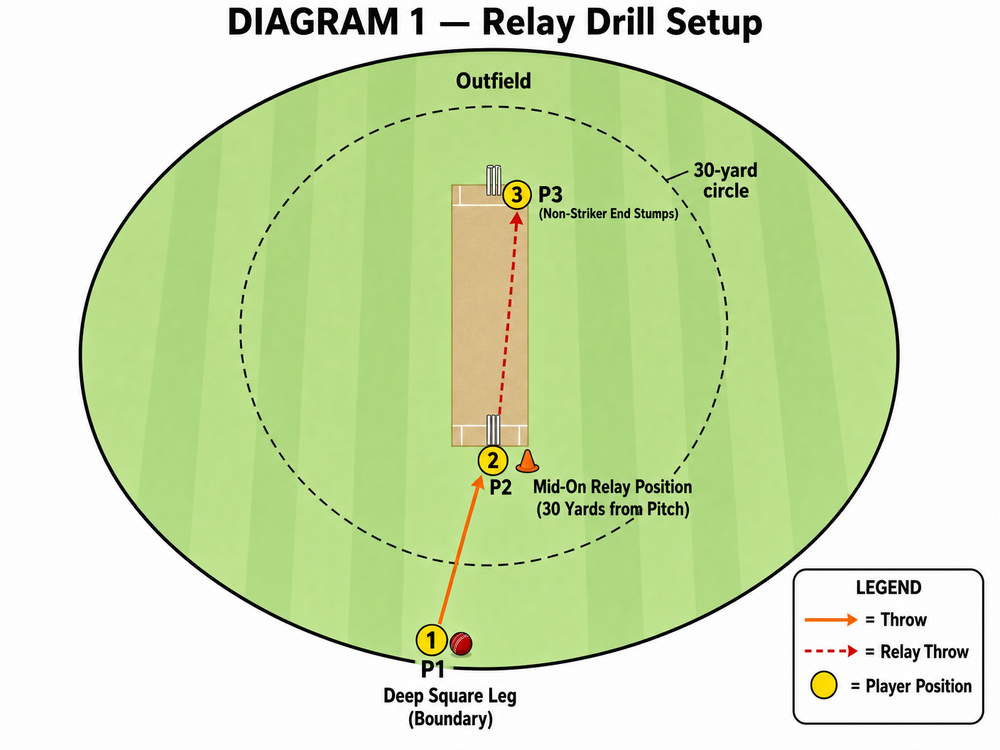
The Precision Relay is an essential fielding drill that simulates a match-scenario boundary fielding situation where a direct hit is unlikely, and a fast, accurate relay throw is required to effect a run-out or prevent extra runs. This drill focuses on the technique of the deep fielder gathering the ball and firing a flat, hard throw to a relay player positioned on the 30-yard circle, who then rapidly transfers the ball to the stumps.
Coaches should use this drill to develop communication between the deep fielder and the relay player, improve the mechanics of the flat throw from the deep, and enhance the quick release of the inner-ring fielder. It is best used in the fielding block of a training session, after a dynamic warm-up, and can serve as both a skill-building exercise and a competitive conditioning activity.
2. Setup
Equipment Needed
- 10–15 cricket balls (per group)
- 2 sets of stumps (or cone targets)
- 6–8 marker cones
- Wicketkeeping gloves (optional, for the player receiving at the stumps)
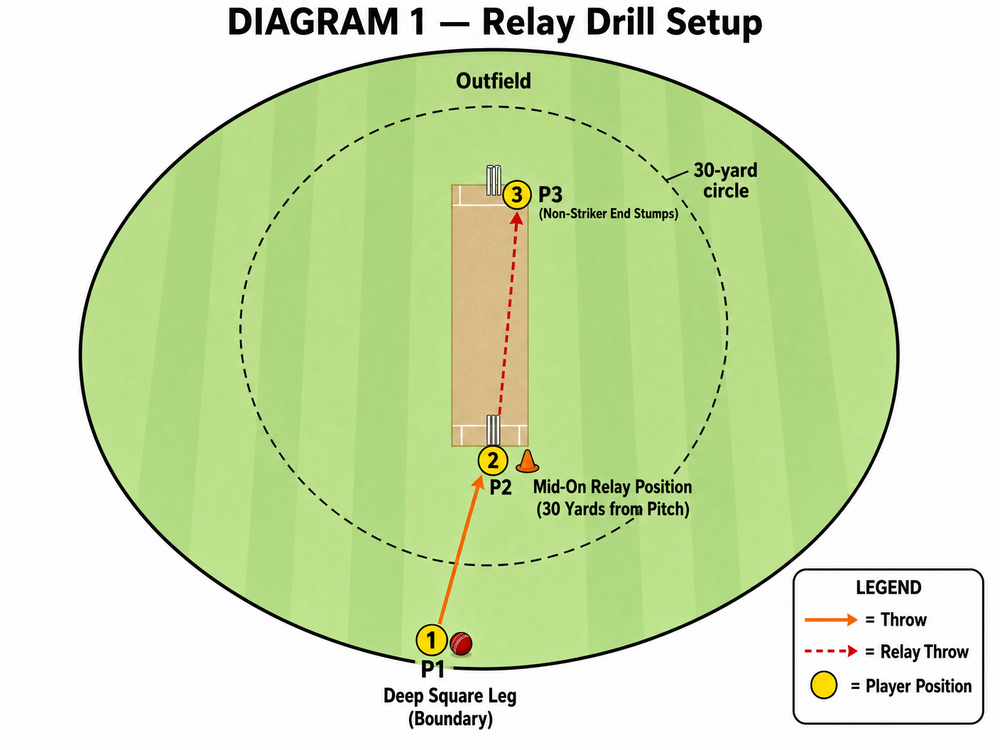
Pitch and Field Setup
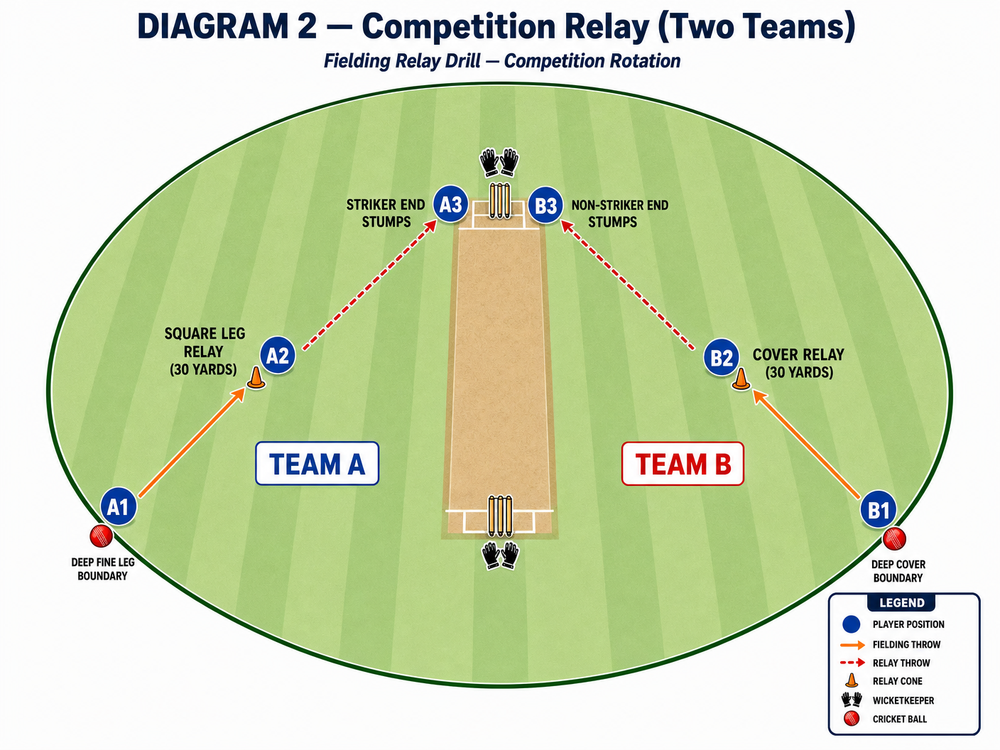
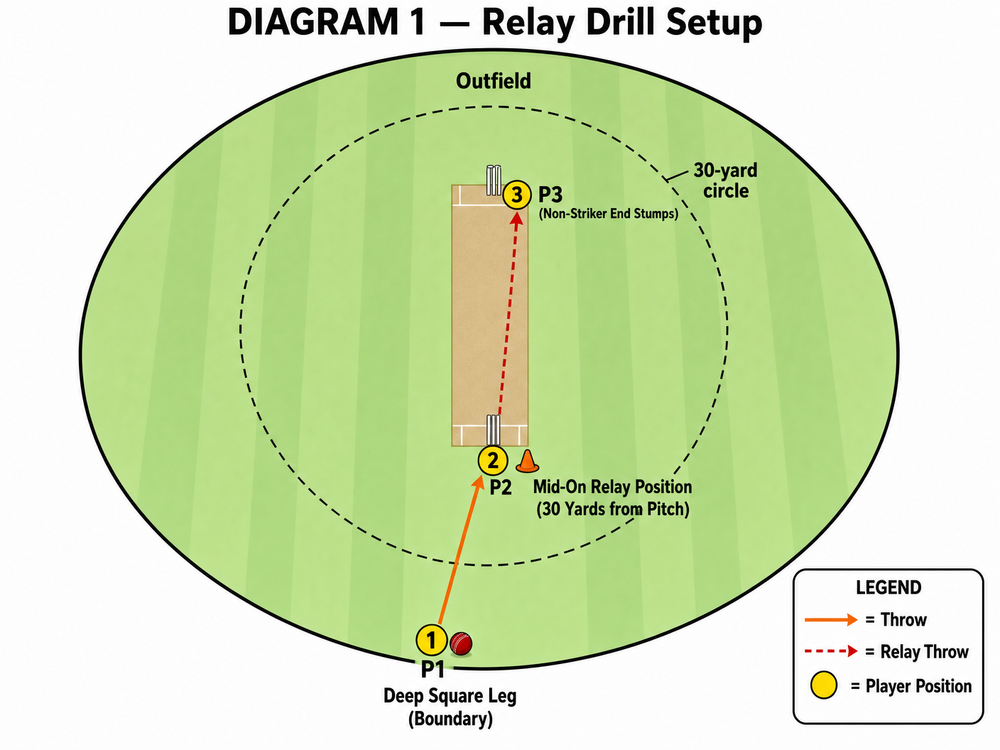
Use a standard cricket oval with the centre 22-yard pitch as your reference point. Place a set of stumps at the non-striker's end. Mark a cone on the boundary edge at Deep Square Leg (approximately 65–75 metres from the stumps) — this is Player 1 (P1). Mark a second cone on the 30-yard circle at Mid-On — this is Player 2 (P2), the relay fielder. Player 3 (P3) stands at the stumps to receive the final throw.
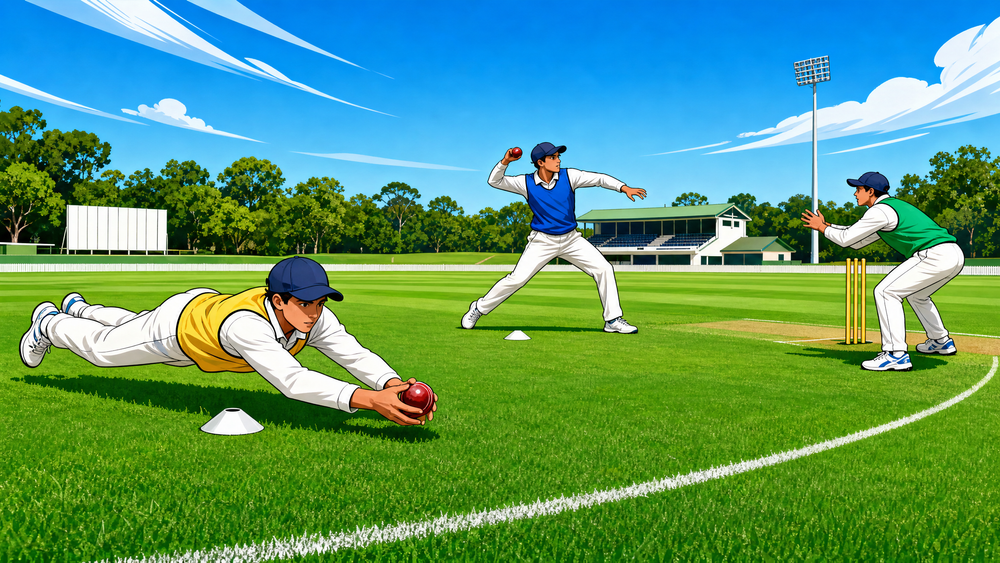
3. Step-by-Step Instructions
- The Feed: The coach (or a designated feeder) rolls or hits a ball out to P1 at the Deep Square Leg boundary. Vary the feed — sometimes a hard, flat roll, sometimes a skied ball — to simulate different match scenarios.
- The Attack: P1 attacks the ball aggressively, using either a long-barrier technique or a one-handed pick-up depending on the pace of the ball. Crucially, P1's momentum must be moving forward, toward the target, as they gather the ball.
- The Call: As P1 moves to gather the ball, P2 at the relay cone must call loudly and early — "Here, here, here!" or "Relay!" — while presenting a large, two-handed target at chest height.
- The First Throw: P1 executes a strong, flat throw using a crow-hop technique, aiming directly at P2's chest. The throw should be fast and flat. If the distance demands it, a hard, flat one-bounce throw is acceptable; a high, looping arc is not.
- The Transfer: P2 catches the ball with soft hands, absorbing the pace, and immediately pivots toward the stumps in one fluid, continuous motion.
- The Final Throw: P2 delivers a sharp, accurate throw to P3 at the stumps. This throw should arrive at waist height over the stumps for a clean take, or hit the base of the stumps directly for a run-out.
- Rotation: After 5 repetitions, players rotate positions: P1 moves to P2, P2 moves to P3, and P3 moves to P1.
4. Key Coaching Points
- Momentum is everything: The deep fielder must attack the ball and step through the throw. Throwing off the back foot drastically reduces both power and accuracy. Look for the fielder's front shoulder pointing at the relay player as they release.
- Flat and hard from the deep: A high, looping throw from the deep gives batters time to complete the run. Demand flat, hard throws. Use the phrase: "If it bounces, it should only bounce once."
- The half-turn relay position: P2 should stand side-on to the stumps — the 'half-turn' stance — so they can catch and throw in a single, continuous movement without needing to reposition their feet. This is the single most important technical point for the relay player.
- Vocal leadership from P2: The relay player must be the eyes and ears of the deep fielder. Loud, early, and sustained calling is non-negotiable. Silence from the relay player is a coaching error to correct immediately.
- Soft hands, quick release: P2 must absorb a hard throw with relaxed, 'soft' hands and transfer the ball to their throwing shoulder as quickly as possible. Rigid hands cause fumbles.
- Accuracy over power at the stumps: From 30 yards, the relay player's priority is accuracy, not pace. A direct hit or a clean take by the keeper is the goal.
5. Common Mistakes
| Mistake | What to Look For | Correction |
|---|---|---|
| Looping throw from the deep | Ball travels in a high arc from P1 to P2 | Cue: "Throw at their chest, not over their head." Reduce distance if needed. |
| Static relay player | P2 standing square-on to the boundary, flat-footed | Drill the half-turn stance in isolation before adding the full relay. |
| Silent relay player | P1 hesitates or throws blindly | Stop the drill and enforce the calling rule. Make it a habit, not an afterthought. |
| Wild throws at the stumps | P2 throws too hard, ball flies wide | Remind P2: "Accuracy first. The keeper can't take what they can't reach." |
| Fielder throwing off the back foot | P1 plants and throws without forward momentum | Use a cone gate — P1 must step through the gate as they throw. |
6. Variations & Progressions
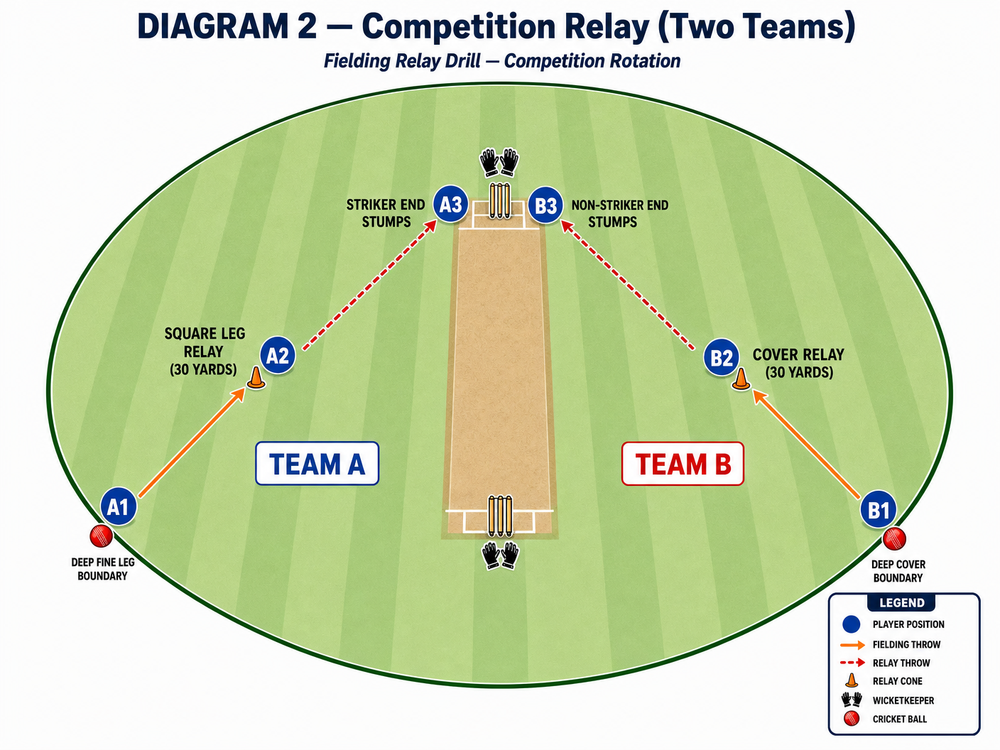
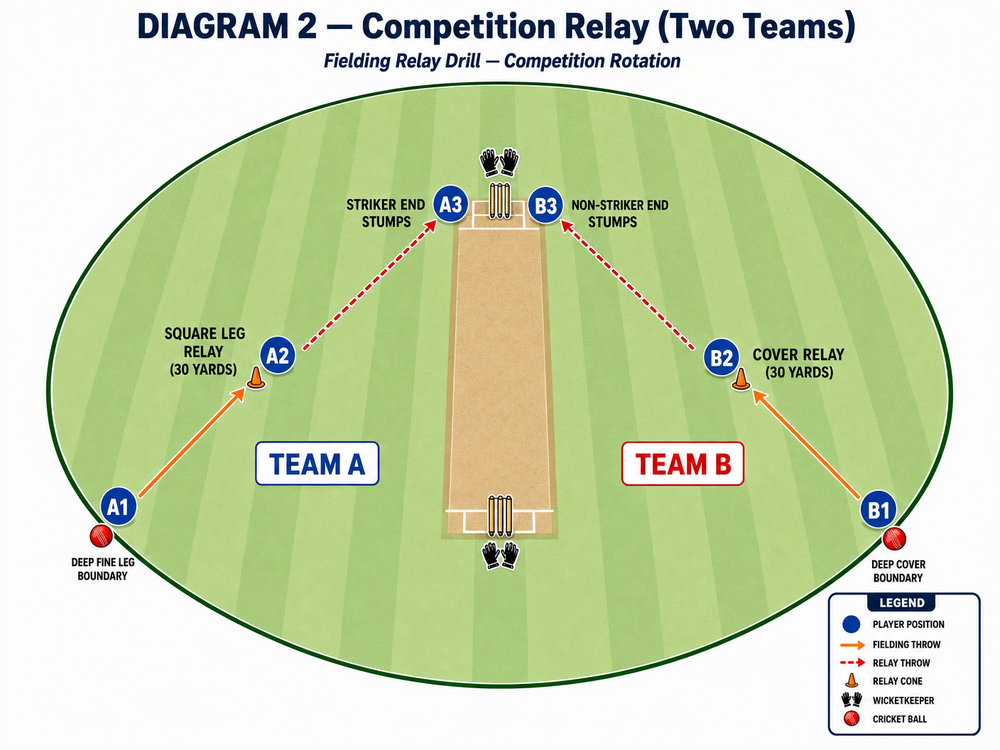
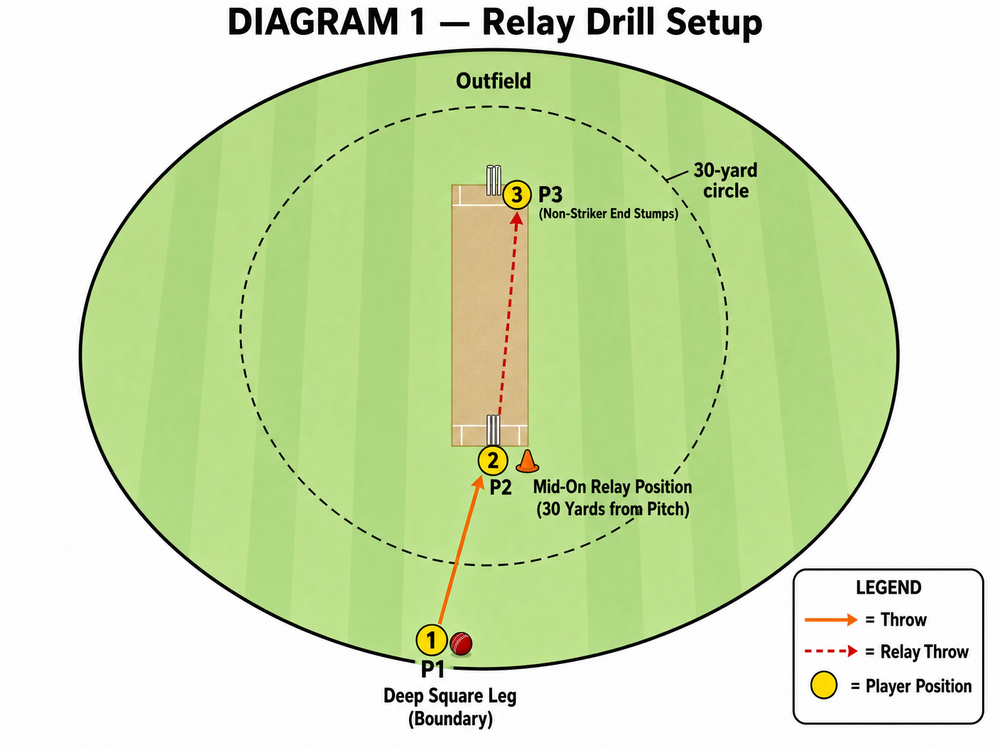
Progression 1: Competition Relay (Two Teams)
Divide the squad into two teams — Team A and Team B. Set up two parallel relay stations simultaneously (e.g., Team A from Deep Fine Leg, Team B from Deep Cover). On the coach's whistle, both teams execute the relay. The first team to successfully have the keeper cleanly take the ball over the stumps wins a point. First team to 10 points wins. This introduces match-day pressure and sharpens focus.
Progression 2: The Moving Target
Instead of P2 standing stationary at the relay cone, require them to jog in from a starting point 10 metres further out as the ball is hit to the deep. P2 must time their run so they arrive at the relay cone just as P1's throw arrives. This simulates the dynamic, reactive nature of real match fielding.
Variation: The 'Blind' Relay
P2 starts facing the stumps with their back to the deep fielder. They can only turn to face P1 when P1 shouts "Throwing!" This forces P2 to react quickly, locate the ball in flight, and execute the catch-and-throw under time pressure. Excellent for developing reaction time and hand-eye coordination.
7. Age Adaptations
| Age Group | Distance (P1 to P2) | Distance (P2 to Stumps) | Key Focus |
|---|---|---|---|
| Under 10s | 20–25 metres | 10–15 metres | Basic gather and throw mechanics; use softer balls |
| Under 12s–14s | 35–45 metres | 20–25 metres | Half-turn relay stance; one-bounce throw from deep |
| Under 16s–Open | 55–70 metres | 25–30 metres | Flat throws; competition variations; direct hits on stumps |
For younger age groups, prioritise the process — correct technique and communication — over speed. For senior and elite groups, introduce time targets (e.g., ball must reach the stumps within 4 seconds of the feed) to replicate match intensity.
