

Netball
Quick Hands Passing Circuit: Mastering Speed and Accuracy
Develop lightning-fast ball release, sharp decision-making, and pinpoint passing accuracy under fatigue with this high-intensity circuit.

What you need
6 cones, 1-2 netballs, Bibs (optional)
Overview
The Quick Hands Passing Circuit is a high-intensity conditioning and ball-handling drill designed to develop rapid ball release, spatial awareness, and passing accuracy under fatigue. In modern netball, the ability to transition the ball quickly through the midcourt and into the goal circle is paramount. This drill simulates match-intensity pressure, requiring players to execute sharp, flat passes while constantly moving. It is an excellent drill for the middle portion of a training session, serving as both a physical conditioner and a technical sharpener. Coaches can use this circuit to identify players who drop their passing standards when tired and to reinforce the importance of early eye contact and strong leads.
Setup
Court Area: One third of a standard netball court (15.25m x 10m).
Players: 6 players per circuit (can be scaled for more or fewer players).
Equipment: 6 cones, 1-2 netballs per group.
Court Setup
- Place 6 cones in a large oval or rectangular circuit within one third of the court. The cones should be spaced approximately 4-5 metres apart.
- Assign one player to start at each cone.
- The starting player (Player 1) begins with the netball.

Step-by-Step Instructions
- Initiate the Pass: Player 1 delivers a strong, flat chest pass to Player 2.
- Follow the Pass: Immediately after releasing the ball, Player 1 sprints to take Player 2's position at the cone.
- Receive and Release: Player 2 receives the ball and instantly passes to Player 3, then sprints to Player 3's position.
- Continuous Flow: This pattern continues around the circuit (Player 3 to 4, 4 to 5, 5 to 6, 6 to 1). The ball and the players should be moving continuously in a clockwise direction.
- Change Direction: After 2-3 minutes of continuous work, blow the whistle to change the direction of the passes and the running (anti-clockwise).
- Maintain Intensity: The focus is on the speed of the ball release. Players must catch and pass in one fluid motion, avoiding any hesitation or 'cradling' of the ball.
Key Coaching Points
- Early Eye Contact: Receivers must have their eyes on the thrower early, calling for the ball and presenting clear targets (hands up and ready).
- Weight Transfer: Throwers need to step into their passes, transferring their weight forward to ensure a strong, flat trajectory. Avoid loopy passes.
- Quick Release: The ball should spend minimal time in the hands. Emphasise 'hot potato' passing—catch and release within one second.
- Sharp Sprinting: The movement between cones must be a hard sprint, not a jog. This replicates the explosive movements required in a match.
- Core Stability: Players must maintain a strong core when receiving and passing, especially when moving at speed, to ensure accuracy and balance.
Common Mistakes
- Loopy Passes: Players often revert to slow, lobbed passes when tired. Correction: Reinforce stepping into the pass and pushing through the chest.
- Watching the Ball: Players watch their own pass instead of immediately sprinting to the next cone. Correction: Cue players to "pass and go" instantly.
- Poor Timing: Receivers lead too early or too late, forcing the thrower to hold the ball. Correction: Emphasise holding space and leading only when the thrower is ready to release.
- Catching on the Chest: Allowing the ball to hit the chest before securing it slows down the release. *Correction: Demand players catch the ball out in front with extended arms.
Variations & Progressions
Progression 1: Lead and Receive
Introduce a passive defender in the middle of the circuit. Instead of standing at the cones, players must make a sharp V-cut lead away from the defender to receive the ball on the move. This adds a layer of spatial awareness and timing.

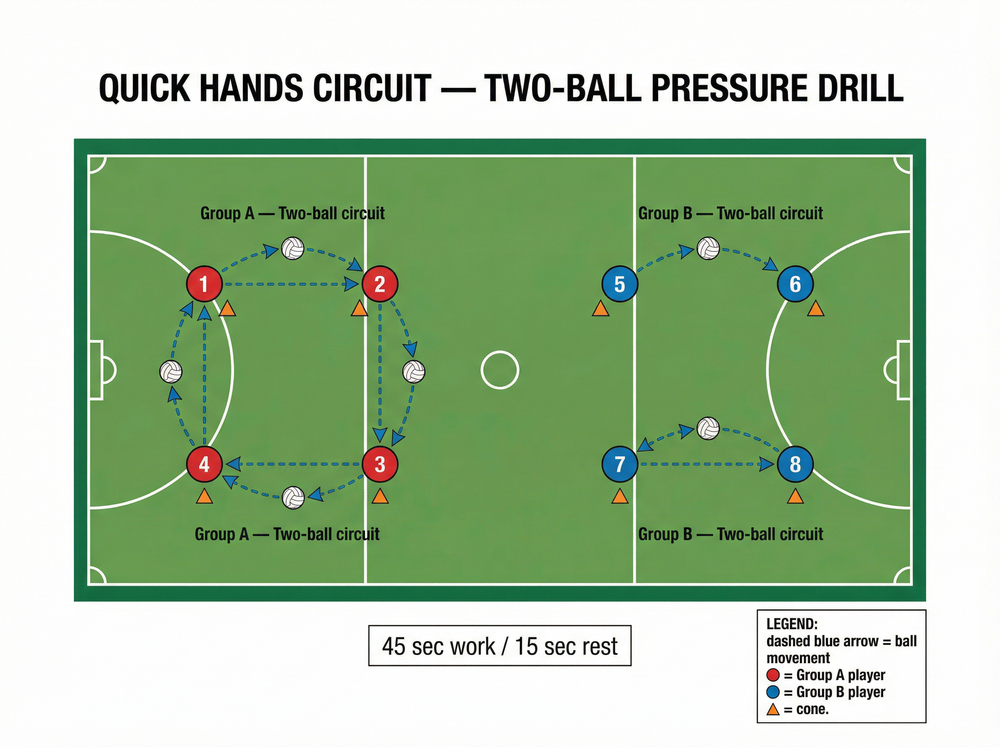
Progression 2: Two-Ball Pressure
Introduce a second netball into the circuit. Start the balls at opposite ends of the circuit. This significantly increases the cognitive load, forcing players to process information faster and communicate more effectively. If the group is large enough, set up two simultaneous circuits on different halves of the court to introduce a competitive element.

Age Adaptations
- Under 8 / Under 10: Focus on the basic mechanics of the chest pass and catching. Reduce the distance between cones to 2-3 metres. Do not use a second ball. Emphasise correct footwork over speed.
- Under 12 / Under 14: Increase the distance between cones. Introduce the 'Lead and Receive' progression. Focus heavily on the speed of release and strong, flat passes.
- Under 16 / Open: Run the drill at maximum match intensity. Use the 'Two-Ball Pressure' progression. Incorporate strict time limits (e.g., how many circuits can be completed in 60 seconds without a drop). Demand perfect execution even under severe fatigue.
