Football
Drill
intermediate
Mastering the Rondo: Possession, Pressing & Decision Making
Develop your players' first touch, quick decision-making, and spatial awareness with this comprehensive guide to the classic Rondo.
Jul 13, 20265 min read15 min drill8 players
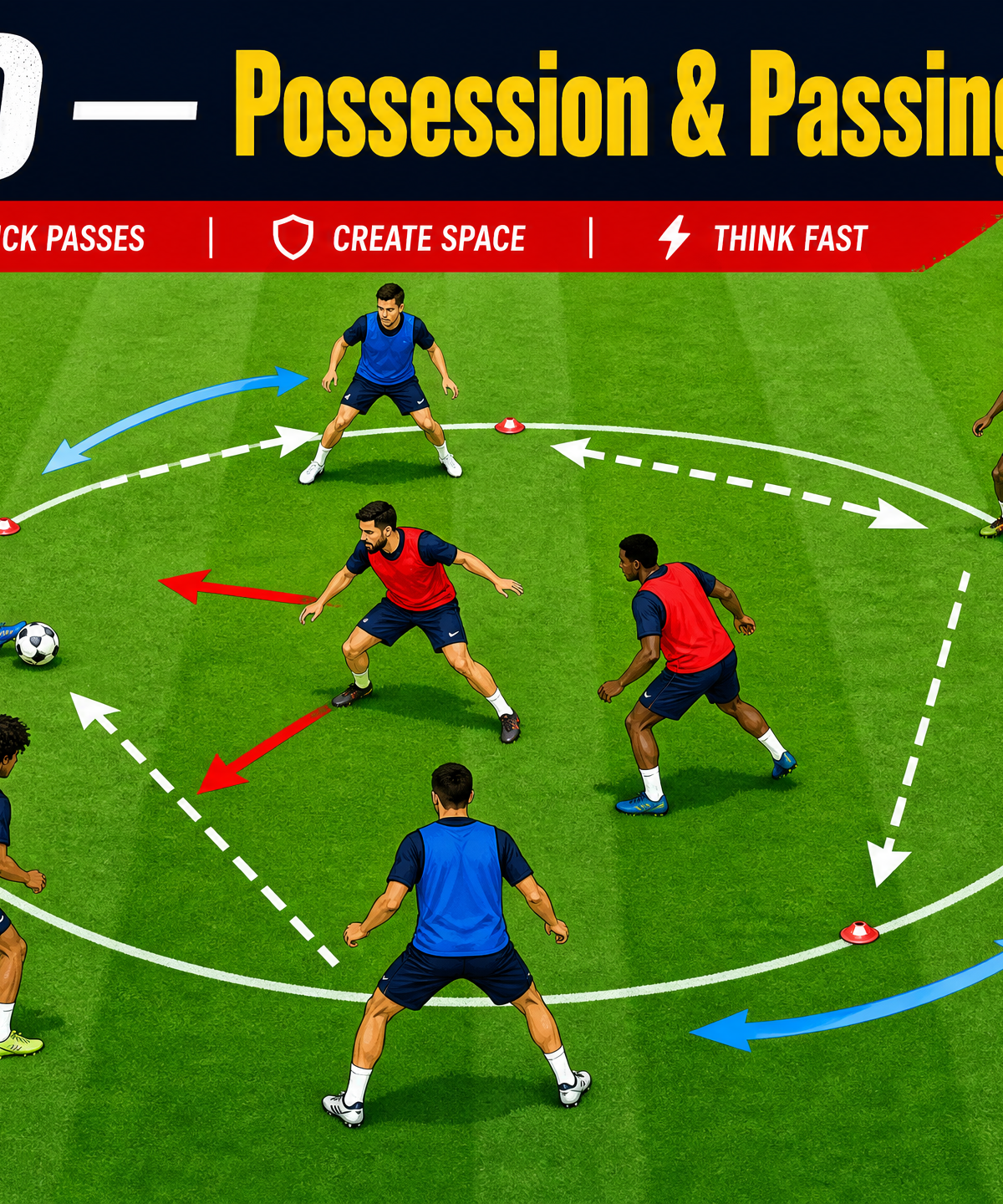
Equipment Needed
4-6 training cones
1 football (plus 3-4 spares)
Training bibs (2 contrasting colors)
1. Overview
The Rondo is the foundational drill for possession-based football. Far more than just a warm-up game of 'piggy in the middle,' a properly structured Rondo teaches players how to maintain possession under pressure, create passing angles, and transition quickly between attacking and defending. When executed with high intensity, it replicates the chaotic, tight-space scenarios players face in actual matches. Use this drill to improve first-touch quality, speed of thought, and collective pressing.
2. Setup
Equipment Needed:
- 4-6 training cones to mark the grid
- 1 football (with 3-4 spare balls placed around the outside for quick restarts)
- Training bibs in two contrasting colors (e.g., Blue for attackers, Red for defenders)
Pitch Setup:
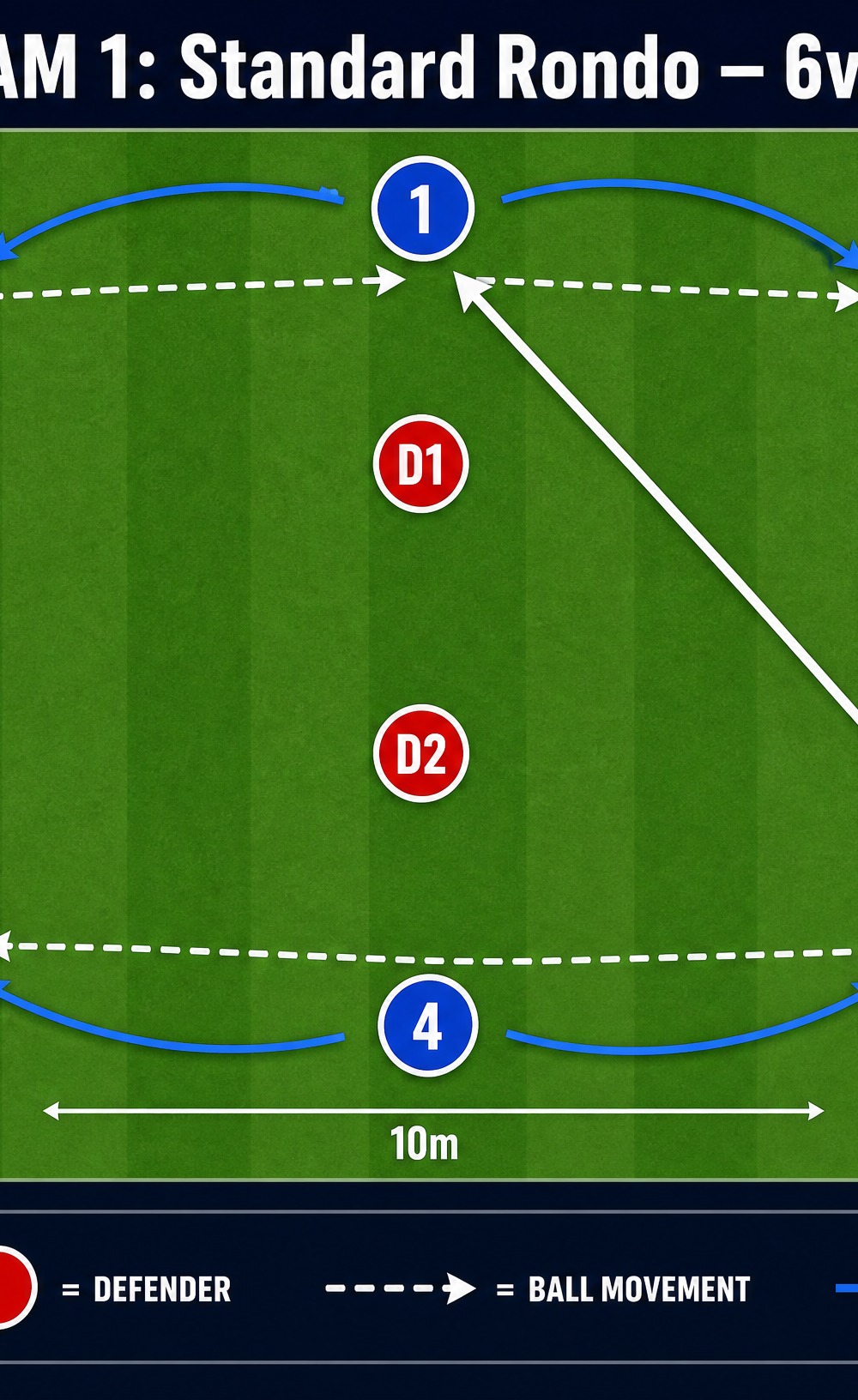
- Create a 10m x 10m grid using the cones. Adjust the size based on the age and skill level of your players (smaller grid = harder for attackers; larger grid = easier for attackers).
Player Positions:
- Attackers (Outside): Position 6 players around the perimeter of the grid. They must stay on the outside lines but can move along them to support the player with the ball.
- Defenders (Inside): Position 2 players inside the grid. They are the 'chasers' trying to win the ball.
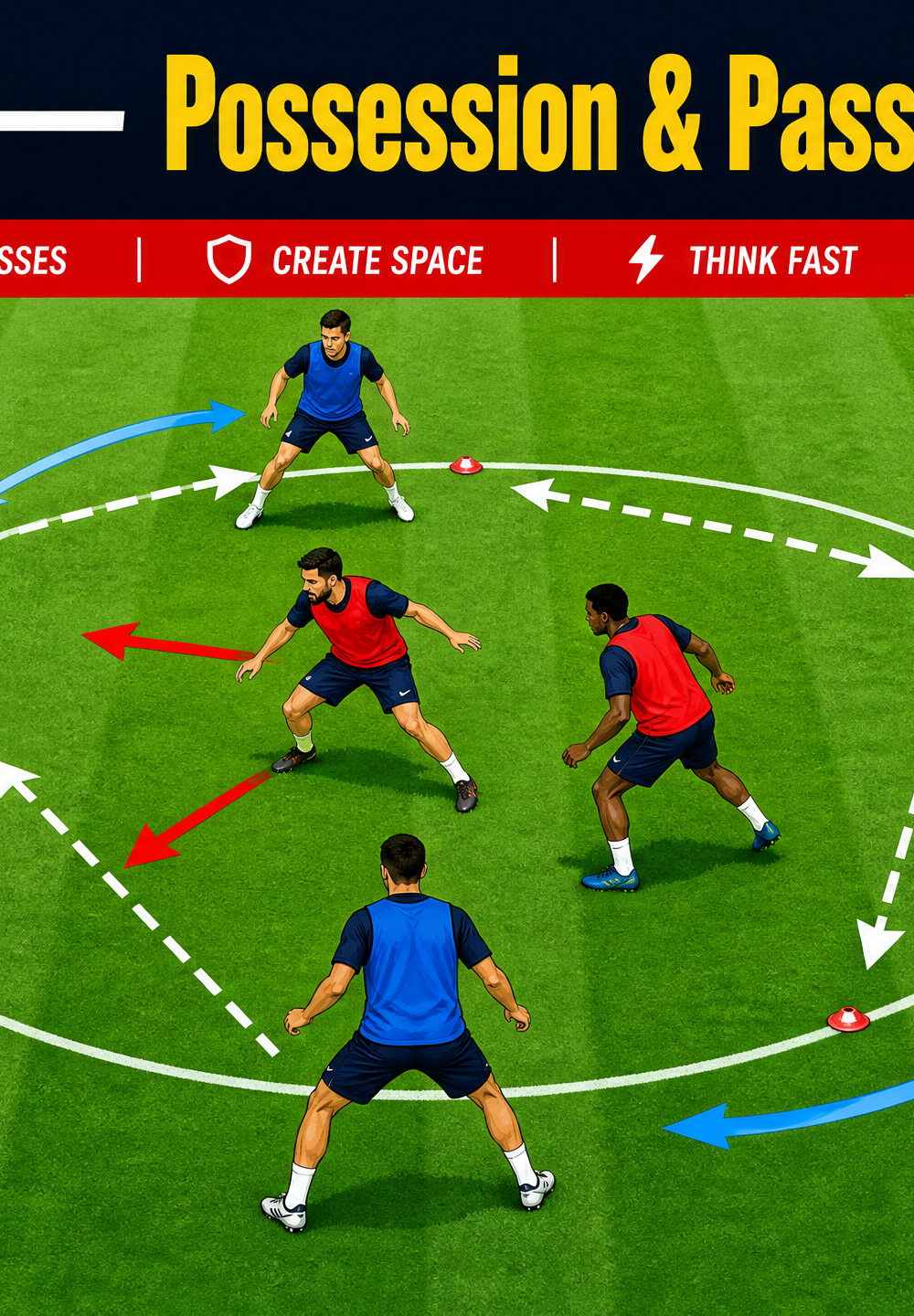
3. Step-by-Step Instructions
- Start the Drill: The coach plays a ball to one of the outside attackers to begin the drill.
- Maintain Possession: The 6 outside players attempt to keep possession by passing the ball to one another. They should utilize the entire perimeter to stretch the defenders.
- Defensive Pressure: The 2 inside defenders work together to press the ball, cut off passing lanes, and force mistakes. They must communicate and coordinate their press (one pressures the ball, the other covers the passing lane).
- Touch Restrictions: Initially, limit attackers to two touches. As they improve, progress to one-touch passing to increase the speed of play.
- Transition: If a defender intercepts the ball or forces an attacker to play it out of bounds, the attacker who made the mistake swaps places with the defender who won the ball (or the defender who has been in the middle the longest). The game restarts immediately.
- Target: Attackers aim to complete a specific number of consecutive passes (e.g., 10 or 15 passes) for a 'point'. Defenders aim to win the ball back as quickly as possible.
4. Key Coaching Points
- Body Shape: Attackers must receive the ball with an 'open' body shape, allowing them to see the entire grid and their next passing option before the ball arrives.
- Weight and Accuracy of Pass: Passes must be firm and to the correct foot (usually the back foot) of the receiving player to maintain the speed of play.
- Constant Support: Players off the ball must constantly adjust their positioning along the perimeter to provide clear passing angles for the player in possession. Never hide behind a defender.
- Defensive Coordination: Defenders must work as a unit. The first defender sprints to apply immediate pressure on the ball carrier, while the second defender drops slightly to cut off the most dangerous passing lane (usually the split pass through the middle).
- Speed of Thought: Players must scan the grid and make decisions before receiving the ball. 'Play what you see' and anticipate the next move.
5. Common Mistakes
- Static Attackers: Outside players standing flat-footed and waiting for the ball instead of actively moving along their line to create angles.
- Poor First Touch: A heavy first touch that brings the ball too close to the defender, killing the speed of the drill and inviting pressure.
- Defending as Individuals: Defenders chasing the ball randomly without communicating or covering each other, making it easy for attackers to split them with a pass.
- Forcing the Pass: Attackers trying to play a difficult 'killer pass' through the middle when a simple, safe pass to the adjacent player is the better option to maintain possession.
6. Variations & Progressions
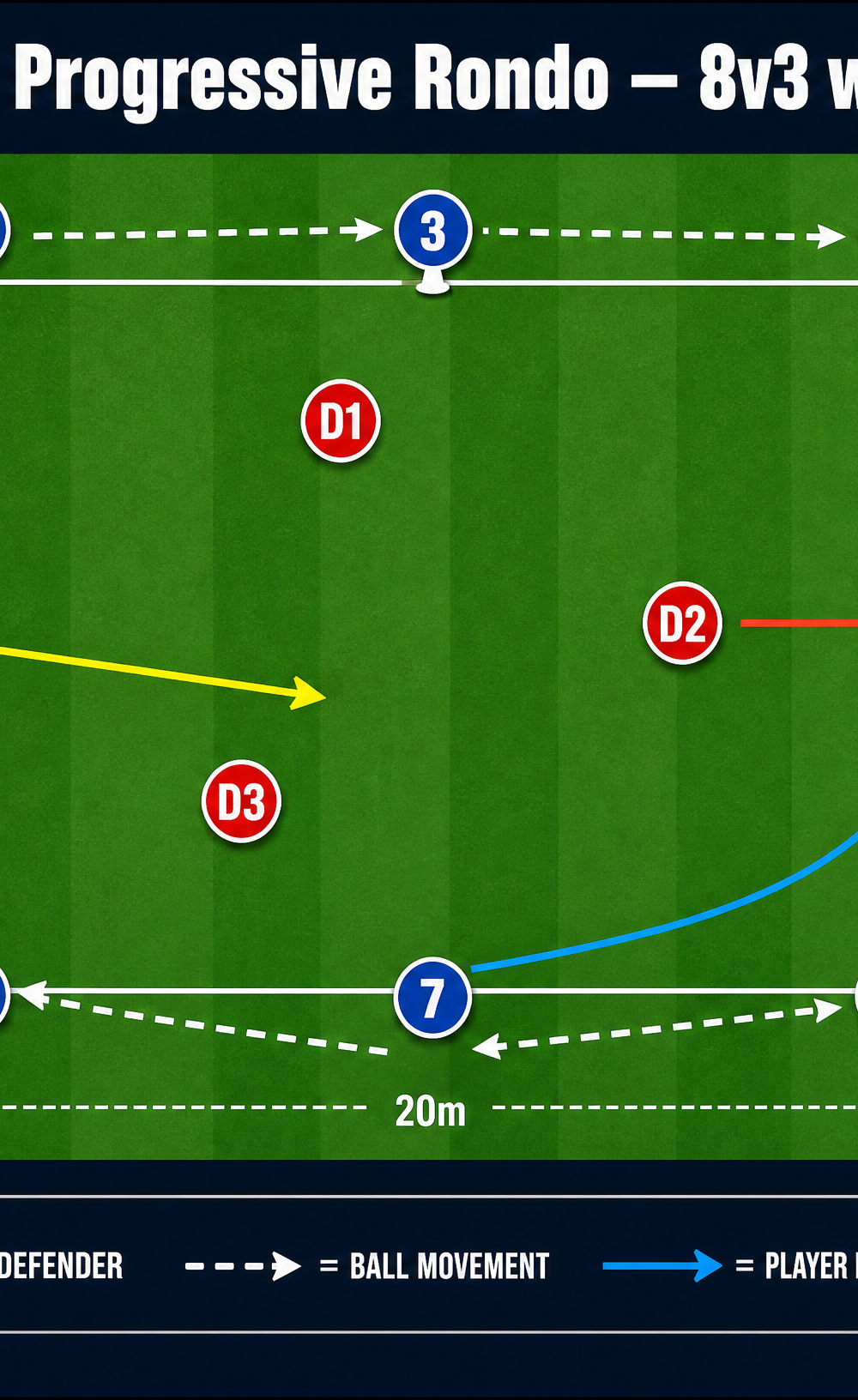
- Progressive Rondo (8v3 with End Zones): Expand the grid to 20m x 15m. Play 8v3. Add a small 'End Zone' at each short end. Attackers score a point by completing 5 passes and then successfully playing a penetrating pass to a teammate making a run into an End Zone. This teaches directional possession and forward passing.
- Touch Restrictions: Reduce from 2 touches to 1 touch. This forces players to scan and decide faster.
- The 'Split' Rule: If the attackers successfully play a pass that splits (goes between) the two defenders, the defenders must stay in the middle for an extra turn, even if they win the ball next.
- Rondo to Goal: Set up the Rondo near the top of the penalty box. After completing a set number of passes, the attackers can break out and attempt to score on a goalkeeper.
7. Age Adaptations
- Under 8 / Under 10: Keep it simple. Play 4v1 or 5v1 in a larger grid (12m x 12m) to give them more time and space. Focus heavily on the basic mechanics of passing and receiving. Don't enforce strict touch limits initially.
- Under 12 / Under 14: Introduce the standard 6v2. Enforce a 2-touch limit. Start focusing on body shape and off-the-ball movement. Introduce the 'Split' rule to encourage intelligent passing.
- Under 16 / Open: Play 1-touch 6v2 or introduce the Progressive Rondo (8v3). Demand high intensity, rapid ball circulation, and aggressive, coordinated pressing from the defenders. The drill should closely mimic match speed.