

Rugby
Crash Ball Play with Decoy Runners
Master the art of breaking the gain line with this essential crash ball set play, using decoy runners to freeze defenders and create front-foot ball.

What you need
1 Rugby ball, 8-10 Cones, Tackle shields
1. Overview
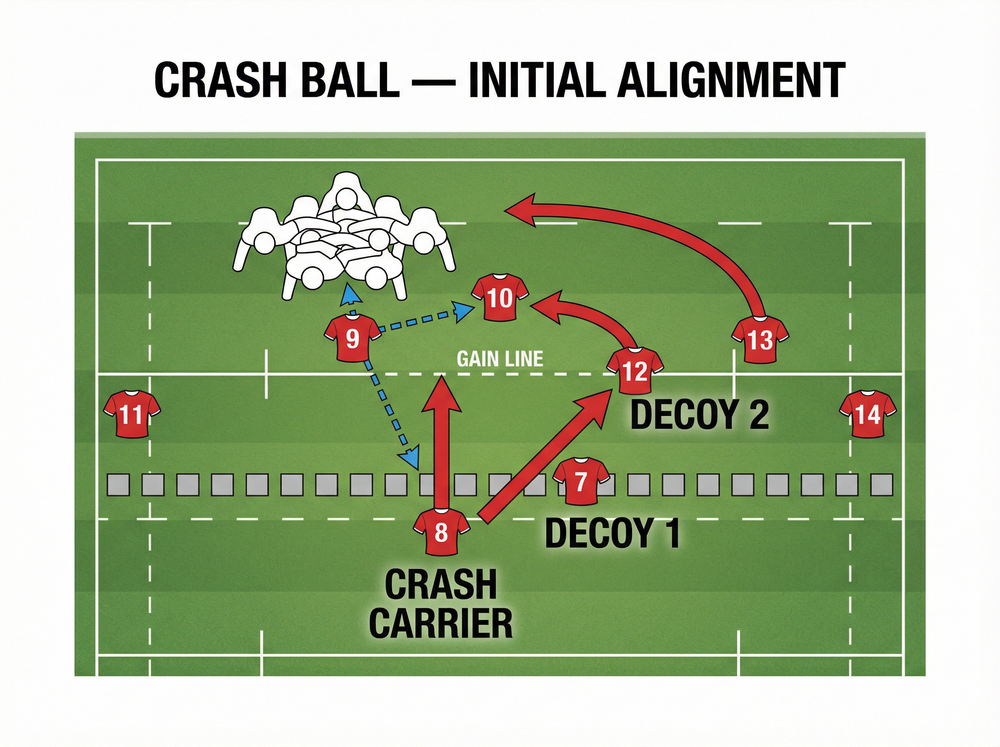
The crash ball with decoy runners is a fundamental attacking set play designed to generate significant forward momentum and secure quick, front-foot ball. By deploying a powerful ball carrier—typically a Number 8, blindside flanker, or inside centre—on a hard, straight line, the attacking team aims to aggressively dent the defensive line. The inclusion of decoy runners is critical; they operate to hold defensive players in place, creating momentary hesitation and isolating the primary tackler. This play is particularly effective from static situations such as scrums, lineouts, or slow rucks near the opposition's 22-metre line, where breaking the gain line is paramount for subsequent phases.
2. Setup

Equipment Needed:
- 1 Rugby ball
- 8-10 Cones (to mark the gain line and starting positions)
- Tackle shields (optional, for defensive simulation)
Pitch Setup:
- Utilize a standard 100m x 70m pitch or a marked 40m x 40m grid for training.
- Place a line of cones to represent the defensive gain line.
Player Positions:
- 9 (Scrum-half): Positioned at the base of the breakdown or set piece.
- 10 (Fly-half): Standing slightly wider, orchestrating the play.
- 8 (Crash Carrier): Lined up flat and straight, ready to hit the line at pace.
- 7 (Decoy 1): Positioned to run a sharp diagonal line across the carrier's face.
- 12 (Decoy 2): Aligned wider to run an outward arc, holding the outside drift.

3. Step-by-Step Instructions

- The Call: The Fly-half (10) or Scrum-half (9) initiates the play with a pre-determined call, ensuring all attacking players are aligned and aware of their roles.
- The Approach: As the ball is secured at the base, the Number 8 (Crash Carrier) begins their run from depth, accelerating straight toward the targeted defensive gap.
- Decoy Movement: Simultaneously, the Flanker (7) sprints on a hard diagonal line across the Number 8, demanding the attention of the inside defenders. The Inside Centre (12) runs a wider, threatening line to freeze the outside defensive drift.
- The Delivery: The Scrum-half (9) delivers a crisp, flat pass directly to the Number 8, who receives the ball at maximum velocity just before the gain line.
- The Contact: The Number 8 hits the defensive line with low body height and powerful leg drive, aiming to break the tackle or dominate the collision to get well over the gain line.
- The Recycle: Support players immediately secure the breakdown, clearing any threats to present fast, clean ball for the next phase.

4. Key Coaching Points

- Timing is Everything: The ball carrier must arrive at the ball at full pace. Catching the ball while stationary defeats the purpose of the crash play.
- Convincing Decoys: Decoy runners must call for the ball and run lines as if they are the primary target. If they jog or look disinterested, the defense will simply drift onto the crash carrier.
- Low Body Height: The crash carrier must lower their center of gravity before contact, driving through the tackle with strong leg pumping rather than accepting the collision upright.
- Ball Presentation: Upon going to ground, the carrier must aggressively place the ball back toward their own team (long placement) to ensure quick recycling.
- Rapid Support: The first two arriving players must act decisively to clear the ruck. The speed of the recycle dictates the success of the subsequent phases.
5. Common Mistakes

- Telegraphing the Pass: The scrum-half looking exclusively at the crash carrier before passing, allowing the defense to anticipate the play and converge early.
- Flat Alignment: The crash carrier starting too flat, leaving insufficient distance to build momentum before receiving the pass.
- Weak Decoy Lines: Decoy runners failing to commit to their lines, allowing defenders to easily read the play and double-team the primary carrier.
- Poor Support Timing: Support players arriving too late, resulting in a turned-over ball or a slow, messy ruck that kills attacking momentum.
6. Variations & Progressions

- The Tip-On Pass: As the defense commits to the crash carrier, the Number 8 tips the ball on to a support runner (e.g., a prop or lock) running a short line off their shoulder.
- The Pull-Back: The Scrum-half passes to the crash carrier, who acts as a distributor, pulling the ball back to a deeper Fly-half (10) to attack the wider channels once the defense has condensed.
- Blindside Attack: Running the exact same shape but attacking the narrow blindside channel to exploit a numerical mismatch.
7. Age Adaptations
- Under 8s - Under 10s: Focus heavily on the basics of running straight, catching the ball while moving, and safe contact techniques. Introduce the concept of a single decoy runner without complex timing.
- Under 12s - Under 14s: Introduce more structured alignment and emphasize the importance of the support players arriving quickly to secure the ruck. Practice the timing of the pass to ensure the carrier hits the line at pace.
- Under 16s - Open Age: Implement the full play with multiple decoys, complex variations, and high-speed execution. Focus on reading the defensive alignment and making split-second decisions at the line.
