

Rugby
High-Pressure Kick Chase and Catch Contest
Master the art of the aerial battle with this comprehensive drill designed to improve kick accuracy, organized pursuit, and under-ball contest skills.

What you need
4-6 Rugby balls, Cones, Bibs (two colours)
Overview
The High-Pressure Kick Chase and Catch Contest is a fundamental drill designed to replicate the chaotic and high-stakes environment of fielding and contesting high balls during a match. This drill focuses on the synchronization between the kicker's execution and the chasers' pursuit, ensuring that the attacking team can either regain possession or immediately apply defensive pressure. It is particularly effective for developing spatial awareness, timing, and communication among the back three and the halfbacks. By integrating this drill into your sessions, you equip your players with the confidence to dominate the aerial battle and transition seamlessly into attack or defense.
Setup

To effectively run this drill, you will need a standard pitch area, specifically utilizing a 50m x 40m zone to simulate realistic match distances. The equipment required includes 4-6 rugby balls to maintain drill flow, cones to mark the designated landing zones, and bibs to differentiate the attacking and defending units.
Position your players as follows. Attackers (Chasers): The Fly-half (10) positions near the 10-metre line to execute the kick. The Scrum-half (9) feeds the ball. The Wingers (11 and 14) position themselves on the edges, ready to sprint upon the kick. The attacking Fullback (15) trails slightly behind the kicker to provide secondary support. Defenders (Catchers): The defending Fullback (FB) and a Winger (W) start deep, approximately 30-35 metres away, anticipating the landing zone.

Step-by-Step Instructions
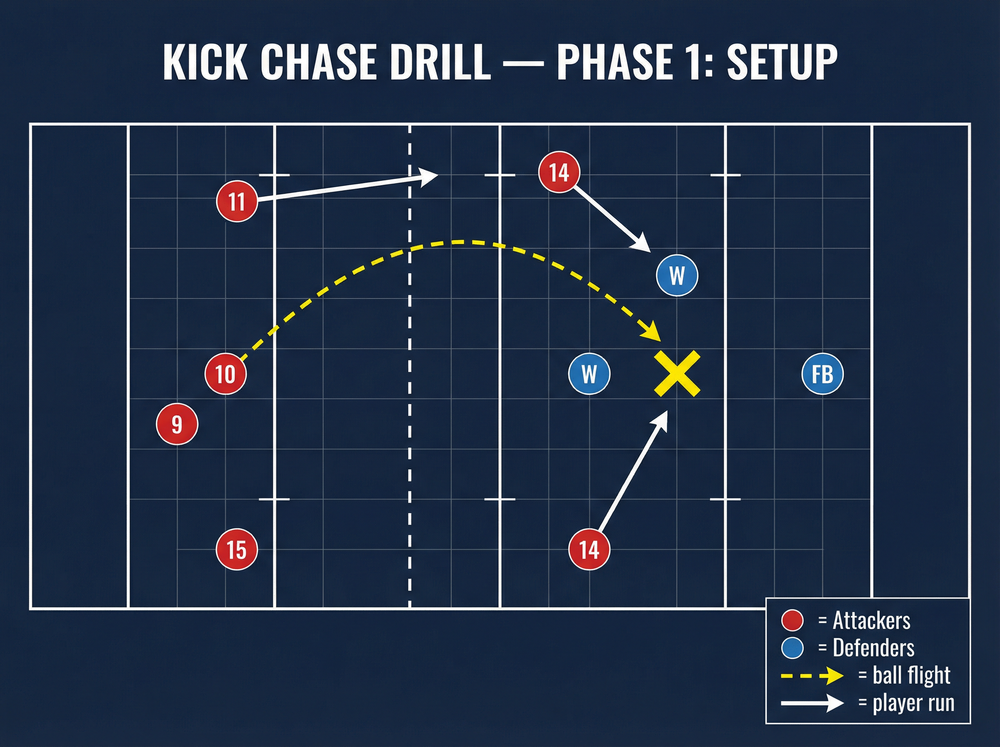
- The Feed and Kick: The Scrum-half (9) passes the ball to the Fly-half (10). The 10 executes a high, hanging box kick or up-and-under, aiming for the designated landing zone marked by the cones (approximately 30 metres downfield).
- The Chase: As soon as the ball leaves the boot, the Wingers (11 and 14) accelerate rapidly, maintaining an onside position. Their goal is to reach the landing zone simultaneously with the ball.
- The Contest: The defending Fullback (FB) tracks the flight of the ball and moves to catch it. The chasing Wingers (11 and 14) converge on the FB, attempting to either cleanly catch the ball themselves, tap it back to their supporting Fullback (15), or immediately tackle the FB upon catching.
- The Post-Catch Transition: If the defense catches, the FB immediately looks to counter-attack into the open space, supported by their Winger (W). The chasers must quickly transition to a defensive line. If the attack regains, the chasers secure the ball and initiate an attacking phase against the disorganized defense.

Key Coaching Points

- Kicker's Hang Time: Emphasize height over distance. The kick must hang long enough (ideally 3.5 to 4 seconds) to allow the chasers to reach the contest zone.
- Onside Discipline: Chasers must hold their runs until the ball is kicked. Penalties for being in front of the kicker are costly in matches.
- Eyes on the Ball: Both catchers and chasers must keep their eyes fixed on the ball's flight path, adjusting their positioning continuously.
- The V Formation: Chasers should converge in a V shape, cutting off escape routes for the catcher and maximizing pressure.
- Communication: The supporting players (15 and W) must communicate loudly, calling for the ball or directing the counter-attack.

Common Mistakes

- Overkicking: Kicking the ball too far and too flat, giving the defenders an easy catch with no pressure.
- Fragmented Chase: Chasers running at different speeds or in straight lines rather than converging, allowing the catcher to easily evade the first tackle.
- Poor Timing of the Jump: Players misjudging the flight and jumping too early or too late, resulting in a knock-on or a missed contest.
Variations and Progressions

- Add Blockers: Introduce 1-2 defending players whose sole job is to legally impede the chasers' running lines, forcing the chasers to adjust and work harder to reach the contest.
- Conditioned Counter-Attack: If the defending team catches the ball, they must execute two passes before they are allowed to be tackled, encouraging rapid support play and offloading.
- Vary the Kick Type: Alternate between high up-and-unders, cross-field kicks, and grubbers to keep both attackers and defenders reacting to different scenarios.
Age Adaptations

- Under 10s: Focus purely on the technique of catching a high ball unopposed. Use softer balls if necessary to build confidence.
- Under 14s: Introduce the chase element but restrict the contest to a touch or grab rather than a full tackle to prioritize safety in the air.
- Under 16s and Open: Full contact and contest in the air, emphasizing the legalities of tackling a player who is jumping for the ball.
