

Rugby
Mastering the Kick-Off Reception and Counter-Attack
Learn how to secure possession from restarts and launch devastating counter-attacks to immediately put the opposition under pressure.
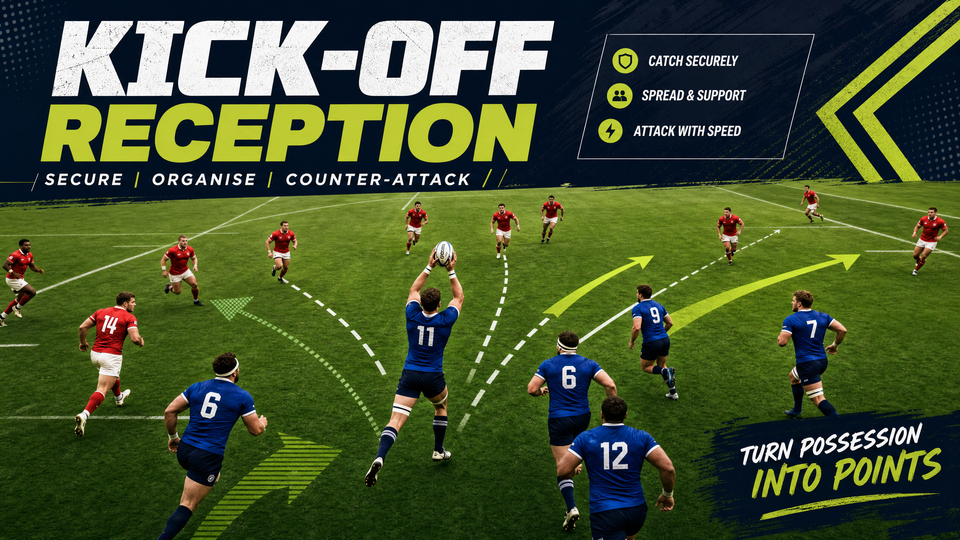
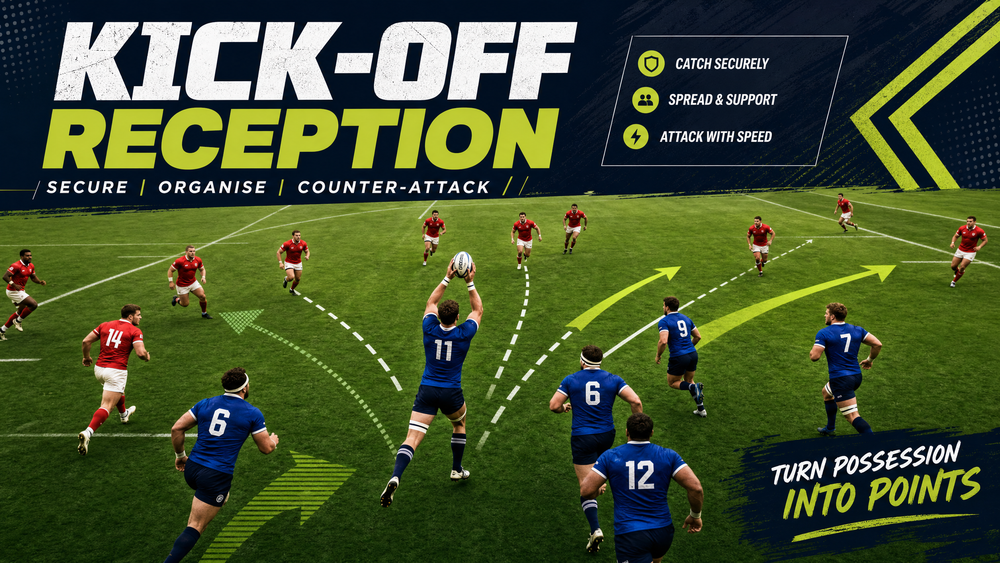
What you need
3-5 Rugby balls, Training bibs (two colors), Cones, Tackle shields (optional for progressions)
1. Overview
The kick-off reception is one of the most critical phases in Rugby. A successful reception not only secures possession but sets the tone for the ensuing phase of play. By efficiently catching the ball and immediately organizing a structured counter-attack, a team can transition from defense to attack in seconds, catching the opposition disorganized and on the back foot. This set play focuses on aligning your players correctly, securing the high ball, and executing a wide strike to exploit the unstructured defense of the kicking team.
2. Setup
- Pitch: Standard Rugby pitch (100m x 70m).
- Equipment: 3-5 Rugby balls, training bibs (two colors), cones to mark zones.
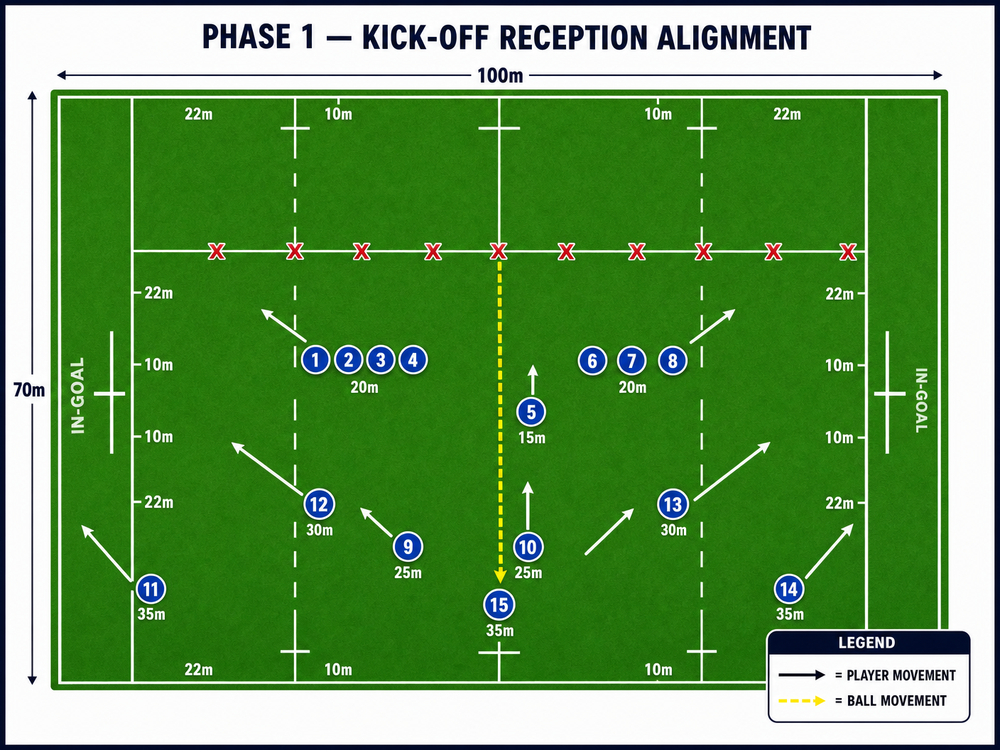
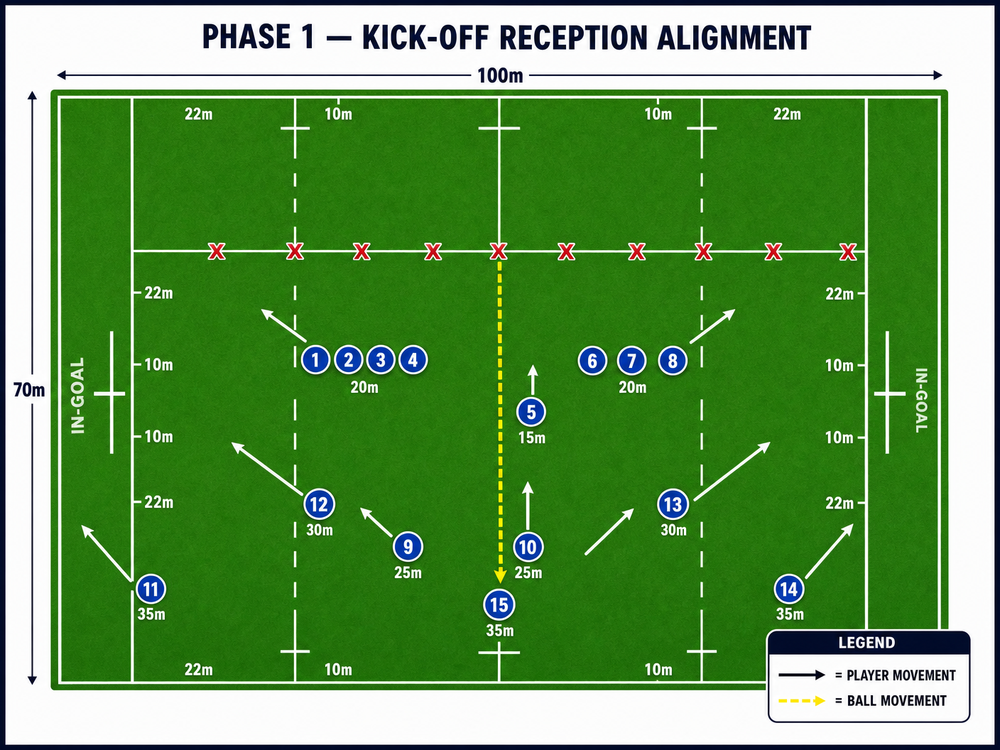
- Player Positions: Full 15-a-side team required. Key roles include the deep catchers (15, 11, 14), the forward lifting/support pods (1-8), and the playmakers (9, 10, 12, 13).
3. Step-by-Step Instructions
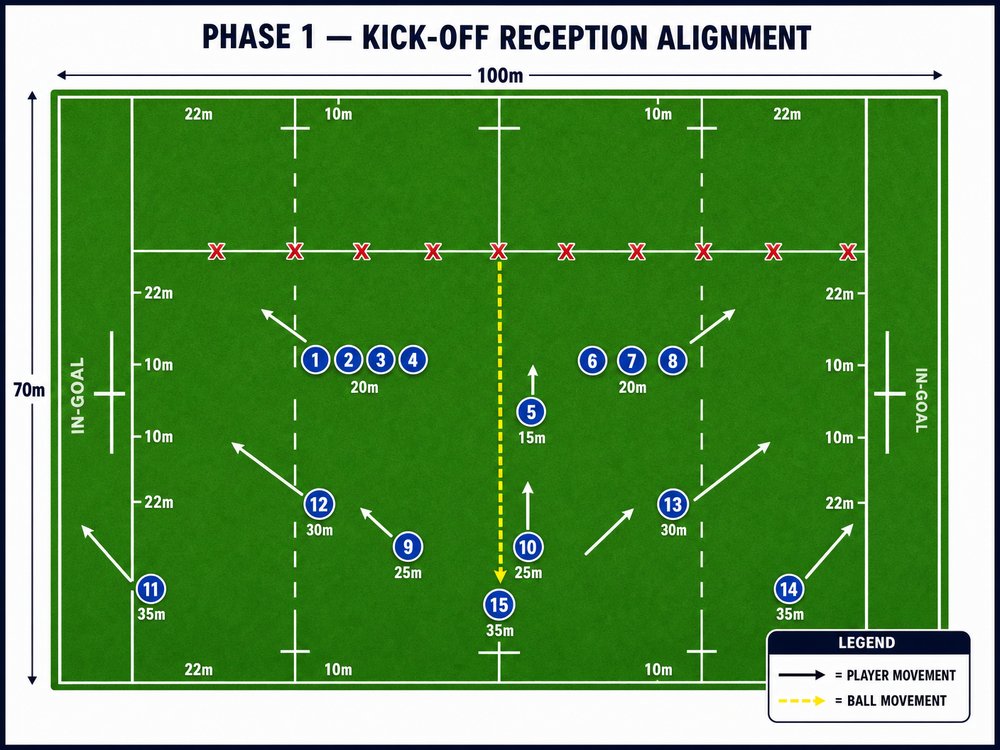
Phase 1: Kick-Off Reception Alignment
- Positioning: The fullback (15) and wingers (11, 14) position deep in the 35m zone to cover long kicks. The playmakers (10, 12, 13) cover the middle ground (25m-30m).
- Forward Pods: Organize the forwards into two distinct pods near the 20m line. One pod (1, 2, 3, 4) covers the left-centre, while the other (6, 7, 8) covers the right-centre. The lock (5) drops back to 15m as a sweeper.
- Tracking the Ball: As the ball is kicked, the designated catcher must communicate early and loudly ("My ball!"). Surrounding players must immediately adjust to support.
Phase 2: Secure & Build - Forward Pod Counter
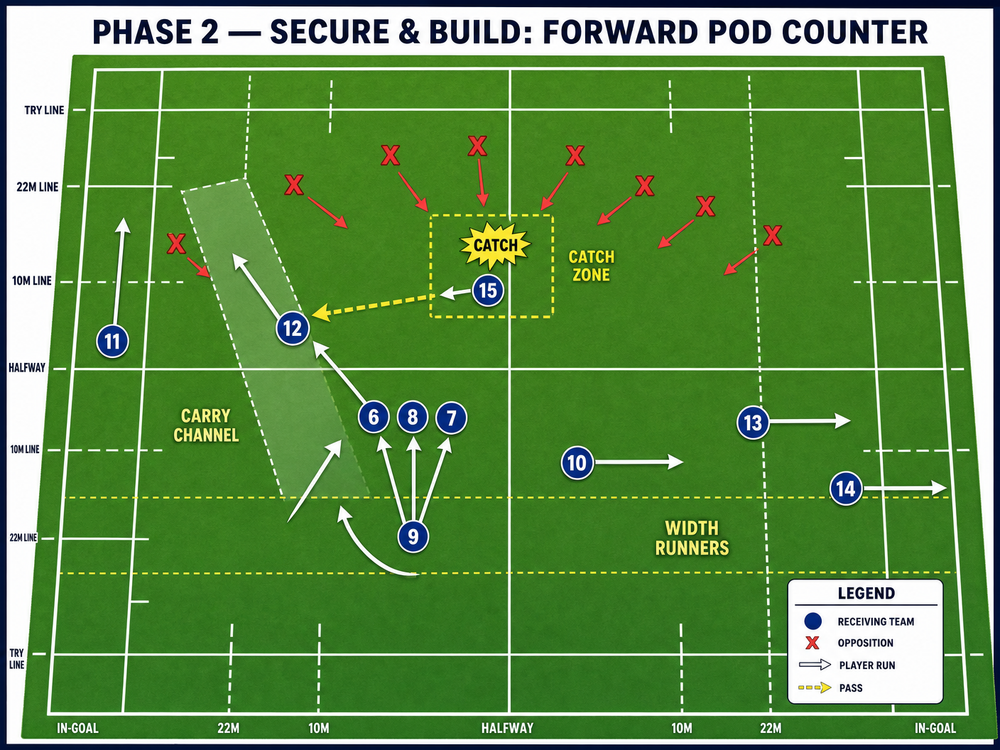
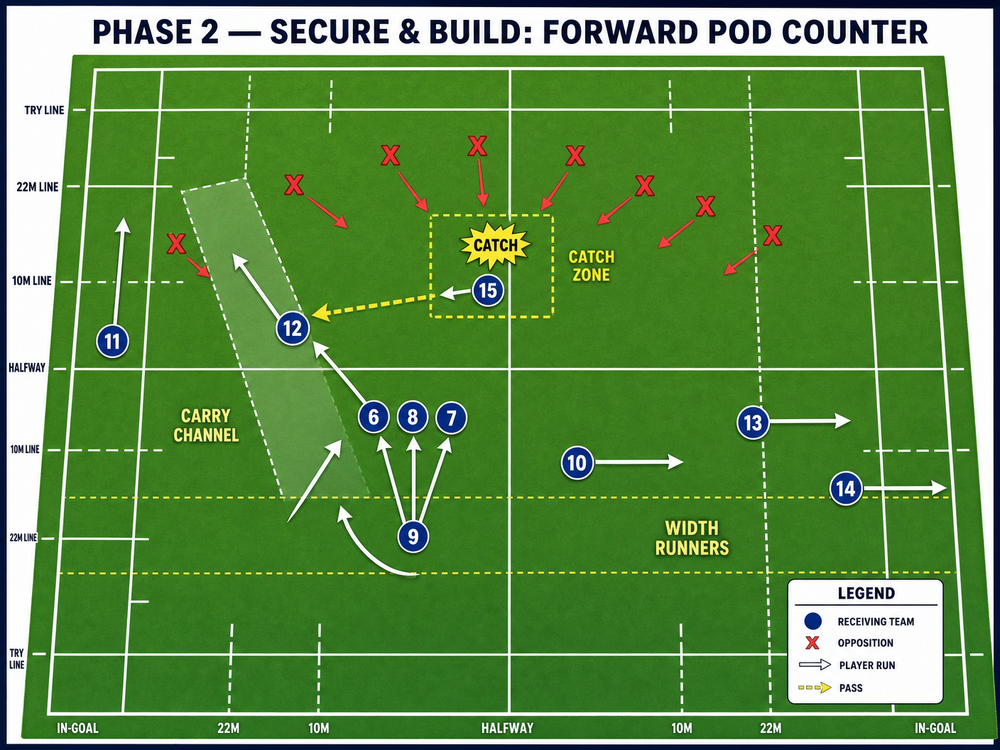
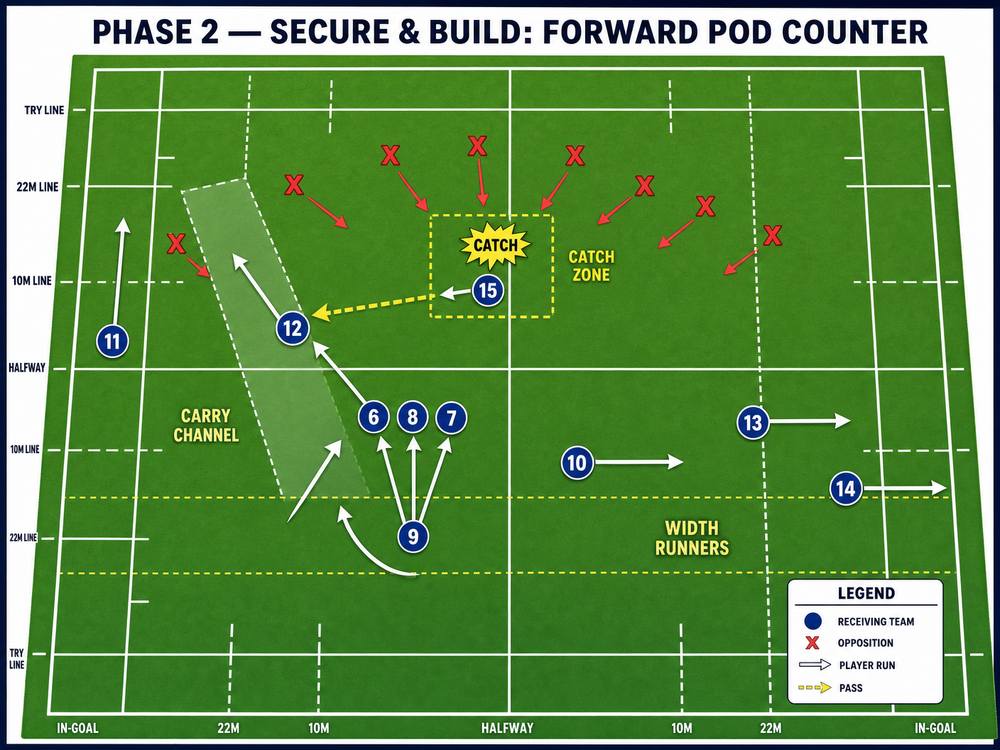
- The Catch: The catcher (e.g., 15) secures the ball. If contested, support players must be ready to bind and drive or secure the breakdown.
- Immediate Distribution: Once secured, 15 makes a short pass to a strong ball carrier, typically the inside centre (12), who hits the carry channel hard.
- Forward Support: The nearest forward pod (6, 8, 7) immediately converges on 12 to provide aggressive support, securing the ruck quickly and cleanly.
- Holding Width: The remaining backs (10, 13, 14) hold their width, preparing for the next phase, while the scrum-half (9) sprints to the base of the newly formed ruck.
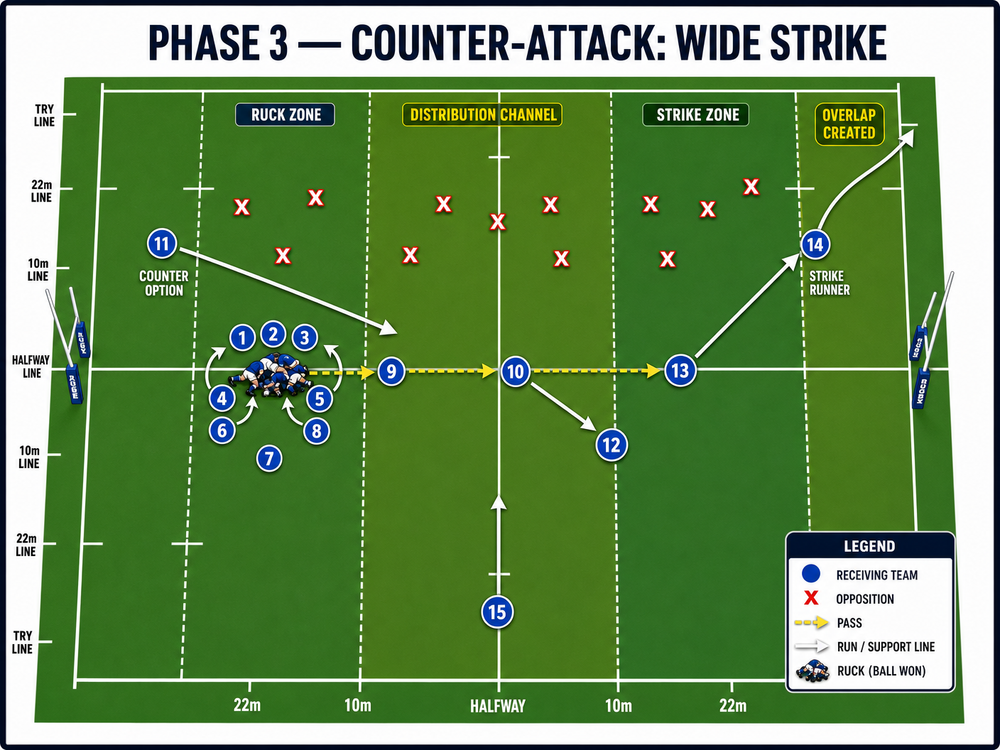
Phase 3: Counter-Attack - Wide Strike
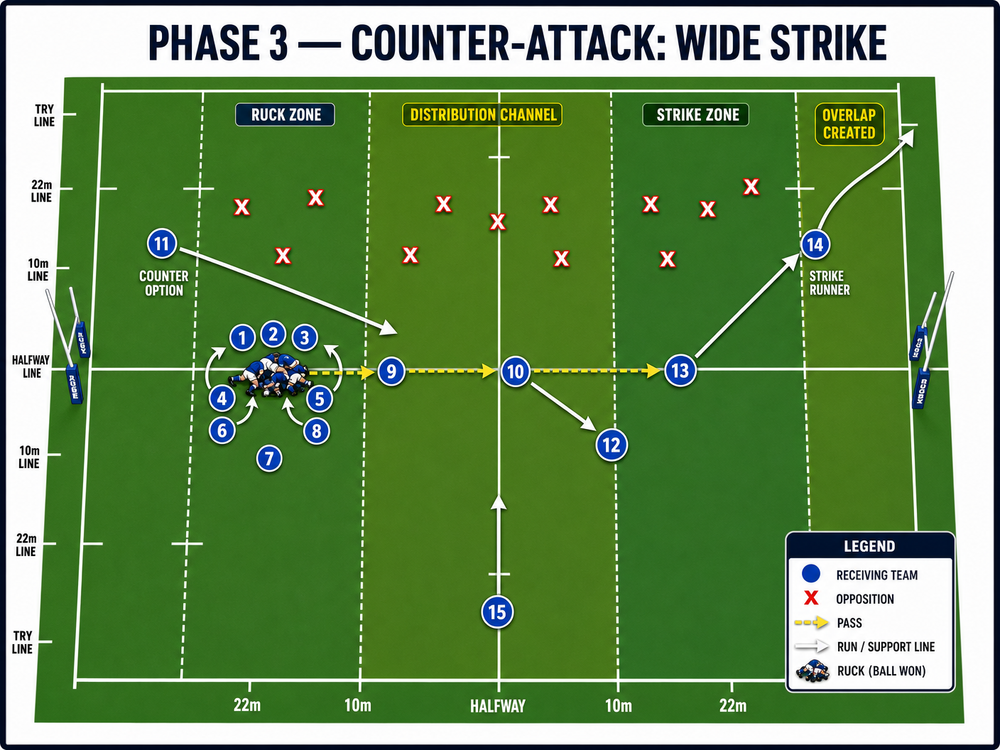
- Lightning Quick Ball (LQB): The scrum-half (9) clears the ball rapidly from the ruck to the fly-half (10).
- Distribution: 10 passes wide to the outside centre (13), bypassing the heavy traffic in the middle of the pitch.
- The Strike: 13 straightens the attack and feeds the winger (14), who runs a deep, arcing strike line toward the corner.
- Support Options: The inside centre (12) runs a short inside line off 10 to hold the defense, while the opposite winger (11) and fullback (15) trail as deep support or counter-strike options.
4. Key Coaching Points
- Early Communication: The catcher must call for the ball early and clearly to avoid collisions and confusion.
- Aggressive Catching: Attack the ball in the air; do not wait for it to come down. Jump and catch at the highest possible point.
- Ruck Speed: The first arriving forwards must be aggressive and accurate in their clear-outs to ensure lightning-quick ball for the counter-attack.
- Maintain Width: Backs must resist the urge to bunch around the ruck. Holding width stretches the disorganized defense and creates the overlap.
5. Common Mistakes
- Static Catching: Waiting flat-footed for the ball, allowing the opposition to contest easily.
- Poor Support Lines: Forwards arriving late or from the side of the ruck, resulting in slow ball or turnovers.
- Drifting Sideways: Playmakers drifting across the pitch instead of running straight, which eats up the space for the outside backs.
6. Variations & Progressions
- Progression 1 (Contested Catch): Introduce opposition chasers with tackle shields to contest the catch and disrupt the initial ruck.
- Progression 2 (Blindside Strike): If the defense over-commits to the open side, have the scrum-half (9) snipe down the blindside with support from the blindside winger (11).
- Variation (Kicking Option): If the counter-attack is shut down early, train the fly-half (10) or fullback (15) to execute a deep territorial kick to relieve pressure.
7. Age Adaptations
- Under 10/12: Focus heavily on the basic skills of catching the high ball safely and forming a secure ruck. Simplify the counter-attack to just passing to the nearest available teammate.
- Under 14/16: Introduce the structured forward pods and specific strike lines for the backs. Emphasize decision-making (run vs. pass).
- Open/Senior: Run the full play at game speed with full contact, focusing on ruck speed and exploiting specific defensive mismatches.
