

Rugby
Mastering the Low Tackle: Body Height and Technique Drill
Develop confident, effective tacklers by focusing on correct body height, approach angles, and dominant shoulder contact in this progressive defensive drill.

What you need
4 cones, 1 rugby ball, Tackle shields (optional)
1. Overview
The ability to execute a dominant, safe tackle is the cornerstone of effective rugby defense. This drill focuses specifically on the tackler's body height and approach mechanics. By isolating the approach and contact phases, coaches can ensure players are dropping their center of gravity appropriately before engaging. This drill is essential for teaching players to target the hips and thighs, maximizing stopping power while adhering to modern safety standards regarding tackle height.
Use this drill early in the season to establish foundational technique, or during defensive review sessions to correct upright tackling habits. It builds confidence in the contact area by breaking the tackle down into manageable, repeatable actions.
2. Setup

Pitch Setup:
Set up a 10m x 10m grid using four cones. This confined space forces the action and allows the coach to closely monitor technique.
Player Positions:
Position one player as the Attacker (Ball Carrier, typically wearing a red bib or designated as 13) on one side of the grid. Position the Defender (Tackler, designated as 7) opposite them, leaving a 5-meter gap between the two players.
Equipment Needed:
- 4 cones (to mark the 10m x 10m grid)
- 1 rugby ball per pair
- Tackle shields (optional for initial progression)

3. Step-by-Step Instructions
- The Approach: On the coach's whistle, the ball carrier jogs forward at 50% pace directly toward the opposite line.
- Closing the Space: The tackler moves forward to close the distance, aiming to make contact in the middle of the grid (the Contact Zone).
- Dropping Height: As the tackler enters the Approach Zone (about 2 meters from the ball carrier), they must visibly drop their hips, bringing their center of gravity lower than the ball carrier's hips.
- Footwork: The tackler must step in close with their 'lead foot' (the foot on the same side as the shoulder making contact). This foot should plant near the ball carrier's feet to generate power.
- Contact and Wrap: The tackler makes contact with their shoulder on the ball carrier's thighs. Simultaneously, both arms must wrap tightly around the ball carrier's legs.
- The Drive: Upon contact, the tackler drives their legs forward, taking the ball carrier to the ground safely and effectively.
- Reset: Players return to their starting positions and swap roles.
4. Key Coaching Points

- Eyes on the Target: The tackler must keep their eyes open and focused on the ball carrier's hips or thighs. Where the eyes go, the body follows.
- Cheek to Cheek: Ensure the tackler's head is positioned safely to the side of the ball carrier's body (cheek to buttock cheek) to avoid head clashes or knee strikes.
- Drop the Hips, Not the Head: Players must lower their body height by bending at the knees and hips, keeping a straight, strong back. Do not simply bend over at the waist.
- Punch the Arms: The arm wrap must be aggressive and tight. Cue players to 'punch' their arms through to secure the legs and prevent offloads.
- Leg Drive: The tackle isn't finished on contact. Emphasize continuous leg drive to ensure the tackler dominates the collision.
5. Common Mistakes

- Tackling Too High: The most frequent error. Players approach upright and attempt to tackle around the chest or shoulders, reducing power and increasing penalty risk.
- Reaching Instead of Stepping: Tacklers throwing their arms out without stepping close enough with their lead foot, resulting in weak, arm-only tackles.
- Head in the Wrong Position: Placing the head across the ball carrier's body, which is highly dangerous and can lead to severe neck or head injuries.
- Stopping Feet on Contact: Tacklers making contact but failing to continue driving their legs, allowing the ball carrier to fall forward over the gain line.
6. Variations & Progressions
Progression 1: Channel Tackle Drill
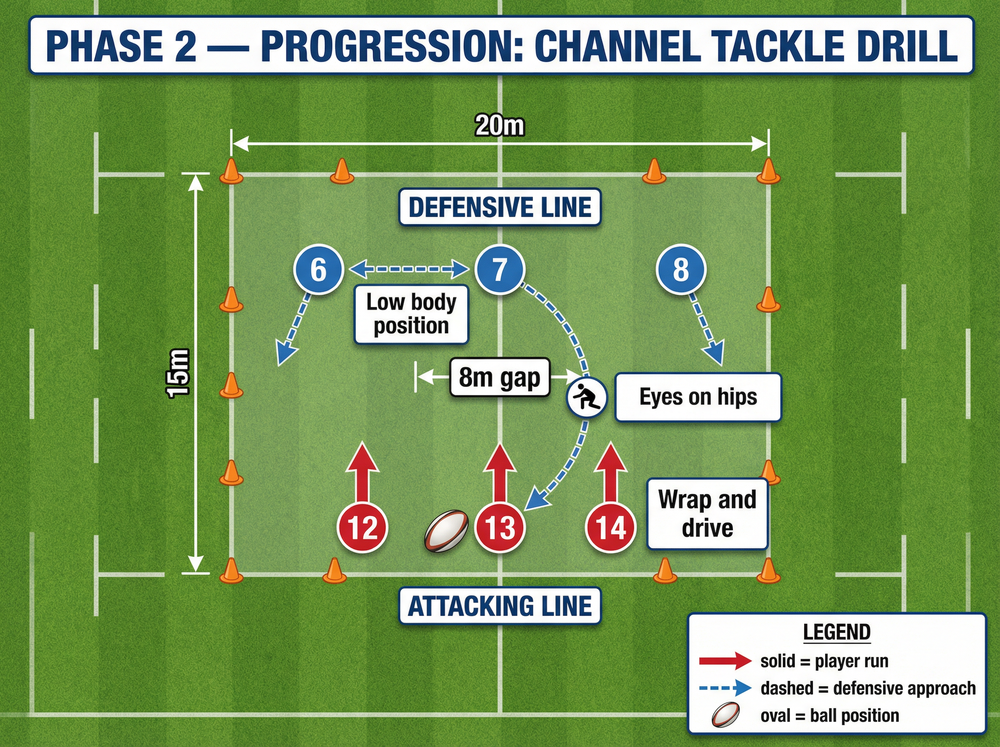
Expand the grid to a 20m x 15m channel. Introduce three attackers and three defenders. This adds decision-making, as defenders must maintain their line, identify their target, and execute the tackle while managing the space around them.

Progression 2: Live Pace
Once technique is sound at 50% pace, increase the speed to 75%, and eventually to full match pace. This tests the tackler's ability to maintain body height under pressure.
Variation 1: Evasion
Allow the ball carrier to use footwork to attempt to evade the tackle within the grid, forcing the tackler to track the hips dynamically.
7. Age Adaptations
- Under 8 - Under 10: Focus entirely on the 'hug' tackle without taking the player to ground. Emphasize cheek-to-cheek positioning and a tight grip around the waist.
- Under 12 - Under 14: Introduce taking the player to the ground using tackle bags first, then progress to live players at walking pace. Focus heavily on dropping the hips.
- Under 16 - Open: Full execution at match pace. Incorporate the channel progressions and focus on the aggressive leg drive post-contact to win the collision area.
