

Rugby
Maul Formation and Drive Drill: Building an Unstoppable Forward Platform
Master the technical foundations of maul formation, body position, and coordinated driving to give your forwards a dominant set-piece weapon near the try line.
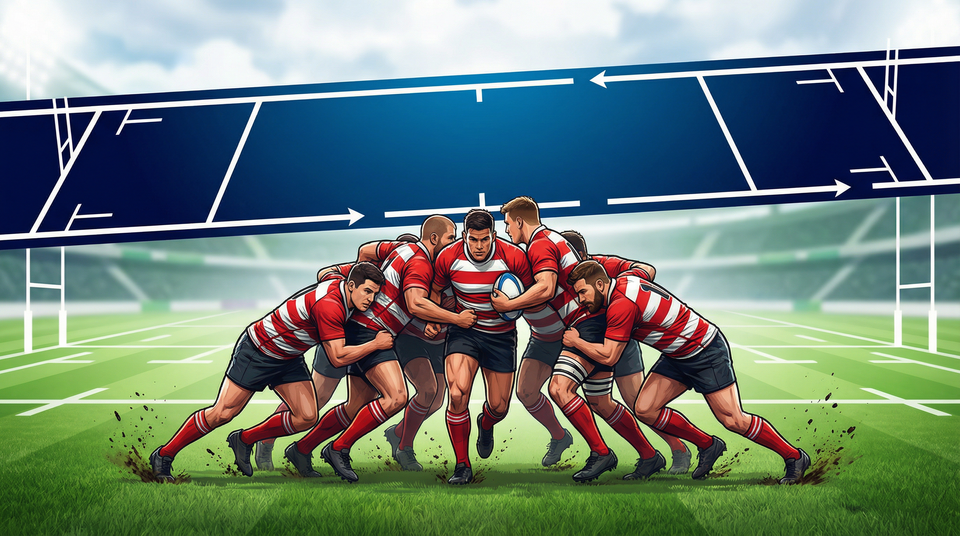
What you need
8 tackle shields, 4 marker cones, 1 match ball, coloured training bibs (two sets), measuring tape or pre-marked pitch
Overview
The maul is one of rugby's most powerful and tactically versatile weapons. When executed correctly, a well-organised driving maul is almost impossible to stop legally — it pins defenders, draws penalties, and creates scoring opportunities from lineouts, kick receptions, and broken-play ball. This drill teaches players the precise mechanics of maul entry, body position, binding, and coordinated leg drive, while simultaneously developing the scrum-half's decision-making at the back of the maul.
Use this drill in the pre-season to establish technical foundations, and revisit it mid-season when your maul has lost its shape or your team is struggling to generate go-forward ball near the opposition's try line. It is equally effective as a warm-up to a full lineout session or as a standalone 20-minute technical block.
Setup
Equipment Required
- 8 tackle shields (one per defender)
- 4 cones to mark the drill grid
- 1 match ball
- Coloured training bibs (two sets)
- Measuring tape or pre-marked pitch
Pitch Setup
Mark a 20m x 15m grid on the pitch, oriented so that one short end represents the try line. Place two cones 5m from the try line to simulate the 5-metre lineout channel. The drill begins at the 15m mark and drives toward the try line. On a full-size pitch (100m x 70m), position the grid in one corner of the 22-metre area to replicate the most common maul scenario in match conditions.
Player Positions
| Position | Number | Role in Drill |
|---|---|---|
| Loosehead Prop | 1 | Left-side pod support |
| Hooker | 2 | Ball carrier / lineout jumper |
| Tighthead Prop | 3 | Right-side pod support |
| Lock | 4 | Primary bind and drive |
| Lock | 5 | Secondary bind and drive |
| Blindside Flanker | 6 | Left-side gate entry |
| Openside Flanker | 7 | Right-side gate entry |
| Number 8 | 8 | Rear anchor and ball protection |
| Scrum-Half | 9 | Ball extraction and distribution |
| Fly-Half | 10 | First receiver after extraction |
For the defensive unit, use 4–6 players holding tackle shields in a flat line 3m from the starting point of the maul.
Phase 1 — Maul Formation


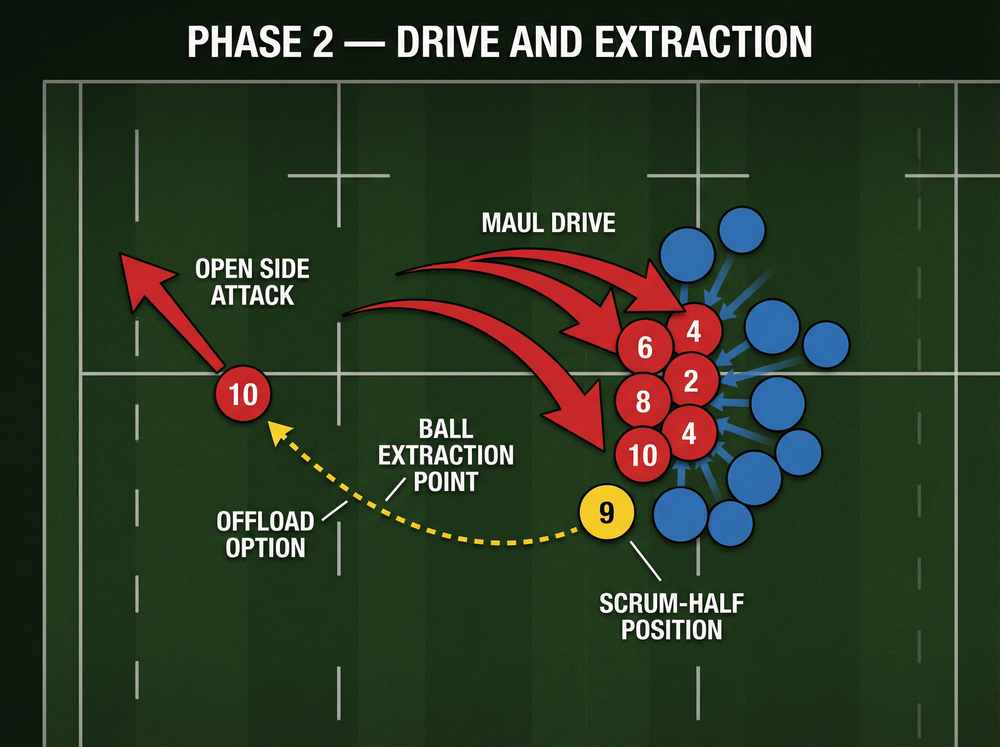
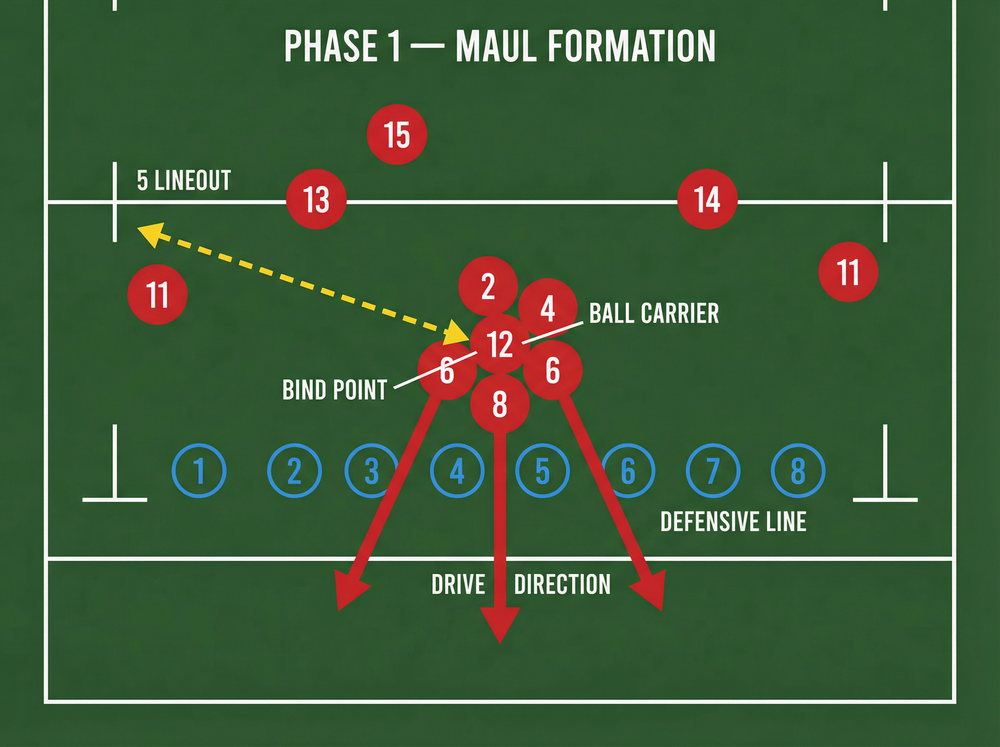
Diagram 1 shows the initial formation. The ball carrier (No. 2 Hooker, receiving a lineout throw) is immediately supported by the two props (Nos. 1 and 3) who bind tightly around the hips. The two locks (Nos. 4 and 5) arrive from depth and bind over the top of the props, creating the primary driving pod. The flankers (Nos. 6 and 7) enter from the sides — always from behind the hindmost foot — and bind onto the locks to widen the platform.
Step-by-Step Instructions

Step 1 — Lineout Trigger (0:00–0:05)
The hooker (No. 2) receives the lineout ball at the 15m mark. He lands with two feet, secures the ball against his chest with both forearms, and immediately calls "MAUL!" to signal his intent to the supporting forwards.
Step 2 — Primary Pod Binds (0:05–0:10)
The loosehead prop (No. 1) and tighthead prop (No. 3) sprint from their lineout positions and bind around the hooker's hips — not the jersey. Hands grip the shorts waistband or the back of the shorts. Heads go to the outside of the ball carrier's hips. Both props drop their hips to 45 degrees and drive their inside shoulder into the carrier's body.
Step 3 — Lock Arrival and Bind (0:10–0:15)
The locks (Nos. 4 and 5) arrive from 2–3m depth and bind over the top of the props, gripping the back of the prop's jersey at the shoulder blade. Heads go between the prop and the ball carrier. Locks must enter from behind the hindmost foot of the existing maul — this is a law requirement and a critical coaching point.
Step 4 — Flanker Gate Entry (0:15–0:20)
The blindside flanker (No. 6) and openside flanker (No. 7) enter from the sides, binding onto the outside of the locks. They must enter from behind the hindmost foot. Their role is to widen the maul and prevent the defence from getting around the sides.
Step 5 — Coordinated Drive (0:20–0:35)
On the call "DRIVE!" from the Number 8 (No. 8), all players simultaneously push with their legs in short, powerful steps — not long strides. The drive is low and forward. Players keep their backs flat and drive from the hips. The maul should move as a single unit. Target: drive the shield-holders back 5m within 10 seconds.
Step 6 — Number 8 Anchors the Ball (ongoing)
The Number 8 (No. 8) positions himself at the very back of the maul, binding onto the rearmost player. His primary job is to protect the ball from the referee's view and prevent the defence from stripping it. He communicates constantly: "Keep driving!", "Ball's secure!", "Ready to go!"
Step 7 — Scrum-Half Decision (0:35–0:45)
The scrum-half (No. 9) circles the back of the maul, reading the defence. He has three options: (a) call "HOLD!" to keep driving for a penalty or try; (b) call "BALL!" to receive the ball from No. 8 and pass to the fly-half (No. 10); or (c) call "PICK!" for No. 8 to pick and go around the side.
Phase 2 — Drive and Extraction
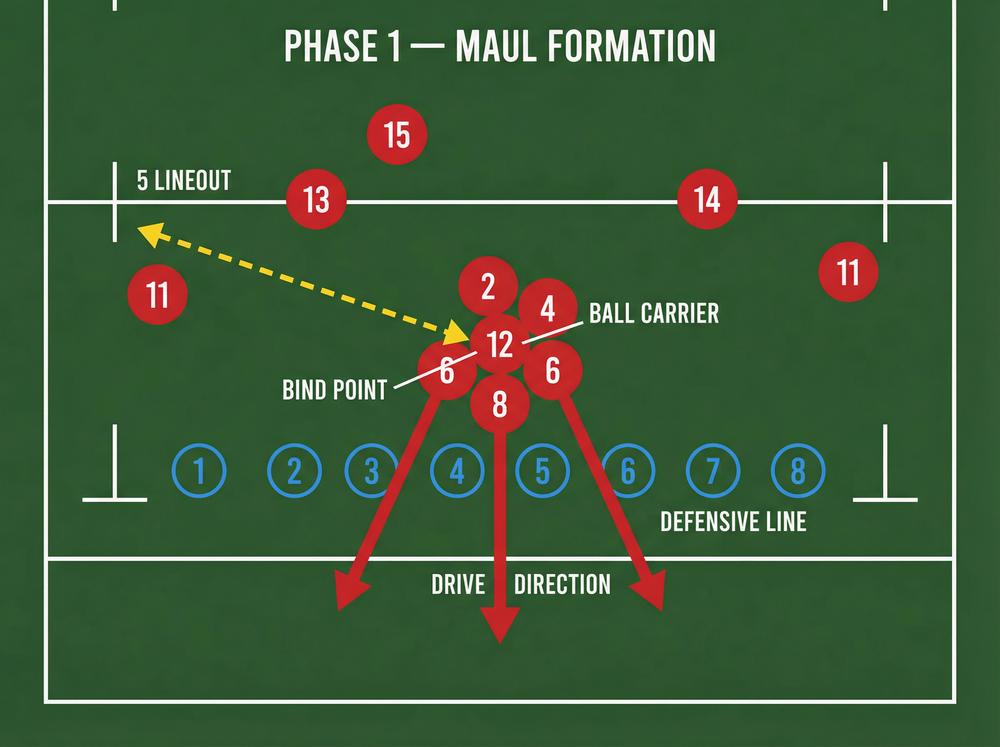

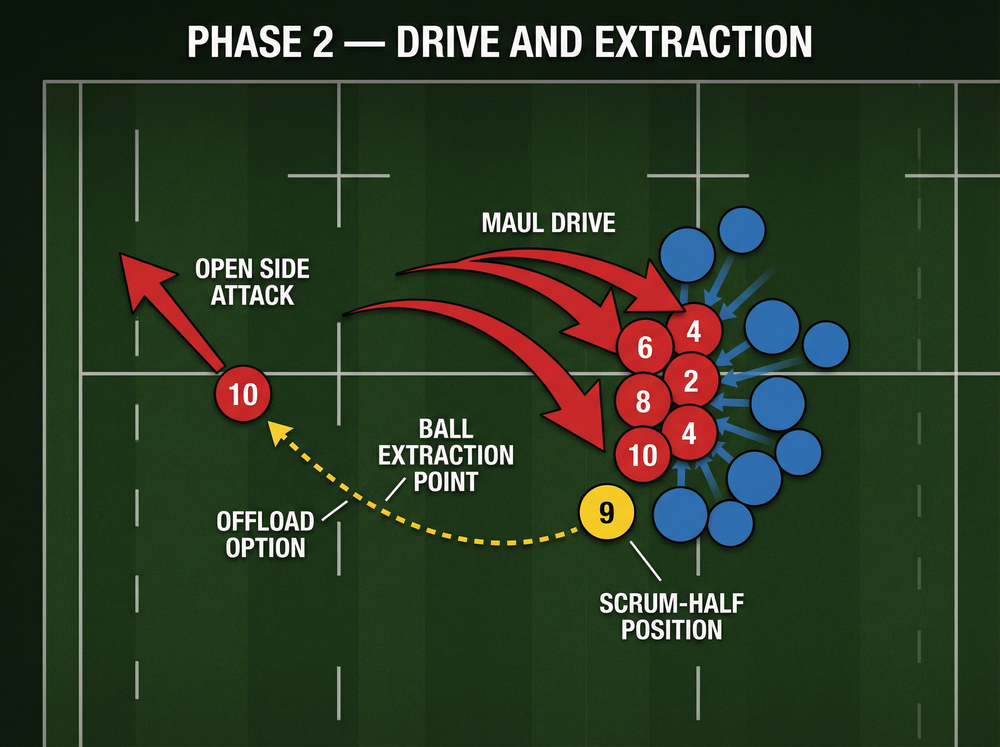
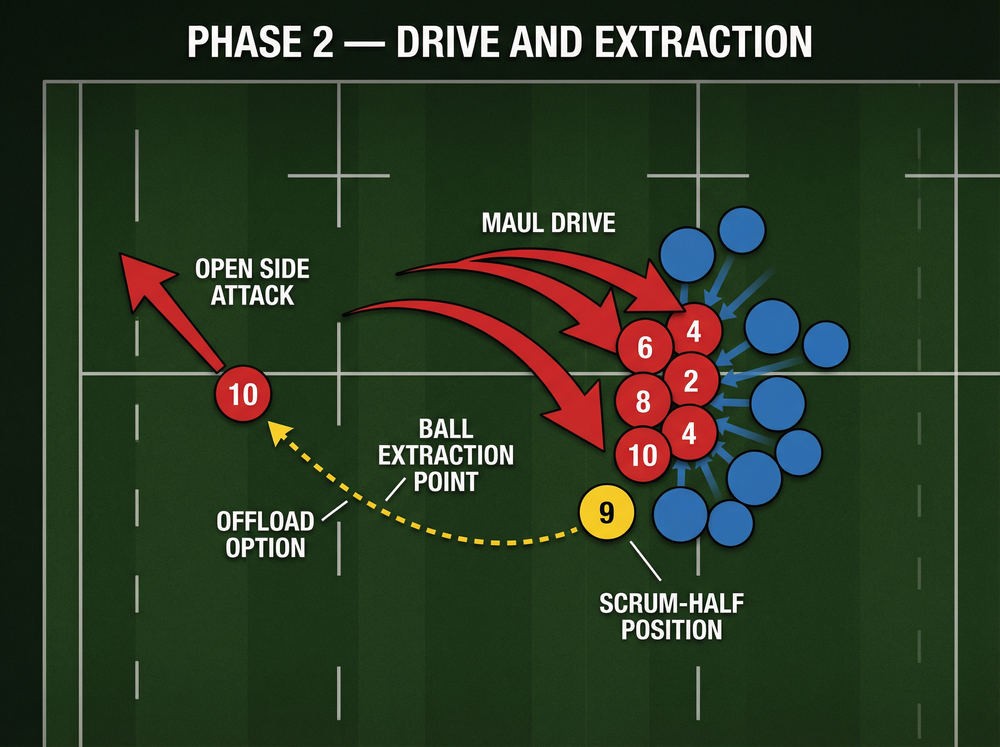
Diagram 2 shows the drive in progress and the ball extraction phase. The maul pod (Nos. 2, 4, 6, 8, 10) continues to drive forward while the scrum-half (No. 9, shown in yellow) positions himself at the back. A dashed arrow shows the ball being passed from No. 8 to No. 9, who then distributes wide to the fly-half (No. 10) for an open-side attack against a defence that has been drawn infield by the maul.
Key Coaching Points
1. Body Height is Everything. The single most important technical point in maul play is body height. Players must drive with their hips lower than their shoulders and their shoulders lower than the opposition's. A player who stands up in a maul loses all their power and becomes a liability. Use the cue: "Hips down, chest forward, eyes up."
2. Bind with Hands, Not Wrists. A full hand grip on the jersey or shorts is far stronger than a wrist-level bind. Insist on this from the first repetition. Weak binds cause the maul to split and give the referee grounds to call it over.
3. Short, Powerful Steps Win the Ground. Long strides in a maul cause players to lose balance and push sideways rather than forward. Teach players to take rapid, short steps — like a scrummaging action — keeping their feet wide for a stable base.
4. Enter from Behind the Hindmost Foot — Always. This is both a law requirement and a structural necessity. Players who enter from the side or in front of the maul are offside and also disrupt the driving channel. Make this non-negotiable in every repetition.
5. The Scrum-Half Must Be Patient. A common error is the scrum-half calling for the ball too early, before the maul has generated momentum. Teach No. 9 to wait until the maul is moving forward before extracting the ball. A stationary maul that releases the ball gives the defence time to reset.
6. Communication is a Weapon. The maul should be loud. The Number 8 and scrum-half must communicate constantly. Use specific, agreed calls — not shouting. "DRIVE!", "HOLD!", "BALL!", "PICK!" — each call has one meaning and the whole team must know it.
Common Mistakes
Mistake 1 — Players Standing Upright in the Maul. This is the most frequent error at all levels. When a player stands up, they push their teammates upward rather than forward, and the maul stalls. Correction: Use a low cone or a coach's hand at hip height as a target — players must stay below it throughout the drive.
Mistake 2 — Illegal Entry (Entering from the Side). Players who sprint directly to the ball carrier and bind on from the side are offside and create a disorganised structure. Correction: Walk through the entry path in slow motion first. Mark a "gate" with cones 1m behind the hindmost foot and insist every player passes through it before binding.
Mistake 3 — Weak or Incorrect Binding. Players grabbing jerseys at the sleeve or binding around the neck create a weak structure and risk injuring teammates. Correction: Pause the drill after the first bind and physically check every player's hand position before allowing the drive to begin.
Mistake 4 — Ball Carrier Going to Ground. If the ball carrier is driven to ground before the maul forms, possession is lost. Correction: The ball carrier must stay on their feet and call for support immediately. Drill the "catch and call" as a separate micro-skill before adding the full maul.
Mistake 5 — Scrum-Half Extracting Too Early. Releasing the ball before the maul has momentum gives the defence an easy reset. Correction: Set a rule in training — the scrum-half cannot call for the ball until the maul has moved at least 2m. Use a cone as the trigger point.
Variations and Progressions
Progression 1 — Live Defenders (Intermediate). Replace the tackle shields with live defenders who are permitted to contest the maul legally (binding and driving, no stripping). This adds realistic pressure and forces the attacking team to maintain structure under genuine physical contest. Begin with 4 defenders against 6 attackers, then equalise numbers as competence improves.
Progression 2 — Maul to Phase Play (Advanced). After the maul has driven 5m, the scrum-half extracts the ball and the full backline runs a pre-called attacking play — for example, a fly-half crash ball, a skip pass to the outside centre, or a blindside pick-and-go by the Number 8. This progression connects the maul to the wider game and teaches backs to read the defensive alignment created by the maul.
Variation 1 — Shortened Maul (Simplification). For teams new to maul play, reduce the pod to just 4 players: the ball carrier, two props, and one lock. This simplifies the binding sequence and allows players to master body position before adding complexity. Use this as the entry point for any squad learning the maul for the first time.
Age Adaptations
| Age Group | Key Modifications |
|---|---|
| Under 12 | Focus on body position and binding only. No live defenders. Use shields held by coaches. Maximum pod of 3 players. No Number 8 ball protection — scrum-half receives directly. |
| Under 14 | Introduce the full 6-player pod but keep defenders passive (shields only). Teach the "DRIVE!" call and coordinated leg drive. Introduce scrum-half decision-making with two options only (hold or pass). |
| Under 16 | Add live defenders with permission to contest. Introduce all three scrum-half options. Begin connecting maul to phase play. Introduce the "pick and go" option for Number 8. |
| Open Age | Full progression including live defenders, backline integration, and game-realistic scenarios (e.g., maul from a kick receipt in the 22, or a maul from a midfield breakdown). |
Coach's Note: At all age groups, prioritise safety in binding. Ensure players are taught the correct technique for head position — heads should never be placed between two opposing players in a way that risks neck compression. If in doubt, refer to your national union's age-grade contact laws.
