The 'Mirror & Spring' Lineout Steal & Counter
Master the art of reading the opposition throw, disrupting their set piece, and launching a devastating counter-attack from stolen lineout ball.

Equipment Needed
1. Overview
The 'Mirror & Spring' lineout steal is a defensive set-piece tactic designed not just to disrupt the opposition's ball, but to actively win possession and launch an immediate counter-attack. In modern rugby, a clean lineout steal is one of the most demoralizing events for an attacking team and presents a prime unstructured attacking opportunity for the defense.
This play focuses on defensive reading, explosive lifting, and rapid transition from defense to attack. It is best utilized when you have identified predictable throwing patterns in the opposition hooker or when defending inside your own half where the opposition might opt for a safe, middle-of-the-lineout throw.
2. Setup
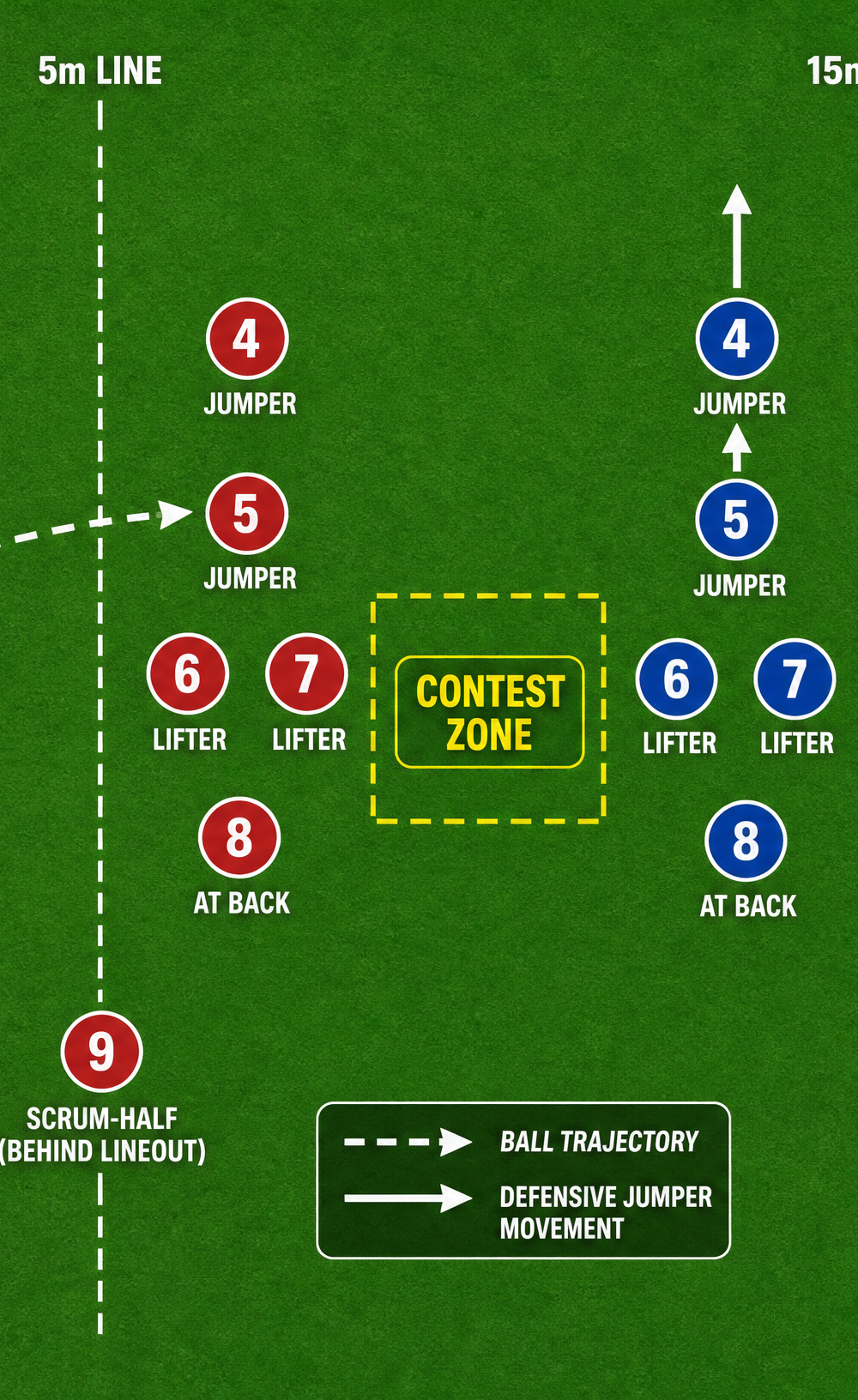
Pitch Area: Anywhere on the field, typically contested between the 5m and 15m lines.
Equipment: 1 Rugby ball, bibs for opposition, standard pitch markings (100m x 70m).
Player Positions:
- No. 2 (Hooker): Positioned in the 5m channel, defending the short throw and ready to join the defensive line.
- No. 4 & 5 (Locks): Primary jumpers. Positioned in the middle and back of the lineout.
- No. 6 & 7 (Flankers): Primary lifters. Positioned to support the jumpers.
- No. 8: Positioned at the back of the lineout, ready to secure the tap-down or defend the drive.
- No. 9 (Scrum-half): Positioned 2m behind the lineout, tracking the ball.
3. Step-by-Step Instructions

Phase 1: The Read and Steal
- The Mirror: As the opposition lineout forms, your defensive pod (Lifter-Jumper-Lifter) must 'mirror' the movement of the opposition's primary pod. Maintain a low, coiled body position.
- The Trigger: The defensive jumpers must watch the opposition hooker's hands, not the jumpers. The moment the hooker's hands break the plane to throw, that is the trigger to move.
- The Spring: The front lifter steps in, the back lifter drives forward and up, and the jumper explodes vertically. The goal is to beat the opposition jumper into the air by a fraction of a second.
- The Contest: The defensive jumper extends their inside arm (closest to the hooker) to disrupt or cleanly catch the ball at its highest point in the trajectory.
- The Delivery: If caught cleanly, the jumper delivers the ball down to the No. 9. If tapped, it must be tapped firmly backwards towards the No. 9 or No. 8.
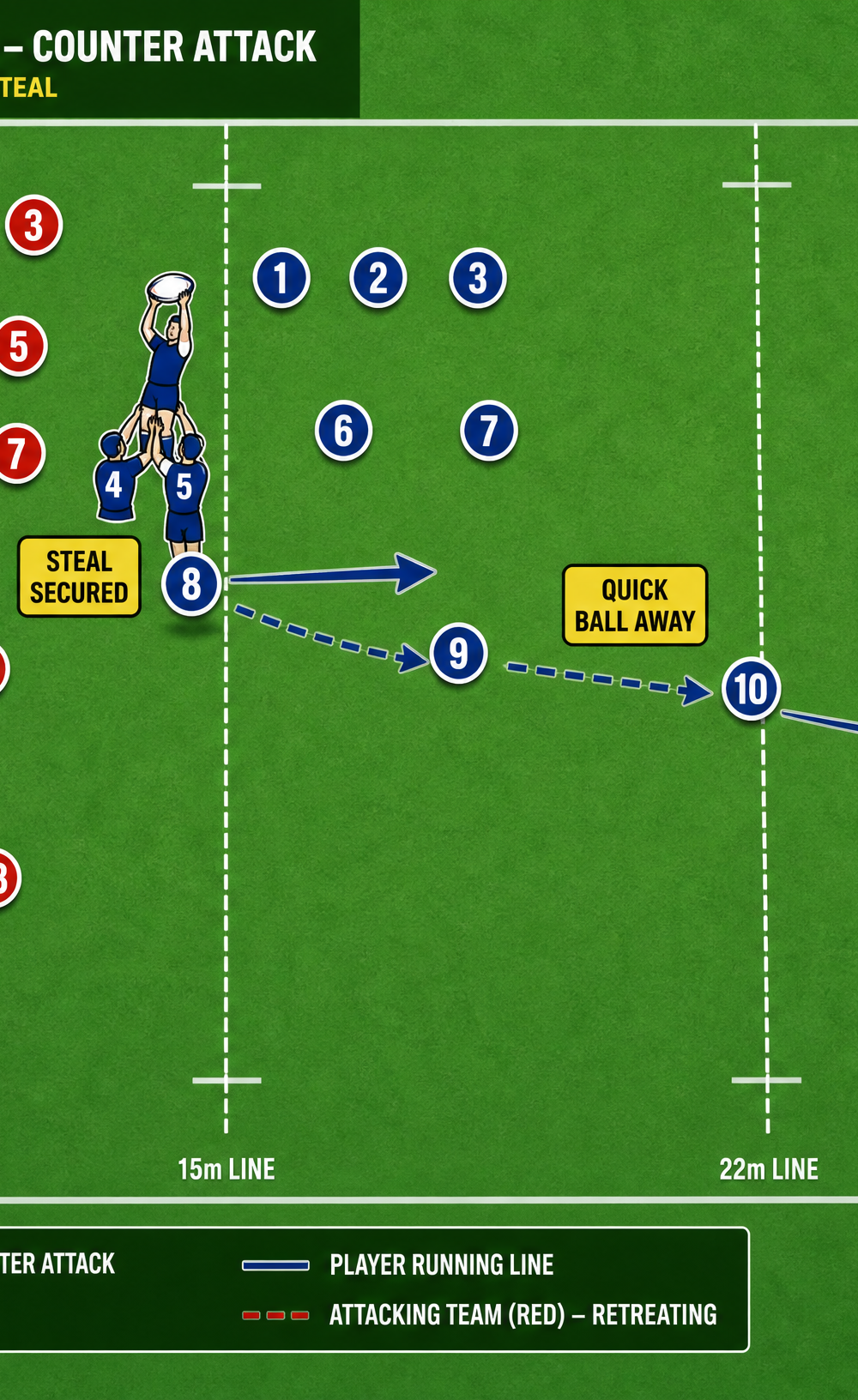
Phase 2: The Counter-Attack
- Secure and Clear: The No. 9 must react instantly to the stolen ball, securing it and delivering a fast, flat pass away from the congested lineout area.
- The Strike: The No. 10 receives the ball on the move. Because the opposition forwards are committed to the lineout and are now out of position (transitioning from attack to defense), there will be space out wide.
- Exploit the Space: The No. 10 moves the ball quickly to the outside backs (No. 11, 14, 15) who should be running aggressive, wide lines to exploit the disorganized defense.
4. Key Coaching Points
- Read the Hooker, Not the Jumper: Jumpers must focus on the thrower's mechanics. Reacting to the opposition jumper means you are already too late.
- Explosive Lifting Technique: Lifters must get their core under the jumper and use their legs to drive upward, ensuring maximum height and hang time.
- Inside Arm Extension: The jumper must lead with the inside arm to protect their space and get the first touch on the ball.
- Instant Transition: The mindset must shift from 'defend' to 'attack' the millisecond the ball is secured. The No. 9 and No. 10 must be demanding the ball.
5. Common Mistakes
- Watching the Opposition Jumper: Results in a delayed jump and losing the aerial contest.
- Poor Lifting Posture: Lifters using only their arms instead of their legs, resulting in a low, unstable lift.
- Tapping Forward: Tapping the ball forward or straight down into the opposition side, resulting in a knock-on or turnover.
- Slow Reaction by the Scrum-half: No. 9 failing to anticipate the steal, allowing the opposition forwards to disrupt the counter-attack.
6. Variations & Progressions
- Progression 1: Unopposed to Opposed: Start by practicing the lift and jump timing against a static throw, then introduce a live, contesting opposition pod.
- Progression 2: The 'Fake' Steal: Defensive pod feints a jump at the front to draw the throw to the back, where a second pod is waiting to steal.
- Variation 1: The Front Peel: If the steal is won at the front, the No. 2 wraps around to receive a quick pop pass from the No. 9, attacking the 5m channel.
7. Age Adaptations
- Under 14s & Below: Focus on the timing of the jump and reading the throw. Lifting is generally not permitted at these age grades, so the emphasis is on vertical leap and positioning.
- Under 16s: Introduce basic lifting techniques (if permitted by local union laws). Focus on safety, core strength, and coordination between lifters and jumpers.
- Open/Senior: Full lifting, dynamic movement, and complex counter-attacking structures off the stolen ball.